Loading cart…
No products in the cart.

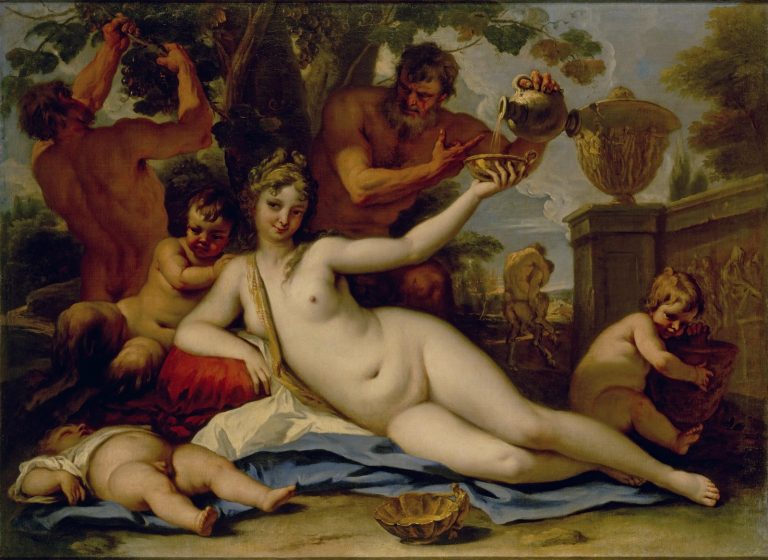
c. 1713 · Oil on canvas · State Hermitage Museum, Saint Petersburg, Russia
Save articles to your collection
Log in or create a free account, and this article will be waiting in your Private Collection.
Log in or sign up Explore the artistSebastiano Ricci →
A bacchante, one of the female followers of Bacchus, the god of wine, lies stretched out on a blue cloth and raises a shallow dish. Behind her, a bearded satyr pours wine into it from a jug. The Venetian painter Sebastiano Ricci painted the scene around 1713.
The painting is in the State Hermitage Museum in Saint Petersburg.
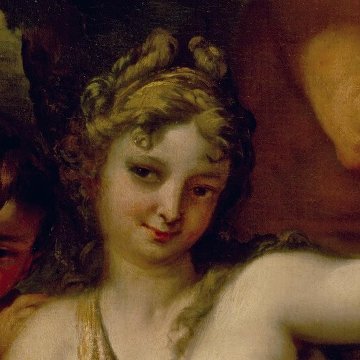
She turns to look out at us with a light, teasing smile, her blonde hair dressed with leaves. Ricci paints her skin in soft, glowing tones against the darker figures around her.
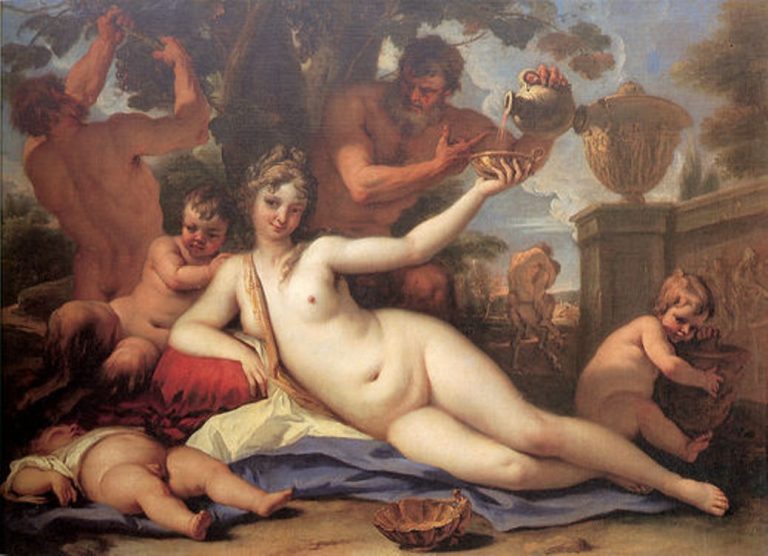
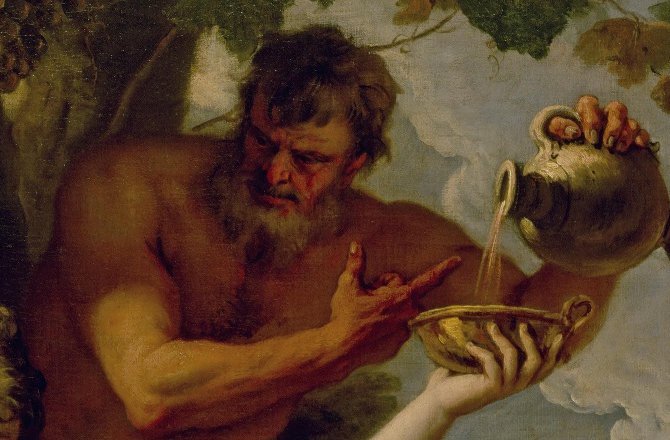
The old satyr tips the jug with both hands. Another, at the left, reaches up to pick grapes from the vine. Satyrs, part man and part goat, were Bacchus’s wild companions.
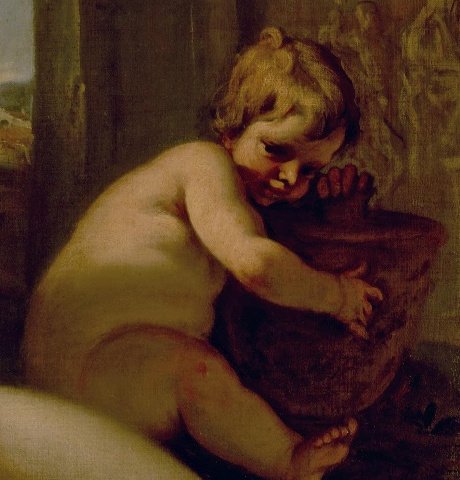
At the right, a small child clutches a large vessel, perhaps sneaking a drink.
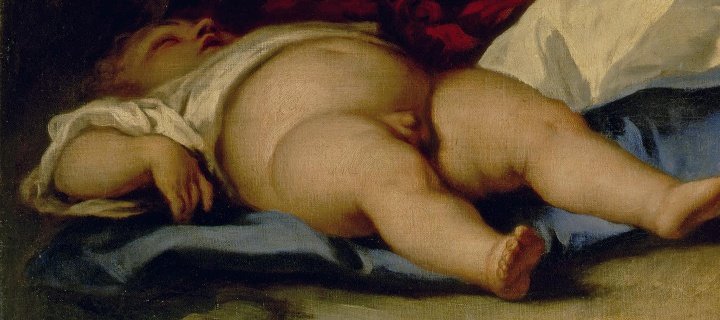
In the foreground, another child has fallen fast asleep on a white cloth, worn out by the festivities.
Sebastiano Ricci (1659 to 1734) was born in Belluno, in the Veneto, and trained in Venice. He travelled widely, working in Bologna, Parma, Rome, Florence and Vienna. From about 1712 to 1716 he worked in England, with his nephew Marco Ricci, decorating great houses. His travels helped spread the light, colourful Venetian style across Europe.
He is seen as a key figure in the revival of Venetian painting, inspired by Paolo Veronese, and a forerunner of Giovanni Battista Tiepolo.
Bacchus, called Dionysus by the Greeks, was the god of wine, festivity and ecstasy. His followers included satyrs, half-human, half-goat creatures, and bacchantes, women who celebrated him with dancing and wine. Such scenes offered painters a chance to show nude figures, rich colour and joyful movement. They were popular decorations for the homes of wealthy collectors.
Ricci paints with warm, luminous colours: the pearly skin of the bacchante, the rich blue cloth, the golden wine and the soft greens of the landscape. The brushwork is fluent and lively. Light falls over the scene from the left, picking out the bodies against the darker background. The style recalls Veronese and the great Venetians of the sixteenth century.
The painting is in the State Hermitage Museum in Saint Petersburg, whose collection of Venetian eighteenth-century painting was largely formed by Russian emperors and nobles. Catherine the Great and her successors bought many works by Italian painters, and the Hermitage holds several pictures by Ricci.
Bacchante and Satyrs hangs in the State Hermitage Museum in Saint Petersburg. Our hand-painted oil reproduction follows this composition. For more paintings of women in art, explore our famous paintings of women.
Sebastiano Ricci (1659 to 1734), a Venetian painter.
State Hermitage Museum, Saint Petersburg.
A female follower of Bacchus, the Roman god of wine.
Around 1713.
Across Italy, in Vienna and in England, spreading the Venetian style.
Half-human, half-goat followers of Bacchus.
Public-domain reproduction of Bacchante and Satyrs (about 1713), via Wikimedia Commons. Detail images are crops of the same image; no reconstruction or upscaling.
Enjoyed this story?
Save articles to your collection
Log in or create a free account, and this article will be waiting in your Private Collection.
Log in or sign up
Man Writing a Letter
Gabriel Metsu, c. 1664
The gallery list
Every painting is already 50% off. Join the list and we will send you an extra $15 code, plus first access to new collections.
No spam. Unsubscribe anytime. · Privacy Policy
Welcome
Your $15 code is on its way. Explore the gallery while you wait.