Loading cart…
No products in the cart.

1773 · Oil on canvas · National Gallery, London, United Kingdom

Save articles to your collection
Log in or create a free account, and this article will be waiting in your Private Collection.
Log in or sign upGiovanni Domenico Tiepolo painted this work in 1773, shortly after he had returned to Venice following the death of his father in Madrid. It belongs to a period of renewed personal independence in his career, when he was establishing his own artistic identity rather than operating primarily as a collaborator within the family workshop. The subject is drawn from the legends of the Trojan War, specifically from the account preserved in Virgil and in Homer, of the famous stratagem by which the Greeks concealed warriors inside a colossal wooden horse and had it brought inside the walls of Troy as a gift. The painting entered the collection of the National Gallery in London, where it has been recognized as one of the most confident and original mythological compositions produced by Domenico working on his own terms. The relatively small scale of the canvas is notable given the ambition of the subject matter, and it demonstrates how thoroughly Domenico had internalized the lessons of large-scale fresco painting and could compress them into an intimate format without any loss of energy or narrative clarity. The commission or original patron for this work is not fully documented, but its quality and finish suggest it was made for a sophisticated private collector who appreciated both Homeric subject matter and the distinctive visual style that Domenico had developed. The painting has been exhibited and studied extensively and is considered a key work for understanding the mature phase of Domenico Tiepolo as an independent master.
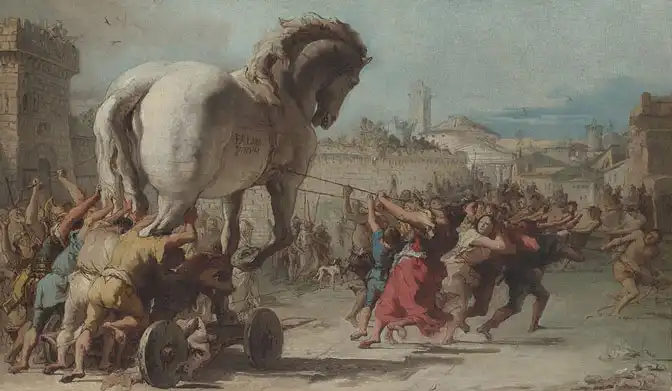
The composition is organized around the diagonal thrust of the great wooden horse as it moves from left to right across the picture plane, pulled by ropes held by the Trojan citizens. Domenico orchestrates a crowd of figures of varied ages, genders, and social stations, arranging them so that each adds to the sense of collective motion and festive, if ultimately tragic, anticipation. His handling of the crowd is one of the most remarkable aspects of the work. Rather than reducing background figures to mere staffage, he differentiates them with small but telling gestures, turned heads, outstretched arms, and expressions that range from jubilation to curiosity. The horse itself is rendered with a solidity and texture that makes it feel genuinely massive and genuinely constructed rather than symbolic or abstract. The architectural setting, with its walls, towers, and gates, is handled in the tradition of Venetian veduta painting, giving the scene a physical plausibility that anchors the mythological subject in something approaching historical reality. The palette is warm and sun-drenched, dominated by golden ochres, terracotta reds, and pale sky blues, all rendered with the fluid, confident brushwork characteristic of the Venetian Rococo tradition. The light falls from the upper left, casting long shadows that reinforce the sense of a specific time of day and give the scene a theatrical luminosity. This is a painting that rewards close looking, because the longer one studies it, the more individual narratives within the crowd reveal themselves. Own this as a hand-painted oil reproduction and bring one of the most celebrated narrative paintings of Domenico Tiepolo into your own home.
The subject of the Trojan Horse carries profound cultural resonance that extends far beyond the story of the fall of Troy. In Western tradition, it has come to represent the danger of accepting gifts from enemies, the vulnerability of pride, and the way in which celebrated victories can contain within them the seeds of catastrophe. Domenico Tiepolo approaches this subject with none of the heavy moralism that a lesser painter might have imposed. Instead, he presents the scene with a kind of luminous, almost festive energy that makes the tragedy all the more powerful precisely because it is so thoroughly suppressed. The Trojans in this painting are not foolish or weak. They are joyful and human, celebrating what they believe is a divine gift and the end of a long and terrible war. That tension between the visible happiness of the crowd and the invisible doom concealed within the horse gives the painting its lasting emotional charge. The painting also speaks to the broader interest in classical antiquity that defined educated European culture in the eighteenth century, when Homeric subjects were regarded as among the most elevated themes a painter could address. For Domenico, working in the shadow of his celebrated father, a subject of this weight and dignity also served as a statement of serious artistic intent. The Procession of the Trojan Horse in Troy remains one of the most searched and studied works associated with this artist, and owning a hand-painted oil reproduction of it means living with a painting that carries centuries of symbolic meaning alongside exceptional pictorial beauty. Visit the product page to commission your hand-painted oil reproduction today.
Enjoyed this story?
Save articles to your collection
Log in or create a free account, and this article will be waiting in your Private Collection.
Log in or sign up