Loading cart…
No products in the cart.

circa 1617 · Oil on canvas · The National Gallery, London, United Kingdom

Save articles to your collection
Log in or create a free account, and this article will be waiting in your Private Collection.
Log in or sign upThis large canvas was almost certainly painted during van Honthorst's extended stay in Rome, a period that ran from approximately 1610 to 1620 and proved decisive for the formation of his mature style. The work reflects the intense interest among Roman patrons of the early seventeenth century in the new naturalistic approach to religious narrative that had been pioneered by Caravaggio. The painting is generally dated to around 1617, placing it firmly within the most productive and experimental phase of his Roman career. It is believed to have been acquired by the Marchese Vincenzo Giustiniani, one of the most important collectors of Caravaggesque painting in Rome, whose collection served as a kind of living museum for northern artists working in the city. The canvas eventually made its way into the collection of the British Crown and from there into the permanent holdings of the National Gallery in London, where it has long been one of the most studied and admired examples of Utrecht Caravaggism outside the Netherlands. The subject is drawn from the Gospel of John, chapter 18, which describes how Christ was taken to the house of Caiaphas following his arrest in the Garden of Gethsemane. Caiaphas, as the presiding high priest of the Sanhedrin, interrogated Jesus about his disciples and his teachings. The choice of this specific moment, rather than the more commonly painted trial before Pilate, reflects van Honthorst's interest in intimate, psychologically loaded confrontations rather than grand public spectacle. The very large scale of the canvas, which measures over two and a half meters in height, suggests it was intended for an important interior, possibly a private chapel or a grand reception room, where its imposing dimensions and dramatic lighting would have created a powerful devotional effect.
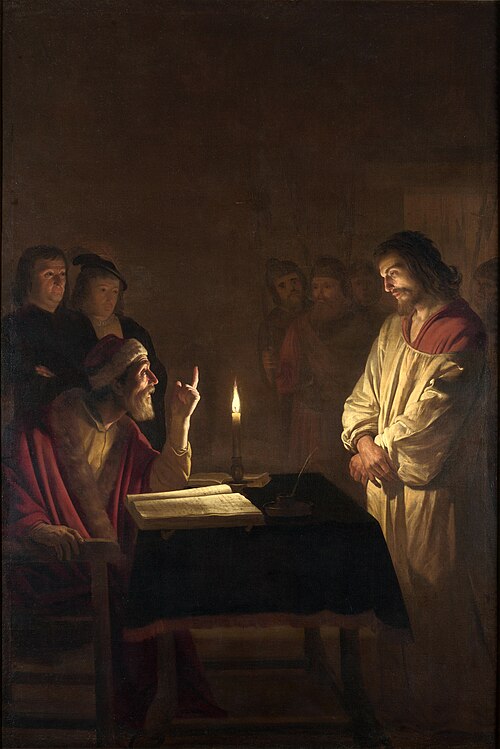
The composition of this painting is organized around a single candle placed on the table between the two principal figures, and this modest light source becomes the engine that drives the entire visual experience. Van Honthorst places Christ on the left side of the composition, standing with a posture of calm dignity, his wrists bound before him. Caiaphas sits on the right, leaning forward across the table with a pointed, interrogating gesture, his finger extended toward an open book as if citing scripture to justify the proceedings. The candle sits between them, and its flame casts a warm, concentrated light upward across both faces, creating a dramatic play of illuminated planes and deep shadows that gives the scene an almost theatrical intimacy. A group of figures crowds the background, partially visible in the darkness, their faces catching only faint traces of the candlelight. The technical execution is among the most refined of van Honthorst's career. The rendering of Christ is particularly notable for its restraint and psychological depth. Rather than depicting suffering or fear, the figure of Christ gazes with a composed, inward quality that communicates spiritual strength in the face of injustice. The high priest, by contrast, is rendered with a slightly agitated energy, his elaborate robes and jeweled headband marking his worldly authority in pointed contrast to the plain garments of the accused. The hands throughout the composition are handled with exceptional care, each pair telling its own story within the larger narrative. This painting is available as a hand-painted oil reproduction, allowing you to bring one of the defining images of Dutch Caravaggism into your own space.
The scene of Christ before Caiaphas carries deep theological weight within the Christian tradition. It represents the moment when human institutions of law and religious authority confront the figure they will condemn, and van Honthorst uses the device of the single candle to invest this confrontation with layers of symbolic meaning. Light in Christian iconography has long been associated with divine truth, wisdom, and the presence of God, while darkness represents ignorance, sin, and the absence of grace. By placing the candle between Christ and his interrogator, van Honthorst creates a visual metaphor in which the light of truth literally stands between the accused and those who would suppress it. The calm of Christ in the face of hostile authority becomes, in this reading, not merely a psychological observation but a theological statement about the nature of divine composure. The lasting impact of this work extends well beyond its devotional function. It became one of the most widely discussed examples of the Utrecht Caravaggist school and helped establish van Honthorst as a leading interpreter of the Italian naturalist tradition for northern European audiences. Art historians have noted that the painting influenced a generation of Dutch and Flemish painters who encountered it either in Rome or through engravings and later reproductions. Its presence in the National Gallery has made it one of the most publicly visible works of the Dutch Golden Age outside the Netherlands itself, and it continues to attract close study for what it reveals about the transmission of Caravaggesque ideas across European borders. Own this iconic scene as a hand-painted oil reproduction through ByMuseum and experience the power of its candlelit drama in your own home.
Enjoyed this story?
Save articles to your collection
Log in or create a free account, and this article will be waiting in your Private Collection.
Log in or sign up