Loading cart…
No products in the cart.

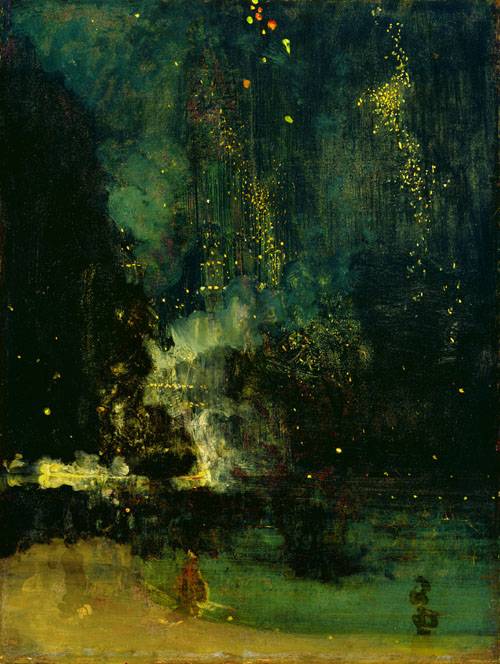
1875 · Oil on panel · Detroit Institute of Arts, Detroit, Michigan, United States
Save articles to your collection
Log in or create a free account, and this article will be waiting in your Private Collection.
Log in or sign upWhistler painted this nocturnal scene around 1875, depicting a fireworks display at Cremorne Gardens, the celebrated pleasure garden situated along the north bank of the Thames in Chelsea. Cremorne was a popular destination for Londoners of all social classes, offering music, dancing, balloon ascents, and elaborate pyrotechnic shows that drew large crowds throughout the summer season. Whistler lived nearby in Chelsea and visited the gardens repeatedly, absorbing the spectacle of colored light bursting against the night sky and cascading downward in showers of gold and amber spark. He translated these observations not as documentary records but as impressions, working from memory and sensation rather than direct transcription, building up thin veils of dark pigment and then flicking and splattering warm gold paint across the surface to suggest the falling fragments of ignited firework casing. The painting was exhibited at the Grosvenor Gallery in London in 1877, where it attracted the attention and fury of the critic John Ruskin, who published a notorious review in his periodical Fors Clavigera accusing Whistler of asking two hundred guineas for flinging a pot of paint in the face of the public. Whistler sued Ruskin for libel, and the trial held in 1878 became a public spectacle that pitted two competing visions of what art should be against each other in open court. Whistler was awarded a farthing in damages, a symbolic and humiliating victory that nonetheless bankrupted him due to legal costs and forced him to sell his Chelsea home. The painting eventually entered the collection of the Detroit Institute of Arts, where it remains a cornerstone holding.
Viewed without knowledge of its history, this painting reads as one of the most audacious works produced in the nineteenth century. The panel, quite small in physical dimensions, is dominated by a deep field of blue-black, punctuated by the faintest suggestion of a treeline silhouette along the lower edge and the blurred impression of a crowd gathered in the middle distance. Above this horizontal base the sky opens into a near-total abstraction, with scattered blooms of golden yellow and warm orange paint suggesting the trailing sparks of exploding rockets. Whistler applied these marks with exceptional freedom, using brushes, possibly palette knives, and almost certainly direct flicking of pigment to achieve the irregular scatter of light particles that so outraged Ruskin and so enchanted later viewers. The handling is entirely without precedent in academic British painting of the period, looking forward to the gestural freedom of Abstract Expressionism by more than seven decades. Yet the painting is not without structure. The dark horizontal band of vegetation anchors the composition, and the distribution of the light marks is carefully varied, denser toward the upper center and thinning toward the edges, guiding the eye through the field of darkness with quiet intentionality. The tonal range is extraordinary, from the near-black of the panel surface where it is barely covered to the warm brightness of the gold, and within this narrow register Whistler has suggested atmosphere, movement, distance, and the peculiar exhilaration of watching fire dissolve against a night sky. This exceptional work is available as a hand-painted oil reproduction through ByMuseum, allowing you to experience its textures and tonal drama at home.
The cultural significance of this painting extends well beyond its visual qualities. It became the battleground on which a fundamental question about art was publicly contested: does a painting owe its audience recognizable subject matter rendered with demonstrable skill in the conventional sense, or can the evocation of an experience, however abstract or rapid in its execution, constitute a legitimate artistic achievement? Ruskin represented the older view, rooted in the Victorian belief that art should instruct, that effort should be visible, and that price should correlate with labor. Whistler represented something entirely new, the idea that a lifetime of developed sensibility, not hours of meticulous application, was the true currency of artistic value. His famous statement during the trial, that he was asking the fee for the knowledge of a lifetime, is among the most quoted remarks in the history of art and crystallizes a debate that has never fully been resolved. Beyond the legal drama, the painting itself embodies the Tonalist commitment to atmospheric experience over descriptive precision. The night, in Whistler's conception, is not simply darkness but a complex environment of layered tone, in which artificial light behaves differently from daylight, dissolving edges and creating halos and trails that the eye processes as emotion before the mind processes them as information. By rendering this nocturnal complexity with the freedom his critics found so offensive, Whistler was producing one of the earliest serious arguments in paint for what we now recognize as abstraction. Own this historically pivotal and visually breathtaking work as a hand-painted oil reproduction, crafted with care and available exclusively through the ByMuseum collection.
Enjoyed this story?
Save articles to your collection
Log in or create a free account, and this article will be waiting in your Private Collection.
Log in or sign up