Loading cart…
No products in the cart.

Original price was: $599.00.$299.00Current price is: $299.00.
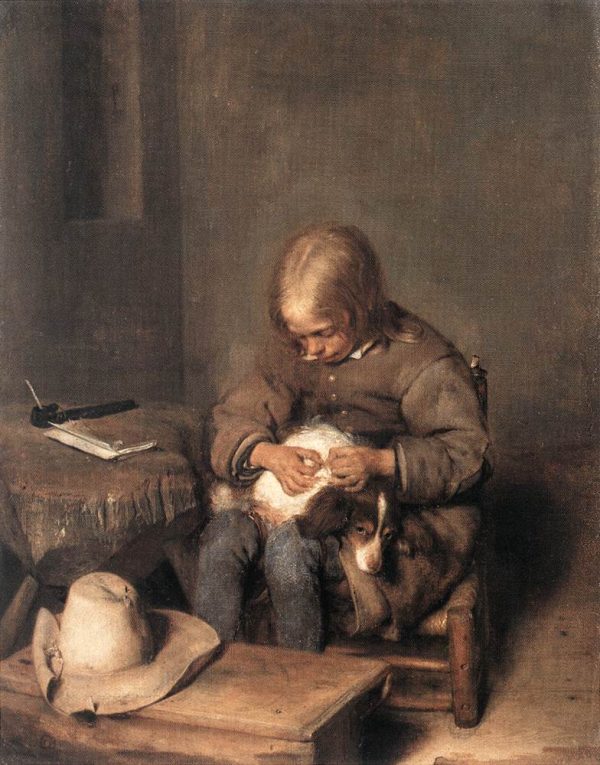
A Boy Ridding His Dog Of Fleas by Gerard ter Borch, recreated as a hand-painted oil reproduction with the quiet tonal restraint that defines the original.
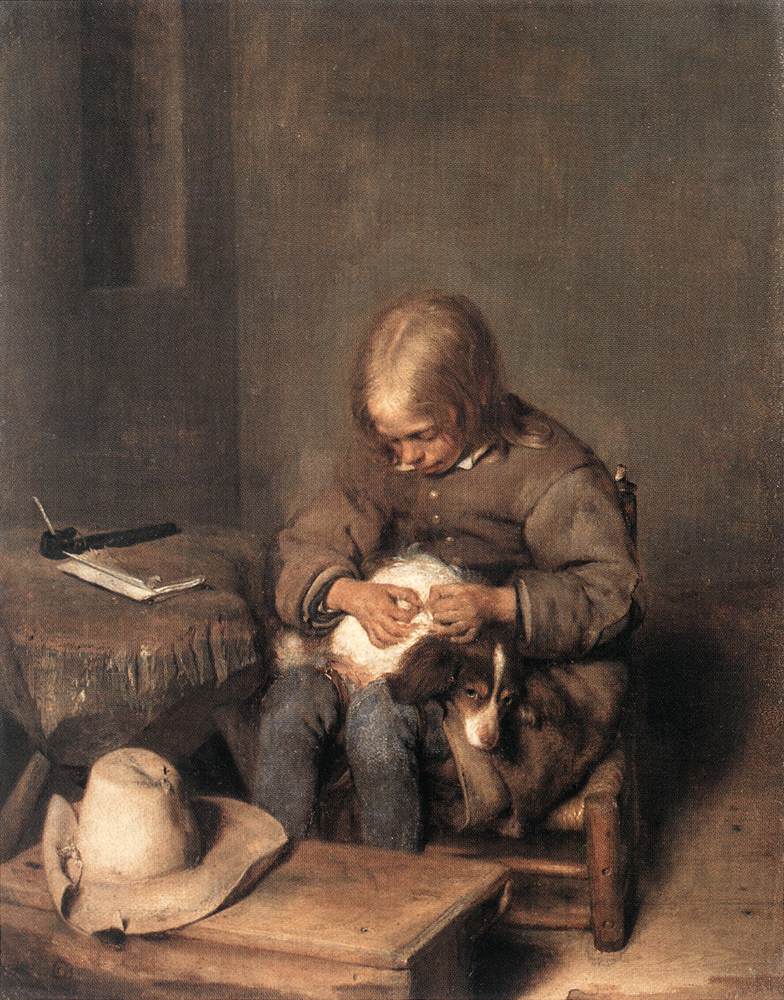
A boy kneels close to the floor, absorbed in a small domestic task, while his dog waits with the patient stillness ter Borch reserved for moments most painters would overlook. Light falls quietly across the scene, gathering on the fabric of the boy clothing and the coat of the animal, and the rest of the room recedes into a soft brown dusk. It is an image built for a wall where people pause rather than pass through.
Gerard ter Borch worked in the Dutch Republic during the middle decades of the seventeenth century, a period when genre painting turned toward small interior subjects treated with unusual seriousness. Here the composition holds close to its two figures, boy and dog, with almost nothing else competing for attention. The floor, a strip of wall, a suggestion of furniture: these are kept dim so that the eye settles on the exchange between the two, on the tilt of the head and the small gesture of the hands. Nothing in the scene is raised to drama. The subject is ordinary, and the painting trusts it to be enough.
The handling of paint is where the picture earns its quiet authority. Ter Borch builds form through closely related tones rather than sharp contrast, so that browns, greys, and warmed whites shift into one another with barely a visible seam. Edges soften where they need to soften and sharpen only where the eye should land, on a collar, a hand, the fall of light on fur. This is the same discipline that made ter Borch sought after for portraits and satin-clad interiors: restraint used as a tool of attention.
Recreating this on canvas asks for the same patience the original demanded. Painters working for ByMuseum study the tonal structure of the composition and rebuild it by hand, layer by layer, matching the muted palette and the softened transitions that give the scene its hush. The result is a hand-painted oil painting reproduction rather than a mechanical copy, one where brushwork and the texture of oil paint remain visible on the surface, so the picture holds light the way an original does and not the way a flat print does. Viewed as a fine art reproduction, it carries the same physical presence that made the subject worth painting in the first place.
Hung in a study, a hallway, or a reading corner with modest, even light, the painting settles into a room rather than dominating it. It suits spaces where the eye returns often and slowly, rewarding a second and third look with details that a first glance would miss. The mood it sets is unhurried, a small daily scene made permanent, well suited to a room used for quiet occupation rather than display.
Empty walls flatten a room. A classical artwork restores structure and visual hierarchy. One painting defines the space, anchors furniture, and establishes identity.
Worldwide shipping included. Each painting is produced to order and safely packed for international transport.
All payments are encrypted and processed through trusted payment providers.
Real brushwork, layered oil paint, and durable pigments on museum-quality canvas.
If the result does not meet expectations, return it for a full refund.


Your artwork is painted on premium cotton canvas, then shipped safely rolled in a rigid tube with extra blank canvas border — ready for stretching or framing locally.
Select a handcrafted frame and we’ll deliver your painting fully assembled, protected, and ready to hang.
For safe shipping, framing is available up to a maximum size. Larger sizes will automatically disable the frame option.


Choose “Stretched” to receive your canvas mounted on wooden stretcher bars — perfect if you’ll frame it later or display it as-is.
Gallery Wrap is a deeper, 1.5" style stretcher. The canvas wraps around the sides and is stapled on the back for a clean, modern, frameless look.
We ship with UPS, FedEx, or DHL straight to your door. You’ll receive a tracking number as soon as your order leaves our studio. Typical delivery is 5 to 7 days after dispatch; large, framed, or stretched pieces may take longer depending on the safest shipping route.


Unframed canvases are protected with a film, carefully rolled, and secured inside a rigid shipping tube.

Stretched, Gallery Wrapped, and Framed paintings are wrapped, cushioned with foam protection, and boxed for safe transit.