Loading cart…
No products in the cart.

Original price was: $599.00.$299.00Current price is: $299.00.
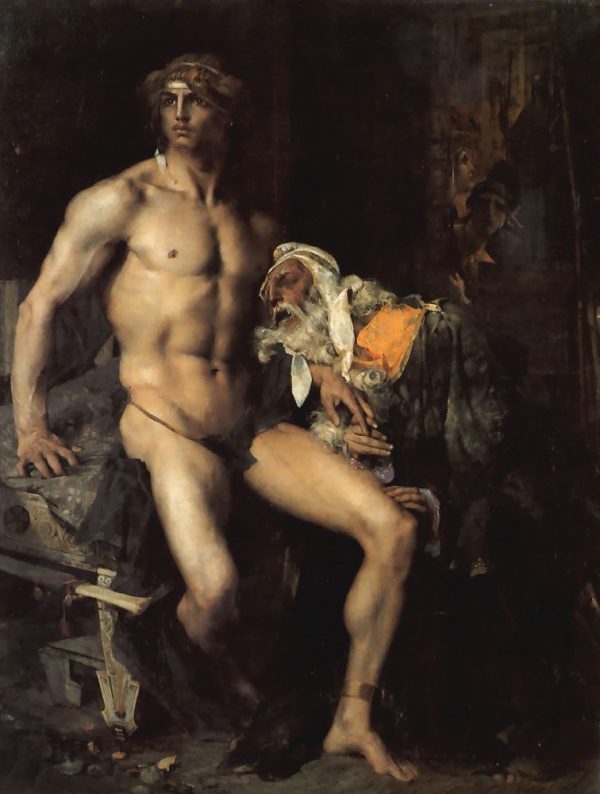
Achilles and Priam by Jules Bastien-Lepage brings naturalist honesty to a Homeric confrontation, its grief and tension rendered with the physical credibility of a realist painter.

Realism in the late nineteenth century often turned to observed life for its authority, but here that same unflinching eye is trained on a scene from Homer, and the result sits at an unusual crossing point between academic subject matter and naturalist conviction. This particular canvas takes one of the most wrenching passages in the Iliad, the moment when a father begs for the body of his son from the man who killed him, and strips away the grandeur that classical painting usually brings to such encounters.
The composition holds two figures in close, almost unbearable proximity. Priam, aged and undone by grief, faces Achilles with a posture that speaks before any inscription could explain it; the warrior, still charged with the violence of battle, meets him with an expression caught between contempt and reluctant recognition. Jules Bastien-Lepage, a painter trained in the academic tradition but drawn increasingly toward realist observation, resists the temptation to idealise either man. Musculature, weathered skin, and the particular slump of exhaustion are rendered with the same honesty he brought to his studies of rural labourers and village life.
Light falls across the scene in a way that favours emotional legibility over theatrical effect, picking out the tension in a hand or the set of a jaw while leaving the background in a hushed, unresolved tone. This handling situates the picture at a hinge point in the artist career, when the discipline of the Salon met the emerging pull of realism, and it is exactly this tension that makes the work rewarding to live with rather than simply admire once. A fine art reproduction of this scene, produced as a hand-painted oil painting reproduction on artist-grade canvas, keeps the visible brushwork and the layered tonal shifts that carry so much of the emotional weight in the original; a trained painter builds the surface by hand rather than printing it flat, so the texture you see up close is the same texture Bastien-Lepage worked with.
Hung where the afternoon light falls at an angle rather than head on, this canvas rewards a room with some quiet in it, a study, a reading corner, a hallway where you pass slowly rather than hurry through. It asks to be looked at more than once, and each time it gives back something different in the exchange between the two figures.
Artwork guide
Explore the painting’s history, composition and meaning in the ByMuseum art guide.
Read the history and meaning of Achilles and PriamEmpty walls flatten a room. A classical artwork restores structure and visual hierarchy. One painting defines the space, anchors furniture, and establishes identity.
Worldwide shipping included. Each painting is produced to order and safely packed for international transport.
All payments are encrypted and processed through trusted payment providers.
Real brushwork, layered oil paint, and durable pigments on museum-quality canvas.
If the result does not meet expectations, return it for a full refund.


Your artwork is painted on premium cotton canvas, then shipped safely rolled in a rigid tube with extra blank canvas border — ready for stretching or framing locally.
Select a handcrafted frame and we’ll deliver your painting fully assembled, protected, and ready to hang.
For safe shipping, framing is available up to a maximum size. Larger sizes will automatically disable the frame option.


Choose “Stretched” to receive your canvas mounted on wooden stretcher bars — perfect if you’ll frame it later or display it as-is.
Gallery Wrap is a deeper, 1.5" style stretcher. The canvas wraps around the sides and is stapled on the back for a clean, modern, frameless look.
We ship with UPS, FedEx, or DHL straight to your door. You’ll receive a tracking number as soon as your order leaves our studio. Typical delivery is 5 to 7 days after dispatch; large, framed, or stretched pieces may take longer depending on the safest shipping route.


Unframed canvases are protected with a film, carefully rolled, and secured inside a rigid shipping tube.

Stretched, Gallery Wrapped, and Framed paintings are wrapped, cushioned with foam protection, and boxed for safe transit.