Loading cart…
No products in the cart.

The Odyssey in Paintings · Part 1 of 3
Odysseus, whom the Romans called Ulysses, left home for a war that lasted ten years and took ten more to get back. Painters have followed him the whole way. This is his story told through the paintings we make by hand, from the sacrifice that let the fleet sail to the night in the giant's cave, with Homer's own words where they matter.
The story starts before Troy, with a wind that would not blow. The Greek fleet lay at Aulis, a thousand ships, and could not sail because the goddess Artemis was angry with its commander, Agamemnon. The seer told him the price: his daughter. Iphigenia was brought to the camp on the pretext of a marriage to Achilles, and put on the altar.
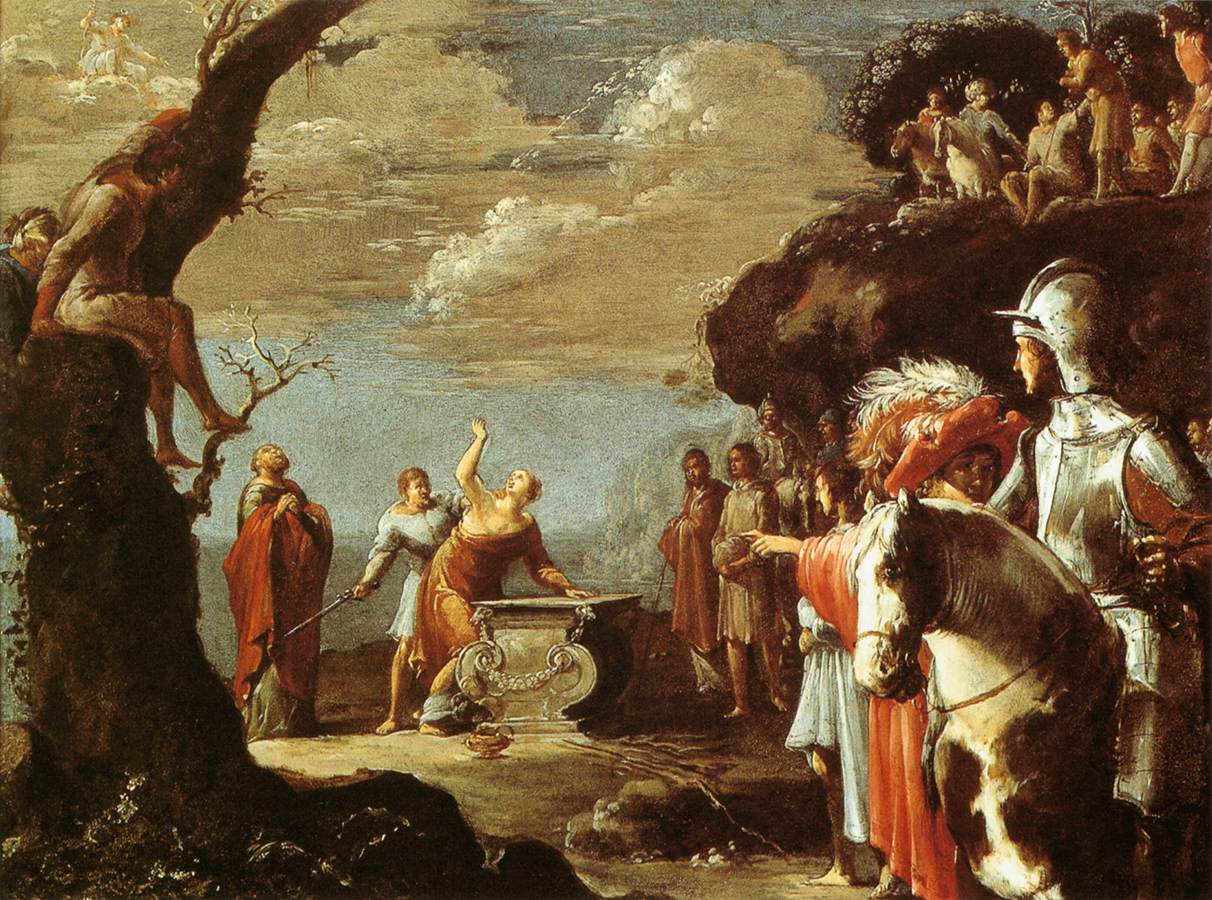
Painters loved the scene for its cruelty and its rescue: in most versions Artemis relents at the last second and snatches the girl away, leaving a deer on the altar. Bramer, a Dutch painter of torchlit dramas, shows the moment before. Fontebasso, a Venetian a century later, shows the goddess arriving in a cloud. Either way the wind blew, and the ships sailed, and the man who would take longest to come home was among them: Odysseus, king of the small rocky island of Ithaca, who had tried to dodge the war by pretending to be mad.

Homer's first poem, the Iliad, covers a few weeks of the tenth year. Odysseus is in it as the clever one, the negotiator, the man sent to talk Achilles out of his tent. He fails. Achilles sulks over a captured girl and a wounded pride while the Greeks are driven back to their ships.

Sing, goddess, the anger of Achilles, son of Peleus, the ruinous anger that brought the Greeks countless griefs and sent so many brave souls down to Hades.
Homer, Iliad, opening lines, translated for this article
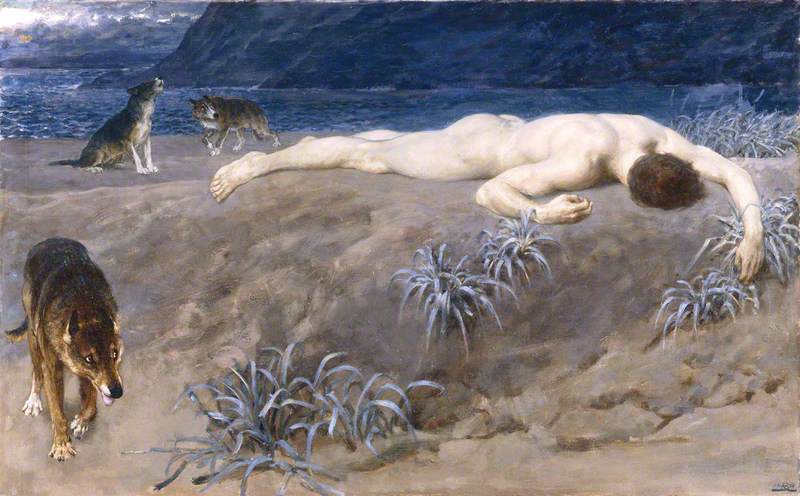
Achilles comes back only when his friend Patroclus is killed by the Trojan prince Hector. He kills Hector in front of the walls, ties the body to his chariot and drags it round the city for days. Rivière, the Victorian painter of animals, painted the aftermath as a still life of the dead: the stripped body on the plain, the dogs and birds kept off it by the gods.
Inside the walls his wife Andromache mourns him over their infant son. David painted her in 1783, the year before the Oath of the Horatii, as a Roman widow on a Roman bed, and it was the picture that got him into the Academy.

Then the old king Priam crosses the lines at night to kneel before Achilles and beg for his son's body, and Achilles, remembering his own father, weeps and gives it back. It is the end of the Iliad, and the one moment of mercy in it.

None of it would have happened without Helen, the Spartan queen who left her husband Menelaus for the Trojan prince Paris, or was taken by him; Homer never quite says. In the Iliad she walks the walls of Troy pointing out the Greek captains to the old men, who look at her and understand why the war is being fought, and wish she would go home anyway.
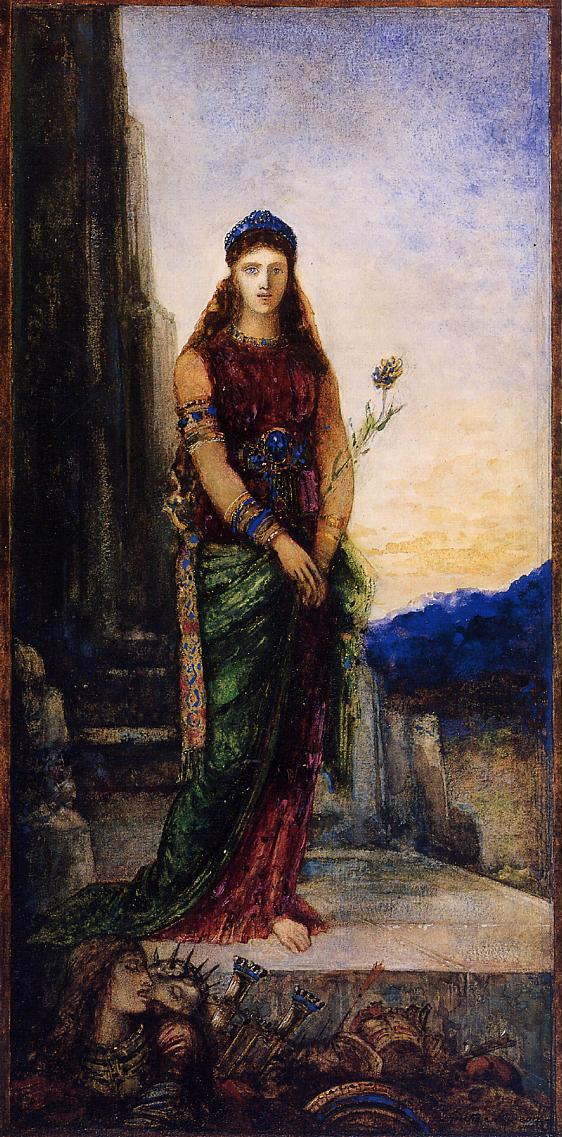
Gustave Moreau, the French Symbolist, painted her that way: a tall figure in white on the ramparts, expressionless, with the city burning below. She is the reason and she is untouched by it. Odysseus will spend twenty years paying for her, and Homer lets her end the story happily married, back in Sparta, offering wine to his son.
The war was not won by Achilles, who died first, shot in the heel by Paris. It was won by Odysseus, who thought of the horse. Homer tells it in the Odyssey, in retrospect, through a bard singing at a feast while Odysseus, the guest, weeps to hear his own story.
He sang how the sons of the Greeks poured out of the horse and left their hollow hiding place and sacked the city, each man plundering in a different quarter, and Odysseus, like Ares himself, went with Menelaus to the house of Deiphobus.
Homer, Odyssey, translated for this article
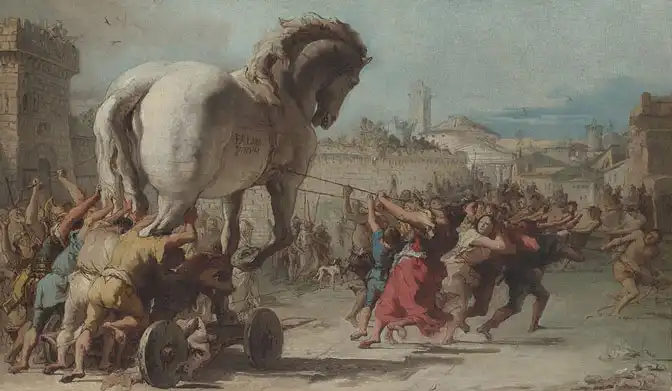
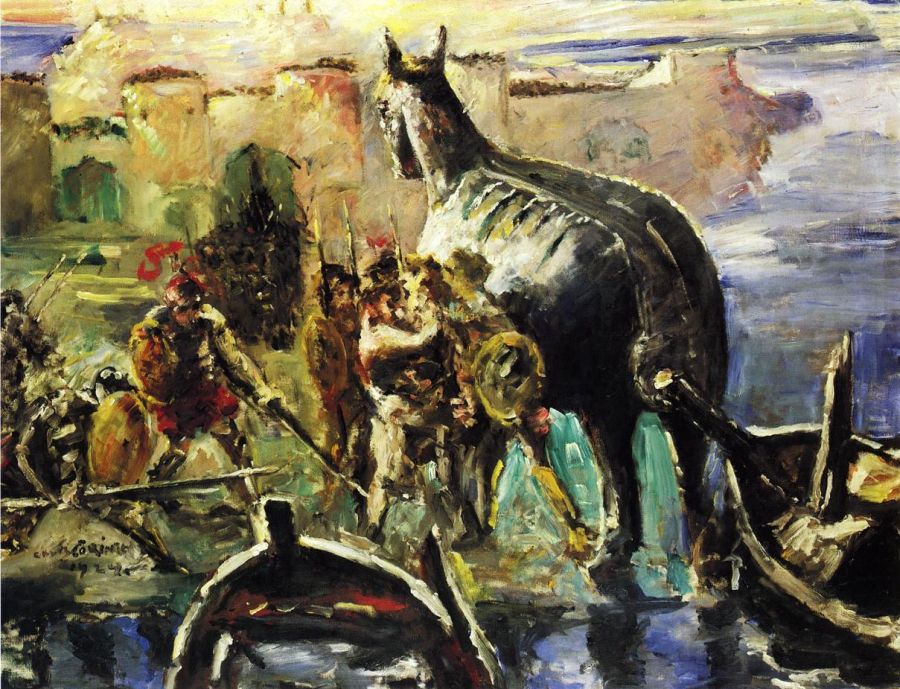
Giovanni Domenico Tiepolo painted the Trojans dragging the horse into the city with ropes and joy, in a sketch for a decorative cycle he never finished. Lovis Corinth, a century and a half later and after the First World War, painted the same scene as a nightmare, the horse a lurching wooden monster over a crowd that already looks dead.
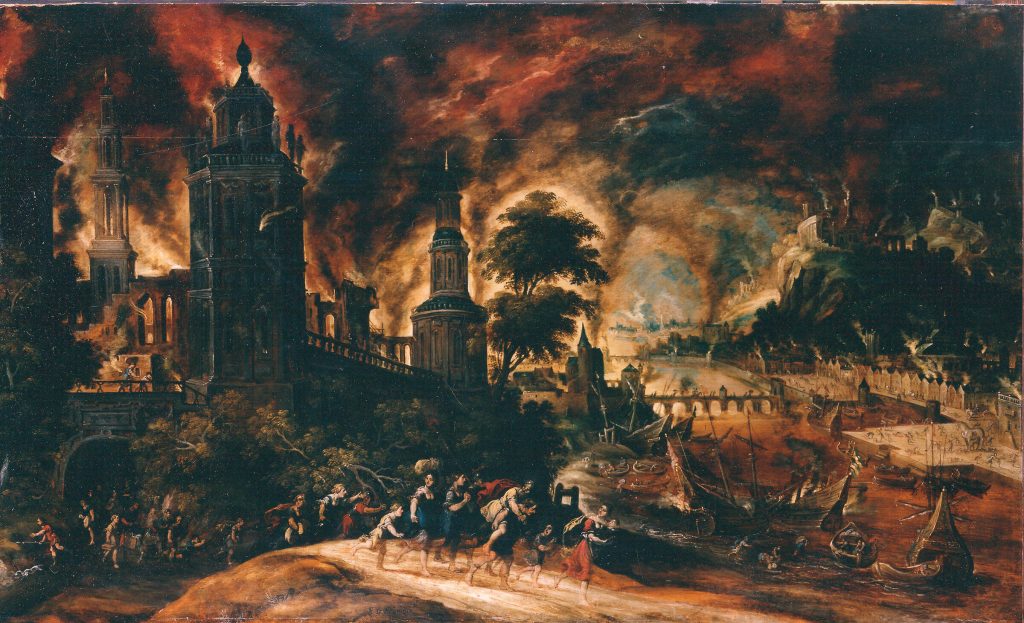
That night the city burned. The one Trojan who mattered afterwards was Aeneas, who carried his old father on his back out of the fire with his small son by the hand, and went on to found Rome. It is the most painted escape in art, and Barocci and Preti painted it in the same century, one as a stage and one as a shadow.
 Aeneas' Flight from Troy
 Aeneas, Anchises and Ascanius Fleeing Troy
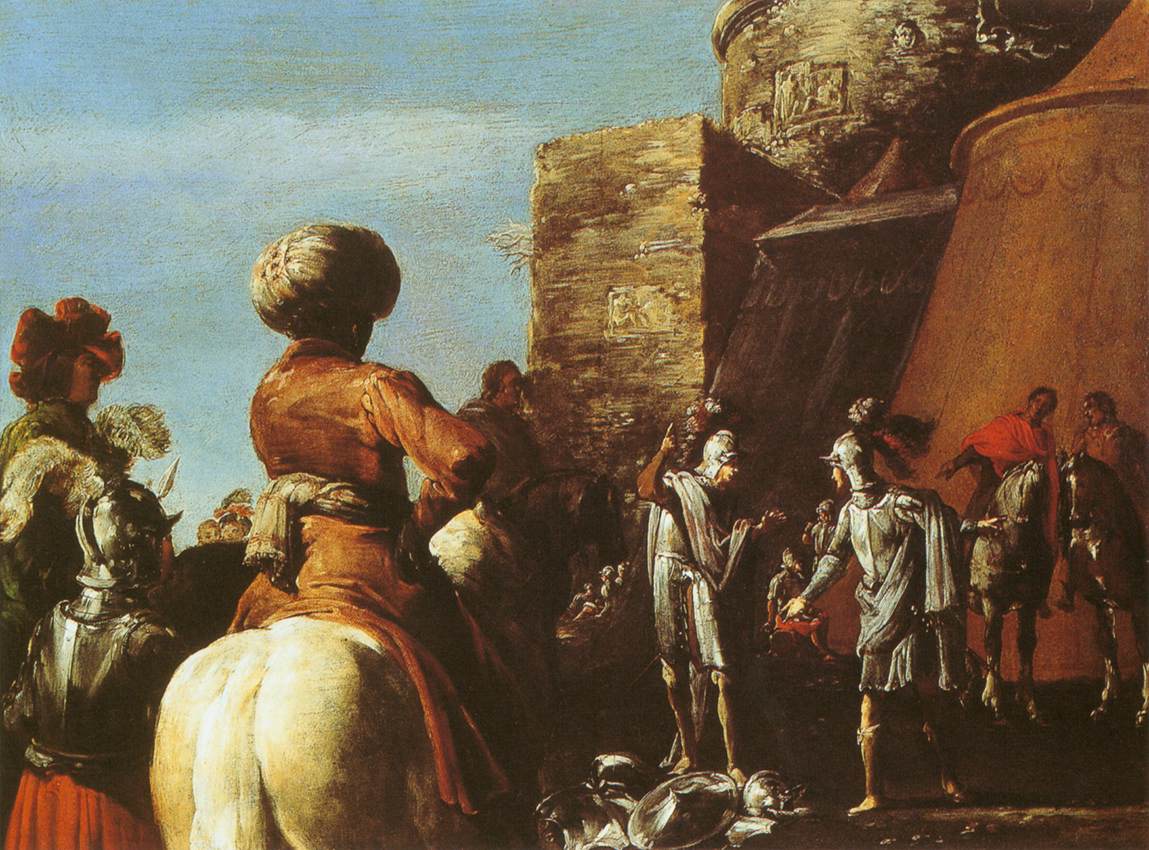 The Quarrel between Ajax and Odysseus
And in the Greek camp, once the city fell, the captains fought over the spoils. Bramer painted the quarrel between Ajax and Odysseus over the armour of Achilles. Odysseus won it by talking, Ajax went mad and killed himself, and Odysseus sailed for home with twelve ships, a hold full of loot, and every god of the sea against him.
The journey home should have taken weeks. It took ten years, and the reasons are the story. First a raid on the Cicones that cost him seventy men. Then the storm that blew him past Cape Malea, off the map, into the world of monsters. Then the Lotus-eaters, whose fruit makes you forget your home; he had to drag his men back to the ships in tears.
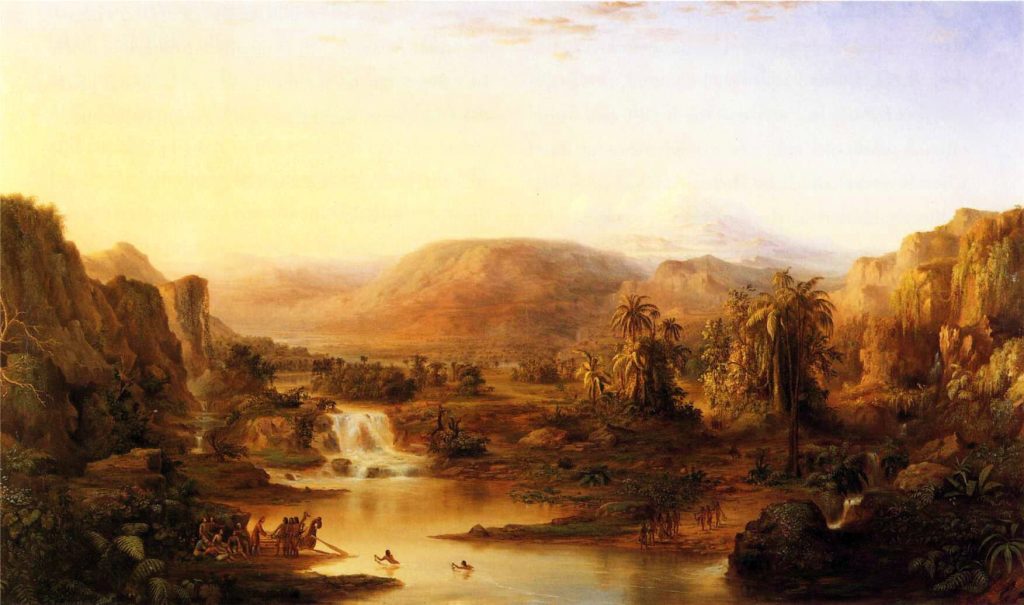
And then, for a moment, luck. Aeolus, keeper of the winds, gave him a bag with every wind in it except the one that would carry him to Ithaca. Nine days later they could see the island, the fires on the shore. Odysseus fell asleep. His crew, sure the bag held gold, opened it.
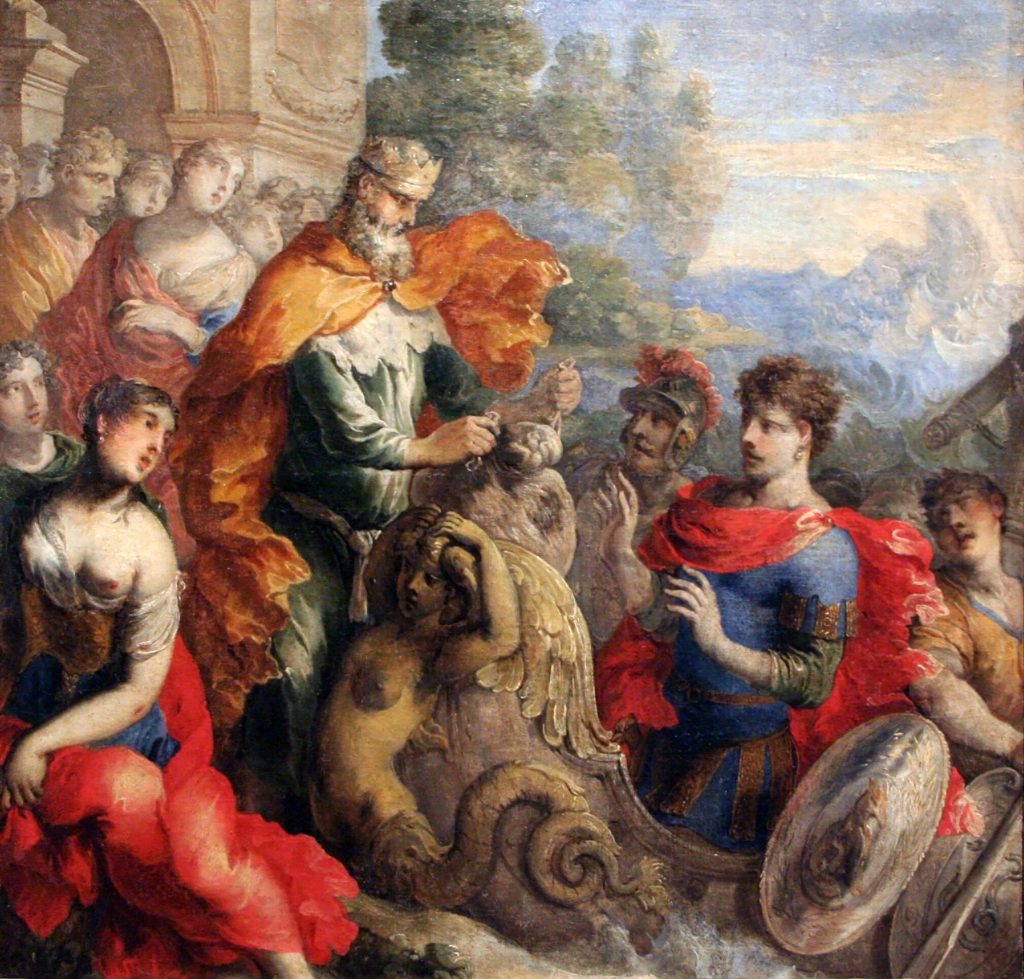
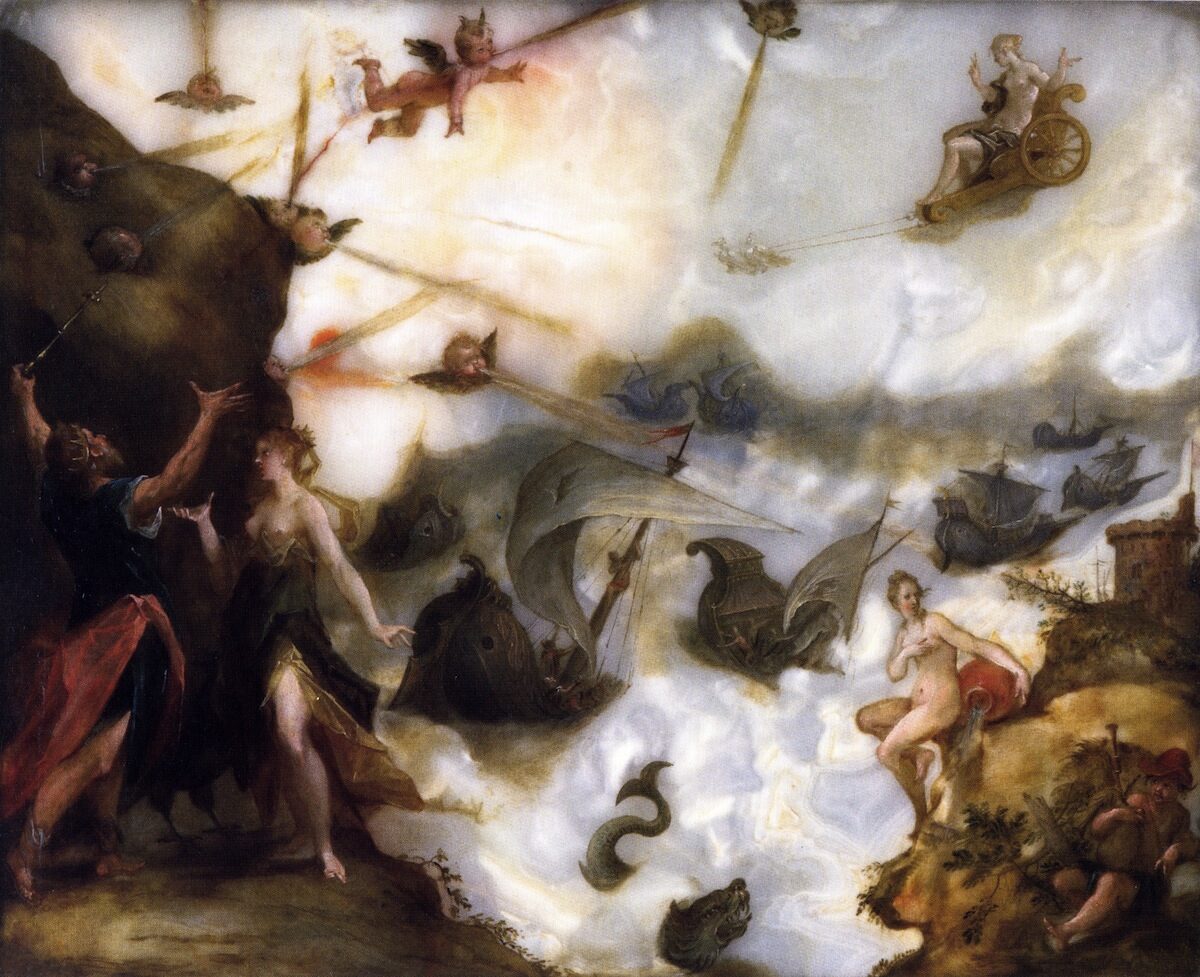
And the winds rushed out, and the storm caught them and carried them weeping back to sea, away from their own country.
Homer, Odyssey, translated for this article
Before Aeolus there had been the cave, and the cave is the episode every painter wanted. Odysseus and twelve men, exploring an island of giants, found a cave stocked with cheese and lambs and waited, against his men's advice, to meet its owner. The owner was Polyphemus, a one-eyed son of Poseidon, who rolled a boulder across the door, picked up two of the men and ate them.
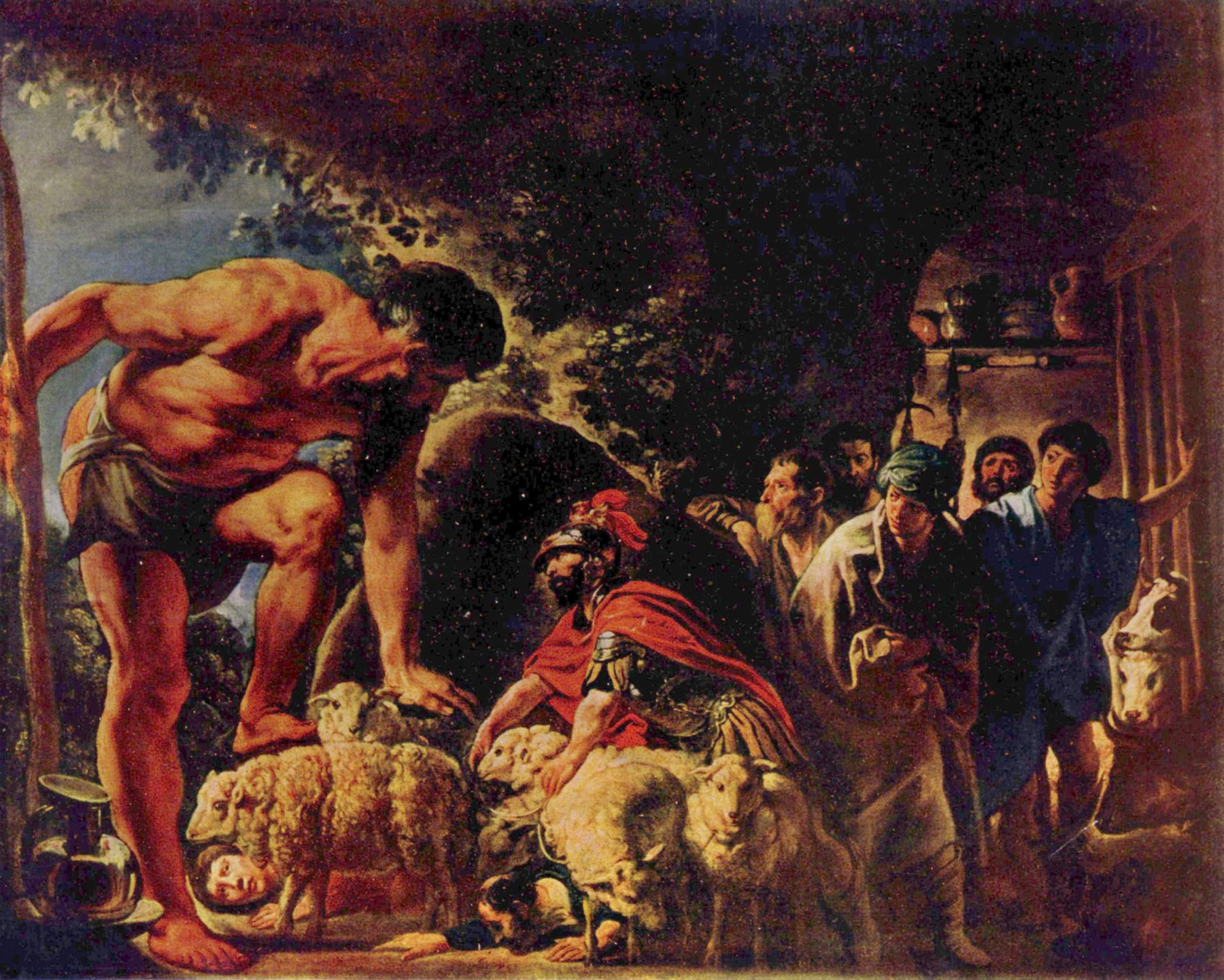
Odysseus got him drunk on the strong wine he had brought, told him his name was Nobody, and when the giant slept drove a sharpened olive stake into the eye. Polyphemus roared for help and told the other giants that Nobody was hurting him, so they went away. In the morning the men escaped tied under the bellies of the sheep.
Cyclops, if any mortal man asks who put out your eye, tell him it was Odysseus, sacker of cities, son of Laertes, whose home is in Ithaca.
Homer, Odyssey, translated for this article
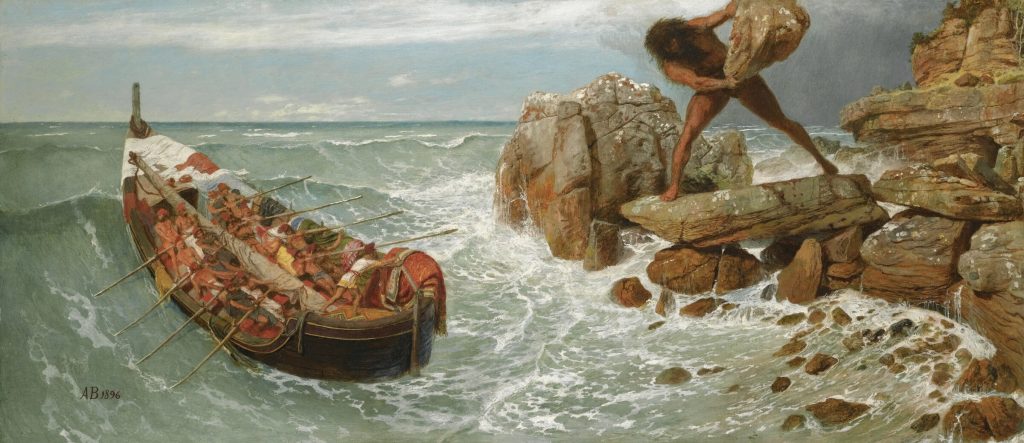
That boast was the mistake of his life. Once Polyphemus had the name, he could pray to his father, and Poseidon heard him: let Odysseus come home late, alone, on a stranger's ship, and find trouble in his house. Every year of the next nine is that prayer being answered.
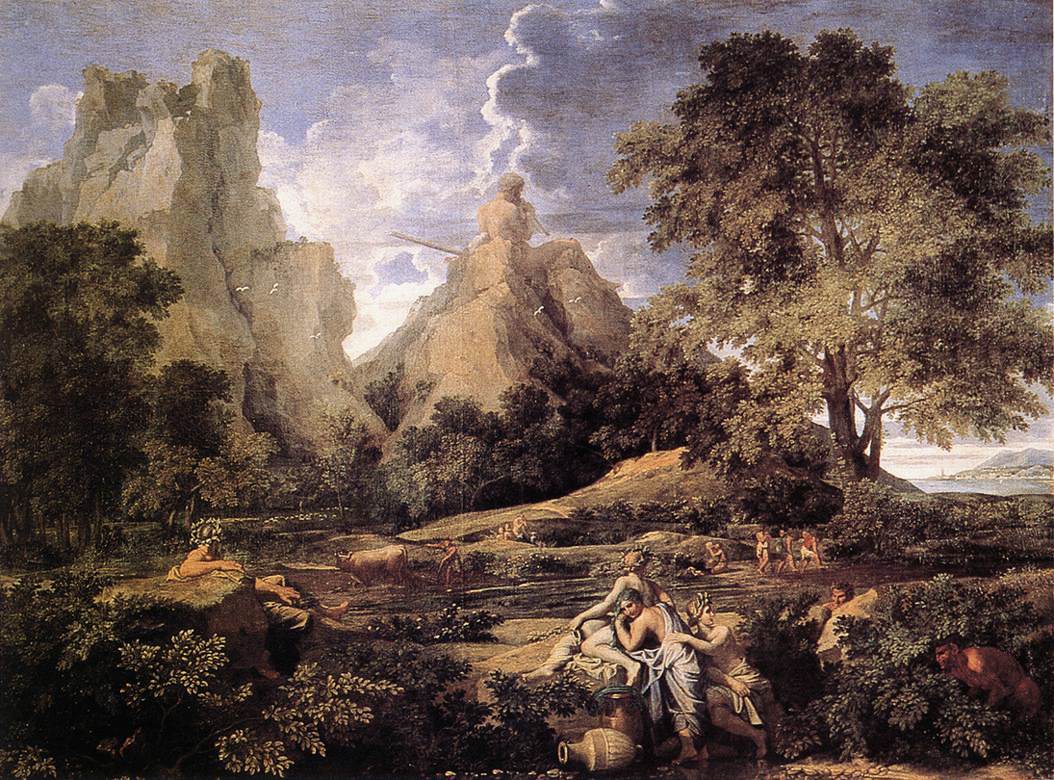
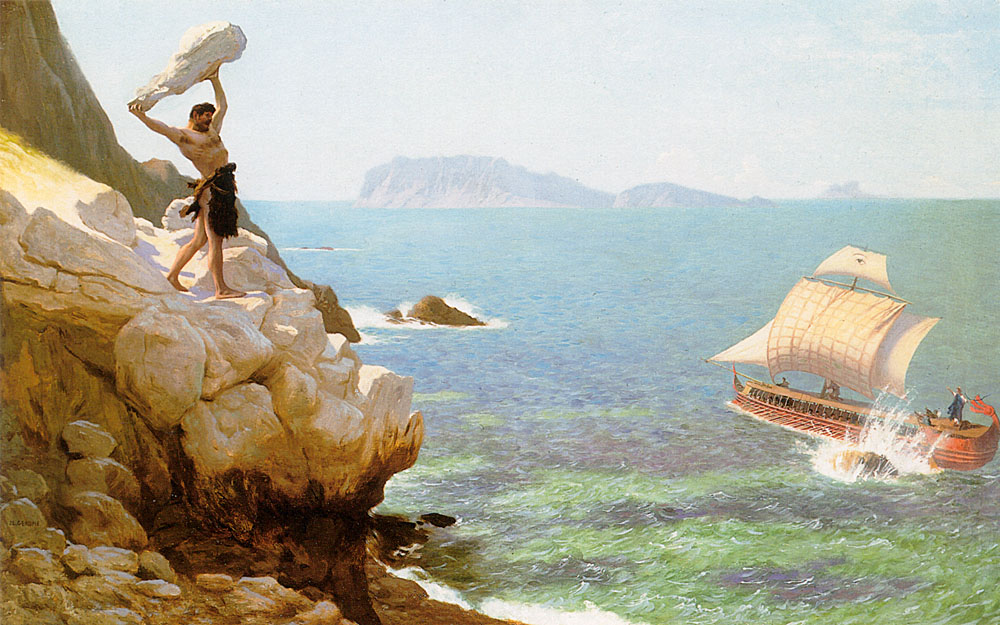
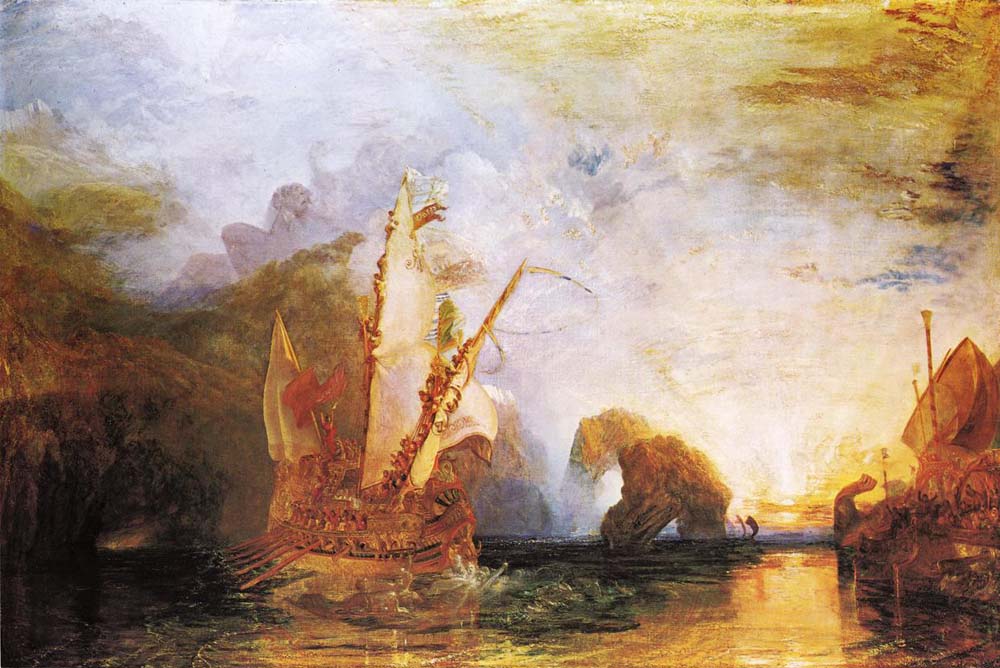
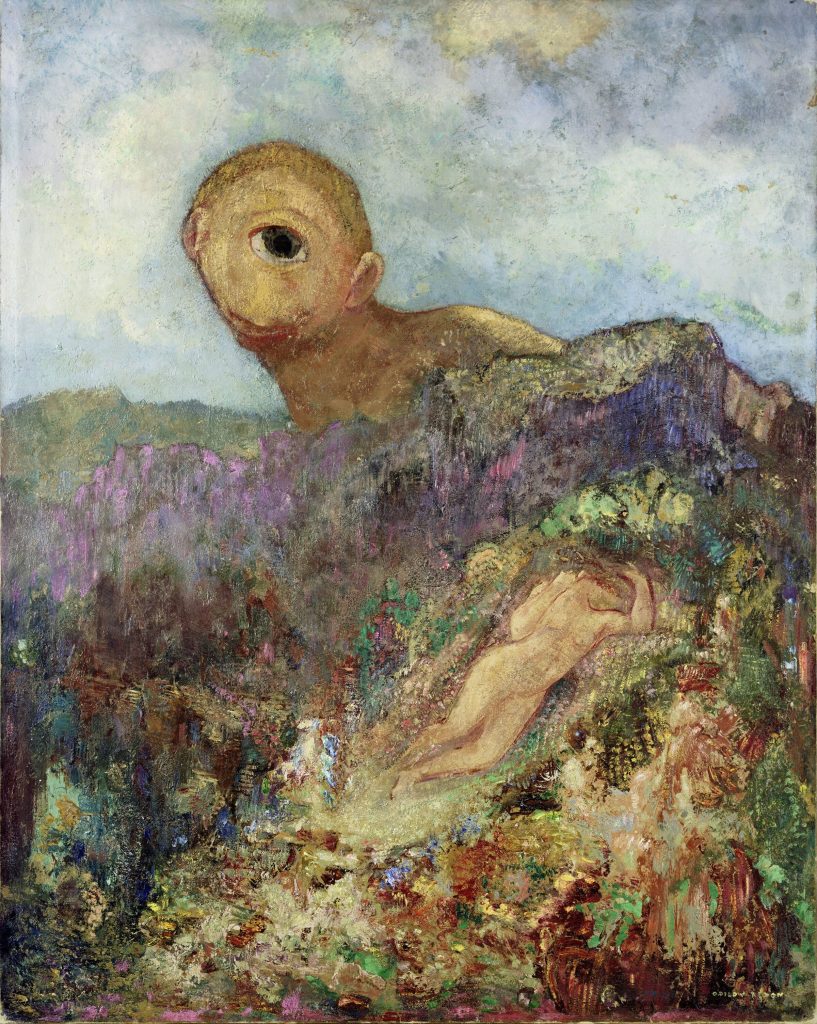
Turner painted the departure, the ships pulling away at sunrise while the giant, blinded, looms in the cliffs like weather. Poussin, two centuries before, painted the same monster at peace, playing his pipes on a mountain for a nymph who will not have him, in one of the calmest landscapes ever made. Gérôme painted him as a solitary rock-thrower on the shore. And Odilon Redon, in 1914, painted him as a shy golden creature with one enormous eye, peering over a hill of flowers at the nymph he loves. The cyclops became whatever the century needed: a horror, a pastoral, a lonely brute, a lovesick child.

Every painting shown is available as a hand-painted oil reproduction; click any image. Dates given for the paintings are the museums' or the standard catalogues'.