Loading cart…
No products in the cart.

Original price was: $518.00.$259.00Current price is: $259.00.
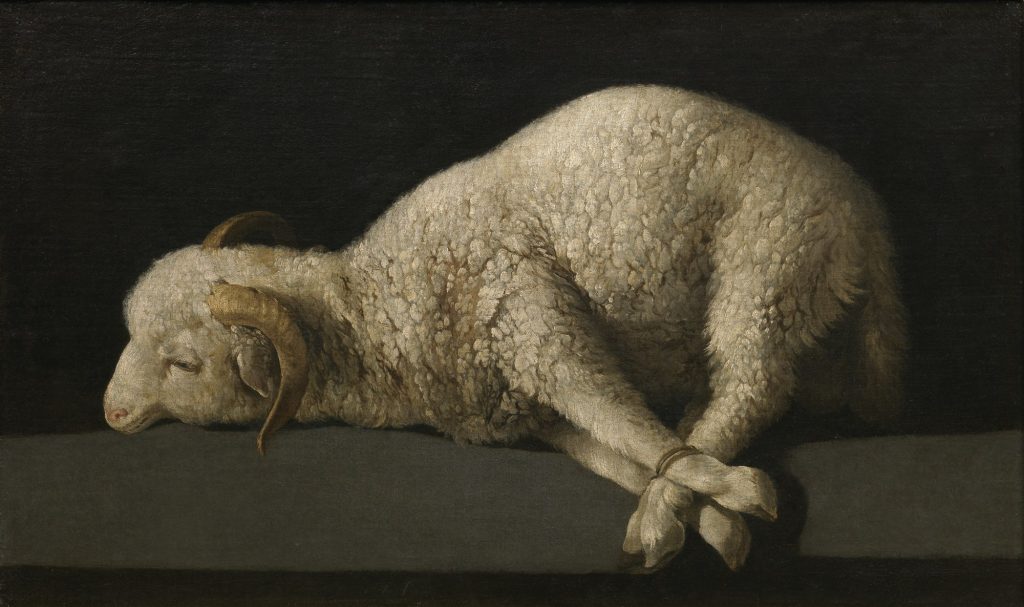
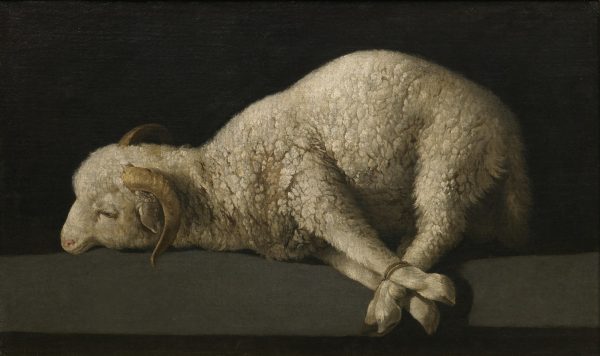
A bound lamb on a bare grey ledge, painted by Francisco de Zurbaran around 1635 to 1640, now offered as a hand-painted Agnus Dei reproduction true to the Prado original.
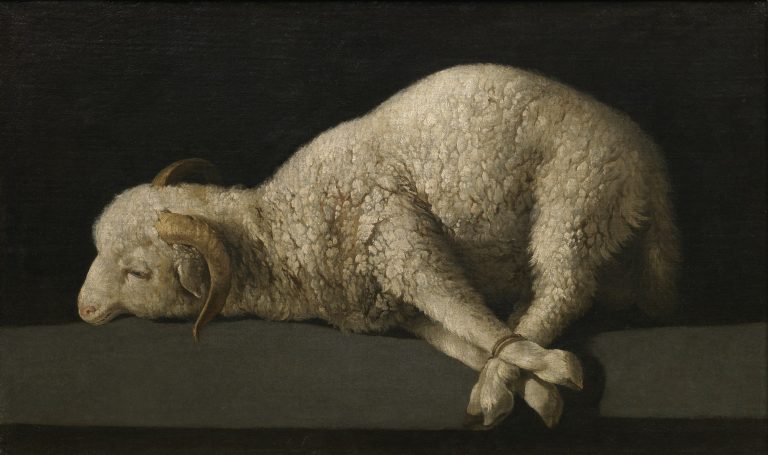
At just over sixty centimetres across, Agnus Dei is a small, close canvas that asks to be seen from near at hand, the way a reliquary or a devotional panel is seen rather than a history painting meant for a distant wall. The narrow format and the near life-size scale of the animal mean a viewer stands close, almost at the level of the ledge itself, which is exactly how Francisco de Zurbaran wanted the lamb to be met.
The subject could not be simpler to describe and is difficult to stop looking at: a young merino lamb, legs bound with rope, laid on its side on a flat grey ledge against a background of unbroken dark. There is no halo, no landscape, no gesture toward the Gospel of John beyond the posture itself, which is unmistakably sacrificial. Zurbaran paints the wool in short, dense strokes that build up real physical thickness, curl by curl, so that the fleece seems to hold actual weight against the stone. Light falls from the upper left in a single controlled sweep, picking out the ridge of the spine and the taut cord at the ankles while the rest of the body sinks into shadow.
This Agnus Dei reproduction belongs to a small group of versions Zurbaran painted of the same motif during his years in Seville, and the Prado canvas is generally taken as the most fully resolved of them, the one where the modelling of the fleece against the flat ledge and the fall of light are most exactly judged. A discerning eye returning to it notices how little is actually there: no horizon line, no texture in the background at all, just the edge where the grey ledge meets the black and the rope that cuts across the foreleg.
ByMuseum painters work from this same restraint, building the reproduction in oil on artist-grade canvas rather than printing it. Each hand-painted oil painting reproduction is layered in the studio stroke by stroke, matching the cool grey of the stone, the near-black of the void behind the lamb, and the raised texture of the wool, so the surface carries real brushwork and impasto rather than a flat printed layer. The result is a hand-painted replica meant to be examined up close, the way the original rewards it, with the ropes, the modelling of the legs, and the particular density of the fleece visible as actual paint rather than as reproduced detail.
Lived with over time, the painting tends to reveal itself slowly: a cooler passage in the shadow one notices only in certain light, the slight asymmetry in how the legs are bound, the way the grey of the ledge shifts almost to blue near the edge of the canvas. It rewards a quiet wall and repeated looking rather than a single glance.
| artists |
|---|
Empty walls flatten a room. A classical artwork restores structure and visual hierarchy. One painting defines the space, anchors furniture, and establishes identity.
Worldwide shipping included. Each painting is produced to order and safely packed for international transport.
All payments are encrypted and processed through trusted payment providers.
Real brushwork, layered oil paint, and durable pigments on museum-quality canvas.
If the result does not meet expectations, return it for a full refund.


Your artwork is painted on premium cotton canvas, then shipped safely rolled in a rigid tube with extra blank canvas border — ready for stretching or framing locally.
Select a handcrafted frame and we’ll deliver your painting fully assembled, protected, and ready to hang.
For safe shipping, framing is available up to a maximum size. Larger sizes will automatically disable the frame option.


Choose “Stretched” to receive your canvas mounted on wooden stretcher bars — perfect if you’ll frame it later or display it as-is.
Gallery Wrap is a deeper, 1.5" style stretcher. The canvas wraps around the sides and is stapled on the back for a clean, modern, frameless look.
We ship with UPS, FedEx, or DHL straight to your door. You’ll receive a tracking number as soon as your order leaves our studio. Typical delivery is 5 to 7 days after dispatch; large, framed, or stretched pieces may take longer depending on the safest shipping route.


Unframed canvases are protected with a film, carefully rolled, and secured inside a rigid shipping tube.

Stretched, Gallery Wrapped, and Framed paintings are wrapped, cushioned with foam protection, and boxed for safe transit.
Baroque
Francisco de Zurbarán
Reviews
There are no reviews yet.