Loading cart…
No products in the cart.

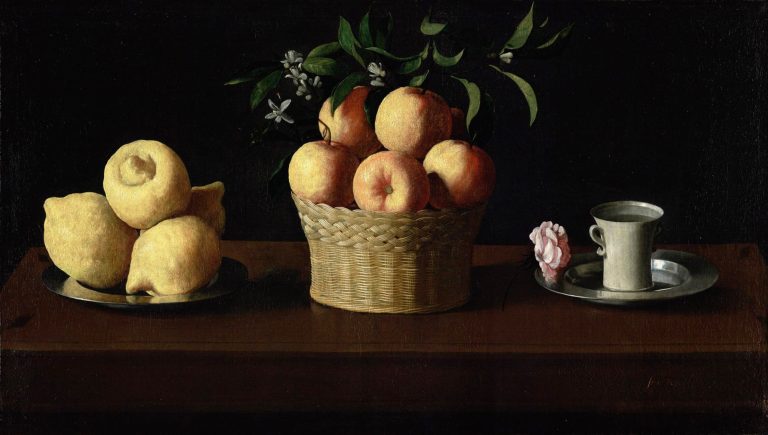
1633 · Oil on canvas · Norton Simon Museum, Pasadena, California
Save articles to your collection
Log in or create a free account, and this article will be waiting in your Private Collection.
Log in or sign upAlmost nothing, and that is the point. On a plain wooden table, against a black background, Francisco de Zurbarán set out three groups of objects in a row: on the left, a pewter plate with four lemons; in the centre, a wicker basket piled with oranges, crowned with a branch of leaves and white orange blossom; on the right, a second plate holding a pale cup of water and a single pink rose. A strong light falls from the left. Nothing moves. Nothing happens.
It is the only still life Zurbarán ever signed and dated. The faint inscription on the front edge of the table, at lower right, gives his name and the year 1633. That makes it the anchor for everything we know about his still life painting, and one of the most admired still lifes of seventeenth-century Europe.
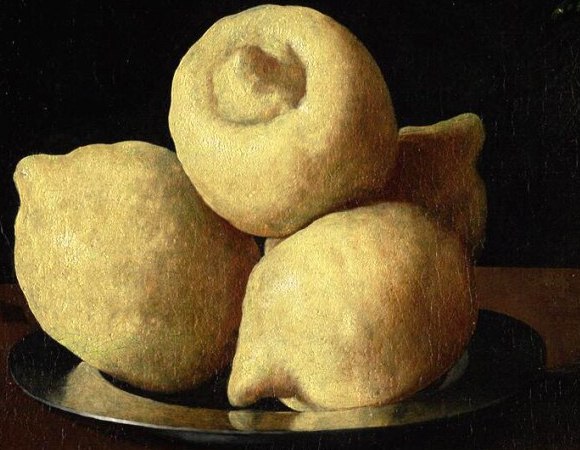
Most still life painters of the time crowded their tables: food, game, flowers and vessels heaped together to show off abundance and skill. Zurbarán does the opposite. He separates his objects into three clear groups, with dark space between them, and lines them up parallel to the edge of the table, almost like objects on an altar.
Each group has its own shape and its own texture. The lemons are lumpy and matt, with their pointed ends and bumpy skin, and their reflections show faintly in the pewter. The oranges are round and smooth and glow red where the light catches them. The cup is cool, pale and perfectly smooth. Seen together, they turn a kitchen table into a study of form and light.
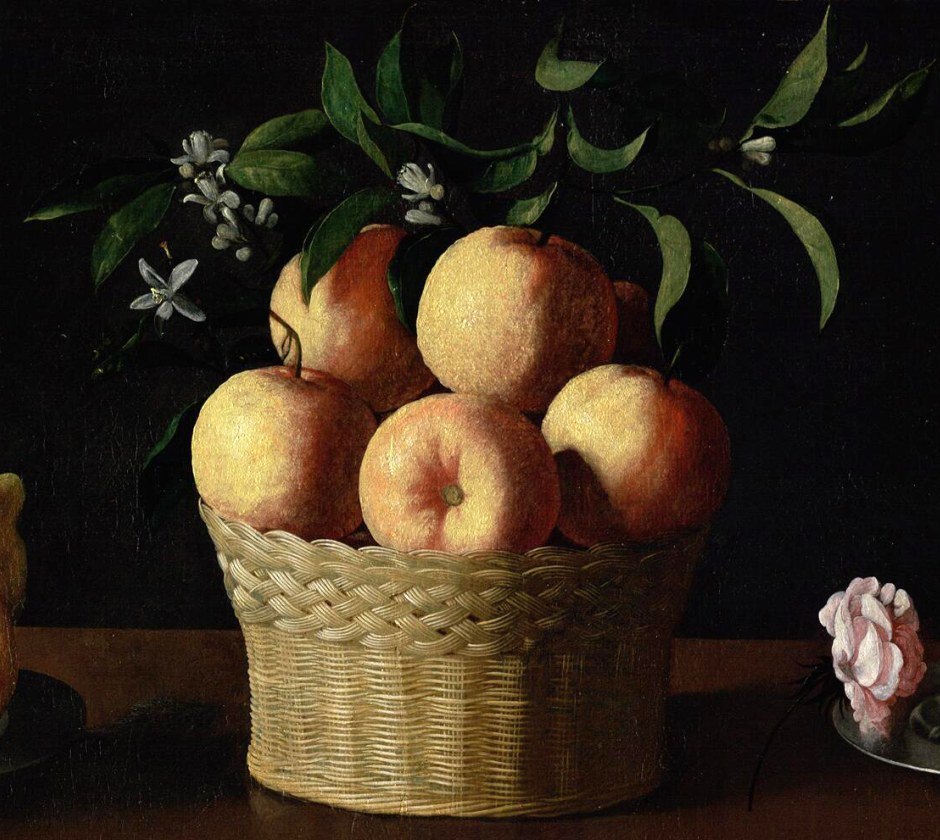
The basket in the middle is the most elaborate part of the picture. Zurbarán paints every strand of the weave, and the branch above it carries both leaves and blossom, as if the fruit had just been cut from the tree.
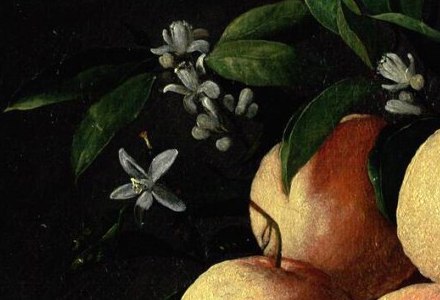
Many art historians think it does. In Spain, orange blossom was linked with purity and was worn by brides. A cup of clean water and a rose were both common symbols of the Virgin Mary. Read this way, the painting becomes a quiet offering to the Virgin, laid out on a table that looks very much like an altar.
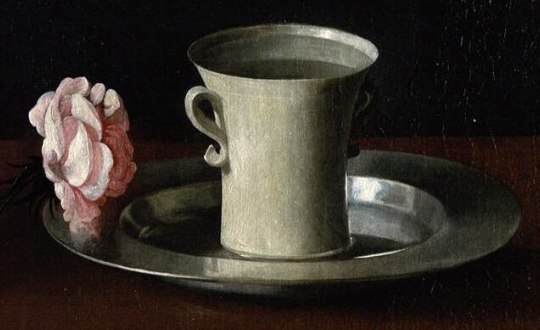
What you can see, and what is interpretation: the lemons, oranges, blossom, cup and rose are all clearly painted, and the lining up of the three groups is plain to see. The religious meaning is not written anywhere on the canvas. It is a reading, a widely shared one, based on what these objects meant in Seville at the time and on the fact that Zurbarán was above all a religious painter.
Because it shows something no one else did quite the same way. Zurbarán takes the humblest objects of a Seville household and gives them the same calm, concentrated light he gave his saints. There is no story, no message written on a ribbon, no show of wealth. Only things, and the time to look at them.
That stillness has made the painting a favourite of modern painters and viewers alike. It looks forward to the bare, meditative still lifes of the twentieth century, and it is often cited as the masterpiece of the Spanish tradition of the bodegón, the kitchen still life.
Read more about the painter and his other masterpieces in our guide to Francisco de Zurbarán.
The painting is in the Norton Simon Museum in Pasadena, California. It is oil on canvas, 62.2 by 107 centimetres, signed and dated 1633.
We paint Still Life with Lemons, Oranges and a Rose by hand in oil on canvas, at the original size or the size that suits your wall, with the glowing fruit, the woven basket and the deep black background built up in layers. See the hand-painted reproduction.
Enjoyed this story?
Save articles to your collection
Log in or create a free account, and this article will be waiting in your Private Collection.
Log in or sign upWhat can be seen in the painting, what is documented, and what is interpretation are kept separate throughout this article.