Loading cart…
No products in the cart.

Original price was: $599.00.$299.00Current price is: $299.00.
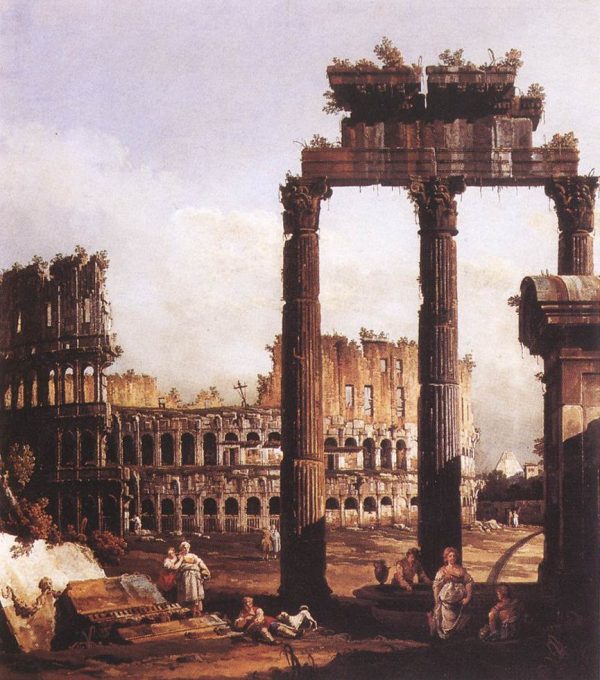
An architectural fantasy by Bernardo Bellotto, this capriccio merges real and invented Paduan structures into a scene of cool, precise light, hand-painted in oil for a wall that calls for quiet authority.
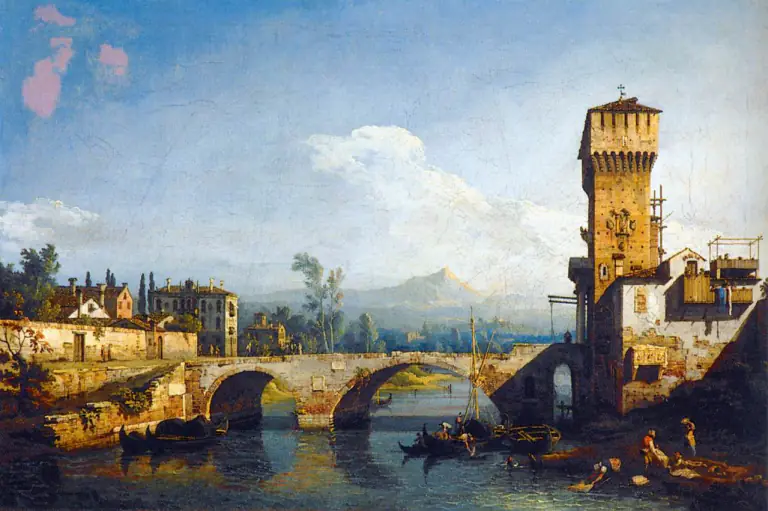
Padua in the middle decades of the eighteenth century drew Bernardo Bellotto not as a literal subject to record but as raw material for invention. Working in the years after he left his uncle Canaletto workshop in Venice and before his long service at the courts of Dresden and Warsaw, Bellotto turned repeatedly to the capriccio, a genre that let him rearrange the architecture of a real city into a scene that had never existed. Capriccio Padovano belongs to this practice, and its appeal for a wall today rests on exactly what made it unusual then: a fictional city rendered with the discipline of an eyewitness account.
The composition gathers arcades, towers, and open stonework that recall Paduan building without reproducing any single view of the city. Bellotto arranges these elements around a wide sky, using the gap between structures to control light and to give the eye a place to rest before returning to the detail of a cornice or a shadowed passage. Nothing in the scene is hurried; each surface receives the same attention whether it belongs to a building that stood in Padua or one that existed only in the mind of the painter.
What separates this work from other architectural fantasies of the period is its refusal of looseness. Bellotto had trained in the veduta tradition, where topographical accuracy mattered as much as pictorial effect, and he carried that habit into his invented scenes. The palette stays cool and silvery, the stonework is drawn with a precision closer to draughtsmanship than to free brushwork, and the atmosphere reads as documentary even where the buildings are pure invention. It is this tension, a famous painting method applied to an imagined place, that gives the picture its lasting interest among Bellotto architectural fantasies.
Recreating this canvas as a hand-painted oil painting reproduction means matching that same discipline stroke by stroke. A trained artist works in oil on artist-grade canvas, following the cool tonal range and the crisp architectural linework that define the original, so the surface carries real brushwork and the texture of built-up paint rather than a flat printed image. The result is a painted object, not a reproduction generated by a machine, made to hold up to close viewing exactly as the source painting does.
A collector drawn to architectural capricci, or anyone furnishing a study or library with something quieter than a landscape and more considered than a portrait, will find this a fitting choice. When you order, you receive:
Empty walls flatten a room. A classical artwork restores structure and visual hierarchy. One painting defines the space, anchors furniture, and establishes identity.
Worldwide shipping included. Each painting is produced to order and safely packed for international transport.
All payments are encrypted and processed through trusted payment providers.
Real brushwork, layered oil paint, and durable pigments on museum-quality canvas.
If the result does not meet expectations, return it for a full refund.


Your artwork is painted on premium cotton canvas, then shipped safely rolled in a rigid tube with extra blank canvas border — ready for stretching or framing locally.
Select a handcrafted frame and we’ll deliver your painting fully assembled, protected, and ready to hang.
For safe shipping, framing is available up to a maximum size. Larger sizes will automatically disable the frame option.


Choose “Stretched” to receive your canvas mounted on wooden stretcher bars — perfect if you’ll frame it later or display it as-is.
Gallery Wrap is a deeper, 1.5" style stretcher. The canvas wraps around the sides and is stapled on the back for a clean, modern, frameless look.
We ship with UPS, FedEx, or DHL straight to your door. You’ll receive a tracking number as soon as your order leaves our studio. Typical delivery is 5 to 7 days after dispatch; large, framed, or stretched pieces may take longer depending on the safest shipping route.


Unframed canvases are protected with a film, carefully rolled, and secured inside a rigid shipping tube.

Stretched, Gallery Wrapped, and Framed paintings are wrapped, cushioned with foam protection, and boxed for safe transit.

Man Writing a Letter
Gabriel Metsu, c. 1664
The gallery list
Every painting is already 50% off. Join the list and we will send you an extra $15 code, plus first access to new collections.
No spam. Unsubscribe anytime. · Privacy Policy
Welcome
Your $15 code is on its way. Explore the gallery while you wait.