Loading cart…
No products in the cart.

Original price was: $599.00.$299.00Current price is: $299.00.
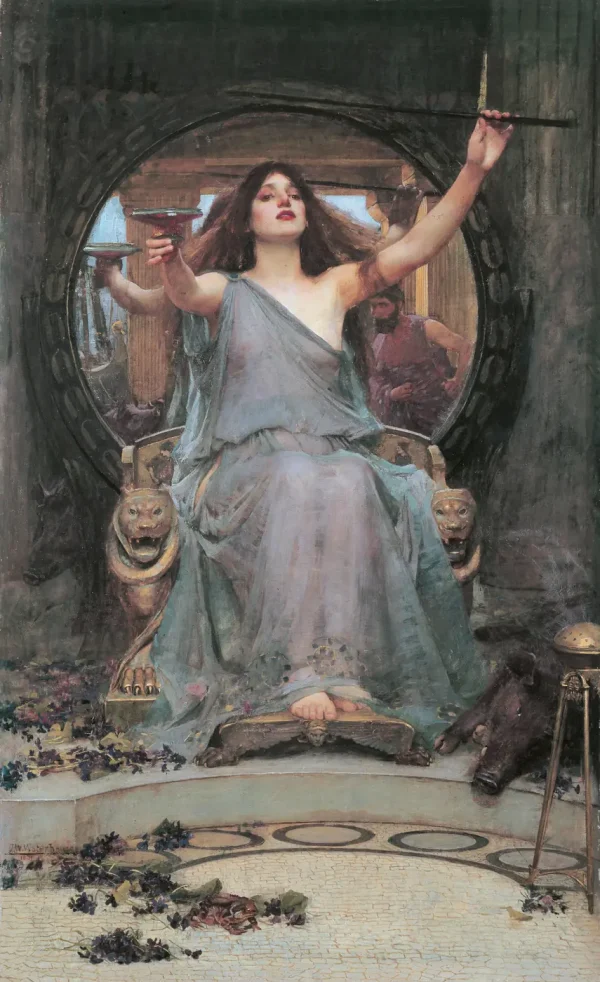
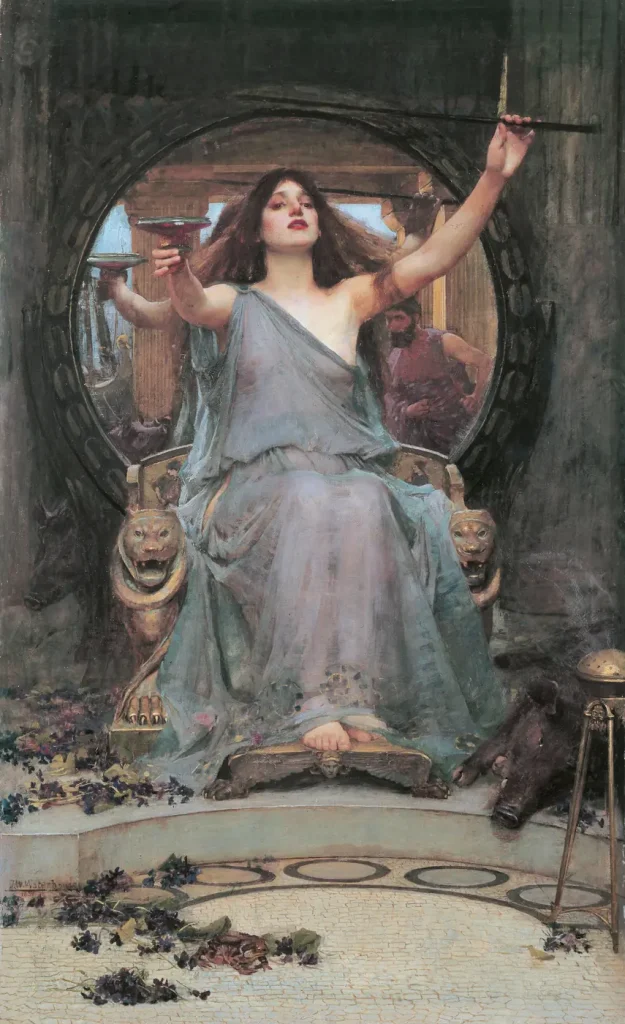
A hand-painted Circe offering the cup to Ulysses reproduction after John William Waterhouse, the enchantress caught mid-gesture with Ulysses reflected approaching in the mirror behind her.
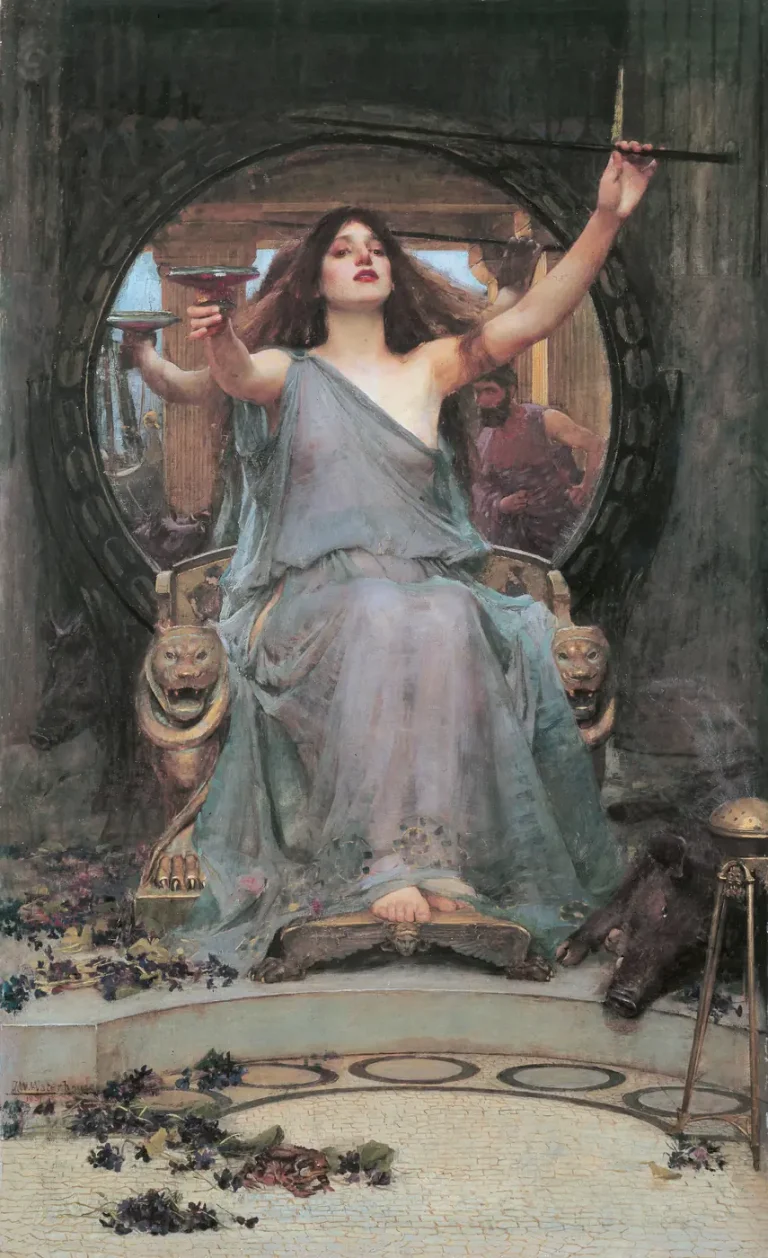
Circe raises the cup and holds it out, her wand resting across her knee, her gaze fixed on the man who has not yet arrived at the edge of the frame. Behind her, in the wide circular mirror, Ulysses is already walking toward her chair. This Circe offering the cup to Ulysses reproduction returns that suspended moment to a room where it can be looked at slowly, the instant just before the choice is made.
John William Waterhouse painted the scene in 1891, drawing on the episode in the Odyssey where the enchantress prepares to drug the companions of Ulysses and turn them into swine. Circe sits on a golden throne flanked by carved lions, her body angled toward the viewer so that the cup seems to be offered outward, past the edge of the canvas, to whoever stands in front of it. Members of Ulysses’ crew, transformed into swine, appear near her feet, and at her side a low dish holds the herbs of her craft. The mirror at her back is the compositional key: it lets Waterhouse show the approach of Ulysses without breaking the frontal address of Circe, doubling the narrative in a single glance.
The palette runs from the deep red of the drapery pooled around the throne to the warm gold of the hair of Circe and the metal of the cup, with the mirror rendered in cooler greys and blues that pull the eye backward into a second, smaller scene. Waterhouse handles the drapery in long, confident folds, the paint built up to catch light along the raised ridges of fabric, and he paints Circe with the same academic precision he brought to his other subjects from Greek myth, working at the height of his career when this kind of theatrical, psychologically charged mythological scene had become his signature.
ByMuseum artists reproduce this composition as a hand-painted oil painting reproduction, working in oil on artist-grade canvas rather than printing the image. Each version is a handmade oil painting, matched to the original palette stroke by stroke, so the folds of the drapery, the sheen of the mirror, and the modelling of the face of Circe carry real paint and real texture rather than a flat printed surface. Held at an angle, the raised ridges of colour along the throne and the drapery catch the light exactly as oil paint does.
Live with the painting for a while and the mirror keeps giving up new information: the exact tilt of the head of Ulysses, the distance still left between him and the chair. The direct gaze of Circe does not soften on repeat viewing. It holds the same address it had the first day the canvas went up.
Artwork guide
Explore the painting’s history, composition and meaning in the ByMuseum art guide.
Read the history and meaning of Circe offering the Cup to UlyssesEmpty walls flatten a room. A classical artwork restores structure and visual hierarchy. One painting defines the space, anchors furniture, and establishes identity.
Worldwide shipping included. Each painting is produced to order and safely packed for international transport.
All payments are encrypted and processed through trusted payment providers.
Real brushwork, layered oil paint, and durable pigments on museum-quality canvas.
If the result does not meet expectations, return it for a full refund.


Your artwork is painted on premium cotton canvas, then shipped safely rolled in a rigid tube with extra blank canvas border — ready for stretching or framing locally.
Select a handcrafted frame and we’ll deliver your painting fully assembled, protected, and ready to hang.
For safe shipping, framing is available up to a maximum size. Larger sizes will automatically disable the frame option.


Choose “Stretched” to receive your canvas mounted on wooden stretcher bars — perfect if you’ll frame it later or display it as-is.
Gallery Wrap is a deeper, 1.5" style stretcher. The canvas wraps around the sides and is stapled on the back for a clean, modern, frameless look.
We ship with UPS, FedEx, or DHL straight to your door. You’ll receive a tracking number as soon as your order leaves our studio. Typical delivery is 5 to 7 days after dispatch; large, framed, or stretched pieces may take longer depending on the safest shipping route.


Unframed canvases are protected with a film, carefully rolled, and secured inside a rigid shipping tube.

Stretched, Gallery Wrapped, and Framed paintings are wrapped, cushioned with foam protection, and boxed for safe transit.