Loading cart…
No products in the cart.

Original price was: $518.00.$259.00Current price is: $259.00.
A hand-painted oil reproduction of the Amsterdam demolition scene by George Hendrik Breitner, rebuilt in real oil on canvas with the layered texture of the original.
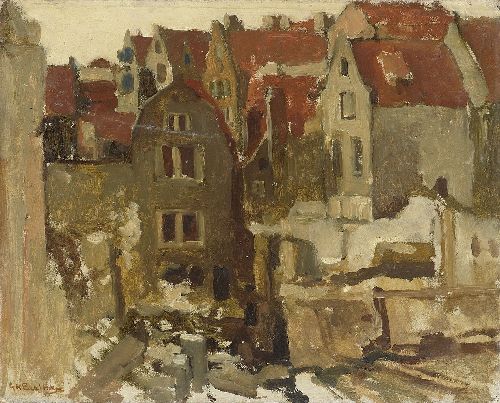
Dutch Impressionism found one of its sharpest observers in George Hendrik Breitner, a painter drawn less to still landscapes than to the working city in motion. Amsterdam under construction, or in this case under demolition, gave him exactly the kind of subject he wanted: a scene charged with dust, labour, and change, captured before it disappeared for good.
The painting records a moment of urban upheaval, the old Grand Bazar de la Bourse coming down at the Nieuwendijk, one of the busiest streets in the city. Breitner does not idealise the site. Instead he builds it from broad, loaded strokes of grey, ochre, and muted brown, letting the structure of the buildings and scaffolding emerge through tone rather than outline. Figures move through the space in quick, economical marks, more suggested than described, which gives the whole scene a sense of transience fitting to its subject.
Light falls unevenly across the composition, catching the rubble and the standing walls in a way that keeps the eye moving rather than settling. This handling reflects Breitner interest in photography, which he used alongside painting to study fleeting urban moments, and the canvas carries that same instinct for capturing a scene mid-change rather than posed and finished. The paint surface stays active throughout, with passages of dense impasto set against thinner, more fluid strokes, a contrast that keeps the demolition site feeling alive rather than static.
Each ByMuseum reproduction of this work is a genuine oil painting reproduction, made entirely by hand rather than printed. A trained painter studies the original palette and brushwork closely, then rebuilds the image layer by layer in oil on artist-grade canvas, matching the tonal shifts and the texture of the paint itself. This is handmade oil painting in the fullest sense: the raised ridges of impasto, the drag of a loaded brush, the slight variation between one stroke and the next are all present on the finished canvas, not simulated by a machine.
A scene of a city tearing down its own past has, ironically, endured. That staying power is part of what makes it worth owning in a form that ages the way the original does, as paint on canvas rather than ink on paper.
Empty walls flatten a room. A classical artwork restores structure and visual hierarchy. One painting defines the space, anchors furniture, and establishes identity.
Worldwide shipping included. Each painting is produced to order and safely packed for international transport.
All payments are encrypted and processed through trusted payment providers.
Real brushwork, layered oil paint, and durable pigments on museum-quality canvas.
If the result does not meet expectations, return it for a full refund.


Your artwork is painted on premium cotton canvas, then shipped safely rolled in a rigid tube with extra blank canvas border — ready for stretching or framing locally.
Select a handcrafted frame and we’ll deliver your painting fully assembled, protected, and ready to hang.
For safe shipping, framing is available up to a maximum size. Larger sizes will automatically disable the frame option.


Choose “Stretched” to receive your canvas mounted on wooden stretcher bars — perfect if you’ll frame it later or display it as-is.
Gallery Wrap is a deeper, 1.5" style stretcher. The canvas wraps around the sides and is stapled on the back for a clean, modern, frameless look.
We ship with UPS, FedEx, or DHL straight to your door. You’ll receive a tracking number as soon as your order leaves our studio. Typical delivery is 4–5 business days after dispatch; large, framed, or stretched pieces may take longer depending on the safest shipping route.


Unframed canvases are protected with a film, carefully rolled, and secured inside a rigid shipping tube.

Stretched, Gallery Wrapped, and Framed paintings are wrapped, cushioned with foam protection, and boxed for safe transit.
Impressionism
George Hendrik Breitner
Impressionism
George Hendrik Breitner