Loading cart…
No products in the cart.

Original price was: $599.00.$299.00Current price is: $299.00.
God the Father over the Piazza San Marco by Veronese Bonifacio, recreated as a hand-painted oil on canvas reproduction with the palette and brushwork of the original preserved.
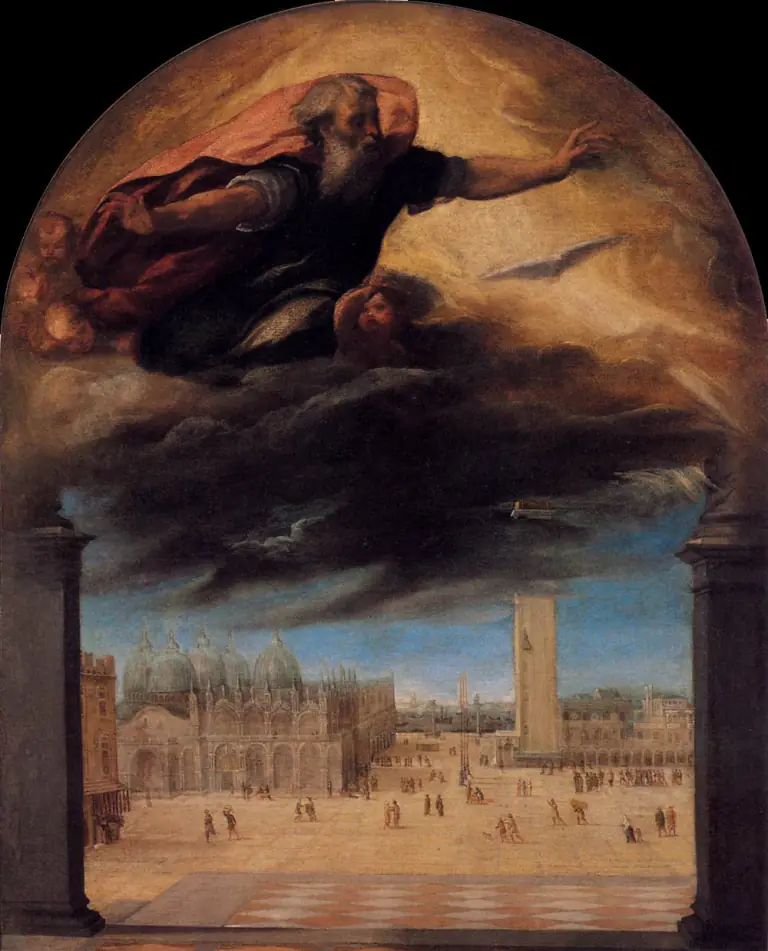
Viewers have returned to this composition for centuries, drawn less by drama than by the steadiness of its architecture and its handling of sky and figure across a civic setting. That sustained attention has less to do with narrative incident than with the discipline of the design itself, the way the eye is guided from the celestial figure downward into the built fabric of Venice below.
The painting sets God the Father above the Piazza San Marco, joining a sacred presence to a recognisable civic space in a manner typical of Venetian painting in the sixteenth century. Bonifacio, working in the orbit of the Veronese workshop tradition, builds the scene through layered passages of warm and cool colour, letting the architecture of the piazza anchor the composition while the figure above is rendered with looser, more atmospheric brushwork. Light moves unevenly across the surface, gathering in the sky and thinning where the stone facades recede, a contrast that gives the picture its sense of depth without resorting to sharp outline.
What holds a discerning eye is the coordination between structure and incident: the architectural elements are painted with a controlled hand, while the figure of God the Father carries freer, more expressive strokes that separate the sacred from the civic without breaking the unity of the whole. This balance between concentrated detail and open passages rewards close inspection as much as distant viewing, a quality that has kept the work under scholarly and collecting attention long after its first appearance.
ByMuseum recreates this painting as an oil on canvas reproduction, worked by a trained painter in real pigment on artist-grade canvas rather than produced by any mechanical process. The palette is matched passage by passage, the architectural detailing and the looser handling of the sky are preserved as distinct textures, and the raised brushwork and weave of the canvas remain visible under raking light, giving the piece the surface presence of a painted object rather than a printed one. For a buyer who wants a hand-painted oil painting reproduction rather than a flat facsimile, this distinction in surface and touch is where the value lies, and it is what makes owning a painted version of a picture that has endured worth the difference.
Empty walls flatten a room. A classical artwork restores structure and visual hierarchy. One painting defines the space, anchors furniture, and establishes identity.
Worldwide shipping included. Each painting is produced to order and safely packed for international transport.
All payments are encrypted and processed through trusted payment providers.
Real brushwork, layered oil paint, and durable pigments on museum-quality canvas.
If the result does not meet expectations, return it for a full refund.


Your artwork is painted on premium cotton canvas, then shipped safely rolled in a rigid tube with extra blank canvas border — ready for stretching or framing locally.
Select a handcrafted frame and we’ll deliver your painting fully assembled, protected, and ready to hang.
For safe shipping, framing is available up to a maximum size. Larger sizes will automatically disable the frame option.


Choose “Stretched” to receive your canvas mounted on wooden stretcher bars — perfect if you’ll frame it later or display it as-is.
Gallery Wrap is a deeper, 1.5" style stretcher. The canvas wraps around the sides and is stapled on the back for a clean, modern, frameless look.
We ship with UPS, FedEx, or DHL straight to your door. You’ll receive a tracking number as soon as your order leaves our studio. Typical delivery is 5 to 7 days after dispatch; large, framed, or stretched pieces may take longer depending on the safest shipping route.


Unframed canvases are protected with a film, carefully rolled, and secured inside a rigid shipping tube.

Stretched, Gallery Wrapped, and Framed paintings are wrapped, cushioned with foam protection, and boxed for safe transit.

Man Writing a Letter
Gabriel Metsu, c. 1664
The gallery list
Every painting is already 50% off. Join the list and we will send you an extra $15 code, plus first access to new collections.
No spam. Unsubscribe anytime. · Privacy Policy
Welcome
Your $15 code is on its way. Explore the gallery while you wait.