Loading cart…
No products in the cart.

Original price was: $518.00.$259.00Current price is: $259.00.
A quiet Auvers-sur-Oise hillside rendered by Paul Cezanne, now offered as a hand-painted oil reproduction with the layered brushwork and surface depth of the original.
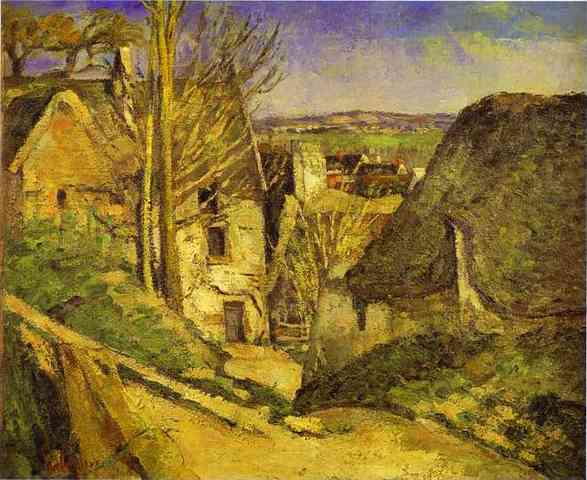
A cluster of rough stone houses climbs a hillside road in the village of Auvers-sur-Oise, their walls catching the pale light of a morning that seems to hold still. Thatched roofs and chalky facades press close together under a sky worked in short, deliberate strokes, and for a moment nothing moves; the scene reads less like a village glimpsed in passing than one built patiently, wall by wall, in paint.
Painted around 1873, House of the Hanged Man marks one of the earliest points where Paul Cezanne began pulling away from the loose, atmospheric handling of his Impressionist contemporaries toward something more structural. The houses are set down as solid geometric masses, their edges firm, their surfaces built from patches of ochre, grey and muted green that sit side by side rather than blending into soft transitions. Light falls unevenly across the rooftops and the dirt track below, but it never dissolves the architecture; instead it reinforces the sense of weight and permanence that would come to define the mature Cezanne.
What makes the composition rewarding on close inspection is the tension between the density of the built forms and the openness of the sky and foreground path, which gives the eye somewhere to rest between passages of thick, worked paint. The brushwork itself is unusually assertive for its date, applied with a palette knife in places, and it points forward to the constructive, almost sculptural approach that later defined his studies of Mont Sainte-Victoire. Shown at the first Impressionist exhibition in 1874, the painting was one of the few works from that show to find a buyer, an early sign that Cezanne was already working toward something distinct from his peers.
Reproducing a painting of this character calls for more than colour matching. Our painters work in oil on artist-grade canvas, rebuilding the layered strokes and the textured surface stroke by stroke, so the raised paint and the weight of the brushwork survive the transfer from original to copy. This is a hand-painted oil painting reproduction, not a printed image, and the difference shows in the way light catches the ridges of dried oil paint across the rooftops and the worked sky, exactly as it would on a canvas painted by hand from the outset.
Cezanne is often credited with laying the groundwork for Cubism, and this early village scene already carries the seeds of that shift, which is part of why it remains a famous artwork nearly a century and a half after it was painted. Owning a hand-painted version of it means living with a surface that has real depth and history behind its technique, not simply a flat image of one.
Empty walls flatten a room. A classical artwork restores structure and visual hierarchy. One painting defines the space, anchors furniture, and establishes identity.
Worldwide shipping included. Each painting is produced to order and safely packed for international transport.
All payments are encrypted and processed through trusted payment providers.
Real brushwork, layered oil paint, and durable pigments on museum-quality canvas.
If the result does not meet expectations, return it for a full refund.


Your artwork is painted on premium cotton canvas, then shipped safely rolled in a rigid tube with extra blank canvas border — ready for stretching or framing locally.
Select a handcrafted frame and we’ll deliver your painting fully assembled, protected, and ready to hang.
For safe shipping, framing is available up to a maximum size. Larger sizes will automatically disable the frame option.


Choose “Stretched” to receive your canvas mounted on wooden stretcher bars — perfect if you’ll frame it later or display it as-is.
Gallery Wrap is a deeper, 1.5" style stretcher. The canvas wraps around the sides and is stapled on the back for a clean, modern, frameless look.
We ship with UPS, FedEx, or DHL straight to your door. You’ll receive a tracking number as soon as your order leaves our studio. Typical delivery is 4–5 business days after dispatch; large, framed, or stretched pieces may take longer depending on the safest shipping route.


Unframed canvases are protected with a film, carefully rolled, and secured inside a rigid shipping tube.

Stretched, Gallery Wrapped, and Framed paintings are wrapped, cushioned with foam protection, and boxed for safe transit.