Loading cart…
No products in the cart.

Original price was: $518.00.$259.00Current price is: $259.00.
Cool greys, dull gold, and the shine of metal meet in this hunting still life by Willem van Aelst, rendered here as a hand-painted replica true to its restrained Dutch Golden Age palette.
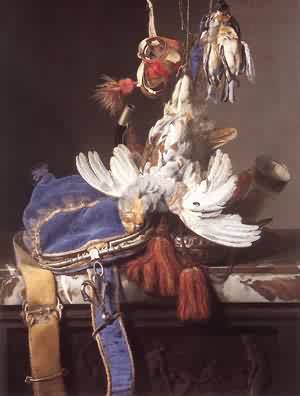
Grey feathers meet dull gold fur meet the cold shine of a hunting horn or blade, and none of them quite settle. Willem van Aelst builds Hunting Still Life 1665 out of these small frictions of tone, each surface pitched against the next so the eye keeps moving across the canvas without ever finding a single bright note to rest on. It is a painting worth having close, precisely because it rewards that kind of looking.
The subject is the aftermath of a hunt: game birds, perhaps a small animal, arranged with accessories that speak to the ritual around the kill rather than the kill itself. Van Aelst treats this arrangement less like a record of objects and more like a problem of balance, each form set against the next with a care that owes something to sculpture. Nothing here feels accidental. The composition holds together through a kind of quiet negotiation between shapes, the curve of a wing answering the straight edge of a strap or barrel.
This is the period in which van Aelst pushed hunting still life into technically demanding territory, insisting that feathers, fur, and metal each demand their own kind of touch. Light falls across the arrangement without drama, the palette staying cool and restrained rather than reaching for spectacle. The paint itself carries the weight of the picture: soft strokes for down, tighter marks for fur, a harder edge where metal catches the light. It is a controlled performance, built from small technical decisions rather than one grand gesture.
ByMuseum artists recreate this hunting still life as a hand-painted oil painting reproduction, working in oil on canvas rather than through print, so the layered brushwork and the tonal shifts between materials survive on the surface where they belong. Painters trained in this kind of work match the palette of van Aelst stroke by stroke, preserving the texture that separates a feather from a strip of fur from a plate of metal. The result is a replica painting built with the same patience the original demanded, not a flat copy of it.
Three and a half centuries on, the picture still holds attention because it refuses to explain itself quickly. It asks for time, the way the original composition asked time of van Aelst. Owning a painted version of that restraint, worked by hand rather than printed, keeps something of that discipline on the wall.
Empty walls flatten a room. A classical artwork restores structure and visual hierarchy. One painting defines the space, anchors furniture, and establishes identity.
Worldwide shipping included. Each painting is produced to order and safely packed for international transport.
All payments are encrypted and processed through trusted payment providers.
Real brushwork, layered oil paint, and durable pigments on museum-quality canvas.
If the result does not meet expectations, return it for a full refund.


Your artwork is painted on premium cotton canvas, then shipped safely rolled in a rigid tube with extra blank canvas border — ready for stretching or framing locally.
Select a handcrafted frame and we’ll deliver your painting fully assembled, protected, and ready to hang.
For safe shipping, framing is available up to a maximum size. Larger sizes will automatically disable the frame option.


Choose “Stretched” to receive your canvas mounted on wooden stretcher bars — perfect if you’ll frame it later or display it as-is.
Gallery Wrap is a deeper, 1.5" style stretcher. The canvas wraps around the sides and is stapled on the back for a clean, modern, frameless look.
We ship with UPS, FedEx, or DHL straight to your door. You’ll receive a tracking number as soon as your order leaves our studio. Typical delivery is 4–5 business days after dispatch; large, framed, or stretched pieces may take longer depending on the safest shipping route.


Unframed canvases are protected with a film, carefully rolled, and secured inside a rigid shipping tube.

Stretched, Gallery Wrapped, and Framed paintings are wrapped, cushioned with foam protection, and boxed for safe transit.