Loading cart…
No products in the cart.

Original price was: $518.00.$259.00Current price is: $259.00.
A hand-painted oil reproduction of Lake Annecy by Paul Cezanne, made stroke by stroke to bring this famous painting into your home.
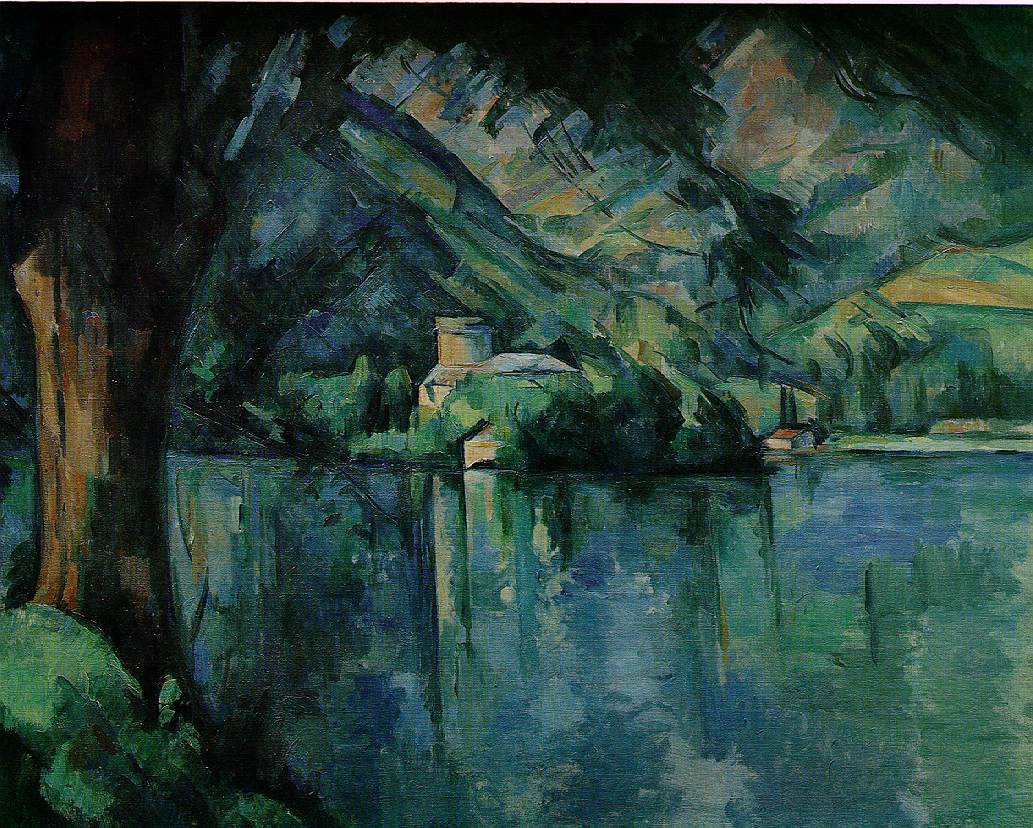
In the summer of 1896, Paul Cezanne took a room at a hotel on the shores of Lake Annecy in the French Alps, sent there partly for his health and partly at the urging of his wife. He was unhappy with the place, finding it too picturesque and too tidy for his taste, yet the weeks he spent there produced this quiet, structured view across the water toward the wooded slopes and the distant chateau. It stands among the more serene images from a difficult year, and its calm has made it a familiar and famous painting among his landscapes.
The composition is built in bands: the pale stone of the shoreline, the dense green mass of trees, the blue plane of the lake, and the hills rising beyond. Cezanne worked the surface with short, angled strokes of colour, letting each patch of paint stand as its own small decision rather than blending into a smooth illusion of water or foliage. The blues and greens are cool and slightly muted, checked here and there by the warmer stone of the buildings on the far bank, so that the whole scene holds together through balance rather than atmosphere.
What gives the picture its lasting interest is the discipline behind it. Cezanne was already moving away from the loose spontaneity of earlier Impressionist painting and toward the more measured, architectural handling that would shape the direction of modern art. Every stroke carries weight in the overall design, and the reflections in the lake are built from the same geometric patches as the land, so that sky, water, and hillside read as one continuous structure rather than three separate things.
ByMuseum artists recreate this oil painting reproduction by hand, working in oil on canvas and matching the cool blues and warm stone tones stroke by stroke. The painter studies the direction and weight of each mark before laying down the paint, building the surface in layers so the texture rises and catches light the way the original does. Nothing about the process is mechanical; a trained hand moves across the canvas the same way Cezanne moved across his, and the result is a painted object with its own depth and grain rather than a flat copy.
Empty walls flatten a room. A classical artwork restores structure and visual hierarchy. One painting defines the space, anchors furniture, and establishes identity.
Worldwide shipping included. Each painting is produced to order and safely packed for international transport.
All payments are encrypted and processed through trusted payment providers.
Real brushwork, layered oil paint, and durable pigments on museum-quality canvas.
If the result does not meet expectations, return it for a full refund.


Your artwork is painted on premium cotton canvas, then shipped safely rolled in a rigid tube with extra blank canvas border — ready for stretching or framing locally.
Select a handcrafted frame and we’ll deliver your painting fully assembled, protected, and ready to hang.
For safe shipping, framing is available up to a maximum size. Larger sizes will automatically disable the frame option.


Choose “Stretched” to receive your canvas mounted on wooden stretcher bars — perfect if you’ll frame it later or display it as-is.
Gallery Wrap is a deeper, 1.5" style stretcher. The canvas wraps around the sides and is stapled on the back for a clean, modern, frameless look.
We ship with UPS, FedEx, or DHL straight to your door. You’ll receive a tracking number as soon as your order leaves our studio. Typical delivery is 4–5 business days after dispatch; large, framed, or stretched pieces may take longer depending on the safest shipping route.


Unframed canvases are protected with a film, carefully rolled, and secured inside a rigid shipping tube.

Stretched, Gallery Wrapped, and Framed paintings are wrapped, cushioned with foam protection, and boxed for safe transit.