Loading cart…
No products in the cart.

Original price was: $518.00.$299.00Current price is: $299.00.
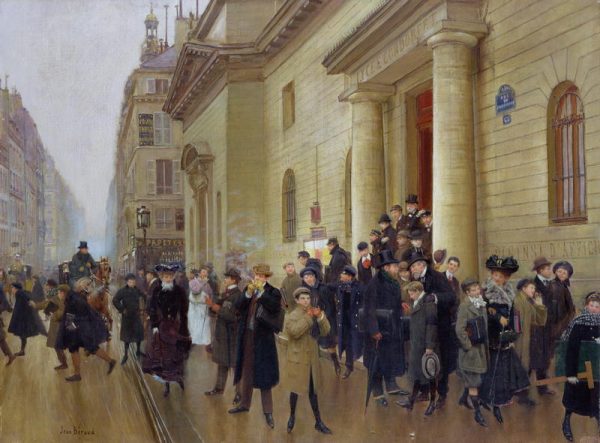
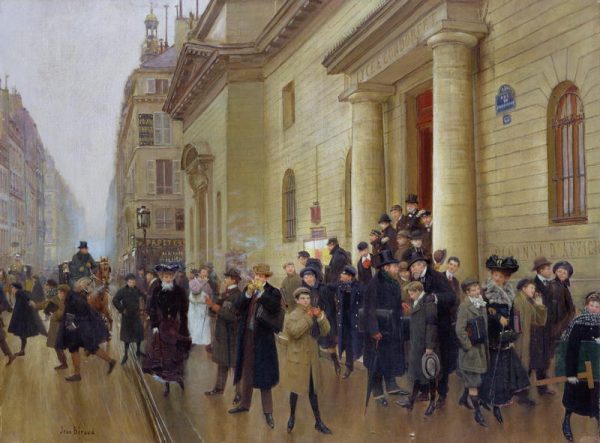
A hand-painted oil reproduction of Leaving the Lycee Condorcet 1903 by Jean Beraud, painted on canvas to hold the crowded pavement scene at full scale and with its original depth of brushwork.

Painted on a canvas proportioned for a scene of gathering rather than isolated figures, Leaving the Lycee Condorcet 1903 asks the viewer to stand back far enough to take in the full sweep of the pavement and the crowd dispersing across it. That horizontal reach, wide enough to hold a street scene without crowding it, sets the picture at a comfortable middle distance, close enough to read individual faces and dress, far enough to see how the whole procession organises itself against the facade of the school.
The subject belongs to the world Jean Beraud returned to across his career: the pavements, cafes, and civic thresholds of Paris at the turn of the century, observed with the eye of someone who treated the street as seriously as any drawing room. Here it is the moment of release at the end of the school day, students and parents spilling from the Lycee Condorcet into the ordinary traffic of the city, the architecture of the building holding steady behind the movement of the crowd. Beraud arranges the figures in loose, overlapping groups rather than a formal line, so the eye travels naturally from the doorway outward, picking up incidental detail, a raised hat, a turned shoulder, without ever losing the sense of a single continuous event.
Light falls evenly across the scene in the manner Beraud favoured for his Paris subjects, neither theatrical nor flat, and the palette stays close to the greys, browns, and muted blacks of contemporary dress, relieved by small accents of colour that draw the eye to particular figures. The brushwork tightens around faces and hands and loosens in the architecture and pavement, a technique that gives the composition its sense of depth without resorting to sharp contrast. It is a picture built on careful observation rather than incident, and that restraint is part of what has kept it interesting to later viewers.
A ByMuseum reproduction of this work is painted by hand, not printed, by a trained artist working in oil on artist-grade canvas. The palette is matched passage by passage against the original, and the brushwork is rebuilt rather than simulated, so the surface carries real texture: the ridges where paint was laid thickly, the thinner passages where canvas grain shows through. As a fine art reproduction it is meant to be looked at the way the original invites looking, from across a room and then up close, and as an oil painting reproduction it exists as a physical object with its own depth of colour rather than a flat facsimile.
Living with the painting rewards that closer attention. Figures that read at first as a general crowd resolve, on repeated viewing, into individual gestures and expressions, and the architectural detail behind them gives the eye somewhere to rest between passes across the busier foreground. What a buyer receives:
Empty walls flatten a room. A classical artwork restores structure and visual hierarchy. One painting defines the space, anchors furniture, and establishes identity.
Worldwide shipping included. Each painting is produced to order and safely packed for international transport.
All payments are encrypted and processed through trusted payment providers.
Real brushwork, layered oil paint, and durable pigments on museum-quality canvas.
If the result does not meet expectations, return it for a full refund.


Your artwork is painted on premium cotton canvas, then shipped safely rolled in a rigid tube with extra blank canvas border — ready for stretching or framing locally.
Select a handcrafted frame and we’ll deliver your painting fully assembled, protected, and ready to hang.
For safe shipping, framing is available up to a maximum size. Larger sizes will automatically disable the frame option.


Choose “Stretched” to receive your canvas mounted on wooden stretcher bars — perfect if you’ll frame it later or display it as-is.
Gallery Wrap is a deeper, 1.5" style stretcher. The canvas wraps around the sides and is stapled on the back for a clean, modern, frameless look.
We ship with UPS, FedEx, or DHL straight to your door. You’ll receive a tracking number as soon as your order leaves our studio. Typical delivery is 5 to 7 days after dispatch; large, framed, or stretched pieces may take longer depending on the safest shipping route.


Unframed canvases are protected with a film, carefully rolled, and secured inside a rigid shipping tube.

Stretched, Gallery Wrapped, and Framed paintings are wrapped, cushioned with foam protection, and boxed for safe transit.