Loading cart…
No products in the cart.

Original price was: $518.00.$259.00Current price is: $259.00.
Bring home Madonna in Glory with Seraphim by Botticelli, a hand-painted oil reproduction that keeps the warm rose tones of the seraphim and the calm drapery of the Virgin true to the original.
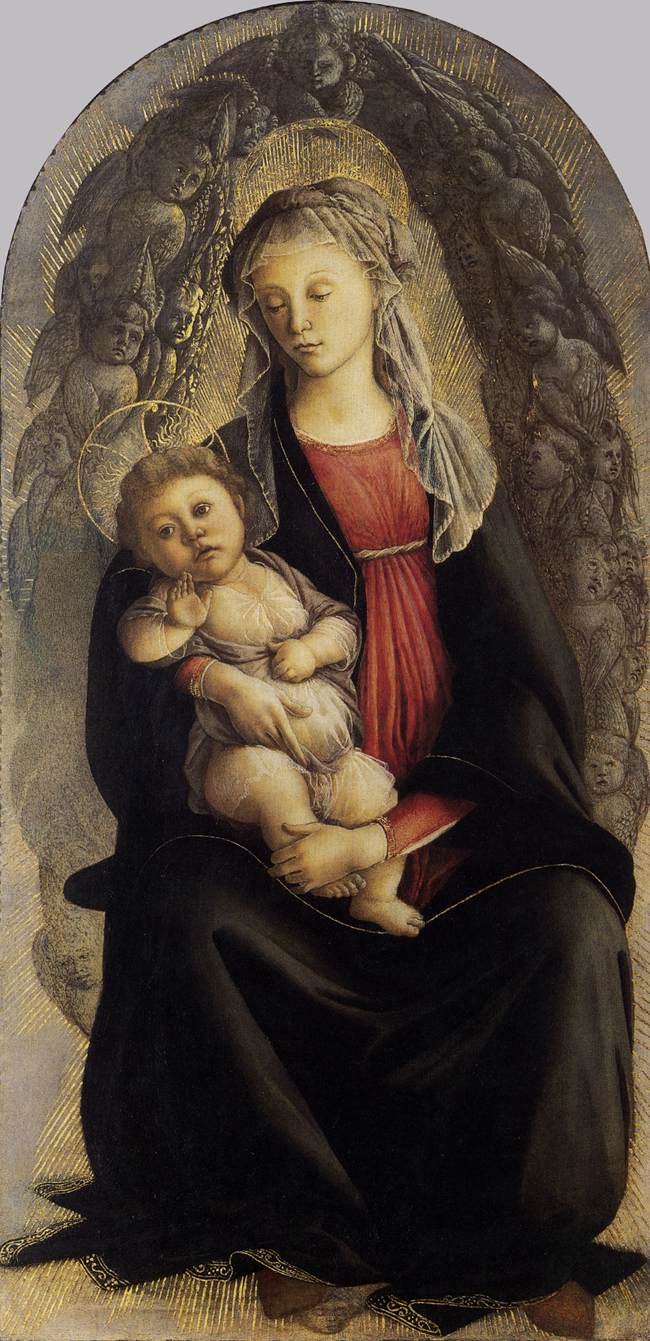
A crowd of seraphim presses close around the enthroned Virgin, their small heads and folded wings filling the gold-washed space above her like a chorus made visible. The subject gave Botticelli reason to explore a crowded, celestial arrangement rather than a solitary devotional figure, and the painting reads as an experiment in how many faces a single composition can hold without losing its centre. Mary remains still and frontal while the seraphim tilt and overlap around her, and that contrast between her calm and their restless massing is what first draws the eye.
The painting belongs to a period when Botticelli was working through the formal problems of Florentine sacred imagery: how to organise a crowd of figures around a fixed devotional centre, and how to let colour carry emotional weight where gesture is kept minimal. The seraphim are painted in close, warm tones that shade from rose to a deeper red, a device that gives the upper register its own internal rhythm and keeps the many small faces from blurring into decoration. Beneath them the Virgin sits in cooler blues and quiet flesh tones, her drapery built from long, deliberate lines that show the same linear discipline visible across the workshop output of the period.
What holds the composition together is the relationship between the dense pattern of wings above and the open, settled form below, a balance achieved through tonal restraint as much as through drawing. Edges are kept soft where the seraphim meet the gold ground, so the crowd feels suspended rather than stacked, and the transitions between figures reward a slow, close look rather than a quick glance.
A hand-painted oil painting reproduction of this composition is built the same way the original was, layer by layer in oil on canvas, so the rose and gold tonal shifts among the seraphim and the quieter blues of the Virugin, the linear drapery, and the softened edges around each wing are carried across rather than approximated. The work is hand-painted by a professional artist trained to match palette and paint handling rather than to copy an image mechanically, which is what allows the raised texture of individual brushstrokes and the woven grain of the canvas to survive into the finished piece. That fidelity to surface and colour is the difference between owning a printed image and owning a painted object that behaves like one.
Empty walls flatten a room. A classical artwork restores structure and visual hierarchy. One painting defines the space, anchors furniture, and establishes identity.
Worldwide shipping included. Each painting is produced to order and safely packed for international transport.
All payments are encrypted and processed through trusted payment providers.
Real brushwork, layered oil paint, and durable pigments on museum-quality canvas.
If the result does not meet expectations, return it for a full refund.


Your artwork is painted on premium cotton canvas, then shipped safely rolled in a rigid tube with extra blank canvas border — ready for stretching or framing locally.
Select a handcrafted frame and we’ll deliver your painting fully assembled, protected, and ready to hang.
For safe shipping, framing is available up to a maximum size. Larger sizes will automatically disable the frame option.


Choose “Stretched” to receive your canvas mounted on wooden stretcher bars — perfect if you’ll frame it later or display it as-is.
Gallery Wrap is a deeper, 1.5" style stretcher. The canvas wraps around the sides and is stapled on the back for a clean, modern, frameless look.
We ship with UPS, FedEx, or DHL straight to your door. You’ll receive a tracking number as soon as your order leaves our studio. Typical delivery is 4–5 business days after dispatch; large, framed, or stretched pieces may take longer depending on the safest shipping route.


Unframed canvases are protected with a film, carefully rolled, and secured inside a rigid shipping tube.

Stretched, Gallery Wrapped, and Framed paintings are wrapped, cushioned with foam protection, and boxed for safe transit.