Loading cart…
No products in the cart.

Original price was: $518.00.$259.00Current price is: $259.00.
A hand-painted oil on canvas reproduction of Pash ee pa ho, Little Stabbing Chief, the Younger, One of Black Hawk’s Braves by George Catlin, painted with visible brushwork and layered pigment true to the original.
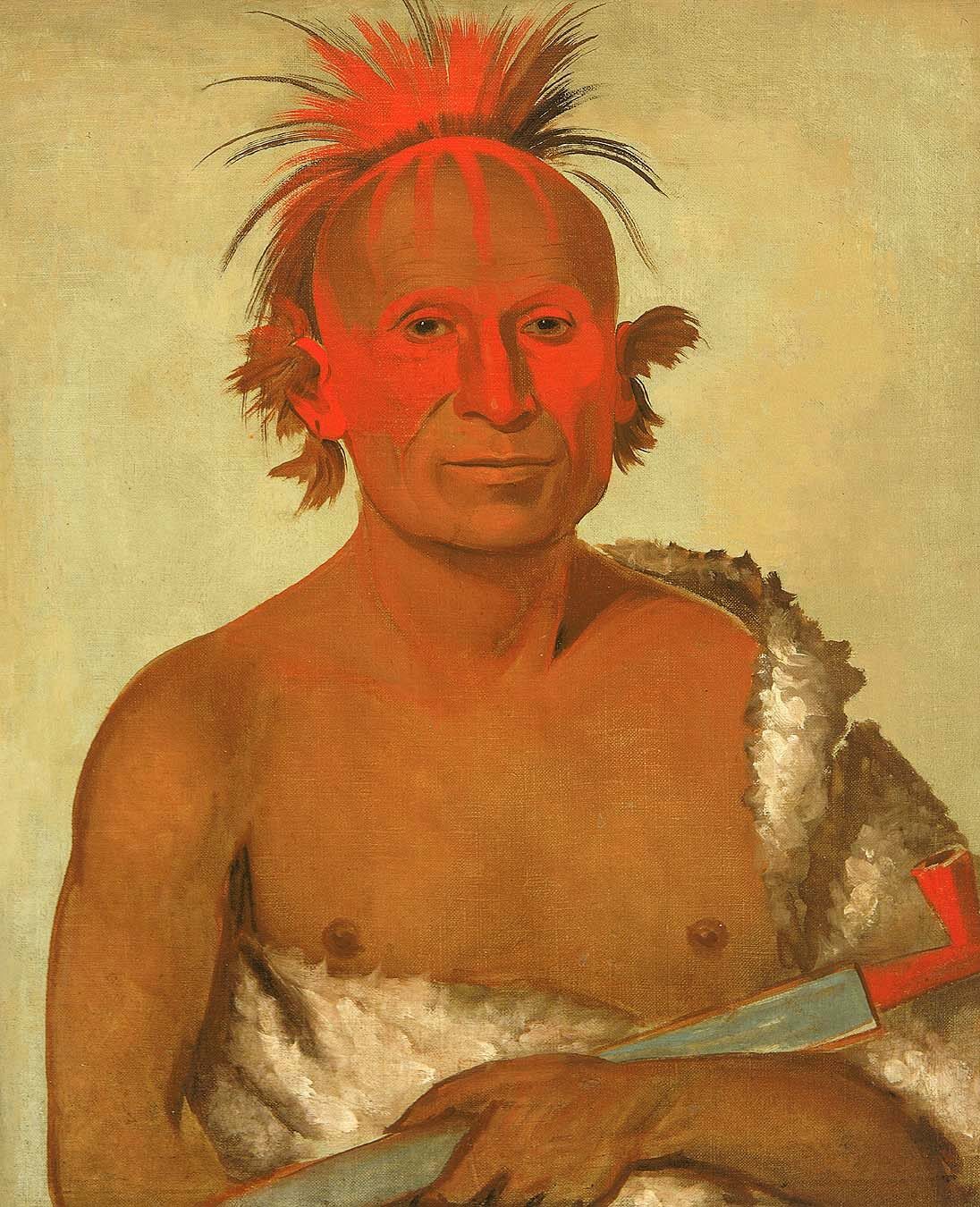
A single dab of red ochre at the temple, set against the deep umber of the face paint, is the first thing the eye catches in this portrait, and it does not let go easily. George Catlin built the whole composition around that concentration of pigment, letting everything else, the feathered ornament, the plain dark ground, the set of the shoulders, fall back into quiet support of it. The effect is direct rather than decorative: a face meant to be read, not merely looked at.
The sitter is identified as Pash ee pa ho, Little Stabbing Chief, the Younger, one of the warriors associated with Black Hawk, and Catlin paints him with the same steady, documentary attention he brought to the many Native American leaders he recorded during his travels along the frontier in the 1830s. There is little in the way of setting; the figure is pushed forward against a plain background so that costume and expression carry the entire picture. Ornament is rendered with care but never allowed to overwhelm the face, which remains the fixed point the composition returns to no matter where the eye wanders first.
Catlin worked quickly and often under difficult conditions, and that urgency shows in the directness of his brushwork, broad where the background falls away, tighter and more exact around the features. Colour is used sparingly and with purpose: earth tones dominate, interrupted by the sharper reds and occasional blues of paint and ornament, so that nothing distracts from the specificity of the individual portrayed. It is a working method suited to a project concerned above all with recording appearance and character before both were lost to history.
ByMuseum recreates this portrait as a hand-painted oil painting reproduction, worked by trained artists in oil on canvas rather than reproduced by mechanical means. The palette is matched passage by passage, the ochre and umber built up in the same layered way Catlin himself worked, and the brushwork is left visible so the surface carries real texture rather than a flat printed image. Buyers who look closely at condition and surface, the qualities that matter in any painted object, will find an oil on canvas reproduction with the depth and irregularity of hand application, not the uniform sheen of print.
Portraits like this one hold attention because they were made as records of specific people at a specific moment, and something of that urgency survives in every version painted after it. Owning a hand-painted copy means owning an object with the same weight of surface and the same demands on the eye as the original, a painted document rather than a decorative image.
Empty walls flatten a room. A classical artwork restores structure and visual hierarchy. One painting defines the space, anchors furniture, and establishes identity.
Worldwide shipping included. Each painting is produced to order and safely packed for international transport.
All payments are encrypted and processed through trusted payment providers.
Real brushwork, layered oil paint, and durable pigments on museum-quality canvas.
If the result does not meet expectations, return it for a full refund.


Your artwork is painted on premium cotton canvas, then shipped safely rolled in a rigid tube with extra blank canvas border — ready for stretching or framing locally.
Select a handcrafted frame and we’ll deliver your painting fully assembled, protected, and ready to hang.
For safe shipping, framing is available up to a maximum size. Larger sizes will automatically disable the frame option.


Choose “Stretched” to receive your canvas mounted on wooden stretcher bars — perfect if you’ll frame it later or display it as-is.
Gallery Wrap is a deeper, 1.5" style stretcher. The canvas wraps around the sides and is stapled on the back for a clean, modern, frameless look.
We ship with UPS, FedEx, or DHL straight to your door. You’ll receive a tracking number as soon as your order leaves our studio. Typical delivery is 4–5 business days after dispatch; large, framed, or stretched pieces may take longer depending on the safest shipping route.


Unframed canvases are protected with a film, carefully rolled, and secured inside a rigid shipping tube.

Stretched, Gallery Wrapped, and Framed paintings are wrapped, cushioned with foam protection, and boxed for safe transit.