Loading cart…
No products in the cart.

Original price was: $518.00.$259.00Current price is: $259.00.
Bring home Pierrot and Harlequin by Paul Cezanne, a hand-painted oil reproduction that rebuilds the original brushwork and palette stroke by stroke on canvas.
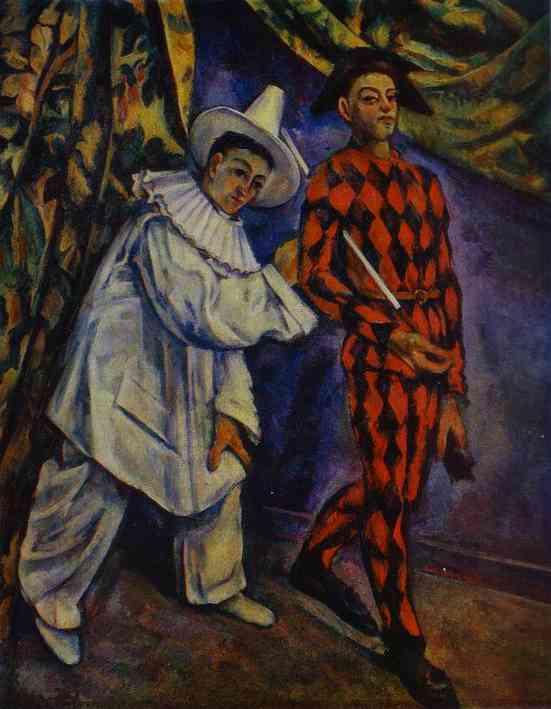
Look closely at the surface here and you can see how the paint went on: broad, deliberate strokes built up in patches, edges left soft where forms meet, the brush turning with the folds of costume rather than tracing a hard outline. That is the working method of Paul Cezanne, and it is what gives this canvas its particular character before you even register the subject. Once you do, two figures in the stock costumes of the commedia dell arte, Pierrot pale and upright, Harlequin in his patterned diamonds, stand close together in a shallow, ambiguous space that feels more like a stage than a room.
The composition rewards a second look. Cezanne was never interested in theatrical drama for its own sake; what draws the eye instead is the structure underneath the costumes, the way each figure is built from planes of colour rather than contour lines, the way a shadow under an arm or across a cheek does as much compositional work as the folds of fabric. Light falls unevenly across the two figures, cooler in the background, warmer where it catches Harlequin, and this shifting temperature is part of how Cezanne creates depth without resorting to conventional perspective tricks. It belongs to a period when he was moving decisively away from illustration and toward an art built on colour relationships and considered form, a direction that would prove enormously consequential for painting in the decades that followed.
Look, too, at the intervals between the figures and the background, the pauses that keep the eye moving at a controlled pace rather than rushing straight to the two costumed men. These are the qualities a fine art reproduction has to carry across if it is to mean anything at all, and it is exactly what a trained painter working in oil can do that a printed copy cannot. Our artists study the original brushwork, the specific palette Cezanne used for flesh, fabric, and shadow, and the way each passage sits against its neighbour, then rebuild the painting stroke by stroke on canvas. The result is a hand-painted oil painting reproduction with real paint standing slightly proud of the surface, a picture you can view from an angle and see the texture change, not a flat print pretending to be one.
What stays faithful across that process matters more than any single technical detail: the balance of warm and cool passages, the density of paint where Cezanne worked it hardest, the quiet authority of the composition. That fidelity is the whole point of choosing a version painted by hand rather than run off a press.
Empty walls flatten a room. A classical artwork restores structure and visual hierarchy. One painting defines the space, anchors furniture, and establishes identity.
Worldwide shipping included. Each painting is produced to order and safely packed for international transport.
All payments are encrypted and processed through trusted payment providers.
Real brushwork, layered oil paint, and durable pigments on museum-quality canvas.
If the result does not meet expectations, return it for a full refund.


Your artwork is painted on premium cotton canvas, then shipped safely rolled in a rigid tube with extra blank canvas border — ready for stretching or framing locally.
Select a handcrafted frame and we’ll deliver your painting fully assembled, protected, and ready to hang.
For safe shipping, framing is available up to a maximum size. Larger sizes will automatically disable the frame option.


Choose “Stretched” to receive your canvas mounted on wooden stretcher bars — perfect if you’ll frame it later or display it as-is.
Gallery Wrap is a deeper, 1.5" style stretcher. The canvas wraps around the sides and is stapled on the back for a clean, modern, frameless look.
We ship with UPS, FedEx, or DHL straight to your door. You’ll receive a tracking number as soon as your order leaves our studio. Typical delivery is 4–5 business days after dispatch; large, framed, or stretched pieces may take longer depending on the safest shipping route.


Unframed canvases are protected with a film, carefully rolled, and secured inside a rigid shipping tube.

Stretched, Gallery Wrapped, and Framed paintings are wrapped, cushioned with foam protection, and boxed for safe transit.