Loading cart…
No products in the cart.

Original price was: $599.00.$299.00Current price is: $299.00.
A hand-painted oil on canvas reproduction of St. Nicolas Frees the Innocent, His Death by Fra Angelico, painted with the measured clarity that defines his early Renaissance narrative work.
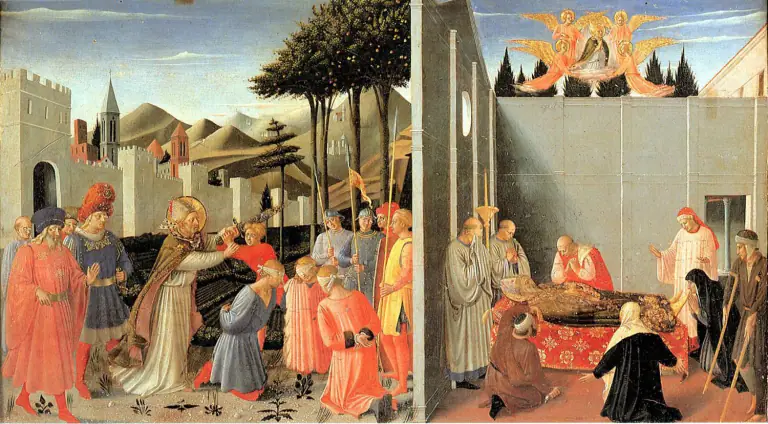
Viewers have long approached this small narrative panel as an exercise in quiet moral clarity, the kind of scene that rewards patience rather than spectacle. It belongs to the predella tradition of early Renaissance altarpieces, where a saint story unfolds in a compressed, almost intimate register, and generations of visitors have read it less for drama than for the calm authority of its telling.
The panel shows St. Nicolas intervening to save condemned men from execution, a subject that gave the artist room to organise figures around a single moment of moral suspension. Fra Angelico arranges the crowd and the central action with a clarity that owes something to Giotto and something to his own training as an illuminator, so that gesture and glance carry the narrative weight rather than gesture alone. Architecture and landscape recede into supporting roles, framing the episode without competing with it.
Colour is handled with the restraint typical of Angelico in this period, working in the 1440s, when his tempera and early oil technique favoured clear, unmodulated hues set against carefully judged passages of shadow. Gold and blue read as structural elements as much as decorative ones, guiding the eye toward the saint and the kneeling figures below him. The light is even rather than dramatic, which suits a scene concerned with justice restored rather than danger unresolved, and it is this evenness that has made the panel a study piece for anyone interested in how early Renaissance painters built pictorial order without recourse to violent contrast.
ByMuseum artists produce this as a hand-painted oil painting reproduction, working in oil on artist-grade canvas rather than reproducing the image by print. Each painter studies the original palette, the placement of gold and blue, and the measured spacing of the figures before building the composition in layered oil, so that brushwork and surface texture remain visible on the finished canvas. The result is an oil on canvas reproduction with genuine paint depth, not a flat facsimile, and it carries the tactile presence of a painted object into a room built for close, unhurried looking.
This suits a collector drawn to early Renaissance narrative painting, or a room that benefits from a smaller, contemplative image rather than a commanding centrepiece, and it works equally well as a considered gift for someone who already knows the period.
Empty walls flatten a room. A classical artwork restores structure and visual hierarchy. One painting defines the space, anchors furniture, and establishes identity.
Worldwide shipping included. Each painting is produced to order and safely packed for international transport.
All payments are encrypted and processed through trusted payment providers.
Real brushwork, layered oil paint, and durable pigments on museum-quality canvas.
If the result does not meet expectations, return it for a full refund.


Your artwork is painted on premium cotton canvas, then shipped safely rolled in a rigid tube with extra blank canvas border — ready for stretching or framing locally.
Select a handcrafted frame and we’ll deliver your painting fully assembled, protected, and ready to hang.
For safe shipping, framing is available up to a maximum size. Larger sizes will automatically disable the frame option.


Choose “Stretched” to receive your canvas mounted on wooden stretcher bars — perfect if you’ll frame it later or display it as-is.
Gallery Wrap is a deeper, 1.5" style stretcher. The canvas wraps around the sides and is stapled on the back for a clean, modern, frameless look.
We ship with UPS, FedEx, or DHL straight to your door. You’ll receive a tracking number as soon as your order leaves our studio. Typical delivery is 5 to 7 days after dispatch; large, framed, or stretched pieces may take longer depending on the safest shipping route.


Unframed canvases are protected with a film, carefully rolled, and secured inside a rigid shipping tube.

Stretched, Gallery Wrapped, and Framed paintings are wrapped, cushioned with foam protection, and boxed for safe transit.

Man Writing a Letter
Gabriel Metsu, c. 1664
The gallery list
Every painting is already 50% off. Join the list and we will send you an extra $15 code, plus first access to new collections.
No spam. Unsubscribe anytime. · Privacy Policy
Welcome
Your $15 code is on its way. Explore the gallery while you wait.