Loading cart…
No products in the cart.

Original price was: $518.00.$259.00Current price is: $259.00.
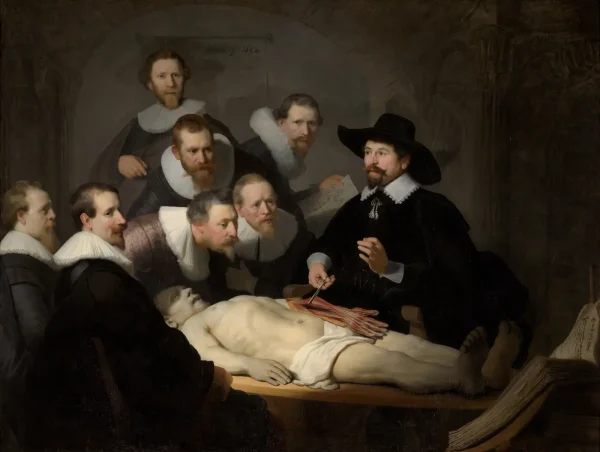
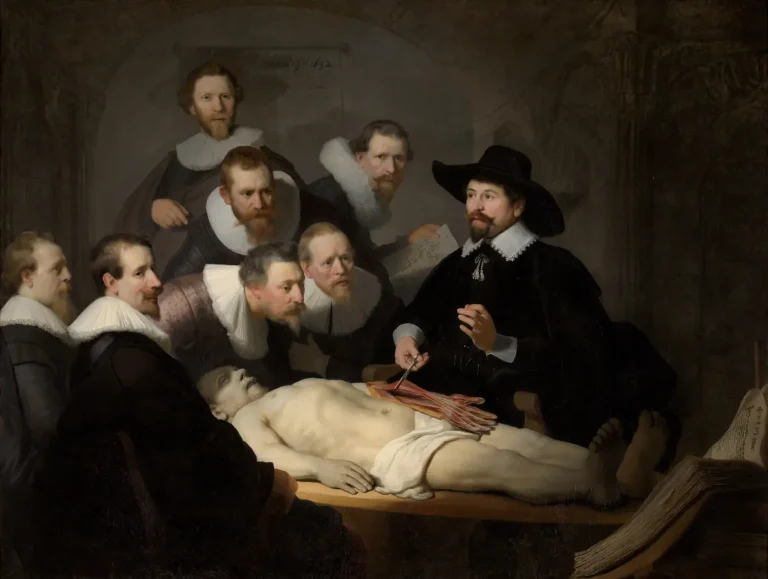
The Anatomy Lesson of Dr. Nicolaes Tulp by Rembrandt, a hand-painted reproduction that carries the dramatic light and individual faces of the original group portrait onto real oil and canvas.
Hang this Anatomy Lesson of Dr. Nicolaes Tulp reproduction in a study, a library, or above a dark wood desk and the room takes on a hush. It belongs in a space where someone thinks for a living, a place with leather chairs and low lamplight rather than bright, open rooms, because the picture itself is built from concentrated dark and a single pool of illumination.
The scene gathers a group of surgeons around a corpse during a public dissection, their attention fixed on the exposed forearm that Dr. Tulp holds open with a pair of forceps. Rembrandt arranges the observers in an arc that climbs from lower left to upper right, so your eye moves across seven distinct faces before it settles on the pale, waxen limb at the centre. Some of the men lean in with open curiosity, others hold back, and one looks directly out at you, breaking the circle of concentration to acknowledge the room beyond the canvas. This was Rembrandt working early in his Amsterdam career, still in his twenties, already commissioned by the surgeons guild to paint a group portrait that most artists would have flattened into rows of static heads.
He refused that convention. Light falls from an unseen source above and to the left, catching the ruffs and collars in crisp white, modelling the flesh of the cadaver in cool greys, and leaving the far side of the room in shadow so dense it reads almost as black velvet. Every face receives enough light to register as a particular man rather than a type, and the layered oil glazes give the skin tones a depth that a flat printed surface cannot reproduce. This is chiaroscuro used not for drama alone but to organise a crowd of individuals into a single coherent moment of looking.
What we carry across in the hand-painted version is that same structure of light and dark, laid down stroke by stroke rather than reproduced as a flat print. Our painters study the original tonal relationships closely, matching the warm ochre of the collars against the cool grey of the corpse and rebuilding the transitions between light and shadow in real oil on canvas. The result is a fine art reproduction with visible brushwork and a raised surface where the paint sits thickest, the kind of object that changes slightly as you move past it, the way the original does under gallery light. This is an oil painting reproduction built by hand, not printed, so the texture of the paint itself carries the picture.
Read the full story in our guide to The Anatomy Lesson of Dr. Nicolaes Tulp.
Artwork guide
Explore the painting’s history, composition and meaning in the ByMuseum art guide.
Read the history and meaning of The Anatomy Lesson of Dr. Nicolaes Tulp by RembrandtEmpty walls flatten a room. A classical artwork restores structure and visual hierarchy. One painting defines the space, anchors furniture, and establishes identity.
Worldwide shipping included. Each painting is produced to order and safely packed for international transport.
All payments are encrypted and processed through trusted payment providers.
Real brushwork, layered oil paint, and durable pigments on museum-quality canvas.
If the result does not meet expectations, return it for a full refund.


Your artwork is painted on premium cotton canvas, then shipped safely rolled in a rigid tube with extra blank canvas border — ready for stretching or framing locally.
Select a handcrafted frame and we’ll deliver your painting fully assembled, protected, and ready to hang.
For safe shipping, framing is available up to a maximum size. Larger sizes will automatically disable the frame option.


Choose “Stretched” to receive your canvas mounted on wooden stretcher bars — perfect if you’ll frame it later or display it as-is.
Gallery Wrap is a deeper, 1.5" style stretcher. The canvas wraps around the sides and is stapled on the back for a clean, modern, frameless look.
We ship with UPS, FedEx, or DHL straight to your door. You’ll receive a tracking number as soon as your order leaves our studio. Typical delivery is 4–5 business days after dispatch; large, framed, or stretched pieces may take longer depending on the safest shipping route.


Unframed canvases are protected with a film, carefully rolled, and secured inside a rigid shipping tube.

Stretched, Gallery Wrapped, and Framed paintings are wrapped, cushioned with foam protection, and boxed for safe transit.