Loading cart…
No products in the cart.

Original price was: $518.00.$259.00Current price is: $259.00.
Bring home The Bridge at Maincy by Paul Cezanne, a hand-painted oil reproduction that captures the layered brushwork and quiet balance of this famous painting.
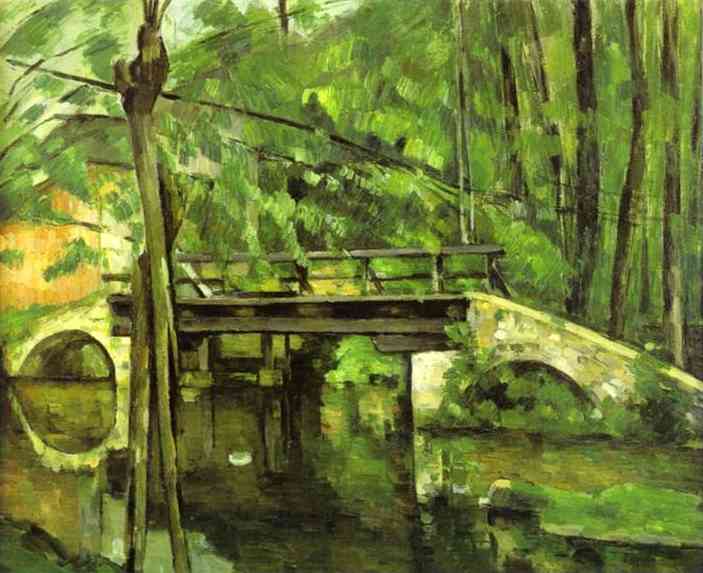
Where much of the mature work by Paul Cezanne pushes toward the angular geometry of Provencal hillsides and the patient architecture of still life, this canvas turns to a quieter subject: a wooden footbridge crossing still water near the village of Maincy, painted during a stay outside Paris in the early 1880s. It shows a different register of his ambition, one built on reflection and stillness rather than the structural drama that defines his later landscapes, and that contrast is part of what makes it a rewarding painting to live with.
The bridge sits low across the canvas, its dark timbers set against a screen of trees whose reflections dissolve into the water below. Cezanne organizes the whole scene through short, directional strokes that build surface without ever settling into pure description; the water in particular reads as a woven fabric of green, ochre, and blue rather than a literal pond. This is the period in which he was beginning to treat color patches as structural units in their own right, a method that would carry through to the compositions that later made him essential to the development of modern painting, and here that method is applied with unusual restraint.
What distinguishes the picture, and what a discerning eye will look for first, is the balance between built form and dissolving reflection. The bridge gives the composition its architecture, a firm horizontal anchoring the picture plane, while the surrounding foliage and water are handled with a looseness that keeps the whole from ever feeling static. Cezanne lets some passages thicken with visible paint and others thin to a wash, and it is this variation in density, rather than any single dramatic effect, that gives the work its quiet authority as a famous painting within his output.
ByMuseum recreates this canvas as a hand-painted oil painting reproduction, worked by a trained painter in oil on artist-grade canvas rather than produced by any mechanical or printed process. The palette is matched stroke by stroke against the original, and the layered brushwork, the raised passages of impasto, and the texture of the woven canvas beneath the paint are all preserved, so the surface behaves the way an oil painting behaves under changing light, not the way a flat print does.
Living with a reproduction of this scale rewards patience. In morning light the water reads as almost abstract; toward evening the bridge asserts itself and the trees recede. Buyers who return to the canvas over months tend to notice new relationships between the passages of thick and thin paint, the kind of shifting attention that a printed image cannot sustain.
Empty walls flatten a room. A classical artwork restores structure and visual hierarchy. One painting defines the space, anchors furniture, and establishes identity.
Worldwide shipping included. Each painting is produced to order and safely packed for international transport.
All payments are encrypted and processed through trusted payment providers.
Real brushwork, layered oil paint, and durable pigments on museum-quality canvas.
If the result does not meet expectations, return it for a full refund.


Your artwork is painted on premium cotton canvas, then shipped safely rolled in a rigid tube with extra blank canvas border — ready for stretching or framing locally.
Select a handcrafted frame and we’ll deliver your painting fully assembled, protected, and ready to hang.
For safe shipping, framing is available up to a maximum size. Larger sizes will automatically disable the frame option.


Choose “Stretched” to receive your canvas mounted on wooden stretcher bars — perfect if you’ll frame it later or display it as-is.
Gallery Wrap is a deeper, 1.5" style stretcher. The canvas wraps around the sides and is stapled on the back for a clean, modern, frameless look.
We ship with UPS, FedEx, or DHL straight to your door. You’ll receive a tracking number as soon as your order leaves our studio. Typical delivery is 4–5 business days after dispatch; large, framed, or stretched pieces may take longer depending on the safest shipping route.


Unframed canvases are protected with a film, carefully rolled, and secured inside a rigid shipping tube.

Stretched, Gallery Wrapped, and Framed paintings are wrapped, cushioned with foam protection, and boxed for safe transit.