Loading cart…
No products in the cart.

$1,499.00
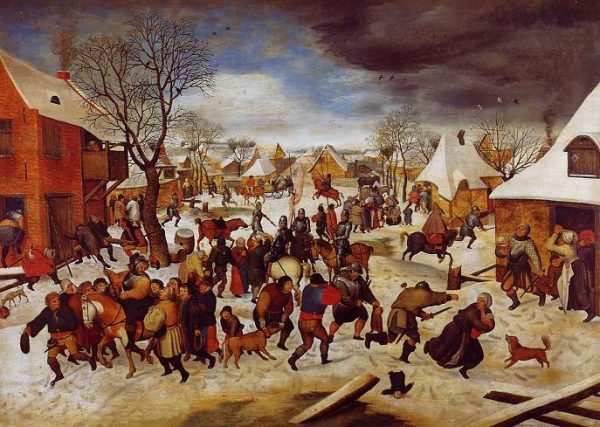
A soldier breaks down a door in a snow-covered village: The Massacre of the Innocents by Pieter Brueghel the Younger, hand-painted in oil for a considered, museum quality reproduction.

Soldiers move through a snow-covered Flemish village, and the calm of the square breaks apart in an instant. Doors are forced, mothers grasp at their children, and the machinery of a distant edict arrives as a very local horror, staged among cottages and frozen ponds that could belong to any winter afternoon in the Low Countries. Bringing this scene into a room is less about decoration than about keeping in view a moment that painting has long insisted on remembering.
Pieter Brueghel the Younger works from a composition his father had established, transposing the biblical massacre ordered by Herod into the setting of a contemporary village raid, complete with the armour, banners, and mounted officers of the Habsburg forces then active in the region. The device was not subtle to its first audience: violence sanctioned from above, falling on ordinary households. Younger multiplies incident across the surface rather than isolating a single dramatic pair, so the eye moves from a soldier breaking down a door to a huddled group by a wall to a rider issuing orders, each vignette complete in itself yet bound into the wider sweep of the raid.
The palette stays close to the muted browns, greys, and iron blacks of a Flemish winter, broken by the red of cloaks and the white of snow, so that colour itself becomes an instrument of alarm wherever it appears. Figures are built with the compact, slightly stiff draughtsmanship that marks Younger and his workshop, a technique suited to producing multiple versions of his father compositions while retaining the narrative clarity that made them legible at a glance. The painting belongs to the decades after 1600, when copying and adapting Bruegel the Elder had become the central occupation of his son studio, and it stands among the more sustained and unflinching of those undertakings.
Recreating this composition by hand asks a painter to slow down at exactly the points where the original speeds the eye along, matching the cold register of the winter palette and building the surface in the same layered, deliberate manner the workshop once used. Each figure is painted rather than printed, so the brushwork carrying a soldier cloak or a mother sleeve sits in real relief on the canvas, and the result is a museum quality oil painting reproduction rather than a flattened copy. The painter works section by section, checking tone against tone, until the piece reads as a single unified surface rather than an assembly of parts, giving the finished canvas the same considered density found in the historical original.
Empty walls flatten a room. A classical artwork restores structure and visual hierarchy. One painting defines the space, anchors furniture, and establishes identity.
Worldwide shipping included. Each painting is produced to order and safely packed for international transport.
All payments are encrypted and processed through trusted payment providers.
Real brushwork, layered oil paint, and durable pigments on museum-quality canvas.
If the result does not meet expectations, return it for a full refund.


Your artwork is painted on premium cotton canvas, then shipped safely rolled in a rigid tube with extra blank canvas border — ready for stretching or framing locally.
Select a handcrafted frame and we’ll deliver your painting fully assembled, protected, and ready to hang.
For safe shipping, framing is available up to a maximum size. Larger sizes will automatically disable the frame option.


Choose “Stretched” to receive your canvas mounted on wooden stretcher bars — perfect if you’ll frame it later or display it as-is.
Gallery Wrap is a deeper, 1.5" style stretcher. The canvas wraps around the sides and is stapled on the back for a clean, modern, frameless look.
We ship with UPS, FedEx, or DHL straight to your door. You’ll receive a tracking number as soon as your order leaves our studio. Typical delivery is 5 to 7 days after dispatch; large, framed, or stretched pieces may take longer depending on the safest shipping route.


Unframed canvases are protected with a film, carefully rolled, and secured inside a rigid shipping tube.

Stretched, Gallery Wrapped, and Framed paintings are wrapped, cushioned with foam protection, and boxed for safe transit.

Man Writing a Letter
Gabriel Metsu, c. 1664
The gallery list
Every painting is already 50% off. Join the list and we will send you an extra $15 code, plus first access to new collections.
No spam. Unsubscribe anytime. · Privacy Policy
Welcome
Your $15 code is on its way. Explore the gallery while you wait.