Loading cart…
No products in the cart.

Original price was: $518.00.$259.00Current price is: $259.00.
Bring home the resolution of a Renaissance wedding commission with The Story of Nastagio degli Onesti Fourth episode by Botticelli, hand-painted in oil on canvas with the surface texture of the original panel.
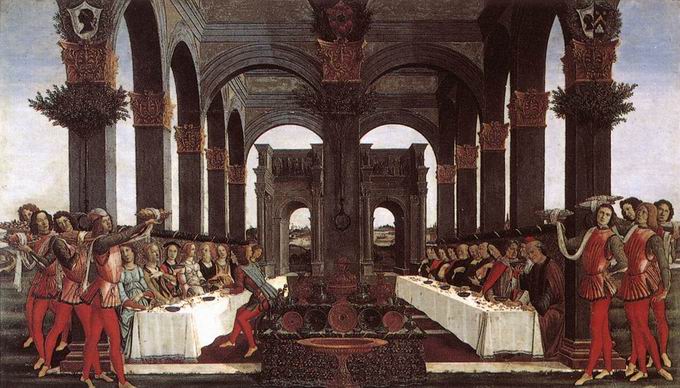
In the mid-1480s, the Florentine banker Antonio Pucci commissioned Sandro Botticelli to mark the marriage of his son Giannozzo to Lucrezia Bini with a set of four panels retelling a grim tale from Boccaccio, the story of Nastagio degli Onesti. This fourth episode closes the sequence, moving from the forest of vision and punishment into the ordered world of the banquet hall, where the wedding guests witness the spectacle that persuades a reluctant bride to accept her suitor. Painted as furniture panels for a domestic interior, the cycle was meant to instruct as much as delight, and this final scene delivers its resolution with unmistakable clarity.
The composition opens onto a loggia of pale stone, its architecture arranged in strict linear perspective that draws the eye toward the seated company at the long table. Figures in rich Florentine dress fill the foreground with a rhythm of gesture and glance, their calm exteriors withholding the horror that has just unfolded before them. Botticelli sets this restraint against passages of vivid colour, brocade patterns and heraldic detail rendered with the same linear precision that defines his mythological work of the same decade.
Tonal control carries much of the meaning here. Botticelli balances the warmth of the banqueting scene against cooler recesses of shadow within the loggia, so the eye settles first on the central drama before drifting to quieter incident at the edges, the servants, the dogs, the half-turned heads. This measured distribution of visual weight, familiar from his religious commissions of the period, gives the panel its particular stillness even as it depicts a moment of resolved terror. It rewards a slow look rather than a quick one.
ByMuseum artists recreate this panel as a hand-painted oil painting reproduction, worked in oil on canvas rather than printed, so the architecture, the drapery, and the tonal shifts across the loggia are built up through the same layered application of colour that the original demanded. As an oil on canvas reproduction it carries the texture a discerning eye looks for, the ridges of dried pigment along a hem, the softened edge where shadow meets stone, the faint variation that comes only from a trained hand working section by section rather than a mechanical process repeating a fixed image. Hung in a room with changing light, the surface shifts subtly through the day, offering new detail on each return visit much as the original panel would have done for the household that first lived with it.
Empty walls flatten a room. A classical artwork restores structure and visual hierarchy. One painting defines the space, anchors furniture, and establishes identity.
Worldwide shipping included. Each painting is produced to order and safely packed for international transport.
All payments are encrypted and processed through trusted payment providers.
Real brushwork, layered oil paint, and durable pigments on museum-quality canvas.
If the result does not meet expectations, return it for a full refund.


Your artwork is painted on premium cotton canvas, then shipped safely rolled in a rigid tube with extra blank canvas border — ready for stretching or framing locally.
Select a handcrafted frame and we’ll deliver your painting fully assembled, protected, and ready to hang.
For safe shipping, framing is available up to a maximum size. Larger sizes will automatically disable the frame option.


Choose “Stretched” to receive your canvas mounted on wooden stretcher bars — perfect if you’ll frame it later or display it as-is.
Gallery Wrap is a deeper, 1.5" style stretcher. The canvas wraps around the sides and is stapled on the back for a clean, modern, frameless look.
We ship with UPS, FedEx, or DHL straight to your door. You’ll receive a tracking number as soon as your order leaves our studio. Typical delivery is 4–5 business days after dispatch; large, framed, or stretched pieces may take longer depending on the safest shipping route.


Unframed canvases are protected with a film, carefully rolled, and secured inside a rigid shipping tube.

Stretched, Gallery Wrapped, and Framed paintings are wrapped, cushioned with foam protection, and boxed for safe transit.