Loading cart…
No products in the cart.

Original price was: $518.00.$299.00Current price is: $299.00.
Vertumnus by Arcimboldo turns the face of Emperor Rudolf II into a harvest of fruit and flowers, a hand-painted reproduction with real surface and texture.
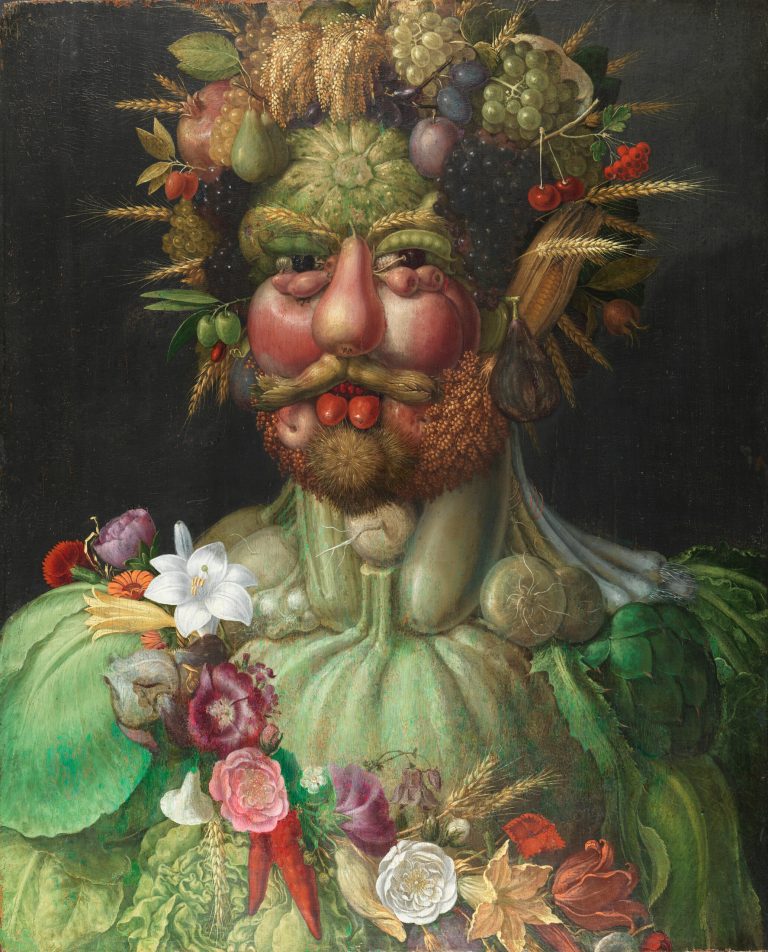
Giuseppe Arcimboldo built an entire career on composite heads assembled from objects, but most of his figures stay anonymous, generic seasons or elements rendered as puzzles for the eye. Vertumnus reproduction buyers are drawn to a different kind of picture: here the riddle has a specific face, that of Holy Roman Emperor Rudolf II, so the game of recognition carries real political weight rather than simple invention. Painted around 1591 for the imperial court in Prague, it is the most pointed of the composite portraits, and the one where decoration and flattery fuse into a single image.
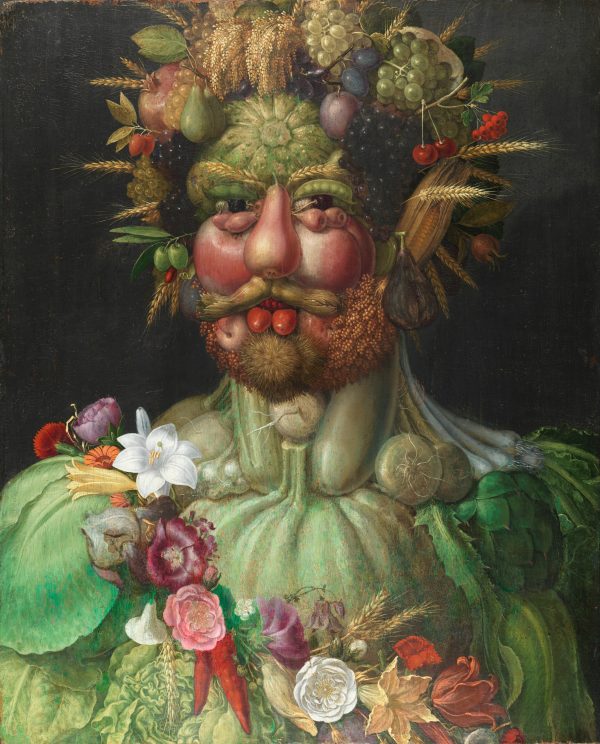
The face resolves from apples, pears, cherries, and grapes, each fruit chosen and placed to read as cheek, brow, or lip when the eye steps back far enough. Gourds, artichokes, beans, and grape leaves build out the collar and the mass of hair, while the shading across each piece of produce gives the whole arrangement a convincing roundness, so that what begins as a still life resolves into a recognizable human presence. The palette moves through ripe golds, dusky purples, and the green-brown of autumn leaves, a harvest range chosen deliberately: Vertumnus was the Roman god of seasons and change, and casting the emperor in his likeness argued that the empire under Rudolf flourished with the same abundance found in cultivated nature. Contemporaries at court recognized the wit in it, a portrait built as a riddle, but the allegory was serious business, aligning the permanence of the emperor with the renewing fertility of the god.
Reproducing this picture in oil on canvas means working through that layering piece by piece rather than copying a flattened image. The trained artists at ByMuseum build up each fruit and leaf as an individual passage of paint, matching the warm, earthy palette of the original panel and preserving the subtle modeling that turns gourd and artichoke into cheekbone and brow. This oil painting reproduction is painted, not printed, so the ridges of pigment that describe a grape skin or a curled leaf sit raised on the canvas exactly as brushwork would on any hand-painted original, giving a collector something with real surface to examine rather than a flat facsimile. Anyone used to looking closely at condition and paint handling will find that same density of touch here, an oil on canvas reproduction built layer over layer until the produce resolves into a face.
| artists |
|---|
Empty walls flatten a room. A classical artwork restores structure and visual hierarchy. One painting defines the space, anchors furniture, and establishes identity.
Worldwide shipping included. Each painting is produced to order and safely packed for international transport.
All payments are encrypted and processed through trusted payment providers.
Real brushwork, layered oil paint, and durable pigments on museum-quality canvas.
If the result does not meet expectations, return it for a full refund.


Your artwork is painted on premium cotton canvas, then shipped safely rolled in a rigid tube with extra blank canvas border — ready for stretching or framing locally.
Select a handcrafted frame and we’ll deliver your painting fully assembled, protected, and ready to hang.
For safe shipping, framing is available up to a maximum size. Larger sizes will automatically disable the frame option.


Choose “Stretched” to receive your canvas mounted on wooden stretcher bars — perfect if you’ll frame it later or display it as-is.
Gallery Wrap is a deeper, 1.5" style stretcher. The canvas wraps around the sides and is stapled on the back for a clean, modern, frameless look.
We ship with UPS, FedEx, or DHL straight to your door. You’ll receive a tracking number as soon as your order leaves our studio. Typical delivery is 5 to 7 days after dispatch; large, framed, or stretched pieces may take longer depending on the safest shipping route.


Unframed canvases are protected with a film, carefully rolled, and secured inside a rigid shipping tube.

Stretched, Gallery Wrapped, and Framed paintings are wrapped, cushioned with foam protection, and boxed for safe transit.


Reviews
There are no reviews yet.