Loading cart…
No products in the cart.

Original price was: $599.00.$299.00Current price is: $299.00.
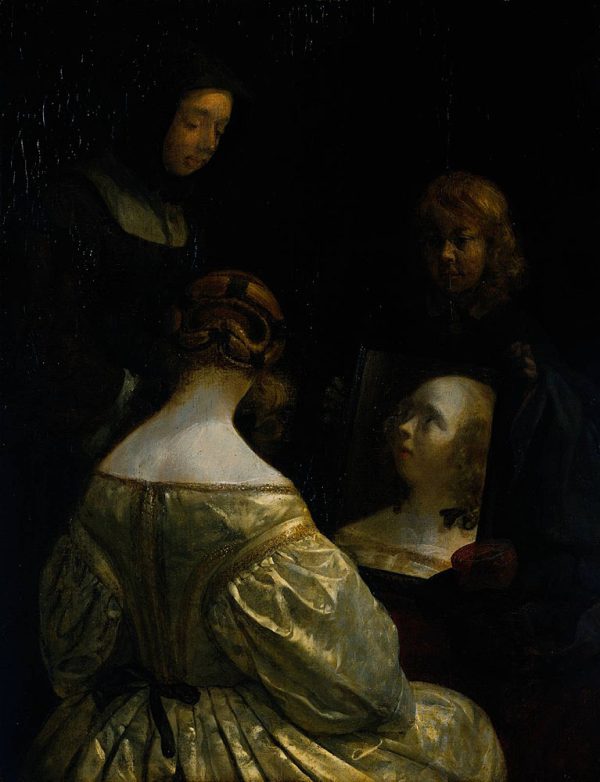
A quiet study in restraint from Gerard ter Borch, this hand-painted oil on canvas reproduction of Woman at a Mirror carries the layered greys and hushed light of the original.

Gerard ter Borch made his reputation painting the quiet interiors of Dutch burgher life, where a soldier reads a letter or a mother tends a child by candlelight, and where the drama lies entirely in gesture and fabric rather than event. Much of his output turns on satin skirts and half-lit faces, on rooms so hushed they seem to hold their breath. Woman at a Mirror belongs to this world but narrows its attention further still, fixing on a single figure absorbed in her own reflection, and in doing so it strips away even the modest incident that animates his other domestic scenes.
The composition is built from a small number of large, calm shapes: the dark mass of the mirror frame, the pale plane of a bodice or collar catching the light, the negative space of the room pressing in around the figure. Ter Borch arranges these elements with the same discipline he brought to his group portraits, so that scale and placement do the work usually left to narrative. There is no incident to explain, only the woman turned toward her own image, and the picture asks the viewer to slow down in the same way she has slowed down before the glass.
Colour and light are handled with the restraint typical of his mature period, greys and warm neutrals built up in thin, controlled layers so that the surface glows rather than shines. Weight is distributed carefully across the canvas: the head and mirror carry the focal interest, while passages of drapery and shadow recede without going slack. It is a picture that repays close looking, since the broad design and the smallest transitions of tone are never separated from one another, each supporting the other the longer one stays with it.
Bringing this quiet economy of means back onto canvas is the real task of the reproduction, and it is why ByMuseum treats each order as an oil painting reproduction rather than a mechanical copy. A trained painter works by hand in oil on canvas, mixing the same muted greys and warm neutrals ter Borch favoured and building them up in comparable layers, so that the surface carries actual brushwork and a genuine depth of paint rather than a flat printed image. Matching the palette is only the beginning; the painter also has to recover the balance of light passages against darker ground that gives the original its stillness, working as an oil on canvas reproduction rather than any kind of print. The finished canvas keeps the tactile presence of oil paint, with ridges and thin passages you can see catch the light, so the object on the wall behaves like a painting rather than a copy of one.
Empty walls flatten a room. A classical artwork restores structure and visual hierarchy. One painting defines the space, anchors furniture, and establishes identity.
Worldwide shipping included. Each painting is produced to order and safely packed for international transport.
All payments are encrypted and processed through trusted payment providers.
Real brushwork, layered oil paint, and durable pigments on museum-quality canvas.
If the result does not meet expectations, return it for a full refund.


Your artwork is painted on premium cotton canvas, then shipped safely rolled in a rigid tube with extra blank canvas border — ready for stretching or framing locally.
Select a handcrafted frame and we’ll deliver your painting fully assembled, protected, and ready to hang.
For safe shipping, framing is available up to a maximum size. Larger sizes will automatically disable the frame option.


Choose “Stretched” to receive your canvas mounted on wooden stretcher bars — perfect if you’ll frame it later or display it as-is.
Gallery Wrap is a deeper, 1.5" style stretcher. The canvas wraps around the sides and is stapled on the back for a clean, modern, frameless look.
We ship with UPS, FedEx, or DHL straight to your door. You’ll receive a tracking number as soon as your order leaves our studio. Typical delivery is 5 to 7 days after dispatch; large, framed, or stretched pieces may take longer depending on the safest shipping route.


Unframed canvases are protected with a film, carefully rolled, and secured inside a rigid shipping tube.

Stretched, Gallery Wrapped, and Framed paintings are wrapped, cushioned with foam protection, and boxed for safe transit.