Loading cart…
No products in the cart.

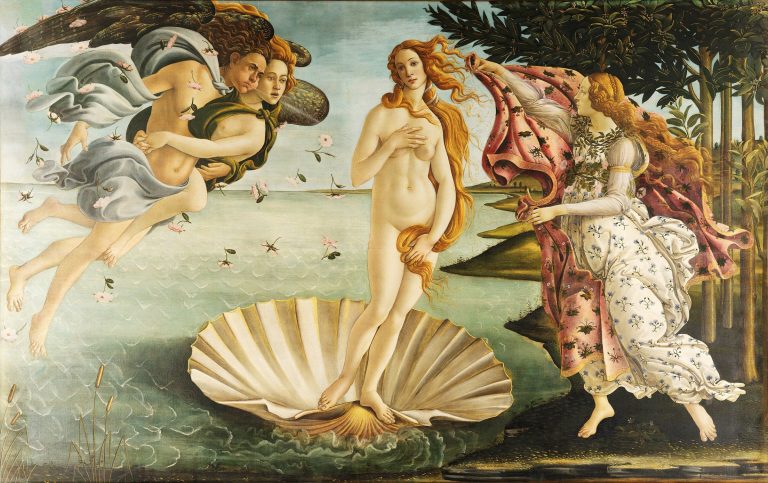
c. 1485 · Tempera on canvas · Uffizi Gallery, Florence
Save articles to your collection
Log in or create a free account, and this article will be waiting in your Private Collection.
Log in or sign up Explore the artistSandro Botticelli paintings →
Everyone seems to be moving except Venus. The winds fly towards her from the left; a woman on the shore reaches forward with a cloak. In the middle, the goddess stands almost motionless on a shell. The action is arranged around her arrival.
The Birth of Venus is Sandro Botticelli’s painting of the goddess of love reaching the shore. It dates to about 1485 and belongs to the Uffizi in Florence. Despite its familiar title, this is an arrival after her birth, rather than the moment she emerges from the sea.
Follow the hands, hair and fabric across the picture. They connect four figures whose identities are not all equally certain.
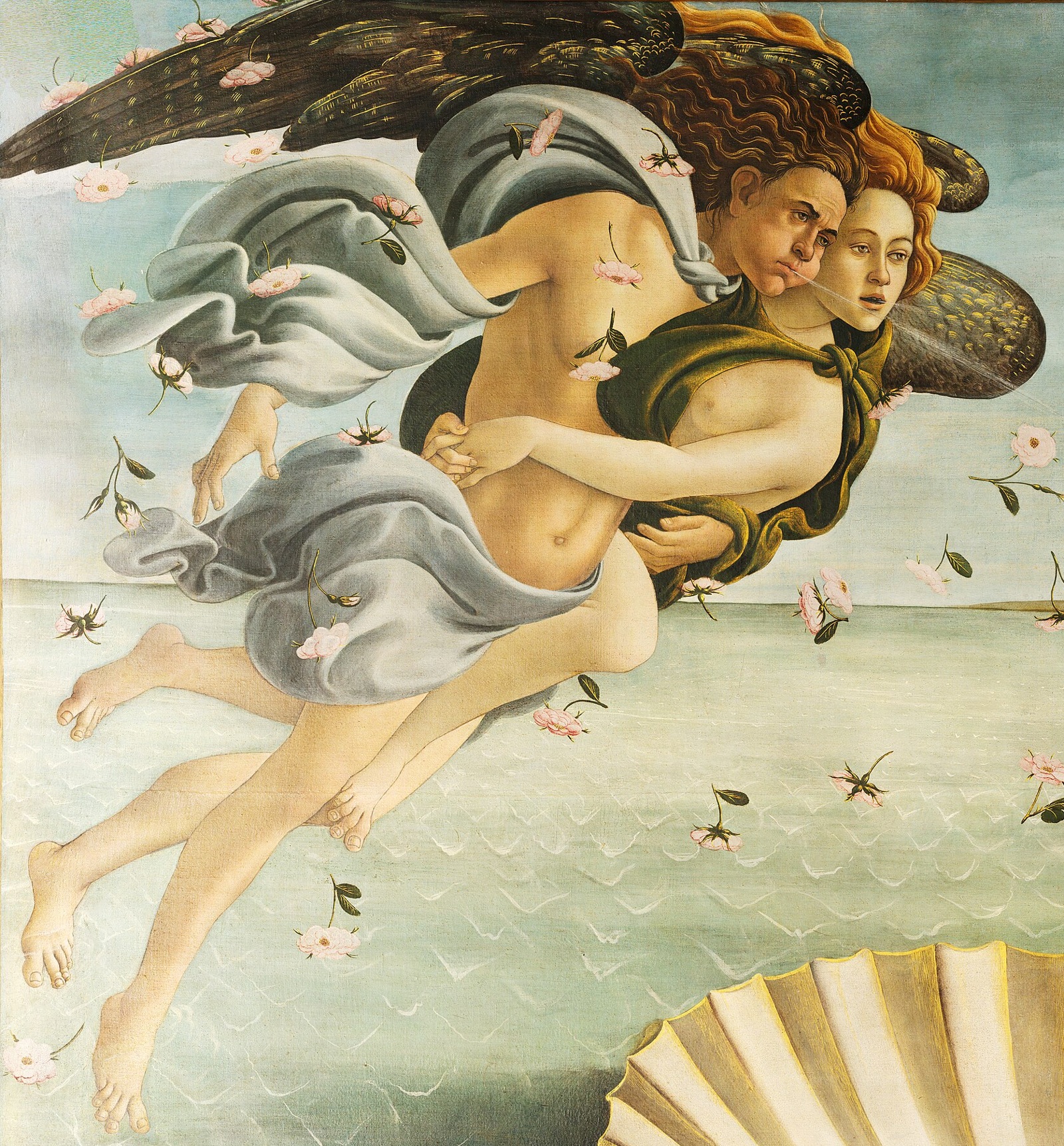
Zephyrus, also called Zephyr, is the west wind. His cheeks swell as he blows towards Venus. His arms and his companion’s arms overlap, while their legs stretch behind them. Their bodies give the wind a visible direction.
The woman entwined with him is often called Aura, a personification of a breeze. The Uffizi qualifies that identification with “perhaps”. Chloris is another proposed reading. The picture does not label her, so neither name should be treated as certain.
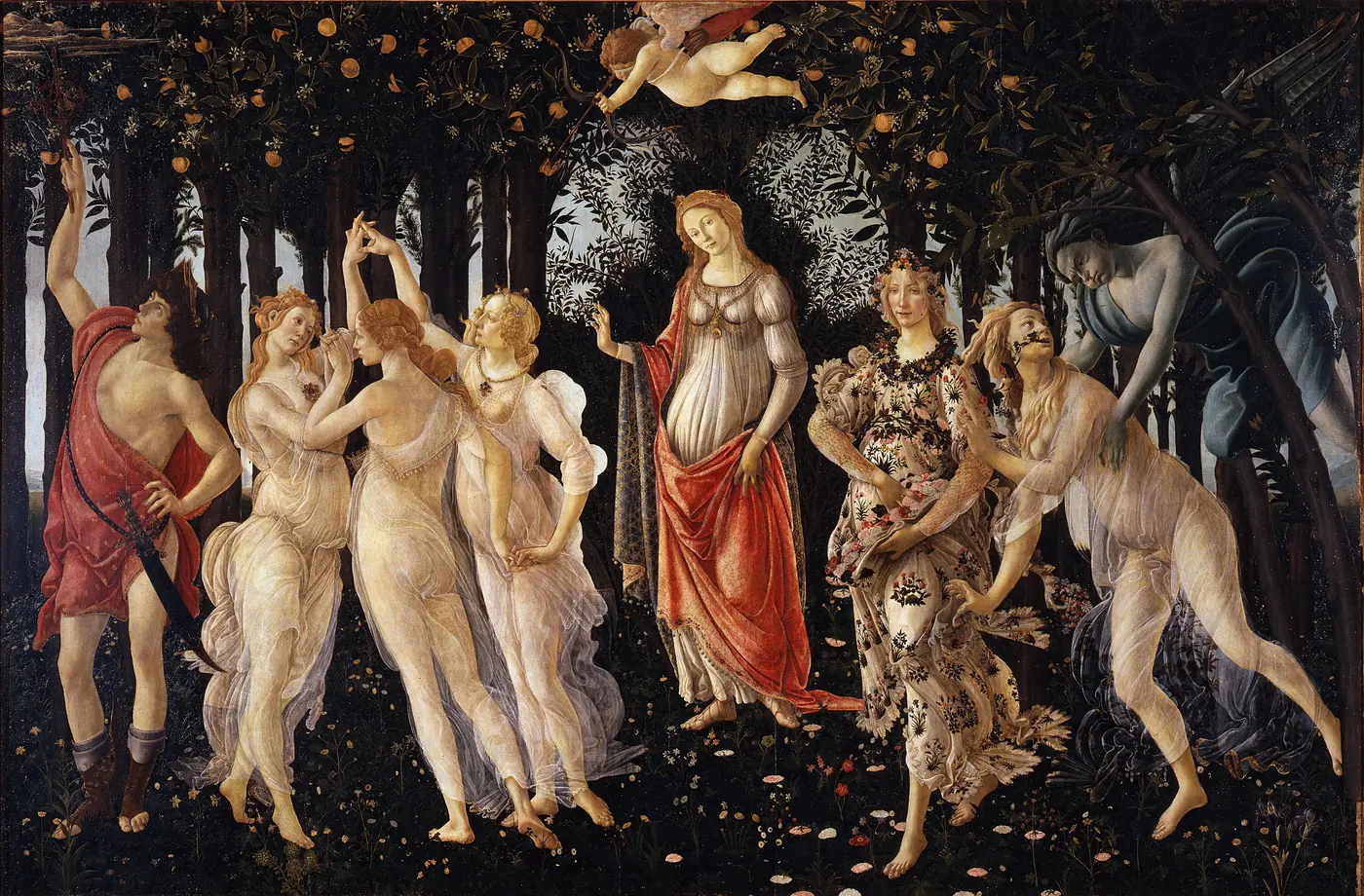
Compare the winds with Botticelli’s Primavera. In that painting, the Uffizi identifies Zephyrus pursuing Chloris, who becomes Flora. A related cast of mythological figures does not mean both pictures tell the same episode.
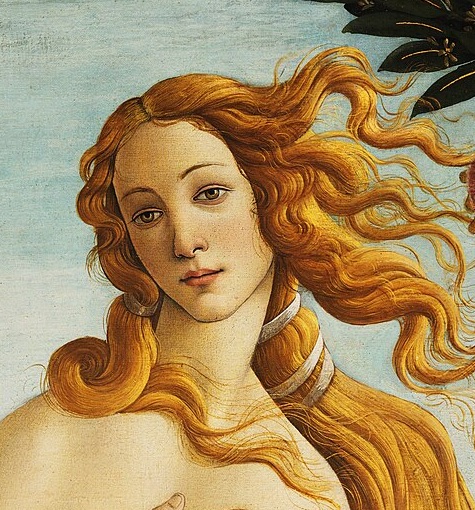
Venus is the Roman goddess of love and beauty, identified with the Greek Aphrodite. Her head tilts slightly and her gaze turns away from a direct encounter with the viewer. She has arrived at the centre of a busy welcome, yet her expression remains difficult to read.
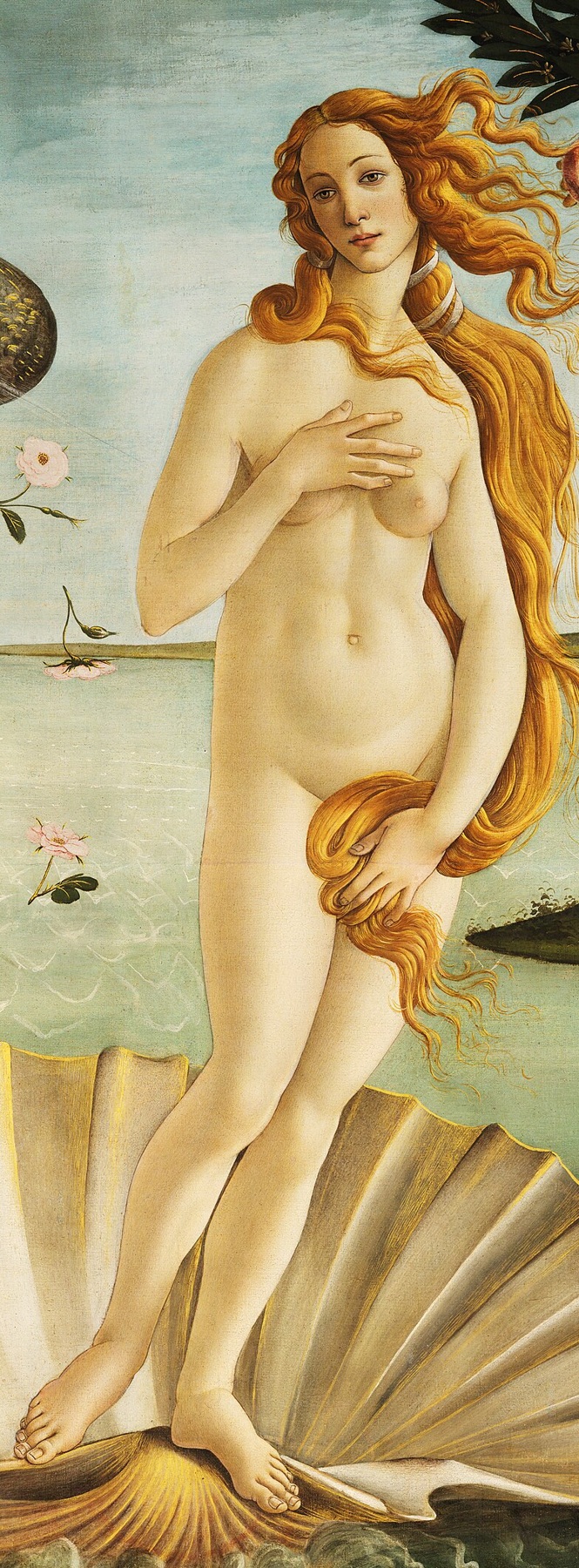
Her hands create a different movement from those of the winds. One rests across her chest; the other gathers a long strand of hair in front of her body. This protective gesture recalls the classical Venus pudica, or modest Venus. The same hair that covers her also carries the breeze across her silhouette.
Look down from her shoulders to her feet. Her neck is elongated, her shoulders slope, and her stance has a fragile sway. The narrow outline of her body matters more to the composition than a convincing account of weight. We can describe that effect without claiming to know what Botticelli thought about anatomy.
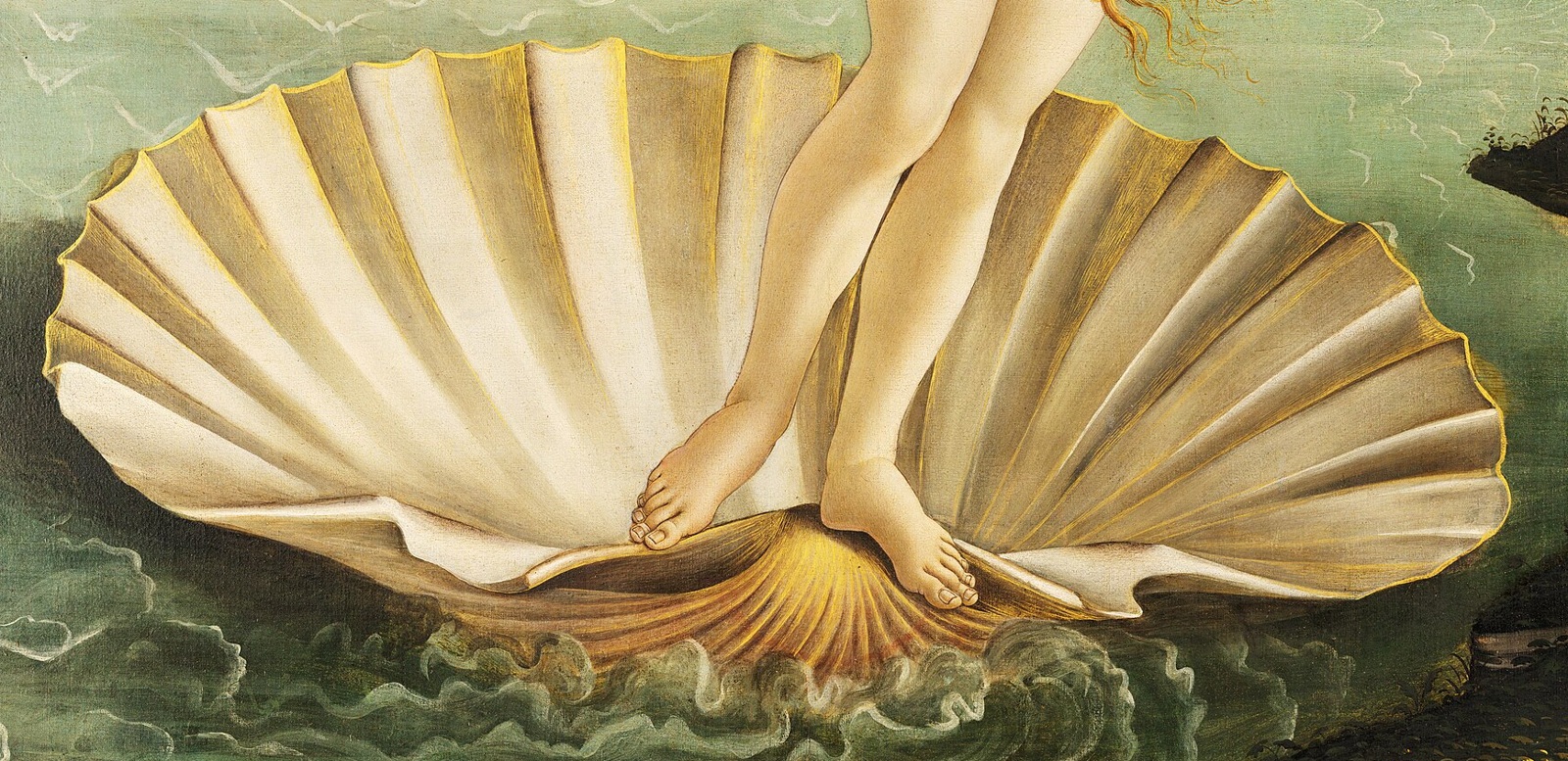
The shell spreads outward beneath her like an open fan. Its ridges draw the eye back towards her feet, while the waves curl around its lower edge. It belongs to her journey across the sea; here it also gives the upright figure a broad, curved base.
The name Simonetta Vespucci is frequently attached to this face. That identification remains a proposal, not an established portrait record. The museum’s account does not identify a sitter. The painting can be read closely without turning an uncertain model into the explanation for everything in it.
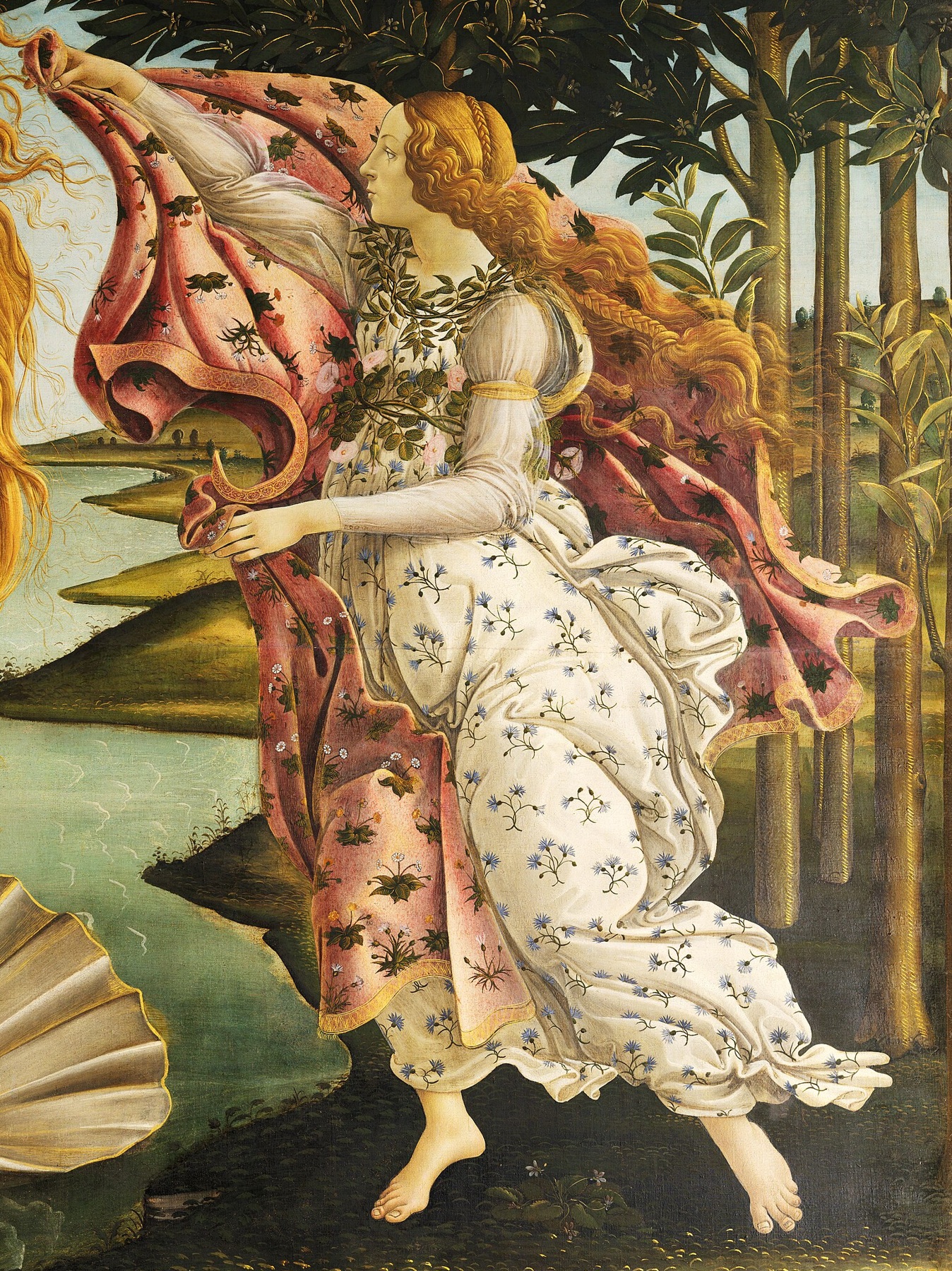
At the right, a woman holds a flowered cloak open towards Venus. She is commonly identified as the Hora of spring, one of the personifications of the seasons. The Uffizi also allows the possibility that she is a Grace.
Her welcome is physical. One hand lifts the cloak high, while the other holds its lower edge. Her bare feet reach towards the shore and the fabric curves back around her body. Against Venus’s stillness, she seems caught midway through a step.
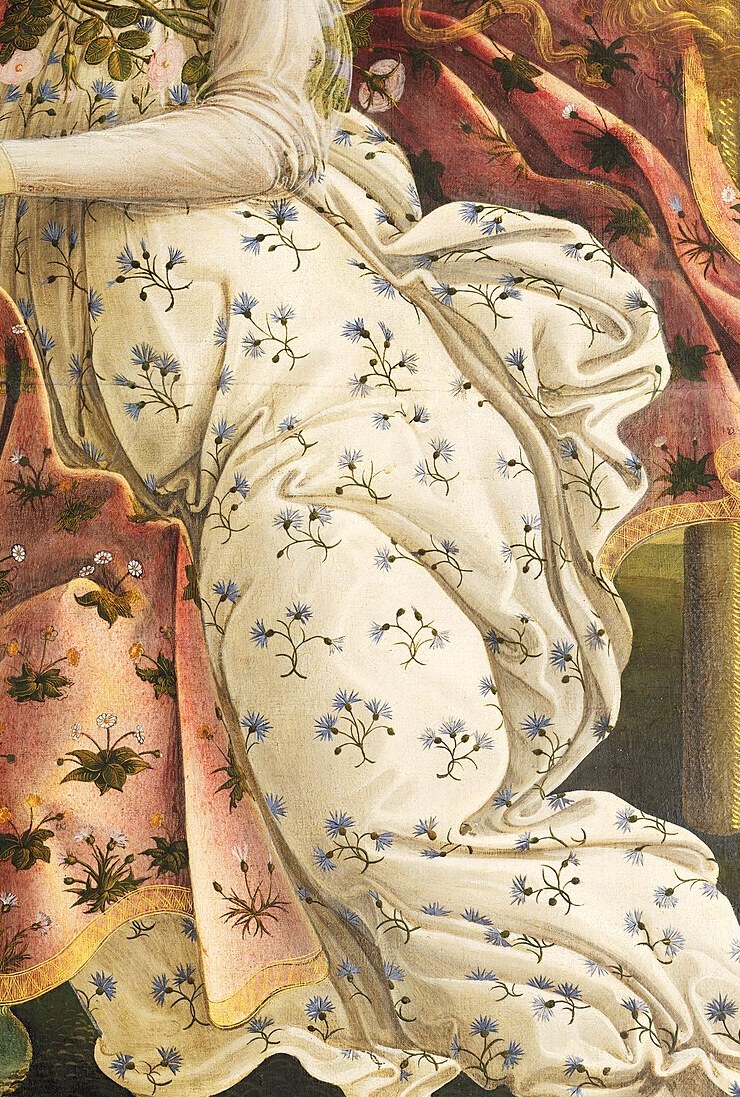
Flowers repeat across her pale dress and the pink cloak. The patterns make clothing part of the spring setting. There is no need to give every small blossom a certain botanical name to see how the decorated fabrics answer the flowers floating over the sea.
The sixth Homeric Hymn to Aphrodite offers an ancient parallel: the west wind carries the goddess across the sea and the Hours receive and clothe her. This helps explain the welcome, but does not prove that Botticelli followed one text word for word.
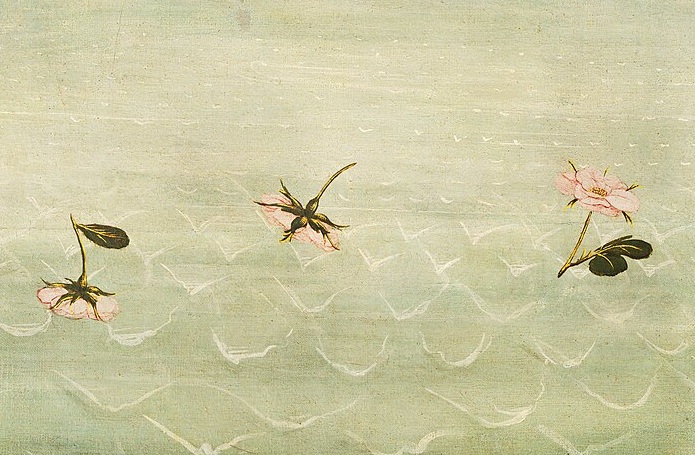
The roses. Individual flowers turn in different directions as they fall. Some face us; others show the backs of their petals. They carry the sense of a breeze into the open space between the figures. They also make spring visible before the eye reaches the flowered clothing on shore.
The orange trees. The dense grove at the right changes the rhythm of the picture. Repeated trunks stand behind the attendant, in contrast to the exposed sea around the winds. The Uffizi relates these trees to a possible Medici association, through the name mala medica. That clue supports an interpretation; it is not a substitute for a surviving commission.
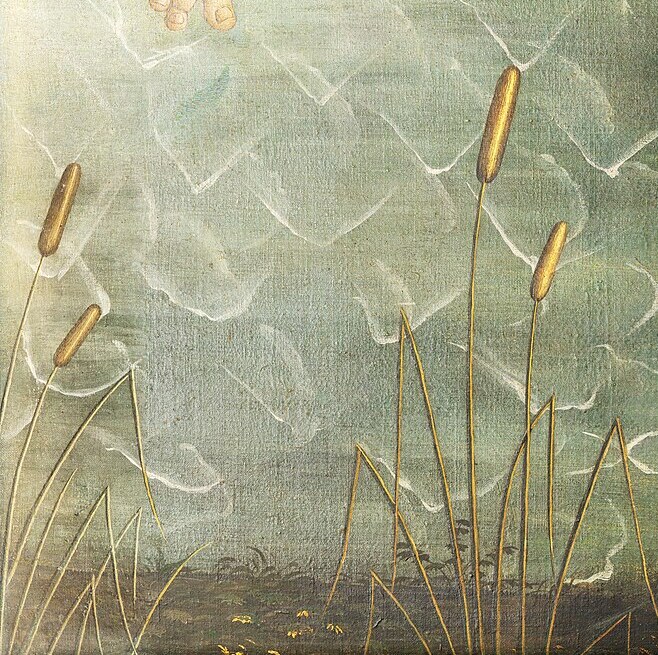
The sea. Small, repeated wave marks spread across the pale water. Near the shell they gather into darker curls. The reeds in the lower corner give the shoreline a sharp, upright accent. The result is a patterned setting whose lines remain easy to follow, rather than a view filled with atmospheric distance.
The Uffizi dates the painting to about 1485 and records it as tempera on canvas. This is the historical work’s medium, not oil paint. The support also distinguishes it from Primavera, which is painted on wood.
A Medici commission is highly probable, but the patron and original setting are not securely documented. In 1550, Giorgio Vasari described the painting at the Medici Villa of Castello. That is a firm point in its recorded history; a more detailed account of the original order should remain qualified.
Its subject places a figure from classical mythology at the centre of a large Renaissance painting. The borrowed pose, the wind and the welcome on shore allow an ancient story to take a new painted form. The surviving picture offers visual evidence; the missing commission leaves some historical questions open.
The painting presents love and beauty arriving in the world through the figure of Venus. Its quiet centre, surrounding movement and abundance of flowers make that arrival feel like a welcome.
A philosophical interpretation connects this beauty with Neoplatonism, in which the experience of physical beauty can lead the mind towards a higher form of love. The Oxford Guide to Classical Mythology in the Arts teaching resource at BYU discusses the painting in relation to this tradition and Gombrich’s scholarship. This is an influential reading, rather than a surviving statement of Botticelli’s exact programme.
Return to the visible contrast. The winds lean forward; the attendant opens her cloak. Venus neither strains against the wind nor hurries to cover herself. That difference in pace lets the painting hold an arrival in suspension. We recognise the activity around her before deciding what her stillness means.
The original belongs to the Uffizi Galleries in Florence. It measures 172.5 centimetres high by 278.5 centimetres wide. These are the dimensions of Botticelli’s historical painting, not the available sizes of a modern reproduction.
Continue with Primavera to see how Botticelli gives Venus another role in a gathering of mythological figures. You can also explore the Sandro Botticelli collection or the hand-painted Birth of Venus reproduction. The original is tempera; the ByMuseum reproduction is made in oil on canvas.
Sandro Botticelli painted the Uffizi work around 1485. Other artists, including Alexandre Cabanel, also painted works with this title.
The wind at the left is Zephyrus. His companion is often called Aura or Chloris. The woman holding the cloak is usually called the Hora of spring, or sometimes a Grace. The latter identities remain interpretations.
No. The original is tempera on canvas. Its support is canvas, but that does not make its paint an oil medium.
Enjoyed this story?
Save articles to your collection
Log in or create a free account, and this article will be waiting in your Private Collection.
Log in or sign upFigure identifications and philosophical meanings are distinguished from documented collection facts. No certain sitter or exact commission is claimed.

Man Writing a Letter
Gabriel Metsu, c. 1664
The gallery list
Every painting is already 50% off. Join the list and we will send you an extra $15 code, plus first access to new collections.
No spam. Unsubscribe anytime. · Privacy Policy
Welcome
Your $15 code is on its way. Explore the gallery while you wait.