Loading cart…
No products in the cart.

c. 1480 · Tempera on panel · Uffizi Gallery, Florence
Save articles to your collection
Log in or create a free account, and this article will be waiting in your Private Collection.
Log in or sign up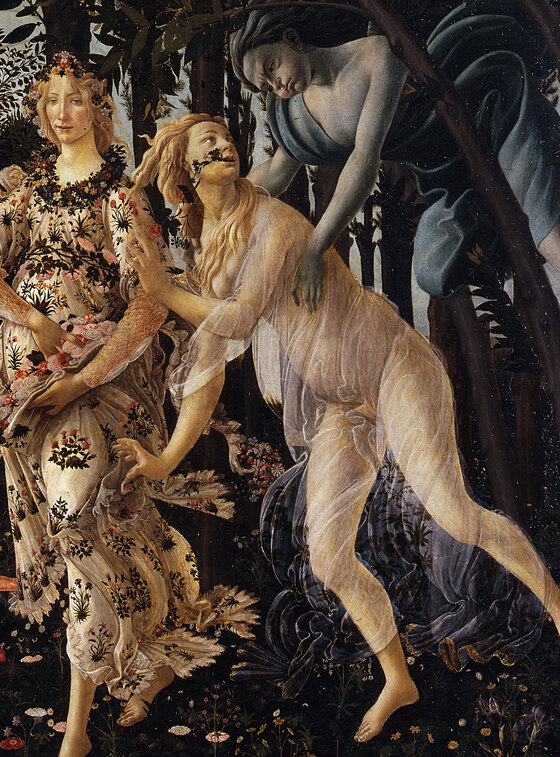
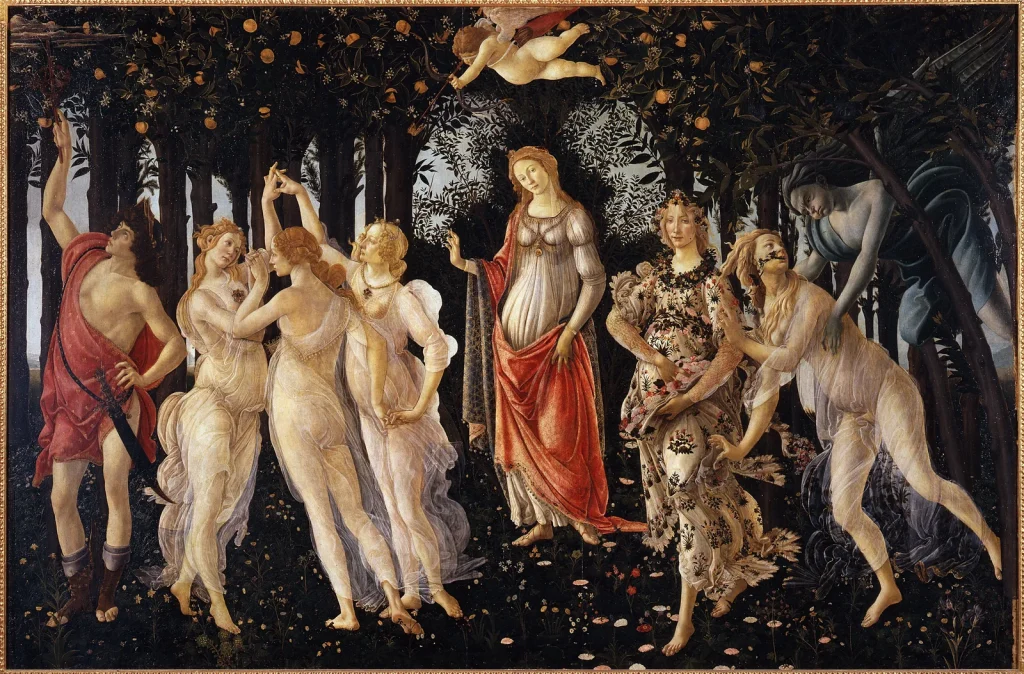
Start at the right-hand edge, because that is where the painting starts. A blue-skinned figure with puffed cheeks swoops out of the trees and seizes a girl in a thin white dress. She twists away from him. Flowers are coming out of her mouth. Next to her, calm and smiling, walks a woman in a gown covered in flowers, scattering roses from her lap.
They are the same person. The story is in Ovid's Fasti, his poem about the Roman calendar, where the goddess Flora explains how she came to be:
I was Chloris, who am now called Flora. It was spring, and I was wandering; Zephyr saw me, and I fled. He was the stronger. Yet he made amends for his violence by making me his wife, and in my marriage bed I have no complaint. I enjoy perpetual spring.
Ovid, Fasti, Book V
Botticelli paints the sentence as a sequence. Zephyr, the west wind of spring, catches the nymph Chloris; at his touch she breathes flowers; and she walks on transformed into Flora, spring itself, dressed in everything she has become. No other painting of the Renaissance tells a metamorphosis this way, as three frames of one motion.
The wind comes in from the right, and everything else in the painting follows it. The trees bend left. Chloris flees left. Flora walks left. The eye moves that way too, across Venus in the centre, past the three dancing Graces, to Mercury at the far edge, who is doing something with his staff to a wisp of cloud.
That direction is unusual: Western pictures normally read left to right, like a page. Botticelli reversed it, and the effect is that you feel the wind at your back as you look. The garden is being blown into being.
Nine figures stand in an orange grove on a carpet of flowers. There is no sky to speak of, only glimpses of pale light between the trunks, and no ground beyond the meadow. It is a stage, and every figure on it is a god.
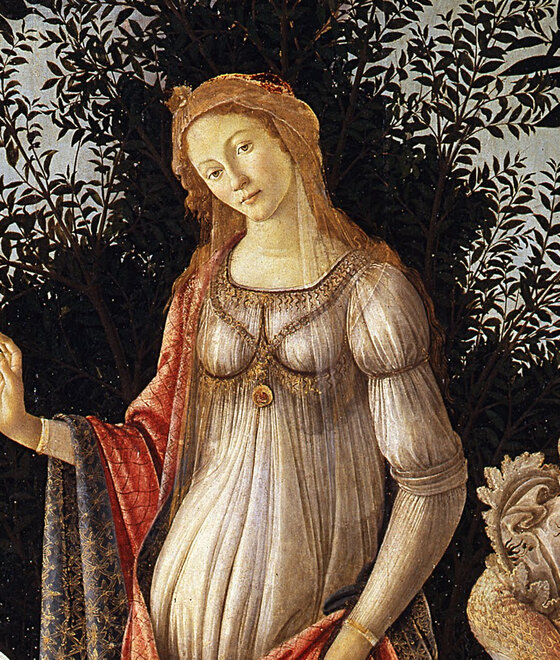
The woman in the centre is Venus. She is easy to miss as a goddess because she is the most modestly dressed figure in the picture: a white gown, a red cloak, a veil over her hair, standing a little behind the others as if she has just come out of the trees. The trees have made an arch for her. It is myrtle, her plant, and it frames her the way a halo frames a saint.
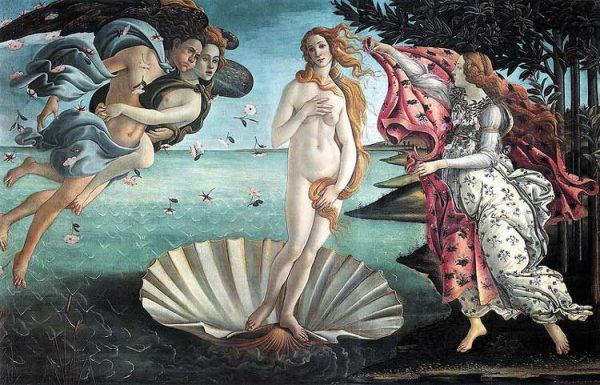
Compare her with the Venus Botticelli painted a few years later in The Birth of Venus, naked on her shell. This is a different goddess: married, clothed, presiding. Her hand is raised in the gesture a hostess makes when she welcomes a guest into her house, and her garden is where the whole drama on either side of her is allowed to happen.
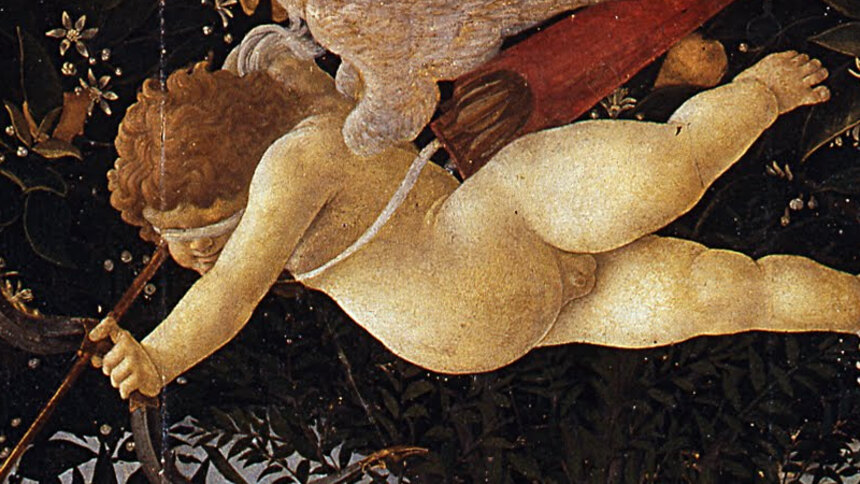
Above her hovers her son, Cupid, blindfolded, drawing a bow. The arrow is on fire. Follow its line and it points at the middle of the three dancing women to the left. Love, in this garden, is about to strike someone who is not looking.
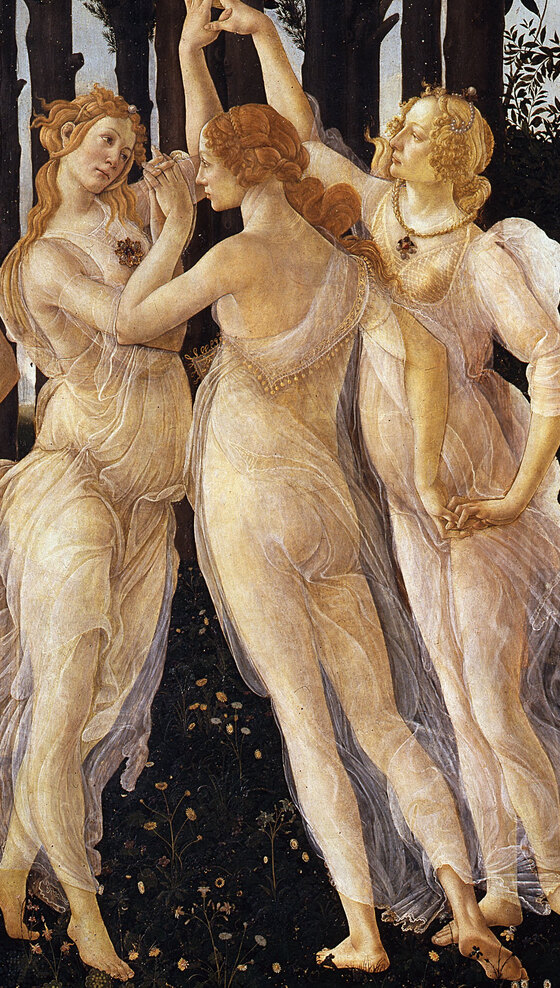
The three women dancing hand in hand are the Graces, the attendants of Venus. Their dresses are painted so thin you can see the bodies through them, which is Botticelli showing off: the ancient writers had described the Graces as dressed in transparent veils, and here they are.
Look at the one in the middle, with her back to us. She is the one Cupid is aiming at, and she is looking, over the joined hands, at Mercury. Her companions dance; she has stopped dancing inside. The Renaissance called this state innamoramento, the moment of falling in love, and Botticelli gives it a face turned three-quarters away so that we work it out from her stillness.
The jewel at her throat and the plainness of her dress have led some historians to see a portrait, and names from the Medici circle have been proposed. None is certain. What is certain is that she is the painting's second story, after Chloris: a woman about to be changed by love.
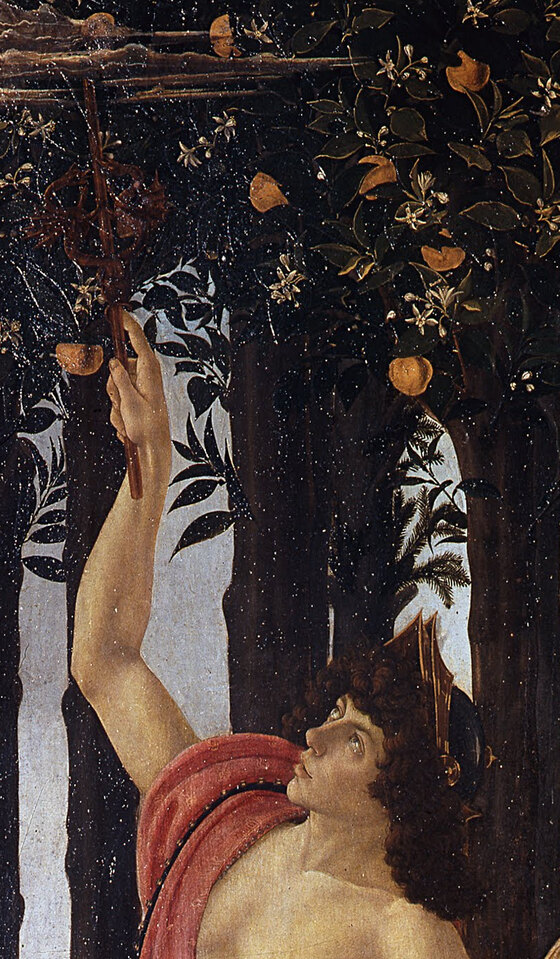
At the far left a young man in a red cloak, winged sandals and a helmet reaches up with a staff twined with snakes. He is Mercury, and the staff is his caduceus. He is touching a tiny grey cloud that has drifted into the orange trees, and he is pushing it out.
That is his job in the picture: to keep the weather out of the garden. Zephyr blows spring in on the right; Mercury clears the last cloud on the left; and between them the season is perfect and permanent. He also faces away from everyone, out of the frame, which makes him the picture's exit. The story enters with the wind and leaves with the messenger of the gods.
His face has often been read as a portrait too, usually of Lorenzo di Pierfrancesco de' Medici, the young man who owned the painting. That would make sense of the pose: the owner, at the edge of his own garden, keeping it clear.
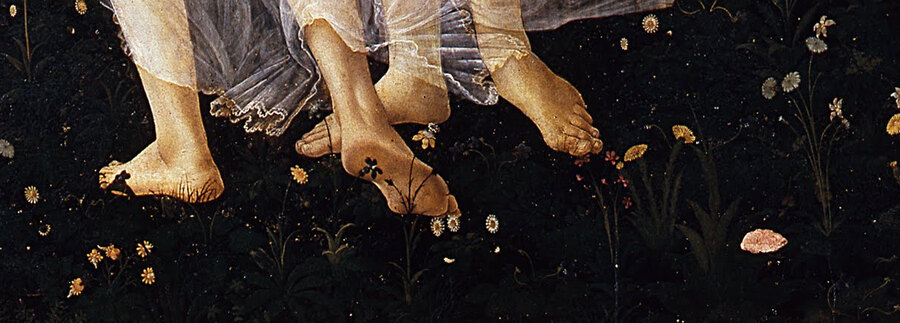
Get close to the ground and the painting becomes a herbarium. Botanists who have studied the meadow count around five hundred individual plants and have put names to well over a hundred species: violets, daisies, cornflowers, forget-me-nots, strawberries, roses, irises, periwinkle, hellebore. Every one of them flowers in Tuscany between March and May, and most had meanings a Florentine of 1480 would have read at a glance. Strawberries for sweetness, violets for modesty, roses for Venus.
Above them, the trees are heavy with oranges. Botticelli's Florence called the fruit mala medica, and the pun on the Medici name was not lost on anyone. This is a Medici garden, in the sense that the family had bought spring.
The painting is first recorded in 1499 in the Florentine townhouse of Lorenzo di Pierfrancesco de' Medici, a younger cousin of Lorenzo the Magnificent, hanging over a daybed in the room next to his bedroom. He was in his teens when it was painted. Most historians connect it with his marriage to Semiramide Appiani in 1482, which would make it, among other things, a very grand wedding present: a picture of love that starts in violence and ends in a garden where the bride is the goddess.
His tutor was the philosopher Marsilio Ficino, who wrote him a famous letter urging him to fix his eyes on Venus, meaning not the goddess of desire but Humanitas, the harmony of the civilised soul. Whether or not Botticelli read the letter, the painting is on its side: a Venus who is a hostess, not a temptress, in a garden where even the wind ends in marriage.
Botticelli never called it Primavera. The name comes from Giorgio Vasari, who saw it at the Medici villa at Castello in the 1550s and described it as Venus, whom the Graces deck with flowers, signifying spring. It has been Spring ever since.
In the Uffizi in Florence, in the Botticelli rooms, a few steps from The Birth of Venus. It is tempera on wood panel, 207 by 319 centimetres, with the figures at life size. It came to the Uffizi in 1919 and was cleaned in 1982, which brought back the whites of the Graces' dresses and the colours of the meadow.
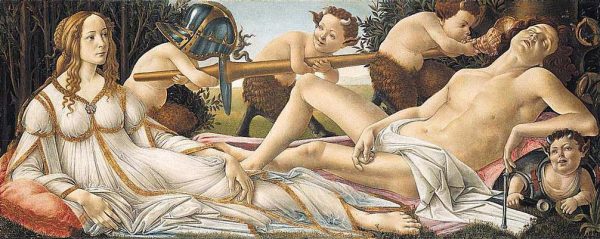
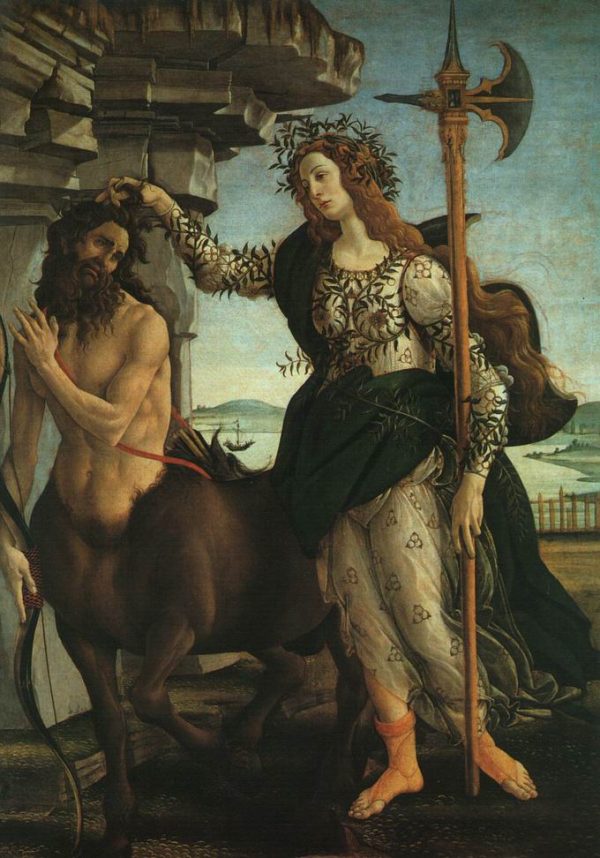
The three great mythologies Botticelli painted for the Medici are all in the Uffizi and all in our collection:
Primavera is wide, dark and full of detail, and it is the rare painting that looks better large than the postcard suggests: at a metre or more across, the flowers come back and the figures separate. Our hand-painted reproduction of Primavera is painted in oil on canvas from the Uffizi composition. It wants a long wall, a dark or gilt frame, and a room where people sit long enough to start reading it from the right.
More Botticelli in our Sandro Botticelli collection, and the wider Renaissance archive.
Enjoyed this story?
Save articles to your collection
Log in or create a free account, and this article will be waiting in your Private Collection.
Log in or sign upVisible details, documented facts and interpretation are kept separate throughout this article. Portrait identifications and the wedding connection are reported as the proposals they are.