Loading cart…
No products in the cart.

1876 · Oil on canvas · Private collection (2010 auction record)
Save articles to your collection
Log in or create a free account, and this article will be waiting in your Private Collection.
Log in or sign up Explore the artistWilliam Bouguereau →
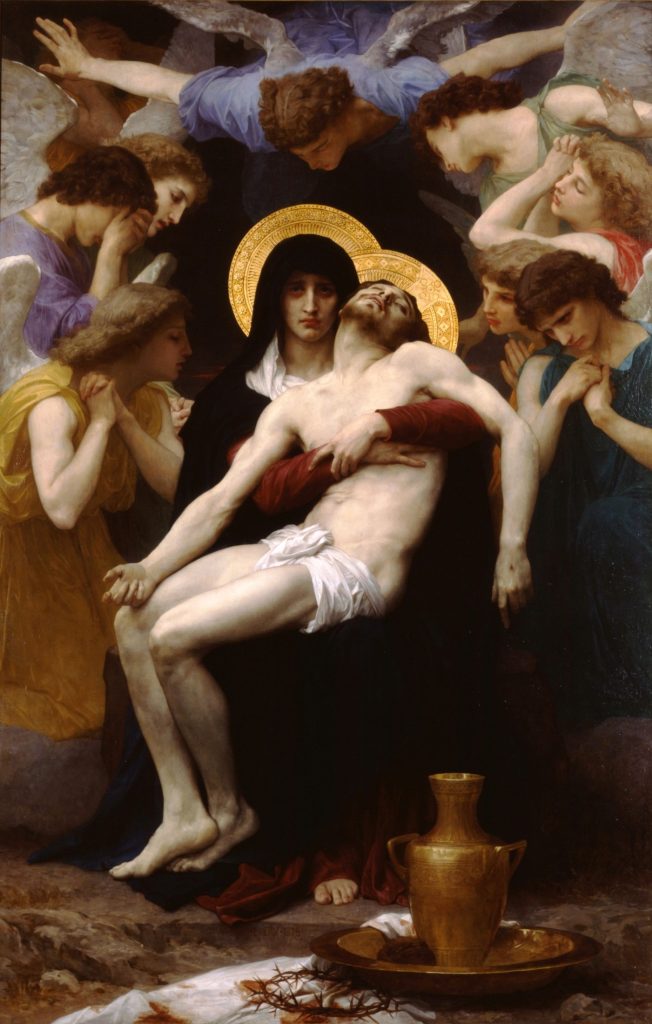
Mary supports the body of Jesus, but her eyes do not follow its downward weight. Beneath a black veil, she looks out from the centre of the painting. Around her, angels bow their heads, press hands to their faces or turn towards the body. Her stillness makes their movements seem more restless.
William-Adolphe Bouguereau painted Pietà in 1876. It shows the Virgin with the dead Christ after the Crucifixion, a familiar subject in Christian art. Yet a small object near the bottom gives this particular image an intensely personal history.
Before looking for it, stay with the two faces.
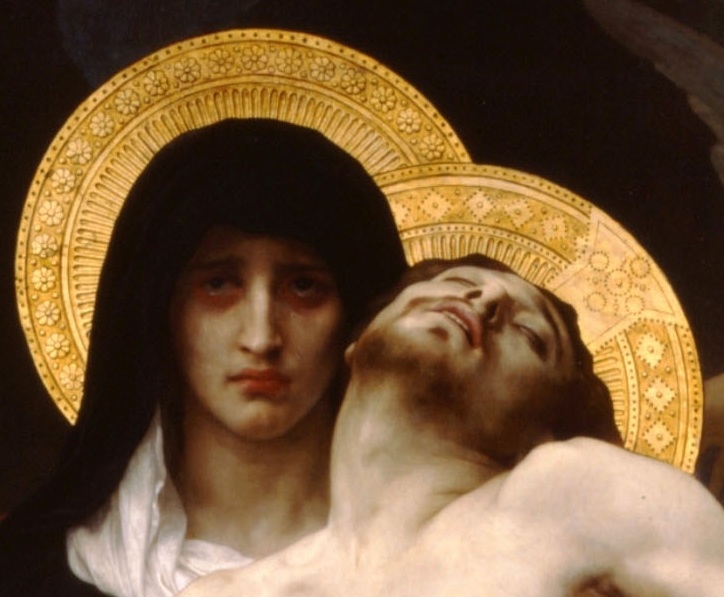
Christ’s head falls back. His eyes are closed, his neck exposed. Mary’s face remains upright, framed by dark cloth. Their golden halos overlap, bringing the heads close together while their directions separate them.
Her gaze can feel like an appeal to the person standing before the picture. It does not tell us precisely what she thinks, or whom she addresses. Its force comes from making it difficult to observe this grief at a comfortable distance.
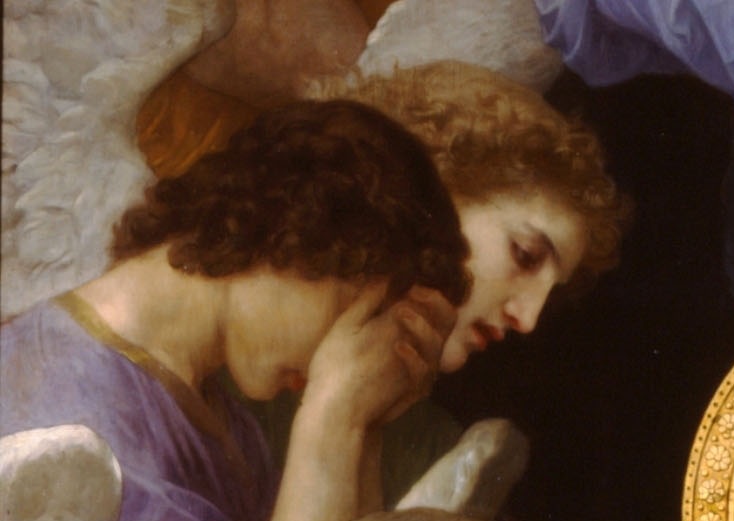
At the left, the angel in violet brings a hand across the face. A second face leans nearby. The gesture conceals an expression that a portrait would normally ask us to examine. Grief becomes visible through the effort to cover it.
Below and around them, other figures lean inward. Some faces remain visible; others retreat behind fingers or bowed heads. Bouguereau gives the surrounding company different responses to the same still body.
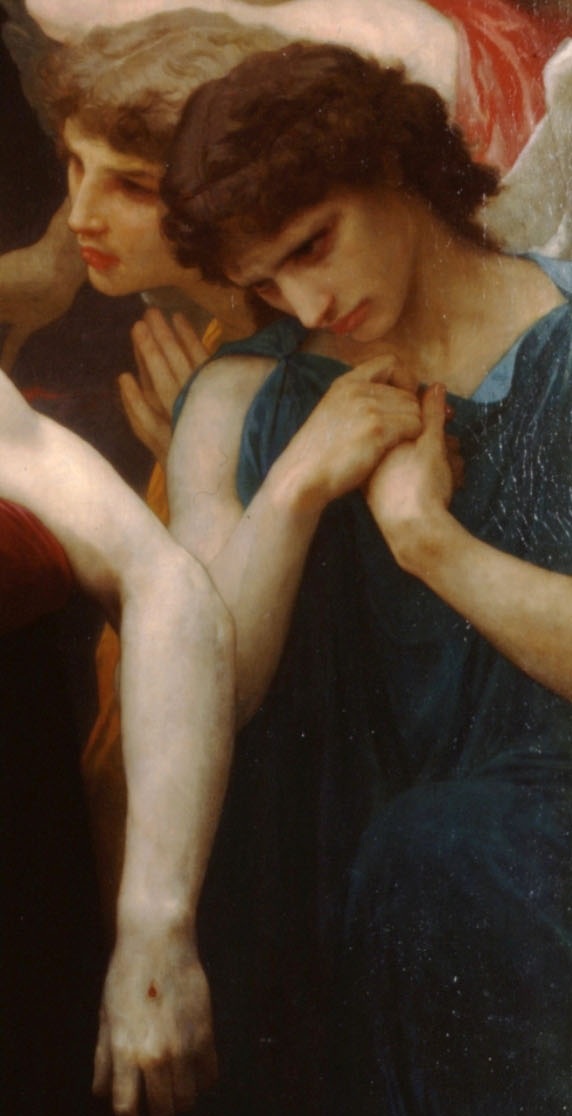
The blue-robed angel at the right lowers the head over clasped hands. The fingers gather into a compact shape beneath the face, a different movement from the hand raised across the eyes on the opposite side.
Bright robes move through violet, yellow, green and blue around Mary’s dark clothing. The changes of colour distinguish individual figures without dispersing the group. Above them, wings and extended arms form a crowded canopy. There is little empty space in which the sorrow can subside.
Mary does not need a more demonstrative gesture to remain central. The surrounding movements make her comparatively motionless face harder to pass over.

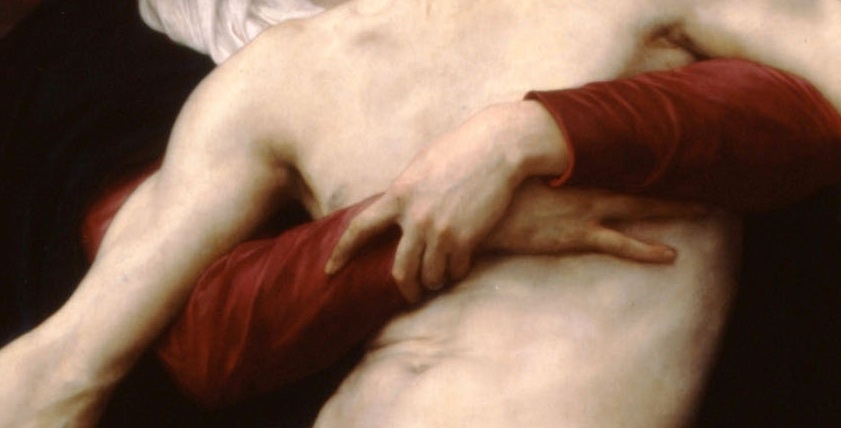
Dark red sleeves cross beneath and around the pale torso. One supporting hand lies against the body; another closes the embrace higher up. These gestures make Mary’s role physical. She is holding a weight, not simply appearing beside a sacred figure.
The contrast continues in Christ’s arms. One extends diagonally towards the left. The other drops at the right, beside the dark folds of her garments. Neither returns the pressure of her embrace.
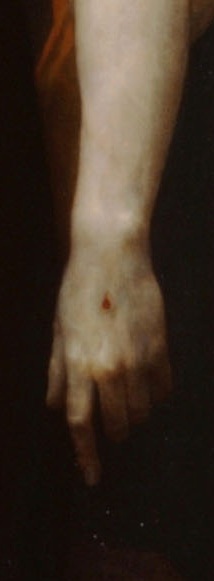
The hanging hand retains a visible wound. Its lowered fingers bring the aftermath of the Crucifixion into a small, exposed part of the body. The pose is quiet, but it is not sleep.
Bouguereau places these different hands within the same field: hands that clasp in prayer, a hand that covers a face, hands that support, and a hand that can no longer respond. Each gives the loss a different physical form.
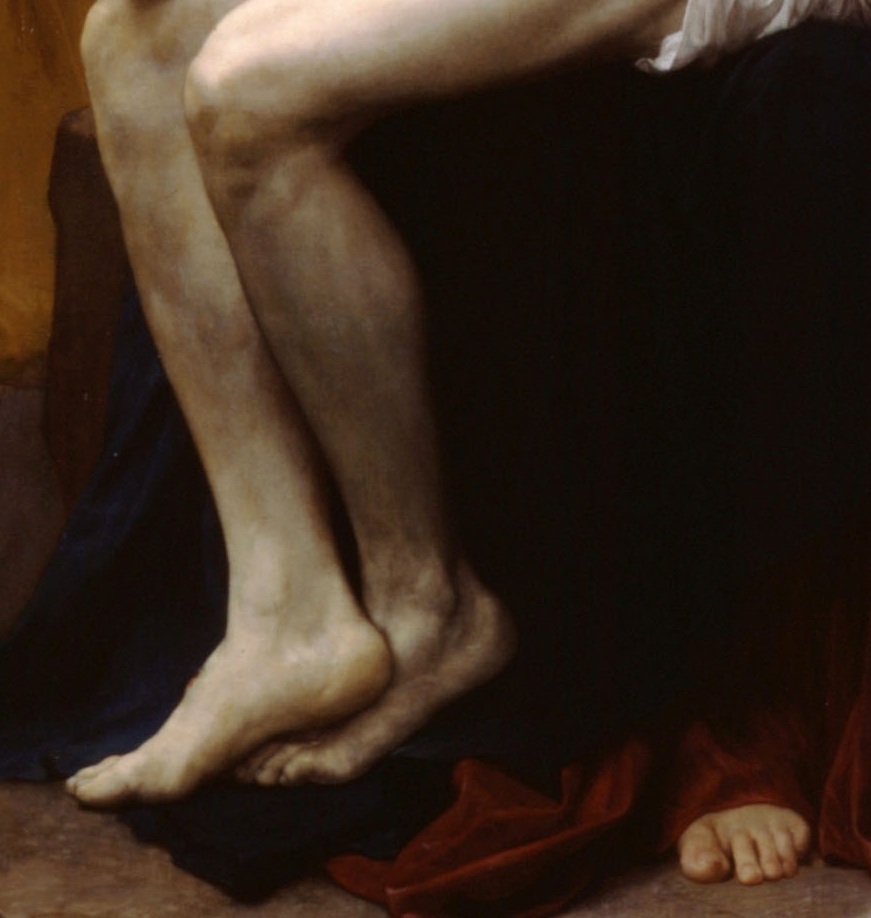
Christ’s lower legs extend across the dark fabric, with the feet drawn together at the left. Beneath Mary’s robe, a small exposed foot touches the stone farther to the right.
The difference is easy to miss when looking only at their faces. Her body still occupies the position of someone seated and supporting another person. His relaxed limbs depend on that support.
The broad black robe unites the central group, while the exposed feet make the bodies distinct again. Looking down the painting reveals how carefully the embrace has been constructed.
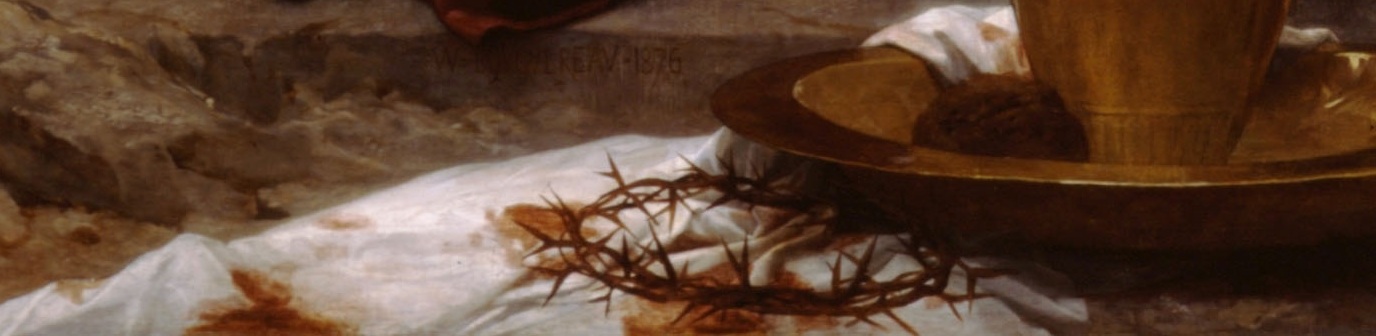
A crown of thorns lies on a pale cloth at the bottom of the composition. Reddish stains interrupt its light surface. The sharp, tangled points contrast with the smooth limbs above.
These objects connect the body’s stillness with the suffering that came before it. The Crucifixion is not shown as an action in progress. Its consequences remain in the wound, the abandoned crown and the stained fabric.
The foreground also brings the subject close to the viewer. The cloth spreads towards the edge of the picture, beneath the larger gathering of mourners. What initially seemed an elevated sacred scene reaches into the space immediately before us.
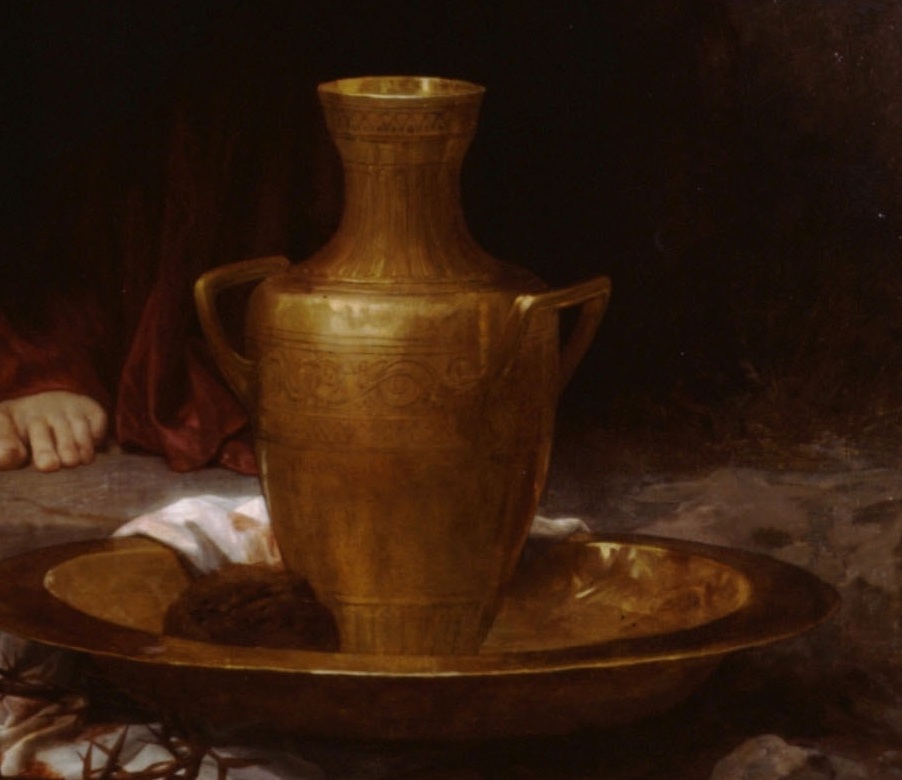
A golden vessel stands in a shallow basin below the figures. Its reflective surface catches the eye, although its size and position make it easy to overlook beside the bodies above.
The decisive detail is its inscription. Christie’s catalogue transcribes the Latin dedication:
IN MEMORIAM DILECTI MEI FILII GEORGII DIE XIX JULII ANNO MDCCCLXXV
It commemorates the painter’s beloved son Georges and gives the date 19 July 1875. The final Roman numerals mean 1875. This is a dedication to a real child within a painting of a biblical mother and son.
The inscription’s wording is documented in the catalogue; the small painted letters are difficult to follow in a full view. The vessel should not be described as an urn containing Georges’s ashes. The dedication establishes its memorial role, not its contents.
Georges died on 19 July 1875, aged sixteen. Christie’s identifies that loss as the immediate impetus for Pietà, completed the following year, and describes preparatory drawings in which Bouguereau worked through the composition.
The dedication makes this connection unusually concrete. We do not have to infer a family tragedy from the sadness of the faces. The painter placed his son’s name inside the image.
That changes the way the central embrace can be understood. Mary remains the Virgin, and Jesus remains Christ. The inscription does not identify either figure as a portrait of Bouguereau or Georges. Instead, it places a father’s loss in dialogue with an established image of a mother’s bereavement.
Seen through that dedication, the contrast becomes devastating: a father who could no longer hold his son painted a mother who still holds hers.
Return to Mary’s face. Her outward gaze has not changed, but we now bring another history to it. The distant sacred subject has acquired a name and a date from the painter’s own life.
A pietà is a devotional image of Mary mourning the dead Christ, usually holding him across her lap. The word carries the sense of pity or compassion. It names a subject represented by many artists, rather than one unique composition.
Museum accounts trace the image to medieval devotion. The Metropolitan Museum of Art notes that the Gospels do not describe this particular moment of Mary holding the dead body in her lap. Artists and religious writers developed it as a focus for prayer and reflection.
Bouguereau therefore works within a long visual tradition. His distinctive choices include the surrounding angels, the emphatic contrast of pale flesh and black fabric, Mary’s outward gaze and the private dedication below.
These choices allow different kinds of attention to coexist. A devotional viewer may contemplate the Passion. Another may first recognise the experience of holding someone who has died. The painting’s religious identity remains clear while the memorial gives its grief a personal history.
The Musée d’Orsay’s historical Salon database records Pietà as number 240 in the Paris exhibition of 1876, under Bouguereau’s name. The entry also associates it with Prince Demidoff.
The scale matters to that public encounter. Christie’s catalogues the oil painting at 222.9 × 149.2 centimetres. Seen at that size, its bodies and gestures occupy a very different space from a small image on a screen.
The 2010 auction record places it in private ownership and lists earlier museum loans. Those loans should not be mistaken for proof of permanent museum ownership or a current display location. The consulted records do not establish where a visitor can see it today.
Its public life and its intimate dedication meet in the same object. Hundreds of viewers could encounter the mother’s grief, while a small inscription preserved the name of the son being remembered.
William-Adolphe Bouguereau. The date appears with his signature, and the painting was exhibited at the Salon that year.
The outward gaze draws us into the scene. It can be read as an appeal or an invitation to share her sorrow, but her exact thoughts are not documented.
Bouguereau’s son, commemorated by the inscription on the foreground vessel. He died aged sixteen in 1875.
The inscription identifies a memorial dedication. It does not establish what, if anything, the vessel represents as containing.
No. Pietà names the subject. Bouguereau’s 1876 work is an oil painting; Michelangelo’s famous version is a much earlier marble sculpture.
It was catalogued in a private collection in 2010. Earlier museum loans do not establish a current permanent display location.
William-Adolphe Bouguereau, Pietà, 1876. Faithful photographic reproduction of the public-domain painting via Wikimedia Commons, PD-Art/PD-old-100-expired. Detail images are intentional crops of this same historical reproduction, without reconstruction or upscaling.
Enjoyed this story?
Save articles to your collection
Log in or create a free account, and this article will be waiting in your Private Collection.
Log in or sign up
Man Writing a Letter
Gabriel Metsu, c. 1664
The gallery list
Every painting is already 50% off. Join the list and we will send you an extra $15 code, plus first access to new collections.
No spam. Unsubscribe anytime. · Privacy Policy
Welcome
Your $15 code is on its way. Explore the gallery while you wait.