Loading cart…
No products in the cart.

1871 · Oil on canvas · Galleria d'Arte Moderna di Palazzo Pitti, Florence, Italy

Save articles to your collection
Log in or create a free account, and this article will be waiting in your Private Collection.
Log in or sign upThe genesis of Ecce Homo stretches back to the early 1840s, when Ciseri first began making preparatory studies for a large-scale composition depicting the moment described in the Gospel of John, Chapter 19, in which Pontius Pilate presents a beaten and crowned Christ to the people of Jerusalem with the words that give the painting its title. The project consumed the greater part of Ciseri's creative life, occupying him on and off for nearly thirty years as he refined the compositional arrangement, reworked individual figures, and searched for the precise emotional register he wished to achieve. The final canvas, measuring an imposing 370 by 290 centimeters, was completed and exhibited in 1871, earning widespread critical admiration and cementing Ciseri's reputation as the leading religious narrative painter of his generation in Italy. The painting was acquired for the collections of the Galleria d'Arte Moderna in Florence, where it has remained ever since, and it quickly became one of the most reproduced religious images of the late nineteenth century, appearing in engravings and photographs distributed across Catholic Europe and beyond. The extraordinary length of the painting's gestation reflects not creative uncertainty but a perfectionism that was central to Ciseri's working method: he was constitutionally incapable of releasing a work until every element had been resolved to his complete satisfaction, and the result of this patience is a canvas of remarkable unity and finish.
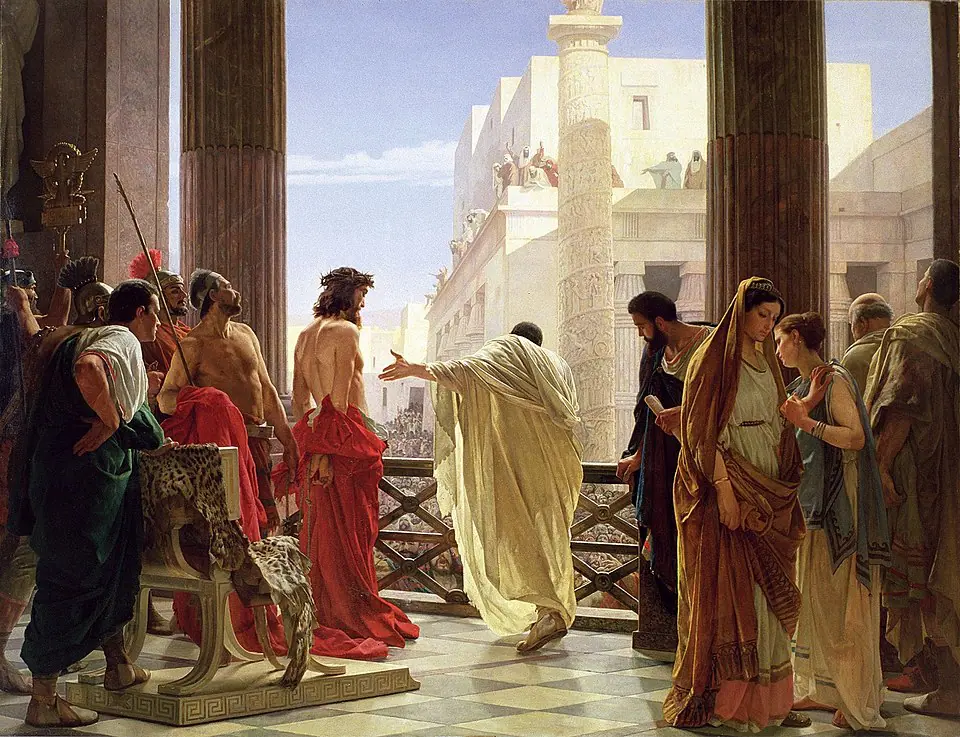
The compositional strategy of Ecce Homo is among the most sophisticated achievements in nineteenth-century religious painting. Ciseri chose to place the viewer at the level of the crowd below, looking up at the elevated loggia where Pilate and Christ stand, and this decision creates an immediate and powerful sense of spatial drama. The figure of Pilate dominates the left portion of the upper register, his toga a cascade of brilliant white that draws the eye and establishes him as the pivot of the narrative, while the figure of Christ, smaller and more withdrawn, occupies a position slightly behind and to the right, simultaneously present and already apart from the world that surrounds him. The architecture of the loggia frames the scene with a severity that echoes the moral weight of the subject, and the group of Roman soldiers behind the two central figures creates a dense, burnished backdrop of armor and shadow against which the pale figure of Christ is rendered even more vulnerable. In the foreground, a group of Jewish women recoil in horror and grief, their twisting bodies and anguished faces forming an emotional counterpoint to the cold authority on the loggia above. Ciseri handled the light with exceptional skill, bathing the loggia in a clear morning illumination that gives the scene an almost forensic clarity while leaving the crowd below in comparative shadow. The result is a composition of tremendous controlled power that rewards prolonged viewing at every level of detail. You can own this celebrated work as a hand-painted oil reproduction, bringing the full scale and drama of Ciseri's vision into your own space.
Ecce Homo operates simultaneously as a religious image, a political statement, and a meditation on human cruelty and compassion. At its most immediate level, the painting illustrates a specific moment in the Passion narrative, the formal presentation of Christ before the people who will call for his execution, and Ciseri rendered that moment with a literalness that draws from the most careful reading of the Gospel text. Yet the painting reaches beyond straightforward illustration into the territory of psychological and moral inquiry. The figure of Pilate, so prominently placed, is not simply an historical actor but an embodiment of the bureaucratic exercise of power, the man who knows the truth and chooses political convenience over justice. The women in the foreground, by contrast, represent the moral witness of the powerless, their grief a silent indictment of the spectacle being enacted above them. The painting was completed in 1871, the very year in which the political unification of Italy was being consolidated and the temporal power of the Catholic Church was being dismantled, and for contemporary audiences this image of institutional authority condemning innocence carried meanings that extended well into the present. The work has remained culturally resonant across successive generations precisely because its central drama, the individual human being subjected to the impersonal machinery of power, is not confined to any single historical moment. Owning a hand-painted oil reproduction of Ecce Homo means bringing home one of the most enduringly meaningful religious paintings of the nineteenth century.
Enjoyed this story?
Save articles to your collection
Log in or create a free account, and this article will be waiting in your Private Collection.
Log in or sign up