Loading cart…
No products in the cart.

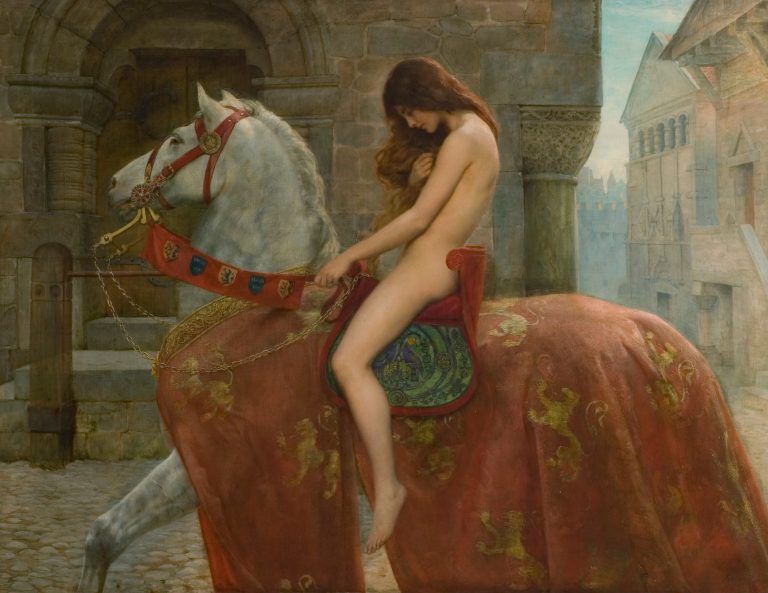
1898 · Oil on canvas · Herbert Art Gallery & Museum, Coventry, England
Save articles to your collection
Log in or create a free account, and this article will be waiting in your Private Collection.
Log in or sign up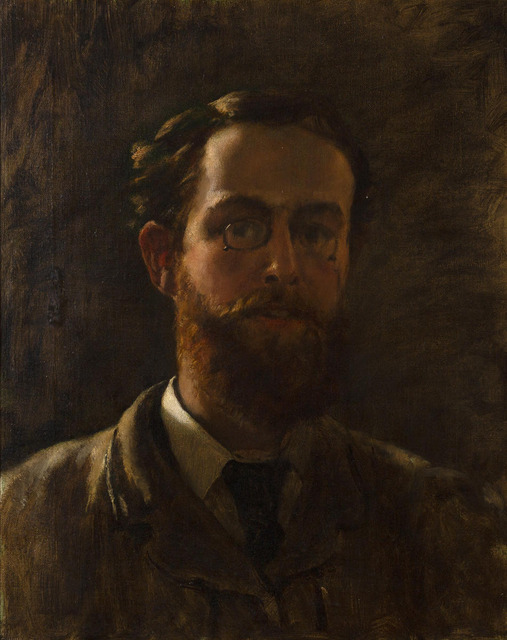 Explore the artistJohn Collier →
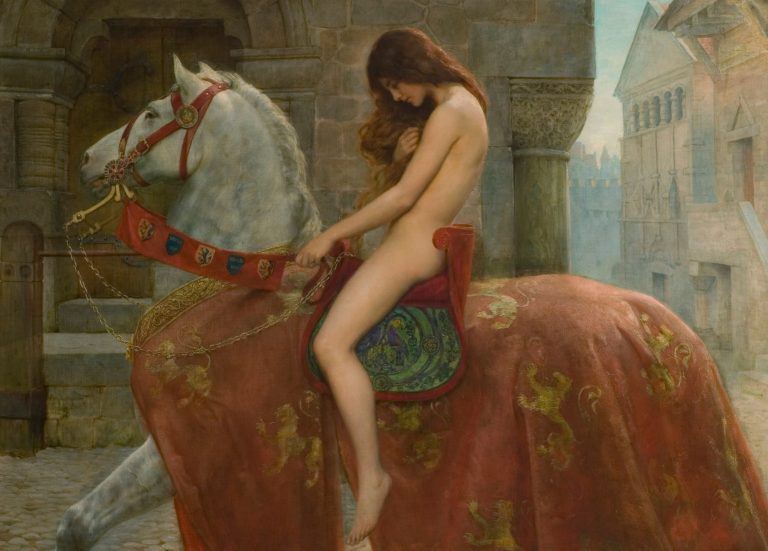
A white horse passes a closed doorway. Its rider lowers her head, gathers her long hair towards her chest and holds the reins with her other hand. There is no crowd, no escort and no husband watching her fulfil his challenge. The street appears to have made room for her by withdrawing from sight.
John Collier's Lady Godiva, also catalogued as Godiva, depicts the legendary ride through Coventry undertaken to relieve its people of oppressive taxation. The Herbert Art Gallery & Museum dates the painting to 1898. It is an oil on canvas measuring approximately 142 × 183 cm, now in the museum's collection in Coventry.
Its quietness is deceptive. The legend asks the townspeople to respect Godiva by refusing to look. A painting of her ride asks us to look closely. Collier leaves that contradiction in front of us.
In the familiar legend, Godiva pleads with her husband, Leofric, Earl of Mercia, to ease the taxes burdening Coventry. He agrees on an extraordinary condition: she must ride naked through the town. She accepts. In the version with which many readers are familiar, the inhabitants remain indoors and close their windows to protect her privacy.
This is a legend about a real woman. The historical Godiva, also known as Godgifu, was an Anglo-Saxon noblewoman and religious benefactor. The account of the ride appears much later than her lifetime and cannot be treated as contemporary evidence. The Herbert's history of Godiva traces how her story grew through art and civic tradition.
Collier gives us the ordeal between the demand and its promised reward. We do not see the argument, the decision or the relief of the townspeople. We see one person carrying out the bargain.
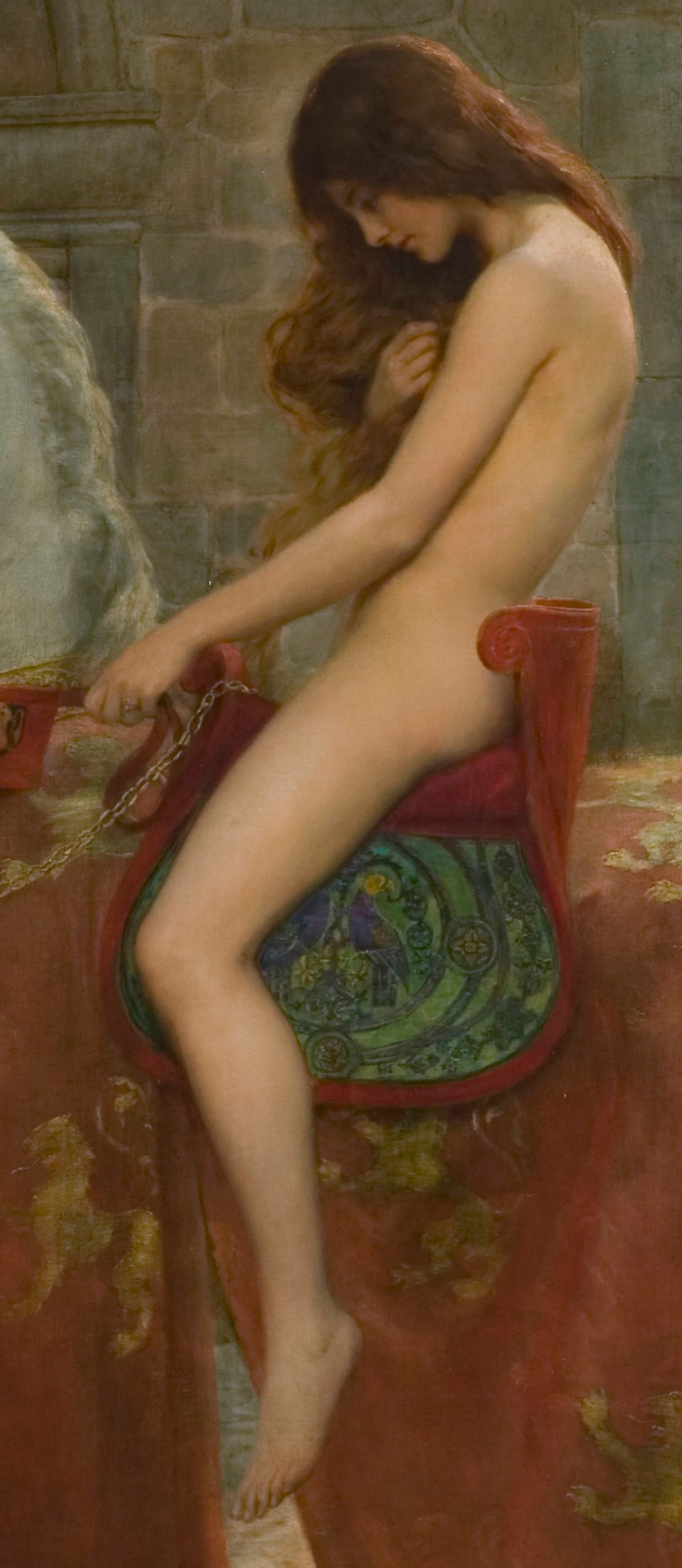
Godiva's bent head and inward gesture make the ride look difficult. Her hair falls forwards, interrupting the line between her face and her raised hand. She does not meet the viewer's eyes.
But her posture also contains composure. Her visible leg hangs down the side of the horse, ending in a relaxed foot. She sits astride, rather than side-saddle, a distinction the museum makes in its collection description. She is exposed to the street without being shown collapsing under the experience.
That balance allows several feelings to coexist. Embarrassment is a possible reading of the lowered gaze; resolve is suggested by the fact that she continues. Neither requires us to imagine that Collier has recorded the real Godiva's expression. This is a Victorian construction of a much older heroine.
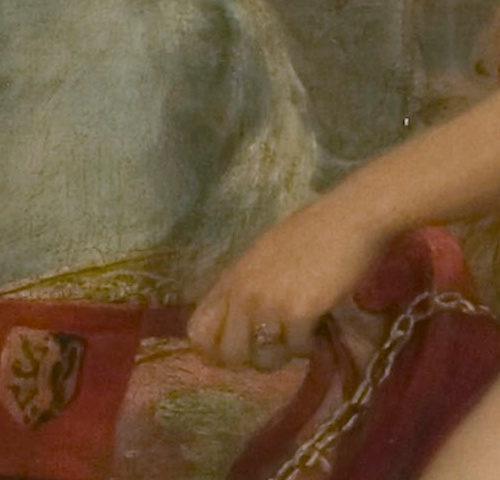
The hand at the reins gives the still figure a practical task. Its fingers close around the tack while the chain drops in a loose curve. The other hand is drawn towards her hair and chest. One gesture manages the journey; the other turns inward. Looking at both within the full rider detail helps explain why the pose feels restrained without being entirely passive.
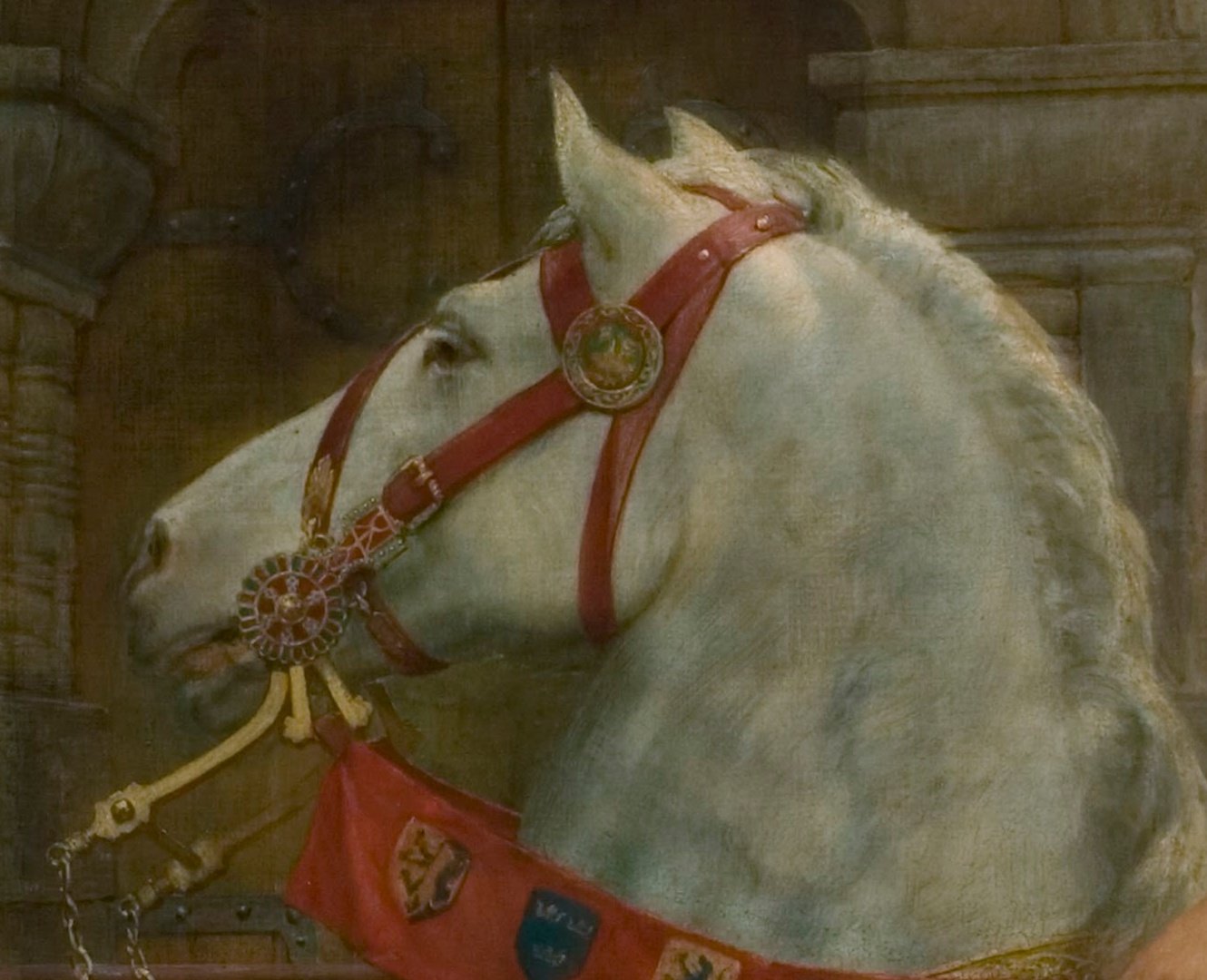
The horse presents a different kind of presence. Its ears rise, its neck arches and its head points into the direction of travel. Red straps cross the pale face, held by round gold-coloured ornaments. A decorative breast strap carries small shield-shaped emblems.
Its alertness makes Godiva's stillness more noticeable. The animal supplies a sense of forward movement while the rider's bowed head keeps our attention on what the passage costs her.
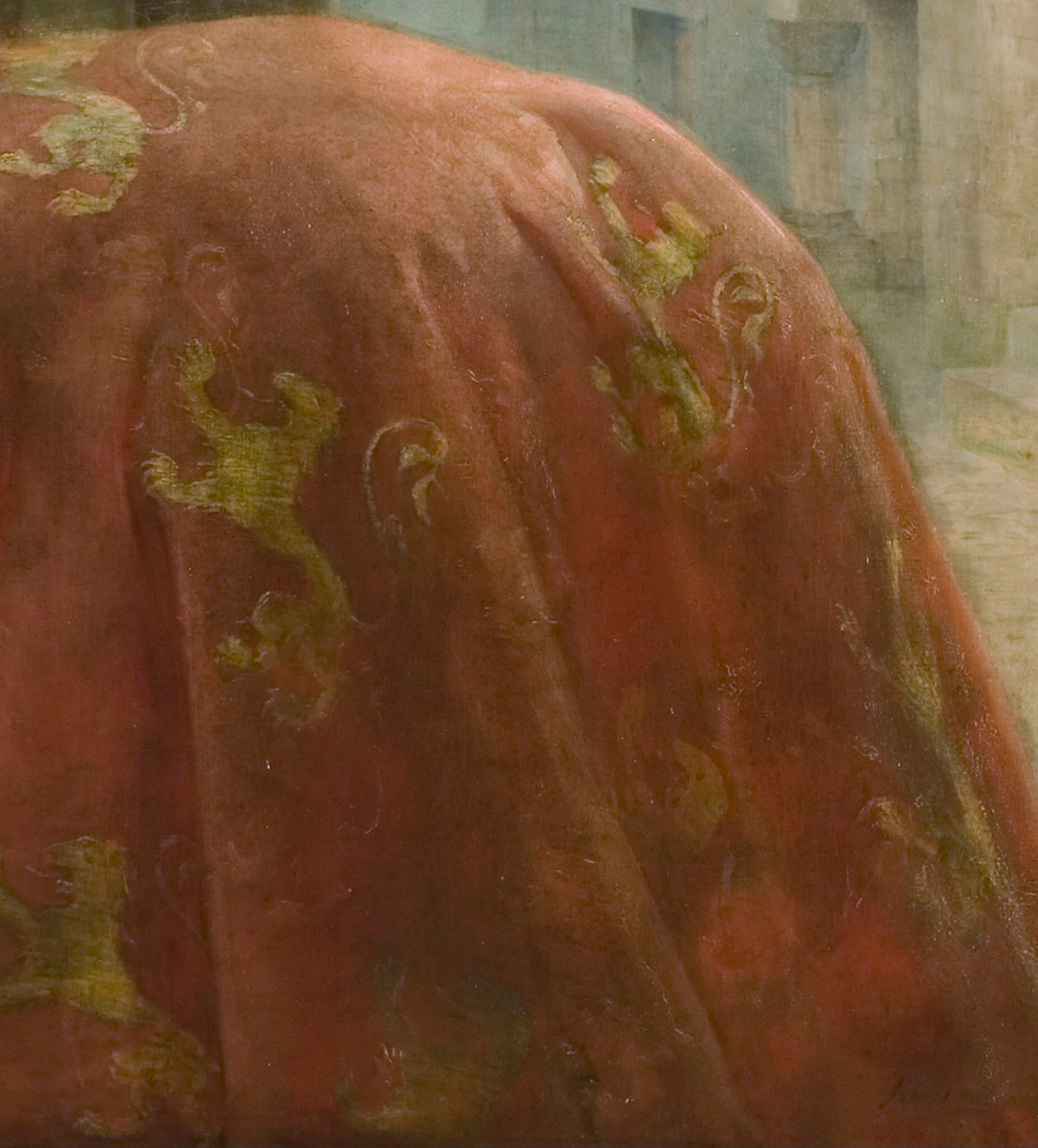
A red embroidered covering, or caparison, conceals most of the horse's body. Gold-coloured lions and curling tails recur across its folds. Near the rider, a smaller green and blue patterned textile introduces another surface and another range of colours.
These trappings matter to the story of rank. Godiva has removed the clothing that normally identifies and protects a noblewoman, yet the horse carries elaborate signs of ceremony and wealth. The contrast remains visible even without assigning each shield to a particular historical family. Collier's painted emblems should not be treated as proof of accurate eleventh-century heraldry.
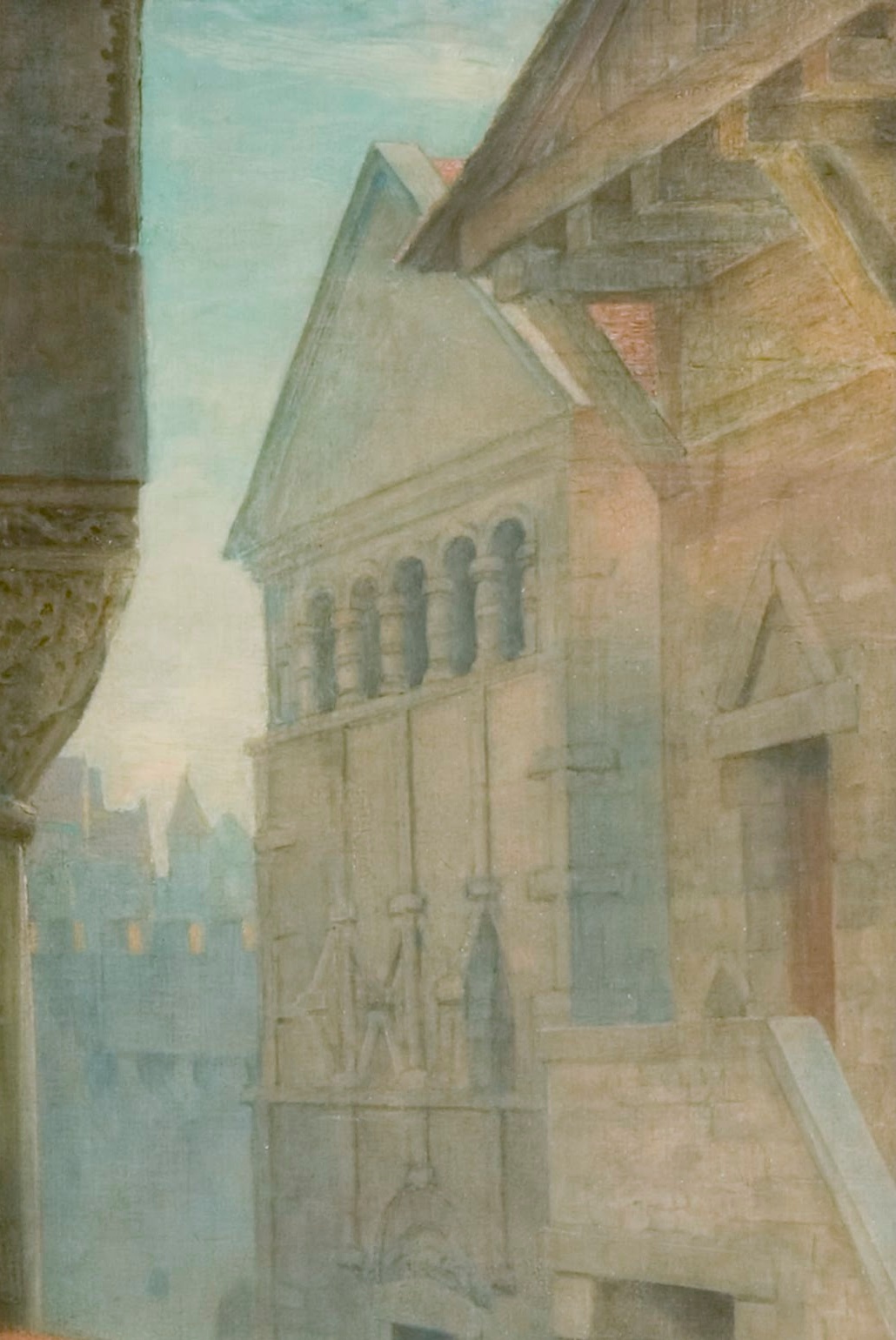
At the right, buildings recede into a pale, hazy distance. Their windows and doors offer places from which someone might look, but no face is clearly presented to us. A heavy stone pier separates the near figure from that narrow view down the street.
The closed doorway behind the horse reinforces the same feeling. Architecture occupies the places where a public gathering might have stood. The setting does not simply tell us that Godiva is in a town; it makes the town's withdrawal part of the action.
In later versions of the legend, one inhabitant breaks the agreement. Peeping Tom looks when everyone else has turned away and is punished for it. Collier does not give us an obvious Tom to condemn inside the scene. The clearest act of looking happens outside the canvas, where we stand.
That is the problem art historian Kate Nichols examines in her study of the painting: an image of a forbidden sight makes the spectator's own position uncomfortable. The empty street intensifies that question rather than removing it.
Alfred, Lord Tennyson's poem Godiva, published in 1842, helped make the subject popular with Victorian artists. In it, the ride becomes a passage through an almost painfully attentive silence:
Then she rode forth, clothed on with chastity:
Alfred, Lord Tennyson, Godiva, as printed in Poems, 1843
The deep air listen'd round her as she rode,
And all the low wind hardly breathed for fear.
The opening line gives the paradox its sharpest form: physical exposure can coexist with moral dignity. Around her, the poem makes the world seem capable of noticing what the townspeople have promised not to see.
Collier's closed door and vacant street offer a visual counterpart to that silence. This does not mean every object illustrates a particular line. The painting and poem share a concern with a public act carried out under the pressure of possible observation.
Collier lived from 1850 to 1934. Those dates describe the artist, not the period in which Godiva lived and not the date of this painting. His canvas presents an imagined medieval scene through the choices of a painter working at the end of the nineteenth century.
Nichols also reports correspondence in the museum's object file suggesting that the model may have been Mabel Violet Hall, later known on stage as Mab Paul. She would have been about sixteen. The identification is tentative. It adds a question about the power involved in making and exhibiting the image, alongside the story of the noblewoman it represents.
The same study records the painting's exhibition at London's New Gallery in June 1898 and in Birmingham that September. This was an image made for public attention, although its subject's privacy is central to the legend.
Holding those circumstances together makes the work more interesting than a straightforward celebration of beauty or courage. Godiva's protest, Collier's pictorial choices and our own response belong to different moments. The painting brings them into contact without settling every disagreement between them.
John Collier painted this version. It is commonly called Lady Godiva, while the Herbert also uses the shorter title Godiva.
1897 appears in some online references and image titles. This article follows the Herbert Art Gallery & Museum's date of 1898, also used in Kate Nichols' scholarly study and its account of the painting's exhibitions that year.
Godiva was a historical person, but the famous ride is a later legend rather than an established event supported by contemporary evidence. Collier depicts the story's imagined ordeal.
It belongs to the Herbert Art Gallery & Museum in Coventry, England. The oil painting on canvas measures approximately 142 × 183 cm.
In Collier's Priestess of Delphi, a seated figure also keeps her eyes from meeting ours. There, a laurel branch, a shallow bowl and rising vapour turn a quiet pose into a story about prophecy and its interpretation.
John Collier, Godiva (Lady Godiva), 1898. Herbert Art Gallery & Museum, Coventry. Public-domain faithful reproduction via Wikimedia Commons; source: Herbert / Google Arts & Culture. Painting image source.
Enjoyed this story?
Save articles to your collection
Log in or create a free account, and this article will be waiting in your Private Collection.
Log in or sign up
Man Writing a Letter
Gabriel Metsu, c. 1664
The gallery list
Every painting is already 50% off. Join the list and we will send you an extra $15 code, plus first access to new collections.
No spam. Unsubscribe anytime. · Privacy Policy
Welcome
Your $15 code is on its way. Explore the gallery while you wait.