Loading cart…
No products in the cart.

1891 · Oil on canvas · Art Gallery of South Australia, Adelaide
Save articles to your collection
Log in or create a free account, and this article will be waiting in your Private Collection.
Log in or sign up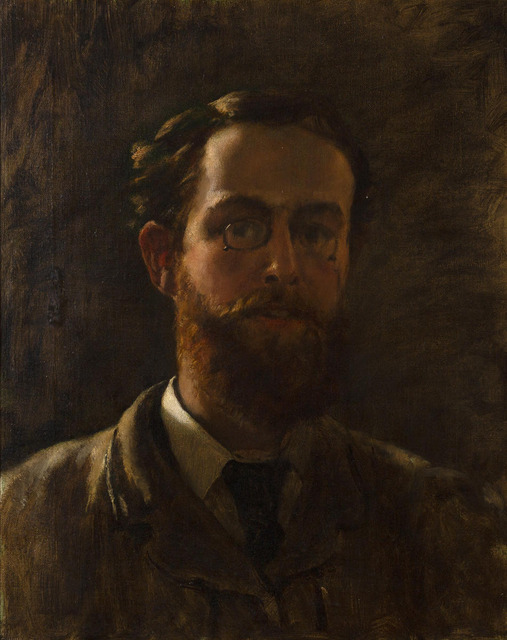 Explore the artistJohn Collier →
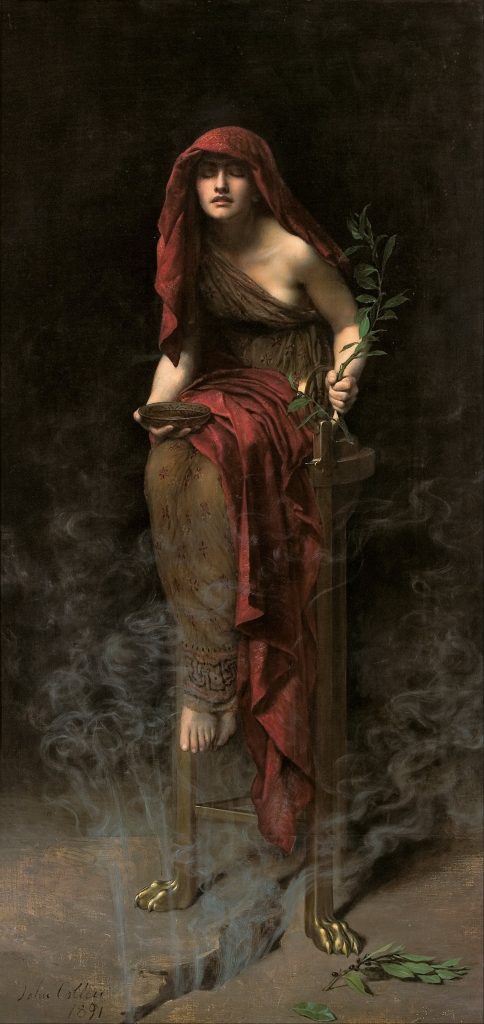
Look beneath the priestess’s bare foot. Two bronze paws stand on either side of a crack in the floor. Vapour rises between them. Higher up, the priestess steadies a shallow bowl, her eyes closed and her lips slightly parted. John Collier’s 1891 painting Priestess of Delphi shows the Pythia, the woman through whom people consulted Apollo at Delphi.
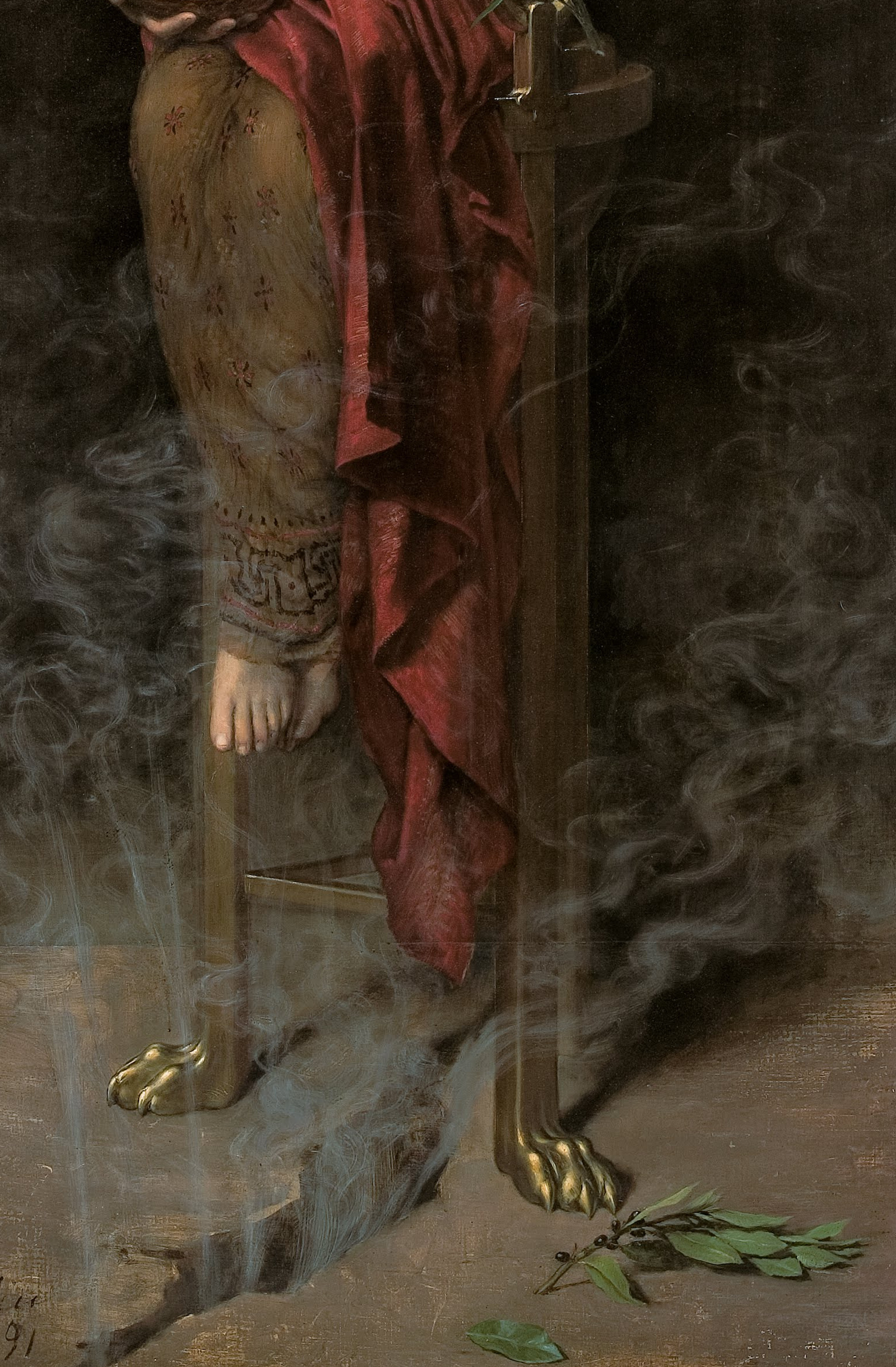
Look at the metal supports and the hem of the robe. Their edges remain visible through some strands and disappear behind others. The crack runs towards the lower edge of the canvas, while the strands of vapour draw the eye back up towards the priestess.
Ancient writers including Plutarch discussed an emanation associated with the oracle. Modern researchers have proposed naturally occurring gases as an explanation, and other scholars have challenged the case for intoxication. Collier’s painting was made in 1891. Its vapour shows how he imagined the scene. The historical evidence leaves the cause of the priestess’s state open.
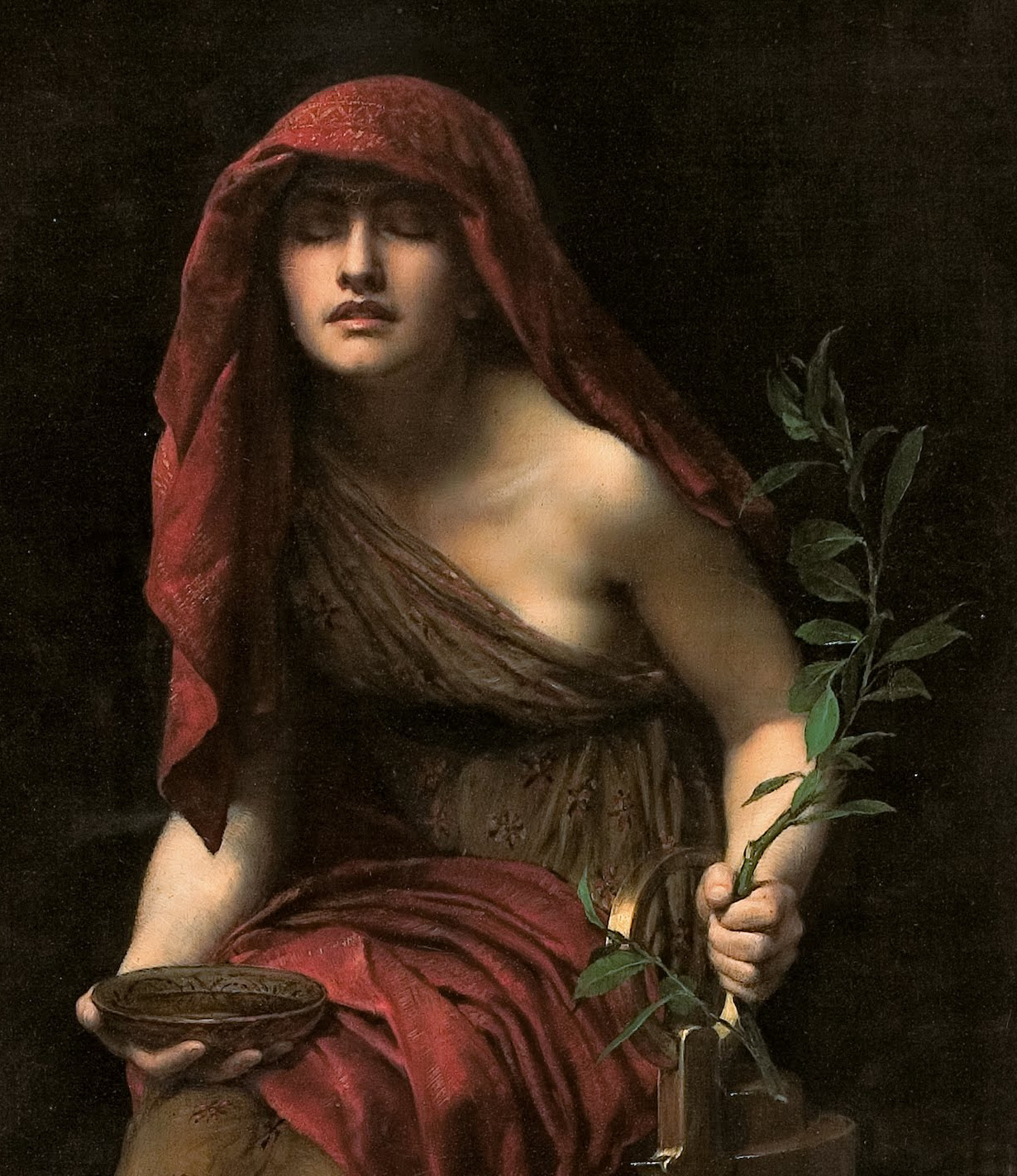
The two hands do different things. One is open beneath a shallow bowl, balancing it level. The other closes around the stem of a branch. The Art Gallery of South Australia identifies the bowl as holding water and the branch as sacred laurel.
Their placement gives the ritual a shape. The bowl sits low against the red cloth, with a narrow line of light around its rim. The branch rises beside her bare shoulder, then continues into the darkness, where the leaves almost disappear. Follow it down the painting and you find another sprig on the floor. That small repetition connects what she holds to the space around her.
These objects give us something to look at while the woman remains absorbed in the rite. We never see a questioner, an assistant or a crowd. Collier puts us close enough to notice how the bowl sits in her hand, then leaves the rest of the ceremony outside the frame.
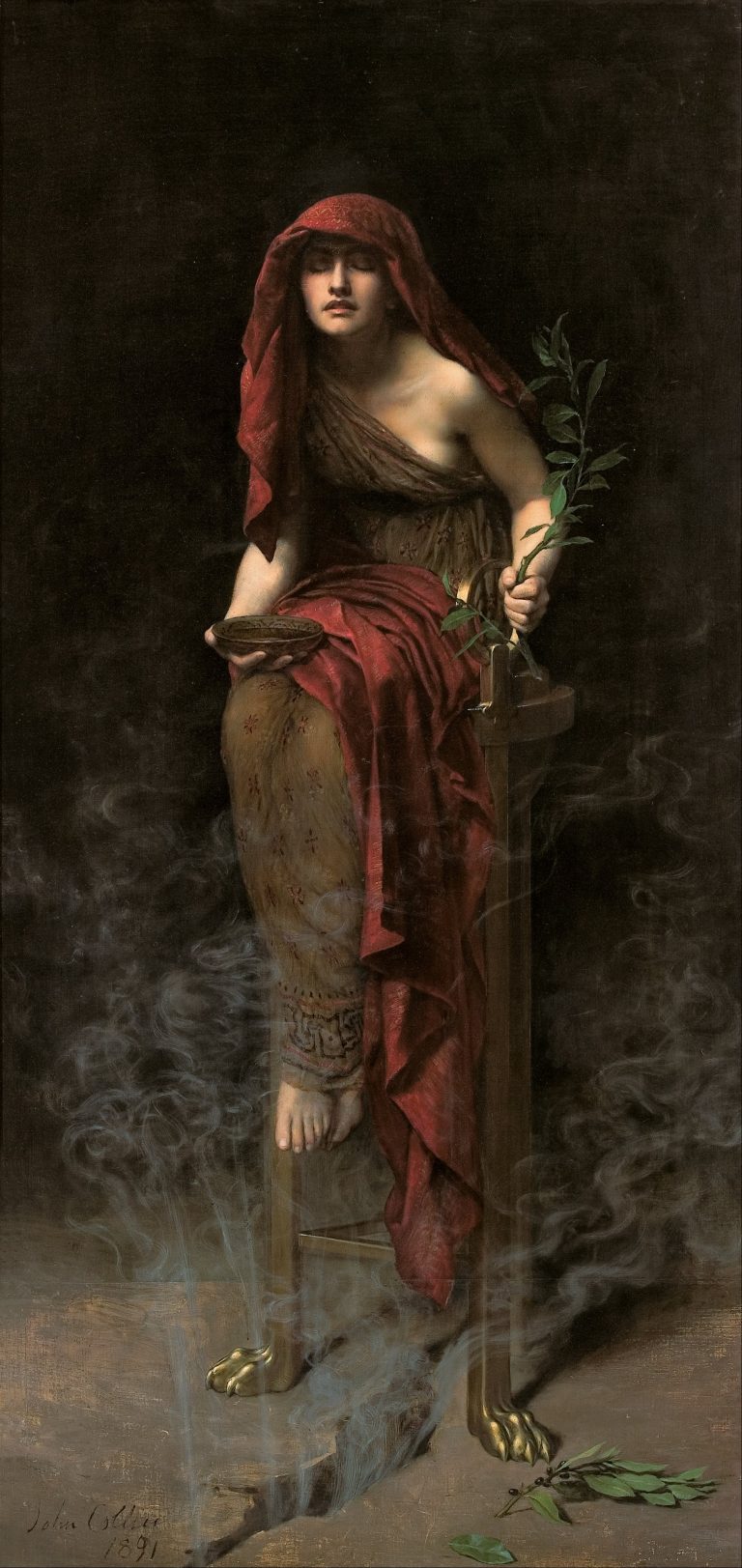
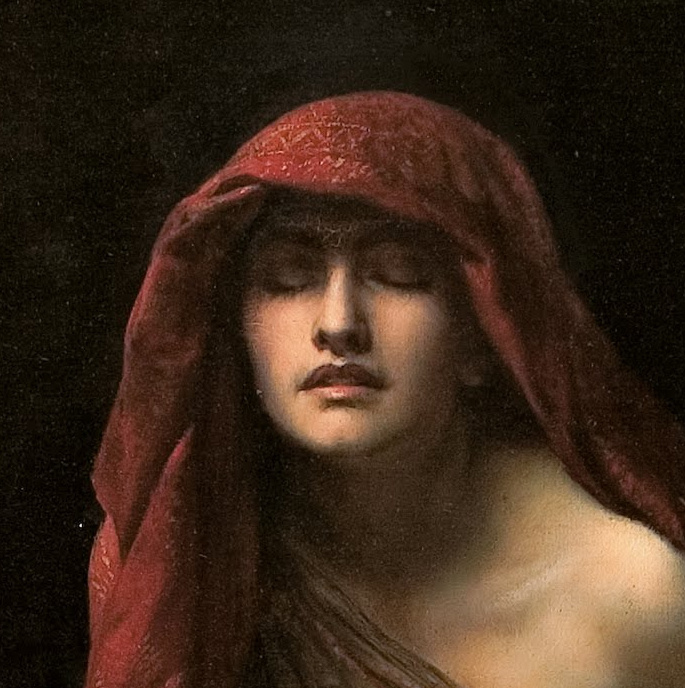
Follow the branch back to the red hood. Her eyelids are in shadow while light catches the bridge of her nose, her lips and one bare shoulder. Her lips are parted just enough to suggest that she might speak. Collier leaves us waiting for the words.
The Pythia was the priestess of Apollo at Delphi. The title belonged to an office held by successive women. People came to the sanctuary with questions, and the responses were understood as Apollo’s. That gave the voice of one woman the authority to reach well beyond the room in which she spoke.
In Herodotus’s account, King Croesus asks whether to march against Persia and learns that he would destroy a great empire. He assumes the empire is Persia’s. The campaign costs him his own. The story shows how much could depend on the way an answer was understood.
Collier leaves us at an earlier point in the exchange. There is no battle, king or written prophecy in the picture. There is only a person on a stool, with her mouth slightly open, at the moment when someone would be waiting to hear what came next.
Collier signed and dated the canvas at the lower left, beside the opening in the floor. The Art Gallery of South Australia records that it was painted in London in 1891. The painting is 160 centimetres tall and 80 centimetres wide. The format gives nearly as much room to the descent from the priestess’s lap to the fissure as it gives to her upper body.
The painting was exhibited in Adelaide in 1893. According to the gallery, the Earl of Kintore, then governor of South Australia, acquired it for the collection after seeing it there. The museum records his gift in the same year. It remains in that collection as accession 0.108.
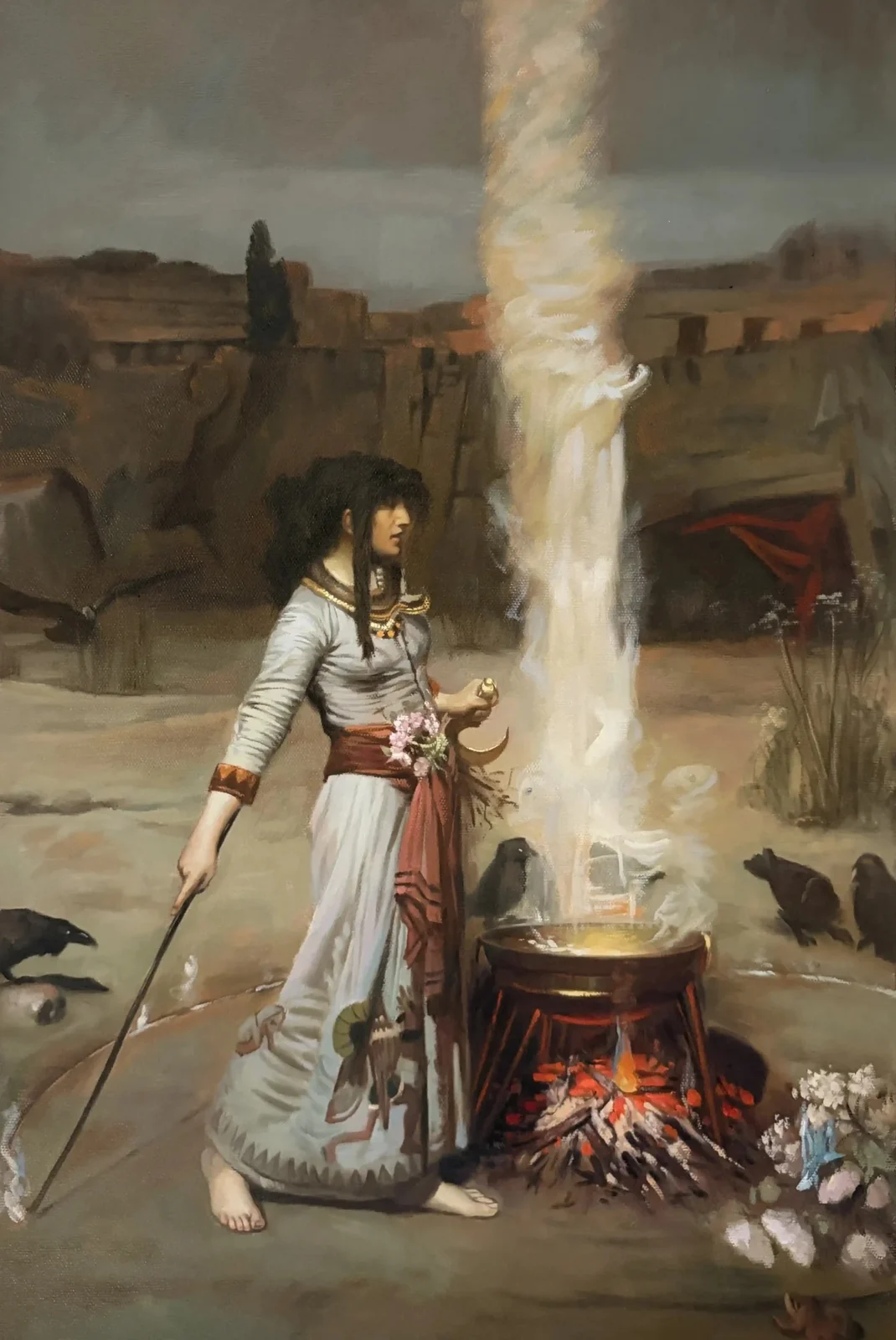
Collier regularly exhibited portraits at the Royal Academy. Here, he uses a portrait painter’s attention to the face within a scene that depends on what we cannot see. If you’re exploring his mythological subjects, compare the figure in Collier’s Circe.
The Art Gallery of South Australia identifies a shallow bowl of water and a branch of sacred laurel. Another sprig lies beside the fissure at lower right.
The original is in the Art Gallery of South Australia in Adelaide. Collier painted it in oil on canvas in 1891. It measures 160 × 80 cm, height by width.
Collier uses it to connect the priestess’s trance with the opening beneath her stool. Ancient descriptions and modern research have prompted several explanations, but the painted vapour belongs to his interpretation of the oracle.
John Collier, Priestess of Delphi, 1891. Art Gallery of South Australia, Adelaide. Google Art Project image via Wikimedia Commons.
Enjoyed this story?
Save articles to your collection
Log in or create a free account, and this article will be waiting in your Private Collection.
Log in or sign up
Man Writing a Letter
Gabriel Metsu, c. 1664
The gallery list
Every painting is already 50% off. Join the list and we will send you an extra $15 code, plus first access to new collections.
No spam. Unsubscribe anytime. · Privacy Policy
Welcome
Your $15 code is on its way. Explore the gallery while you wait.