Loading cart…
No products in the cart.

1849–1850 · Oil on canvas · Formerly Dresden; original destroyed in 1945
Save articles to your collection
Log in or create a free account, and this article will be waiting in your Private Collection.
Log in or sign up Explore the artistGustave Courbet →
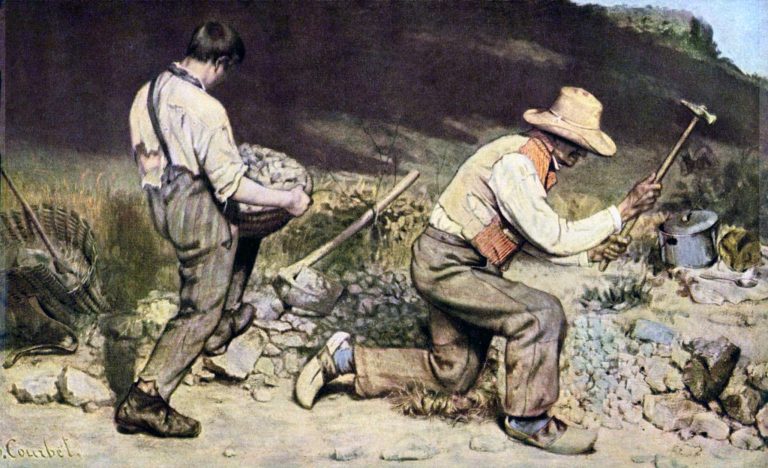
A younger man lifts a basket of broken stone. An older man kneels with a hammer. Behind them, a dark bank rises so steeply that only a small corner of sky remains.
Gustave Courbet's The Stone Breakers, painted in 1849–1850, gives these workers the space and seriousness that large paintings had often reserved for heroes. Their task is ordinary, repetitive and physically demanding. Nothing in the picture supplies a triumphant conclusion to it.
The original painting was destroyed in 1945. The image we know survives through reproductions. That loss changes how carefully we should talk about its colour and painted surface, but it does not erase the force of its composition.
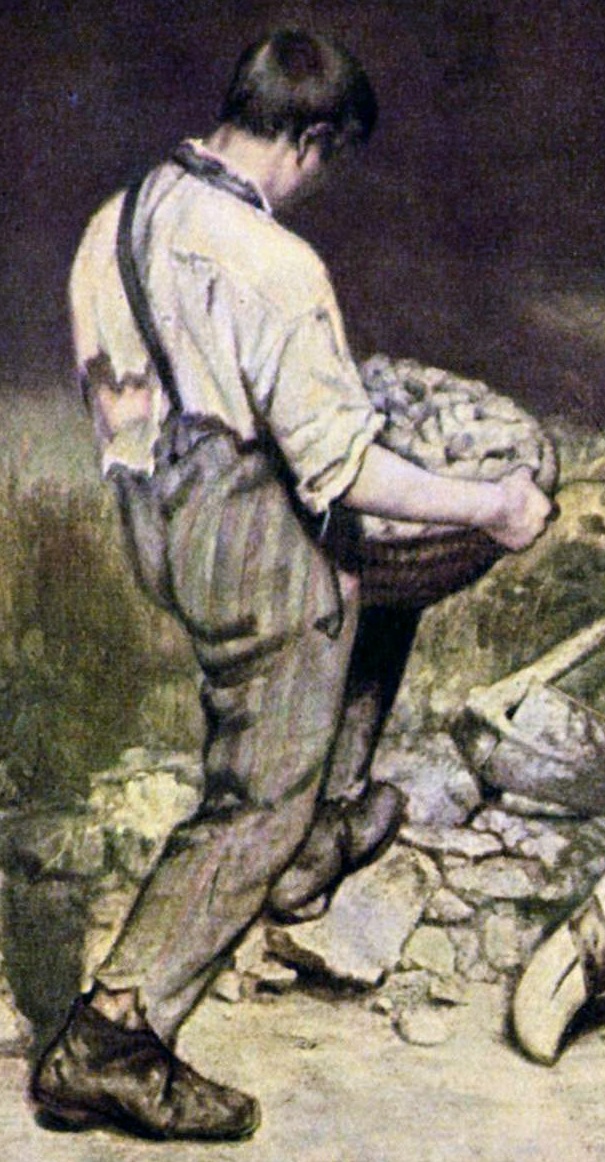
The standing figure's back faces us. His shirt is torn, his clothing hangs unevenly and his arms hold the weight of a basket. His bent head keeps his expression largely out of view.
That choice denies the viewer an easy emotional portrait. We cannot look into his eyes and turn him into one neatly readable feeling. We have to notice what his body is doing.
The load is held in front of him while his legs brace below. The basket carries an accumulation of small fragments, linking his lifting to the other man's hammering. These are related stages of one task.
Courbet does not need to identify him as a named individual for his labour to become a substantial subject. At the same time, the absence of a visible face should not make him interchangeable with an abstract idea of poverty. His posture, clothing and action remain specific.
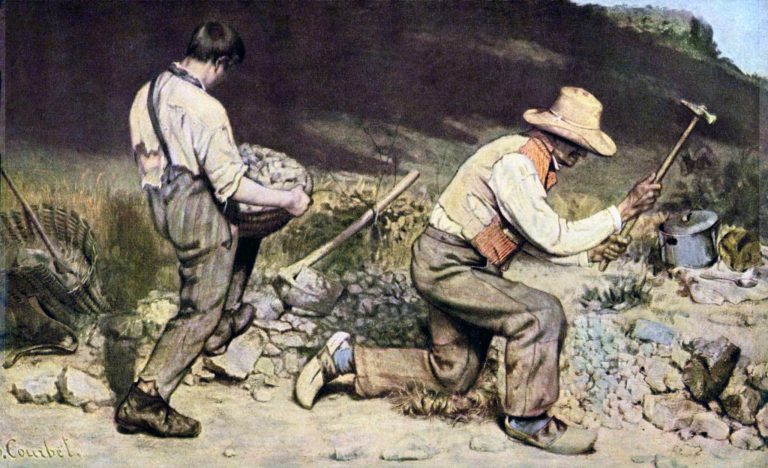
His bent body differs from the younger man's standing one. Together they offer two arrangements of effort: carrying and breaking. Their movements occupy much more space than the narrow glimpse of landscape beyond them.
The age difference has encouraged readings of a working life extending from youth into old age. That is an interpretation of the paired figures, not a biography of two securely identified sitters. The painting's visible contrast supports the thought without telling us everything about either man's past.
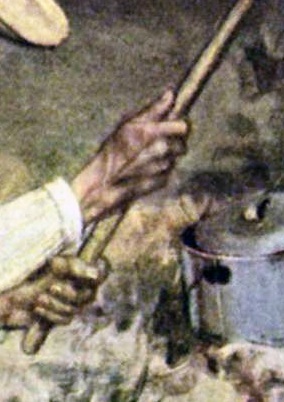
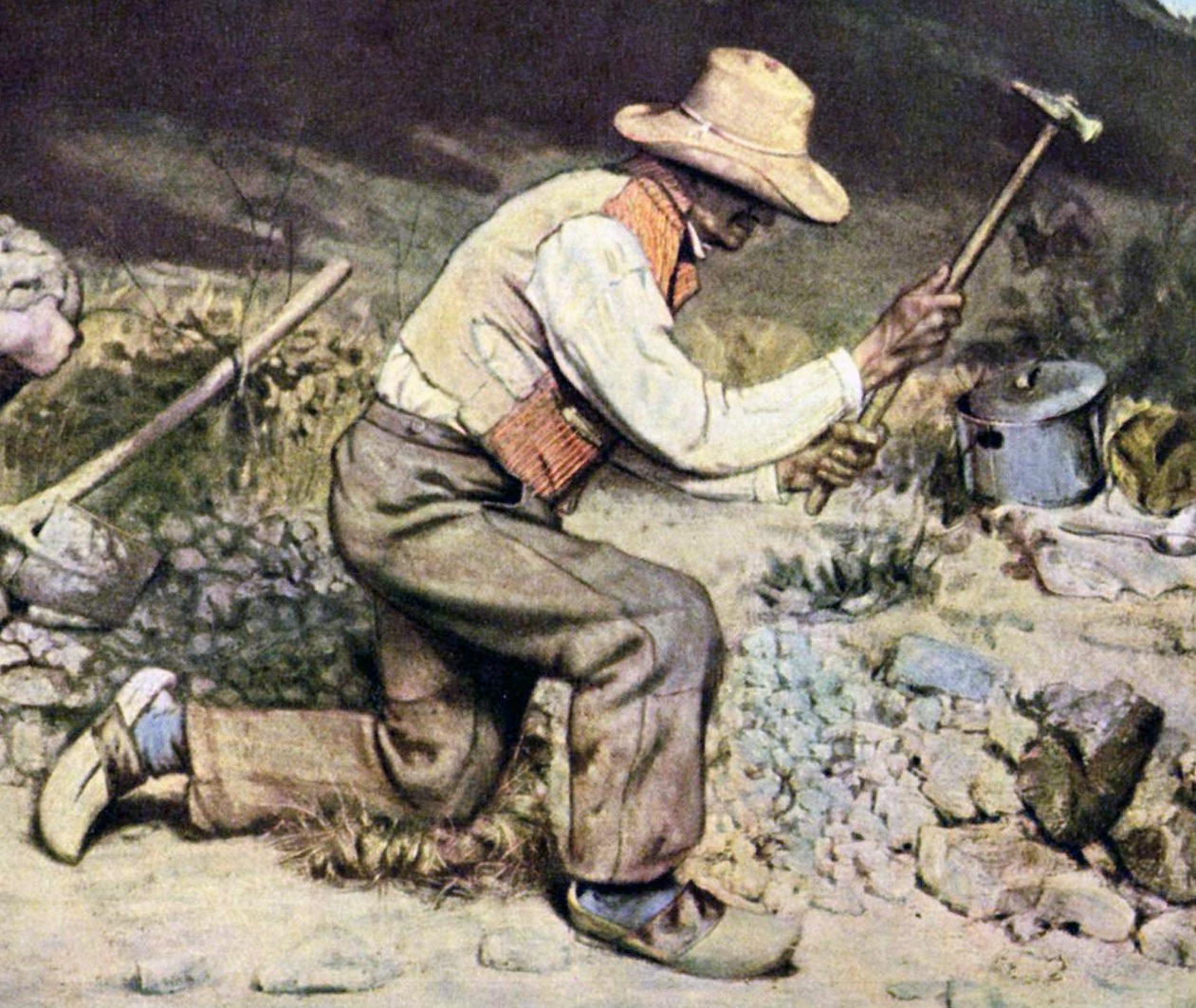
The kneeling worker grips the hammer at two points. His hands arrange the tool for a blow; the stone waits below. The action has not yet completed itself.
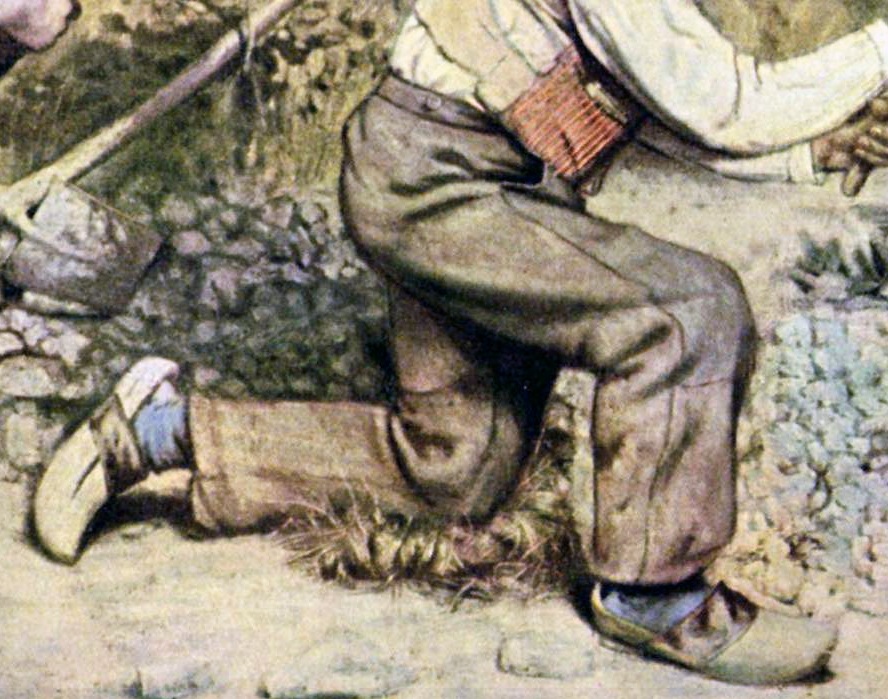
Patches, folds and worn footwear are conspicuous. Fabric bunches around the bent knee, while the low working posture brings clothing close to the rough ground.
These details carry some of the information that a grand gesture might convey in a history painting. Repeated use has marked the material around the bodies. Labour has a visible environment and a visible cost.
Calling the clothes picturesque would describe only the pleasure of looking at their varied shapes. Courbet also lets them describe working conditions. The worn surfaces belong to people whose task is neither leisurely nor ornamental.
Because we see a reproduction rather than the surviving original, fine claims about the exact handling of individual brushstrokes would go beyond the evidence available here. The larger arrangements of light fabric, dark ground and bent limbs remain clear.
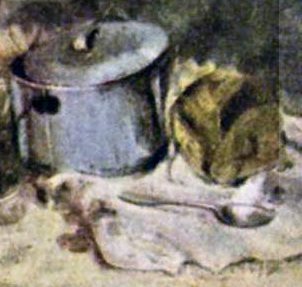
A pot, a spoon and food resting on a cloth occupy a small patch of ground beside the worker. They are easy to miss while following the much larger human forms.
The meal implies a duration beyond the lifted hammer. People have brought something to eat because work continues over time. The painting shows an instant while allowing the viewer to imagine a longer day around it.
The objects also belong to the same ground as the stones. There is no comfortable, separate domestic interior waiting within the frame. Work and the practical requirements of sustaining a body meet in one confined space.
A rising bank closes much of the background. It does not provide the broad distance that might transform the scene into a pleasant excursion through the countryside.
The small opening of sky at the upper right makes the enclosure more apparent. The workers do not stand before a horizon that promises movement into a larger world. The composition keeps attention low, where bodies, tools and stones press together.
This does not prove that Courbet intended every element as a symbol of imprisonment. It explains an effect the arrangement produces. The little available distance cannot compete with the immediate task.
The Metropolitan Museum's account places The Stone Breakers among Courbet's major challenges to the conventions of the Paris Salon of 1850–1851. He presented contemporary rural life on an ambitious scale, with an emphatically direct approach.
Large paintings traditionally carried expectations of historical, religious or mythological importance. Courbet's workers did not arrive with the narrative credentials of ancient heroes. The decision to give them sustained attention was itself a challenge to that hierarchy.
The response was political as well as aesthetic. The Met notes that viewers associated Courbet's rural subjects with contemporary social questions. That history does not mean every detail was a coded manifesto or that the artist's politics can be reduced to one simple slogan.
In this painting, the formal decision and the social question remain closely joined. What kinds of lives deserve a large picture? How long should a viewer be asked to look at work that is usually passed by?
The original belonged to the Dresden collections and was destroyed during the Second World War in 1945. Historical photographs and reproductions preserve the composition. A French museum record for a later lithograph after Courbet explicitly records the loss.
That is why claims that the original can be visited in a present-day Dresden gallery are misleading. A collection association in an old caption is not evidence that the painting survived.
The loss also puts limits on the apparent certainty of a digital image. Different reproductions can vary in colour, contrast and the amount of detail they preserve. They should not be treated as interchangeable access to the original painted surface.
Its absence makes the repeated work in the image feel different. The men continue their task in reproductions, while the object Courbet made no longer exists. A painting about overlooked labour has become an example of cultural memory depending on imperfect surviving records.
It is useful to place the painting within Courbet's wider work and the history of Realism. It is less useful to let that label replace looking.
The younger worker's turned head, the older man's two-handed grip and the small meal beside the stones do not all make the same point. Each expands the working day in a different direction.
The painting remains forceful because the task does not become a decorative pretext for a beautiful landscape. Courbet makes us stay with the people doing it.
It is generally dated 1849–1850; it is also frequently listed simply as 1849. The Met discusses it in connection with Courbet's Salon work of 1850–1851.
The original was destroyed in 1945. It is known through historical images and reproductions.
Two workers break and carry stone. Courbet makes their bodily effort, tools, worn clothes and working environment the main subject.
It gives contemporary manual labour the scale and seriousness associated with more prestigious subjects in academic painting. Its reception helped make that choice an important artistic and social argument.
Gustave Courbet, The Stone Breakers, 1849–1850. Original destroyed in 1945. Historical colour reproduction via Wikimedia Commons, public domain; source limits prevent claims about the original surface or exact colour.
Enjoyed this story?
Save articles to your collection
Log in or create a free account, and this article will be waiting in your Private Collection.
Log in or sign up
Man Writing a Letter
Gabriel Metsu, c. 1664
The gallery list
Every painting is already 50% off. Join the list and we will send you an extra $15 code, plus first access to new collections.
No spam. Unsubscribe anytime. · Privacy Policy
Welcome
Your $15 code is on its way. Explore the gallery while you wait.