Loading cart…
No products in the cart.

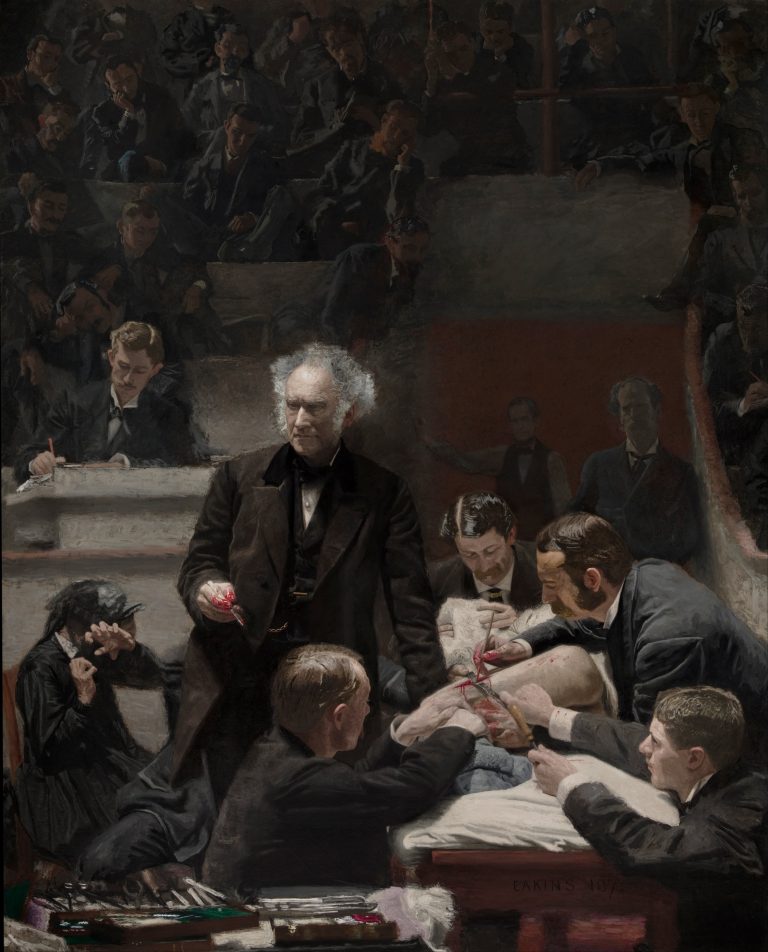
1875 · Oil on canvas · Jointly owned by Philadelphia Museum of Art and PAFA
Save articles to your collection
Log in or create a free account, and this article will be waiting in your Private Collection.
Log in or sign up Explore the artistThomas Eakins →
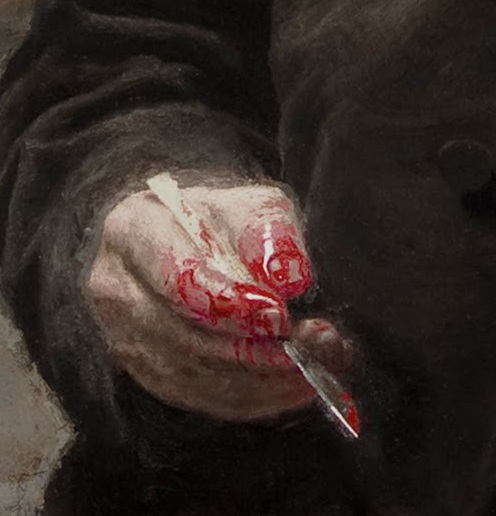
Samuel D. Gross stands beside a patient while the operation continues. His head is brightly lit. His dark coat gives him a firm, upright silhouette. In one hand he holds a scalpel, and the red on his fingers prevents the lecture from becoming detached from the body on the table.
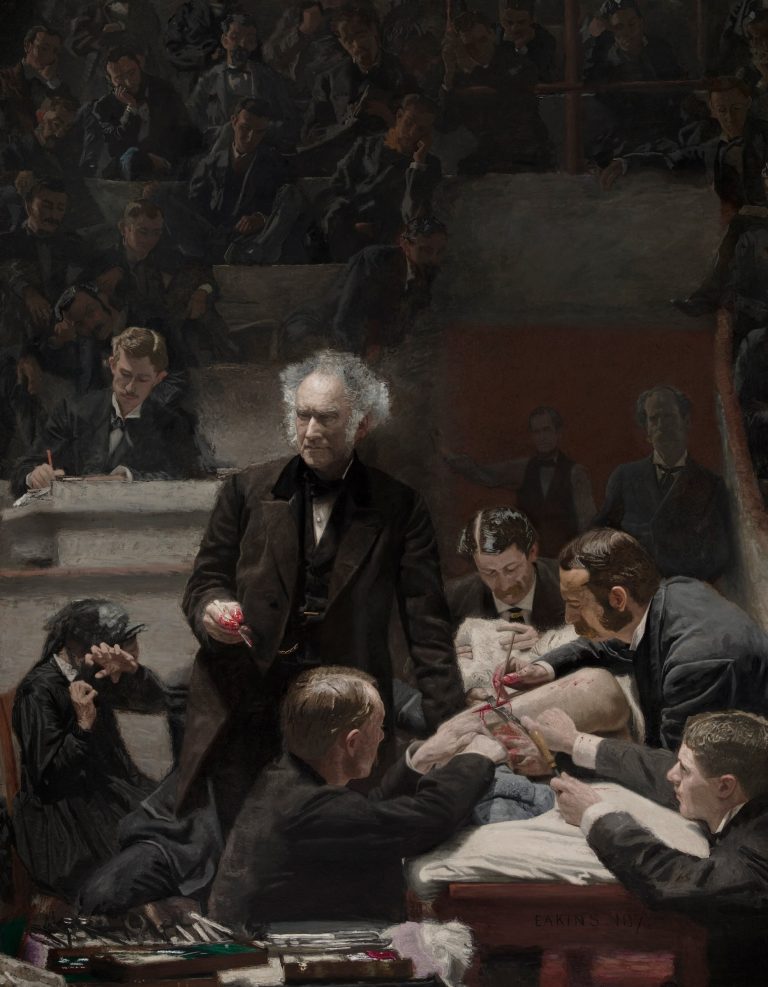
Thomas Eakins painted The Gross Clinic in 1875. Its full title is Portrait of Dr. Samuel D. Gross, but the surgeon's likeness occupies only part of its ambition. Eakins surrounds him with assistants, students, instruments and a woman who turns away.
The painting asks how different people look at the same distressing event. Expertise, curiosity and fear coexist in a single room. The viewer is given no position entirely outside that encounter.
The scene is set in the surgical amphitheatre at Jefferson Medical College in Philadelphia. Gross demonstrates an operation on a patient's left thigh to students seated above him. The museums identify the condition as osteomyelitis, a bone infection.
The operation demonstrates an approach intended to preserve the limb by removing diseased material rather than automatically amputating. That historical context helps explain why the subject could represent medical achievement to its participants while remaining alarming to a general audience.
The patient's body is difficult to read at first. White material covers much of it, and other bodies surround the exposed area. Eakins does not provide the complete, easily isolated figure familiar from an academic nude. Here the body's visibility is governed by work being done to it.
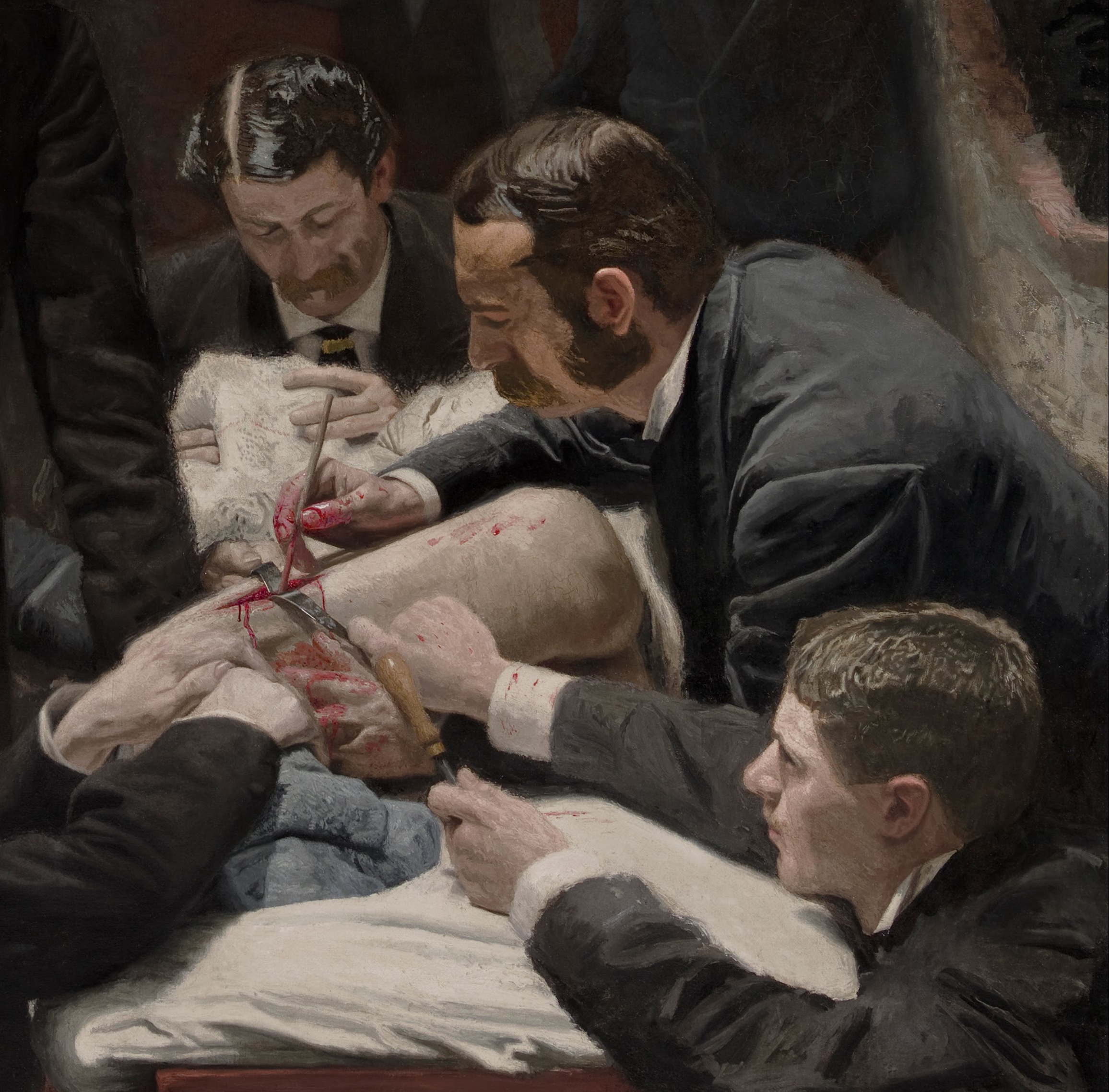
Several hands converge at the site of the procedure. They hold, steady or manipulate different things. The assistants' lowered heads join that concentration, while Gross briefly turns away from it to address the room.
The painting belongs to the history of medicine, but its depicted practice should not be confused with present-day surgical care. Its interest is historical and visual: what Eakins chose to make visible, and how an audience responded.
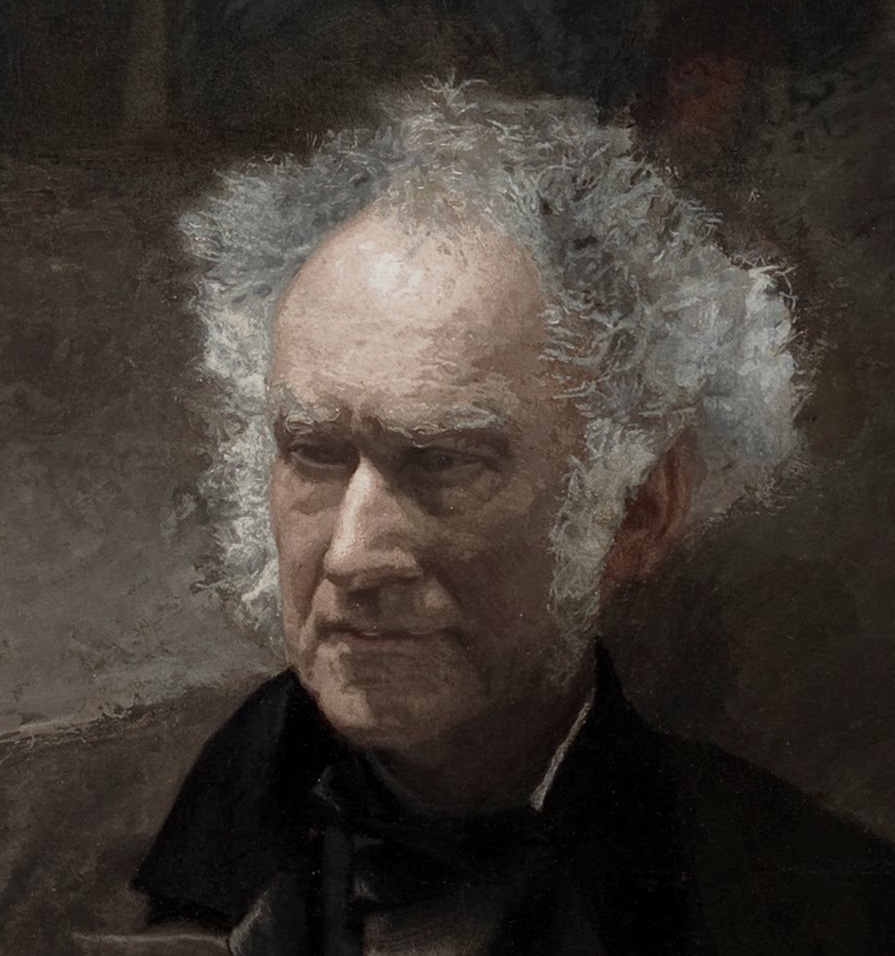
Gross's grey hair catches the light, separating his head from the dark rows behind him. His face turns slightly away from the operation. The attention of the picture can follow that turn without losing sight of the procedure below.
His upright position distinguishes him from almost everyone nearby. The assistants bend, the woman recoils and the students sit. Standing does not make him larger than the others by accident: it gives the teacher a commanding place within a crowded arrangement.
The dark coat has an important role. It forms a relatively stable shape between the brightness of his face and the complicated forms around the patient. The hand carrying the scalpel interrupts that stability with a small, emphatic red area.
There is confidence in this arrangement, but the painting does not ask every viewer to feel confident. Gross's professional composure and the woman's distress are visible at the same time.
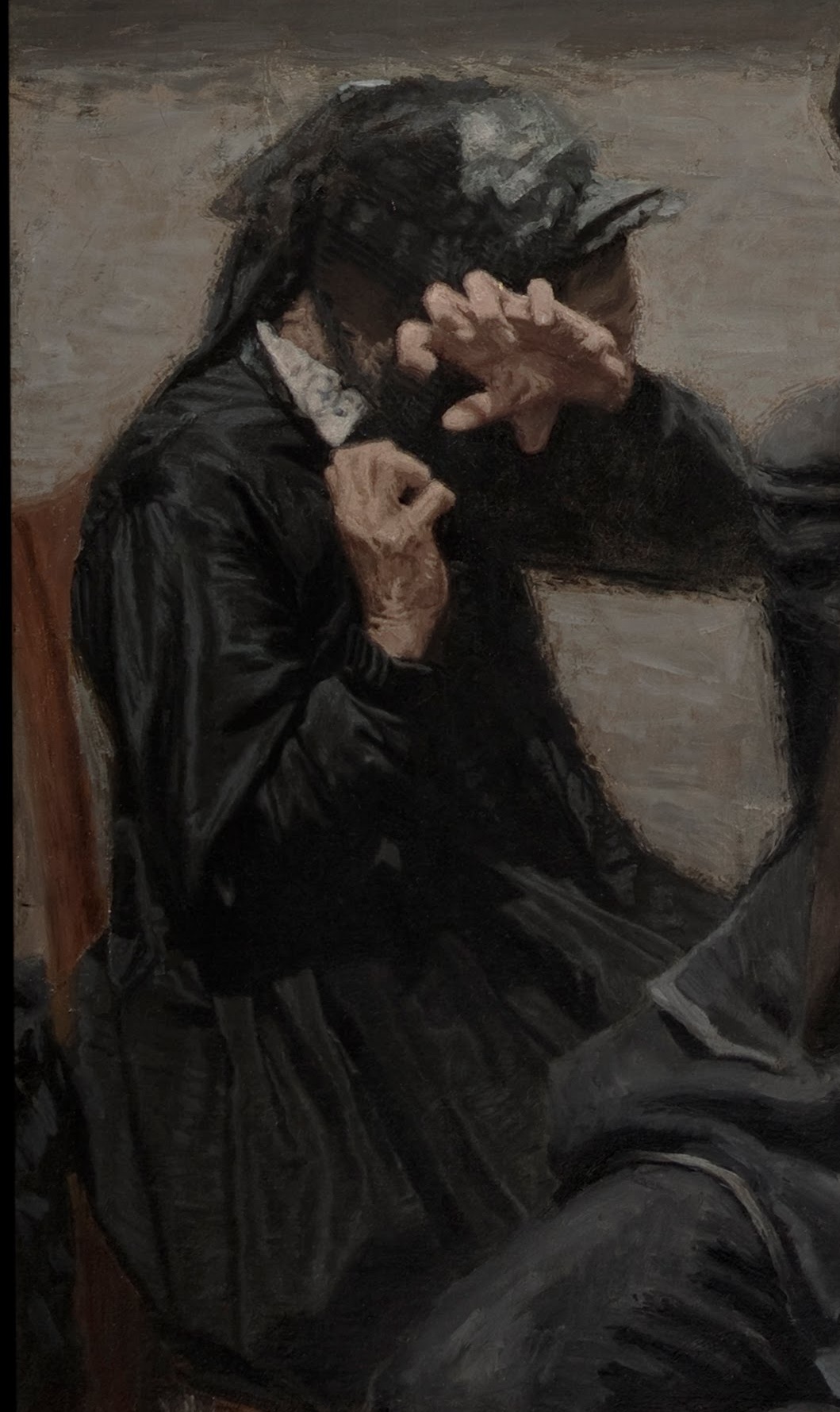
At the left, a seated woman lifts her hands and turns her face away. The Philadelphia Museum of Art describes her as traditionally identified as the patient's mother; PAFA similarly treats the identification as probable. The picture does not establish her relationship with the certainty of a named portrait.
Her reaction needs no exact identity to become legible. Unlike the people who lean toward the procedure, she tries to interrupt her own view of it. One hand comes close to her face while the other appears tense against her clothing.
It would be reductive to treat her simply as an obstacle to scientific progress. She gives the scene a human cost that professional concentration alone might leave unexpressed. Her posture allows the painting to contain distress without making Gross himself recoil.
The contrast is also spatial. She sits below the lecturer and near the edge, yet the light catches enough of her hands and head to keep her response present. A marginal figure can change how the centre is understood.
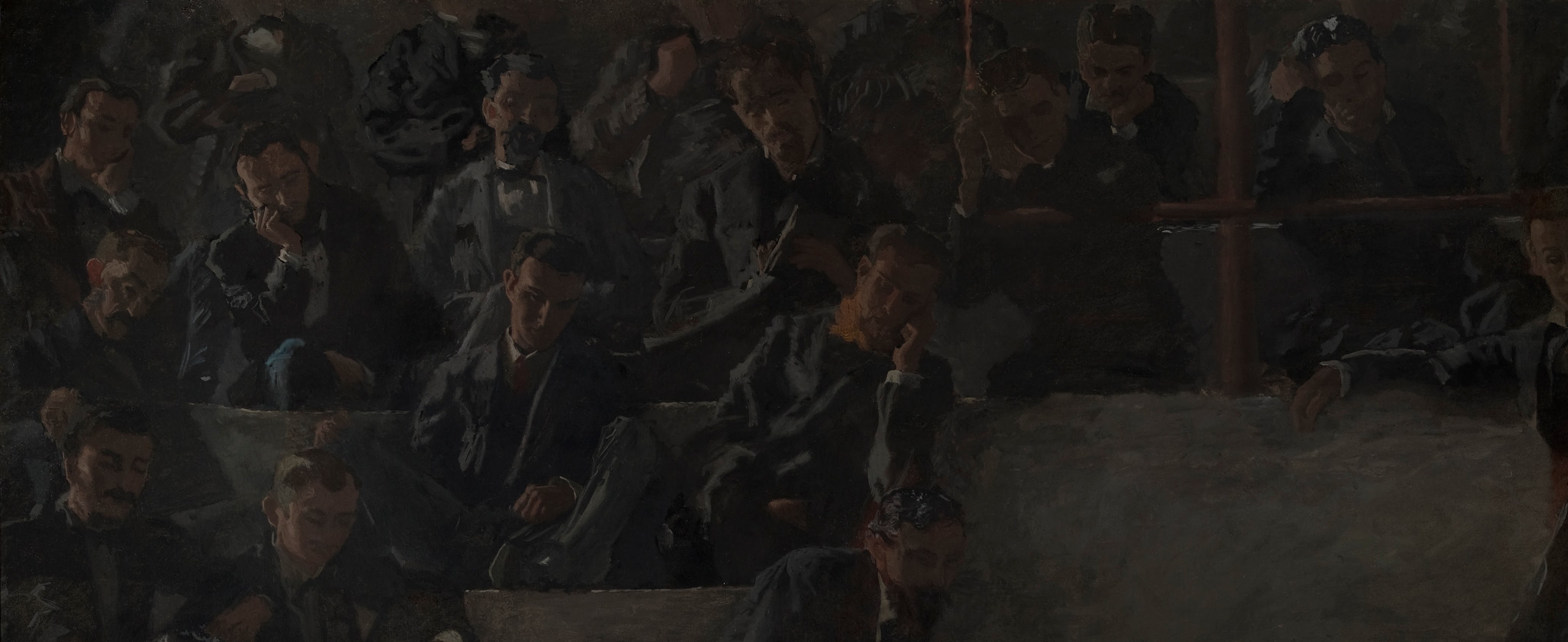
Rows of spectators recede into shadow. Heads turn, bodies lean and hands approach faces. The audience is a collection of small responses rather than one repeated silhouette.
The brightness of the procedure makes these upper figures comparatively difficult to see. That difference in visibility gives the room depth, while also encouraging the viewer to follow the attention directed downward.
Look long enough and the spectators cease to be a simple dark background. Some appear more engaged than others. Eakins makes the setting feel inhabited without supplying a separate narrative for every student.
The museums identify Eakins himself as a witness at the right of the tunnel railing, sketching or writing. By placing himself among the observers, the artist connects his work of looking with the work the room is organised to teach.
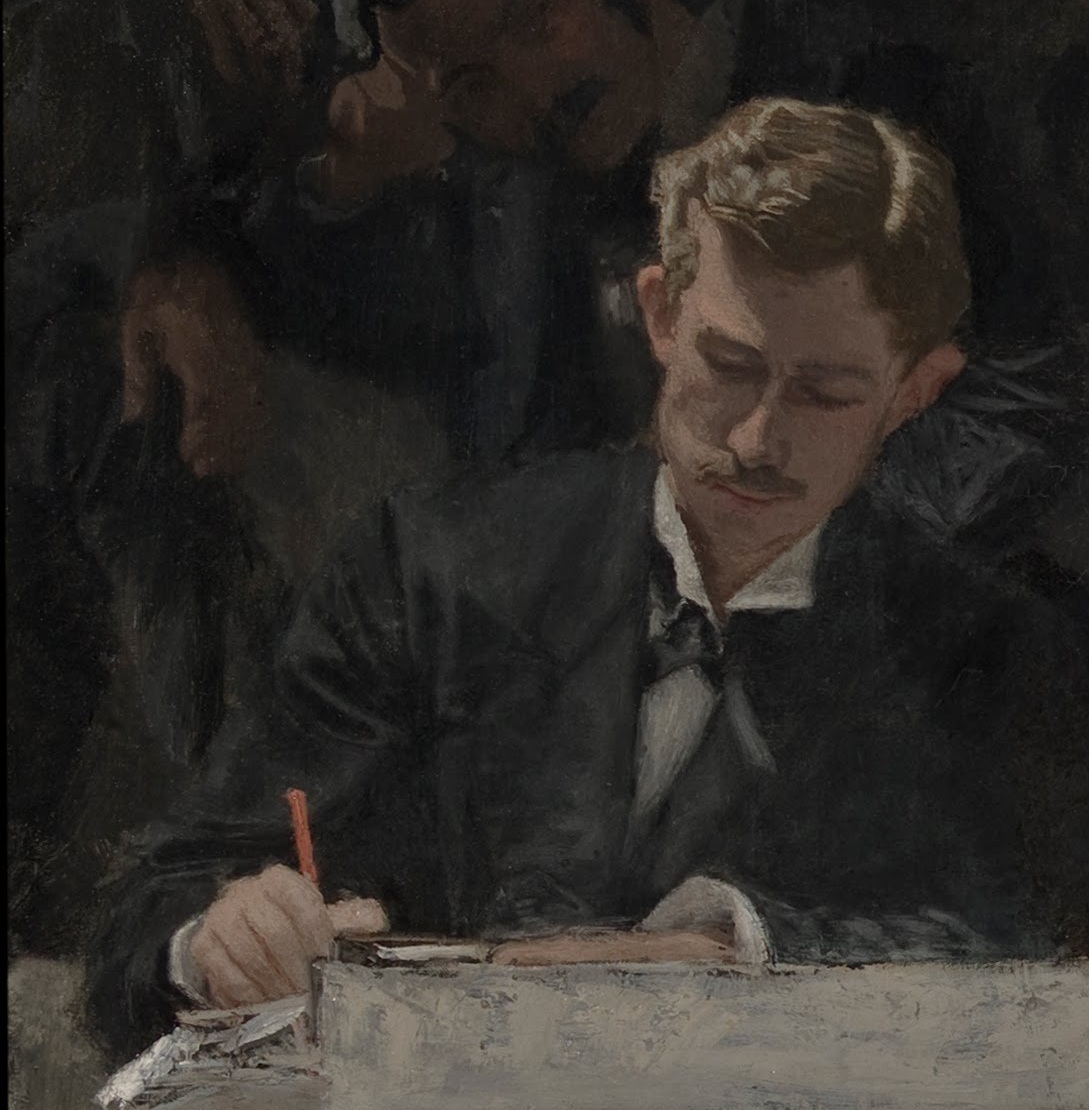
A man at a raised desk writes while the demonstration proceeds. His pale page and the movement of his hand give him a separate, quieter task within the same room.
This detail expands the painting beyond the instant of an incision. Knowledge is being performed, watched and recorded. The lecturer's speech can pass into notes; the physical event can become something studied later.
The painter also turns an observed practice into a lasting object. That parallel does not mean the picture is a neutral transcription. Eakins chooses the light, arranges attention and determines how close the viewer will seem to the operation.
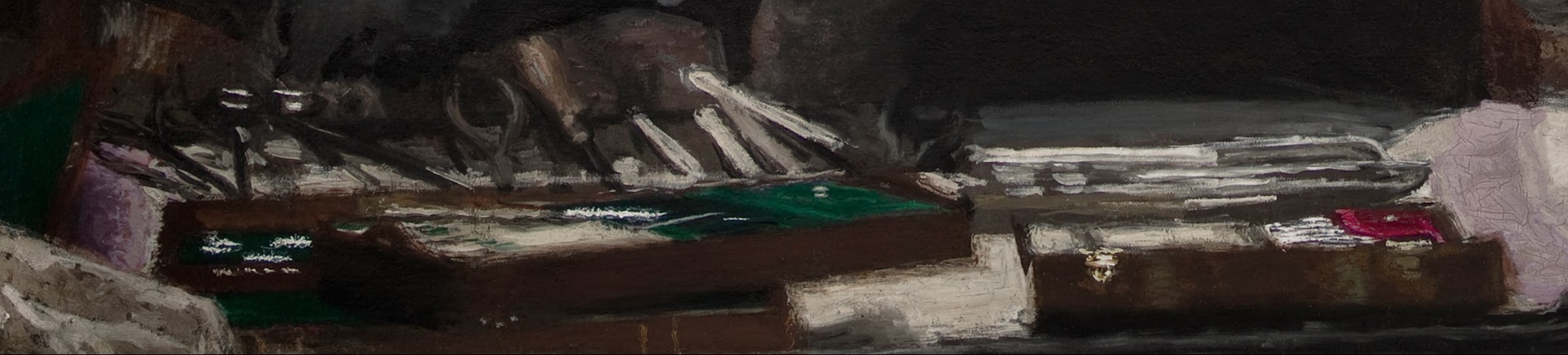
Metal instruments lie in trays at the lower edge. Their repeated pale lines catch the light against darker containers. White cloth connects this foreground surface to the area around the patient.
These are among the things nearest to the viewer, yet they do not offer an easy escape from the procedure. Instead, they make its working environment more specific. The room contains equipment prepared for use, not merely an impressive speaker and an anonymous body.
The instruments also complicate the painting's rhythm. Their small horizontal marks sit below the broad upright figure of Gross and the bent forms of his assistants. Eakins moves between a commanding portrait and the ordinary material requirements of work.
Eakins intended the painting for Philadelphia's 1876 Centennial Exhibition. The subject could celebrate both his abilities and the medical knowledge of his city.
The art jury rejected it from the exhibition's fine-art display. It was shown instead in a model United States Army hospital exhibit. The museums connect the rejection with the subject's graphic character, although the precise motives of every juror cannot be recovered from the image.
The change of setting sharpened a question the painting already posed. Was an operation a subject suitable for a major work of art, or did its practical and disturbing details belong elsewhere?
The contrast with traditional grand painting is striking. Eakins gave contemporary professional life an ambitious scale, with no mythological costume to distance the action. Visitors confronted blood as part of work performed by recognisable modern people.
The Gross Clinic was acquired jointly in 2007 by the Philadelphia Museum of Art and the Pennsylvania Academy of the Fine Arts. It remains associated with both institutions rather than belonging exclusively to one.
That joint ownership is worth stating carefully. Display arrangements can change, so an old photograph or exhibition listing should not be treated as a current promise of where it hangs on a particular day.
The painting's relationship with Philadelphia is more durable than a room number. Its artist, surgeon, medical college and original exhibition all belong to the city's history. The acquisition kept that network of associations within the city that produced it.
Look back at Gross's hand after considering that public history. It is a small part of a large painting, but it holds the central tension: the activity that can be celebrated as knowledge is also an encounter with a vulnerable body.
Thomas Eakins painted it in 1875, in oil on canvas.
Dr. Samuel D. Gross, a prominent surgeon and teacher at Jefferson Medical College in Philadelphia.
No. That is the traditional identification, presented with qualification in the museums' accounts.
It is jointly owned by the Philadelphia Museum of Art and PAFA. Consult the museums' current visitor information for its display location.
Its graphic medical subject was considered unsuitable for the fine-art display. It appeared instead in the Centennial Exhibition's model Army hospital exhibit.
Thomas Eakins, The Gross Clinic, 1875. Jointly owned by the Philadelphia Museum of Art and Pennsylvania Academy of the Fine Arts. Faithful public-domain reproduction via Google Art Project/Wikimedia Commons. Details cropped from this source.
Enjoyed this story?
Save articles to your collection
Log in or create a free account, and this article will be waiting in your Private Collection.
Log in or sign up
Man Writing a Letter
Gabriel Metsu, c. 1664
The gallery list
Every painting is already 50% off. Join the list and we will send you an extra $15 code, plus first access to new collections.
No spam. Unsubscribe anytime. · Privacy Policy
Welcome
Your $15 code is on its way. Explore the gallery while you wait.