Loading cart…
No products in the cart.

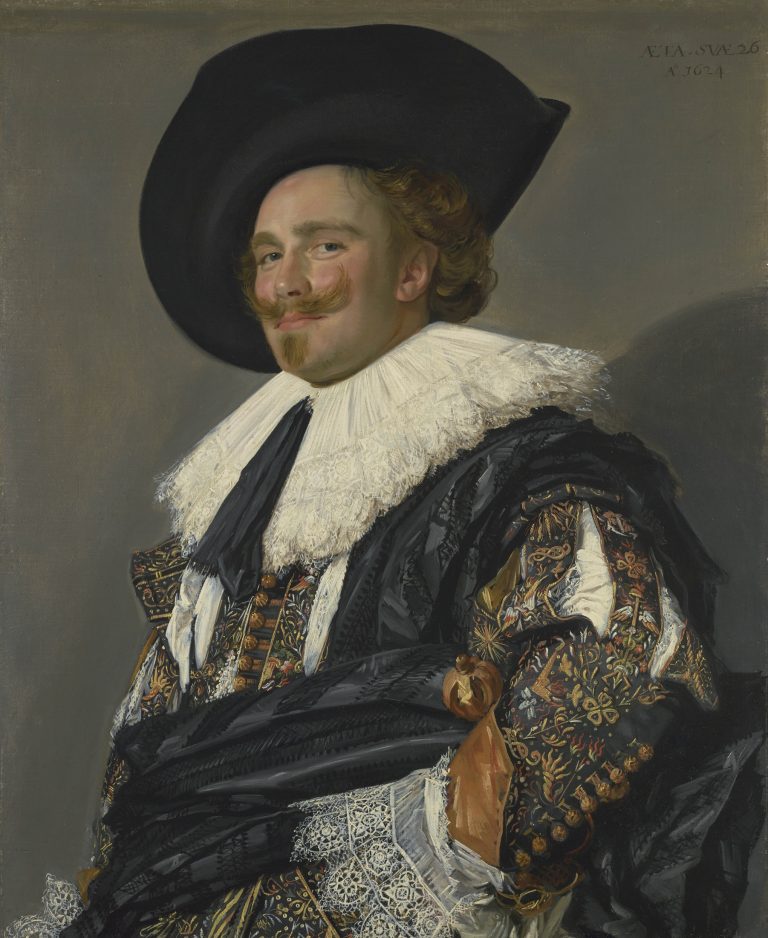
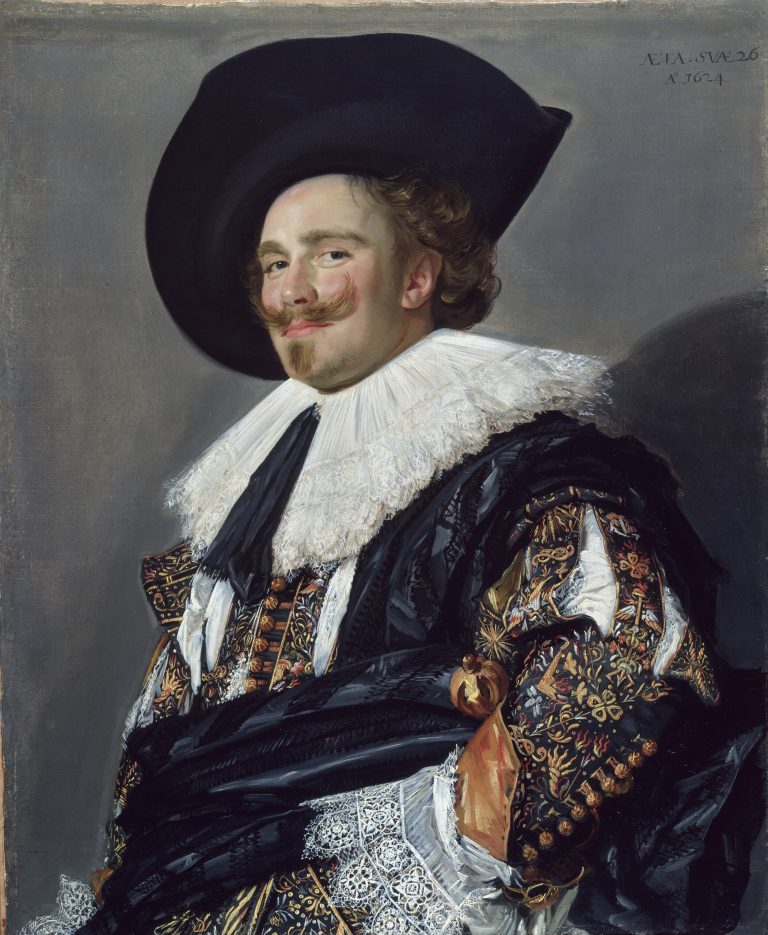
1624 · Oil on canvas · Wallace Collection, London
Save articles to your collection
Log in or create a free account, and this article will be waiting in your Private Collection.
Log in or sign up Explore the artistFrans Hals →
The mouth is closed. A pointed moustache turns upwards at its ends. Bright eyes meet ours beneath a broad black hat. Before we have examined the costume, Frans Hals has made the encounter feel personal.
The familiar title, The Laughing Cavalier, supplies more of a story than the painting can confirm. The Wallace Collection notes that the man is neither visibly laughing nor securely identified as a cavalier. The name became attached to the work long after it was painted in 1624.
The original is an oil painting on canvas, 83 × 67.3 centimetres, in the Wallace Collection, London. It portrays a man aged twenty-six. His presence feels immediate, although his name remains uncertain.
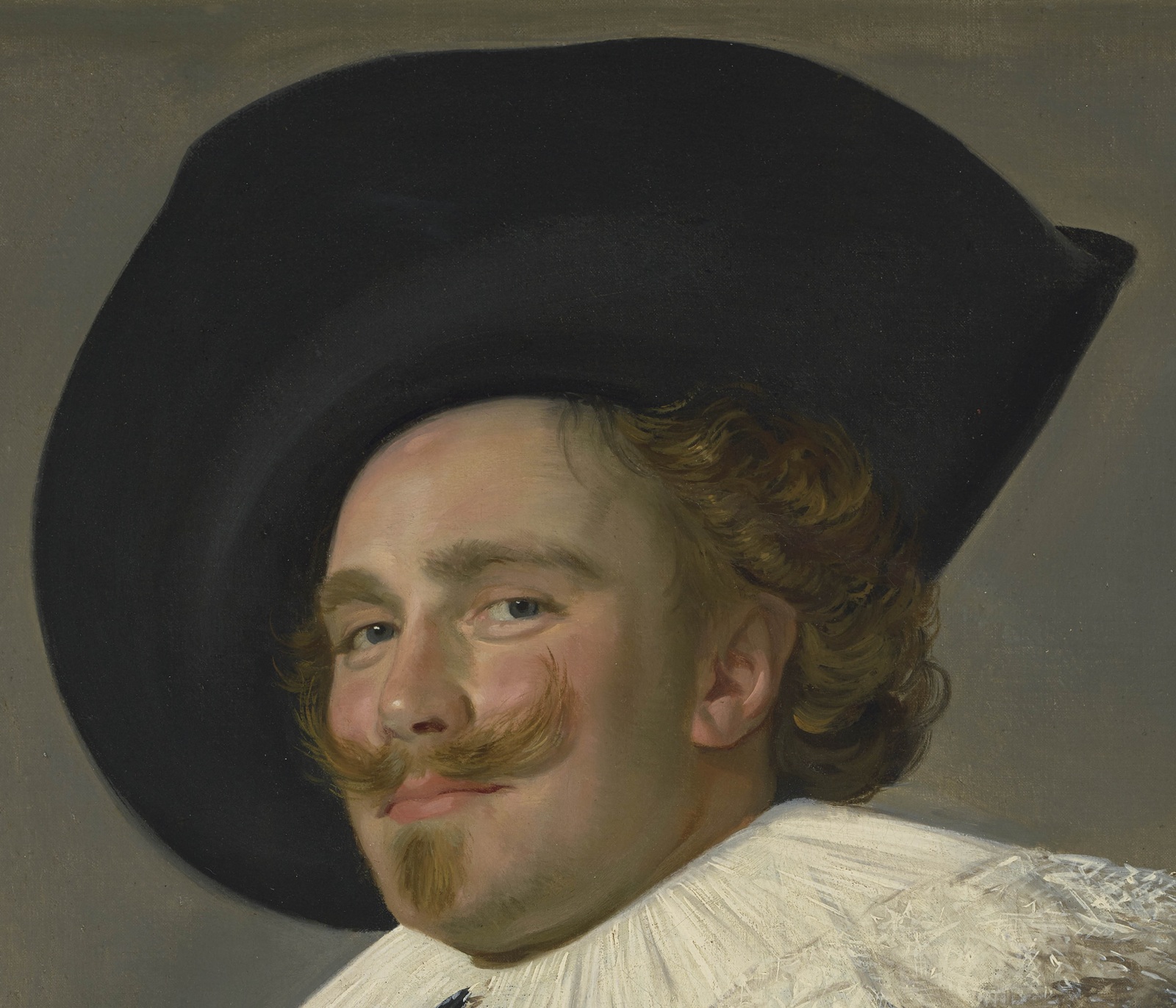
The expression is not a broad grin. It depends on the relationship between the eyes, cheeks, closed lips and curling facial hair. The moustache can make the mouth appear more animated than it would alone.
His head turns towards the viewer while the body takes a different direction. That slight disagreement keeps the posture from becoming a flat presentation. We seem to have attracted his attention in the middle of an already confident pose.
Describing him as amused is a reasonable response. Claiming to know what he has just heard would be an invented anecdote. Hals offers the signs of a social encounter without supplying its conversation.
The hat reinforces the face’s prominence. Its broad dark shape frames the smaller warm area of skin. The eye repeatedly returns to that bright opening, even after wandering through the more complicated clothing.
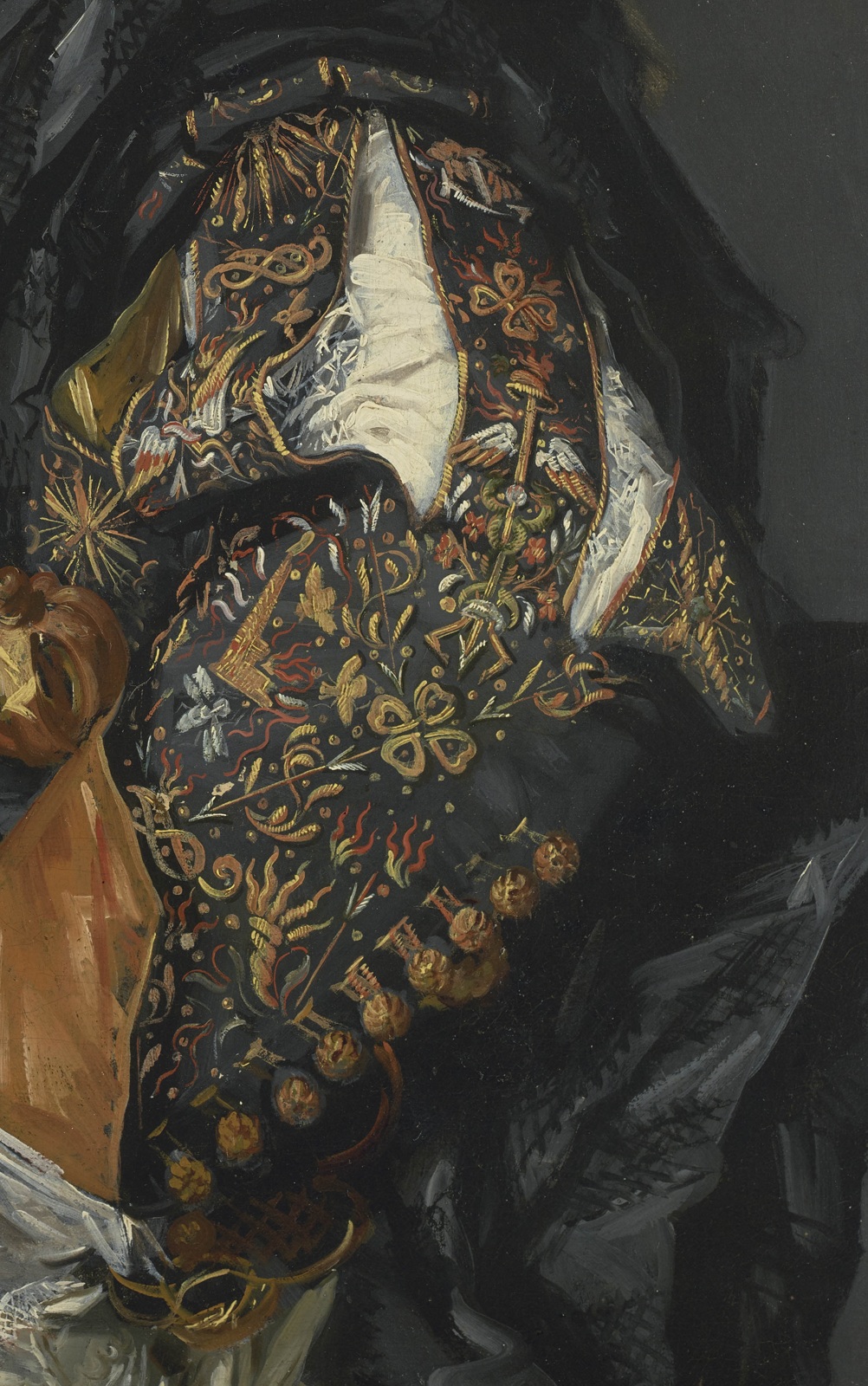
The embroidery is almost a picture within the picture. Small coloured forms, curling lines and gold-toned marks fill the doublet. The pattern follows the volume of the arm rather than lying flat like a sample of decorative fabric.
The Wallace catalogue associates its emblems with love, virtue, strength and fortune. That gives the clothing a suggestive social character. It does not turn the portrait into proof of a specific engagement or marriage.
The abundance is deliberate. The sitter can afford a costume that asks to be looked at closely, while Hals can demonstrate that he is capable of painting it. Fashion and artistic skill advertise one another.
From a distance, the sleeve reads as a richly decorated whole. In detail, its apparent intricacy resolves into varied strokes, some precise and some surprisingly abbreviated. The illusion does not depend on reproducing every stitch.
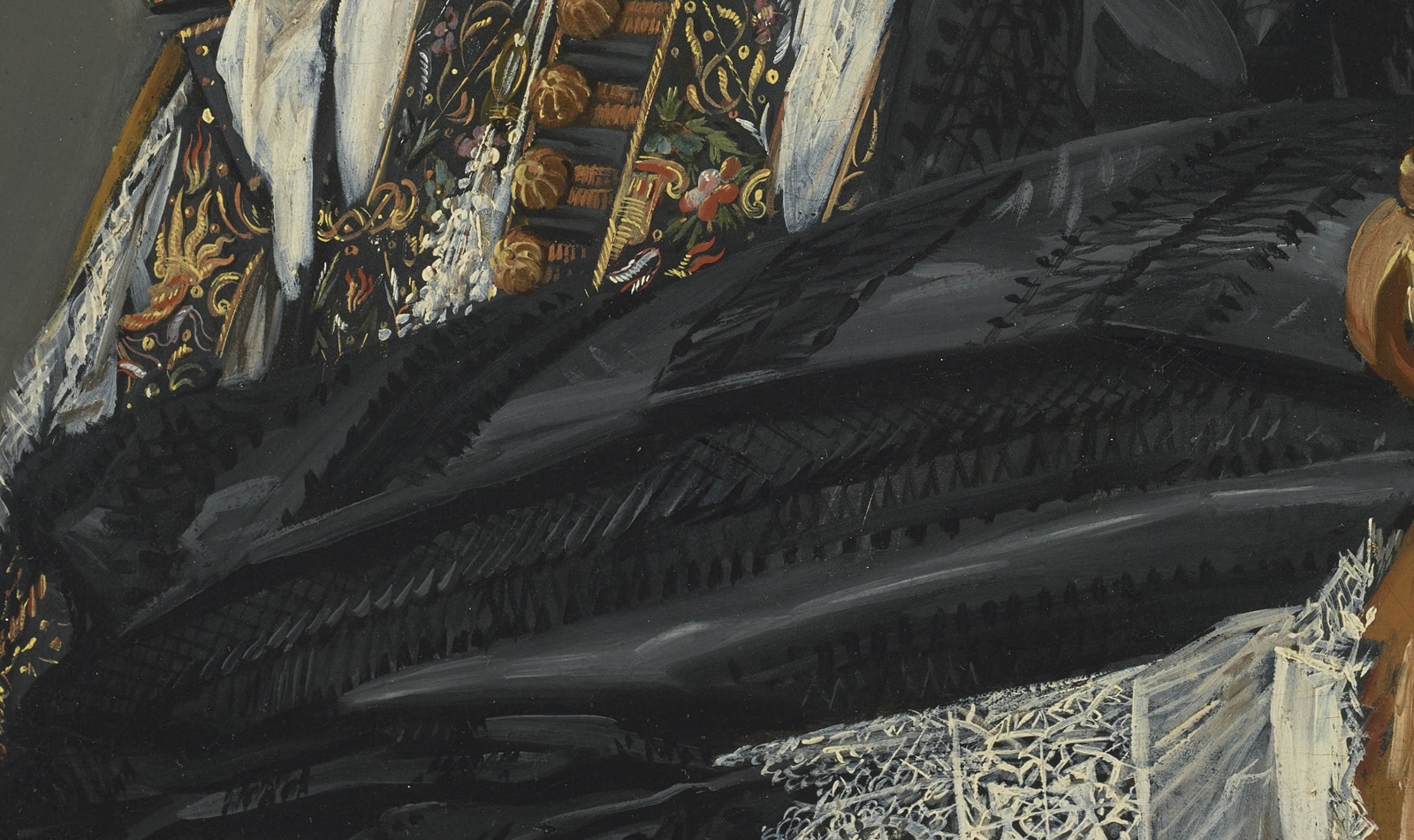
Across the torso, dark cloth folds over itself. Some ridges catch grey light; others sink into near-black. Narrow marks describe edges that would disappear if the sash were painted as one solid shape.
This passage offers a contrast with the sleeve. There, colour and pattern multiply. Here, much of the effect comes from restrained differences within a dark range.
The fabric also gives the body a direction. Its diagonal movement meets the raised elbow and the hand set at the hip. The posture occupies space rather than merely standing upright inside the frame.
Confidence is communicated through this arrangement as much as through the face. A viewer might disagree about whether the man looks charming, proud or self-satisfied. The expansive pose gives all of those responses something visible to work with.
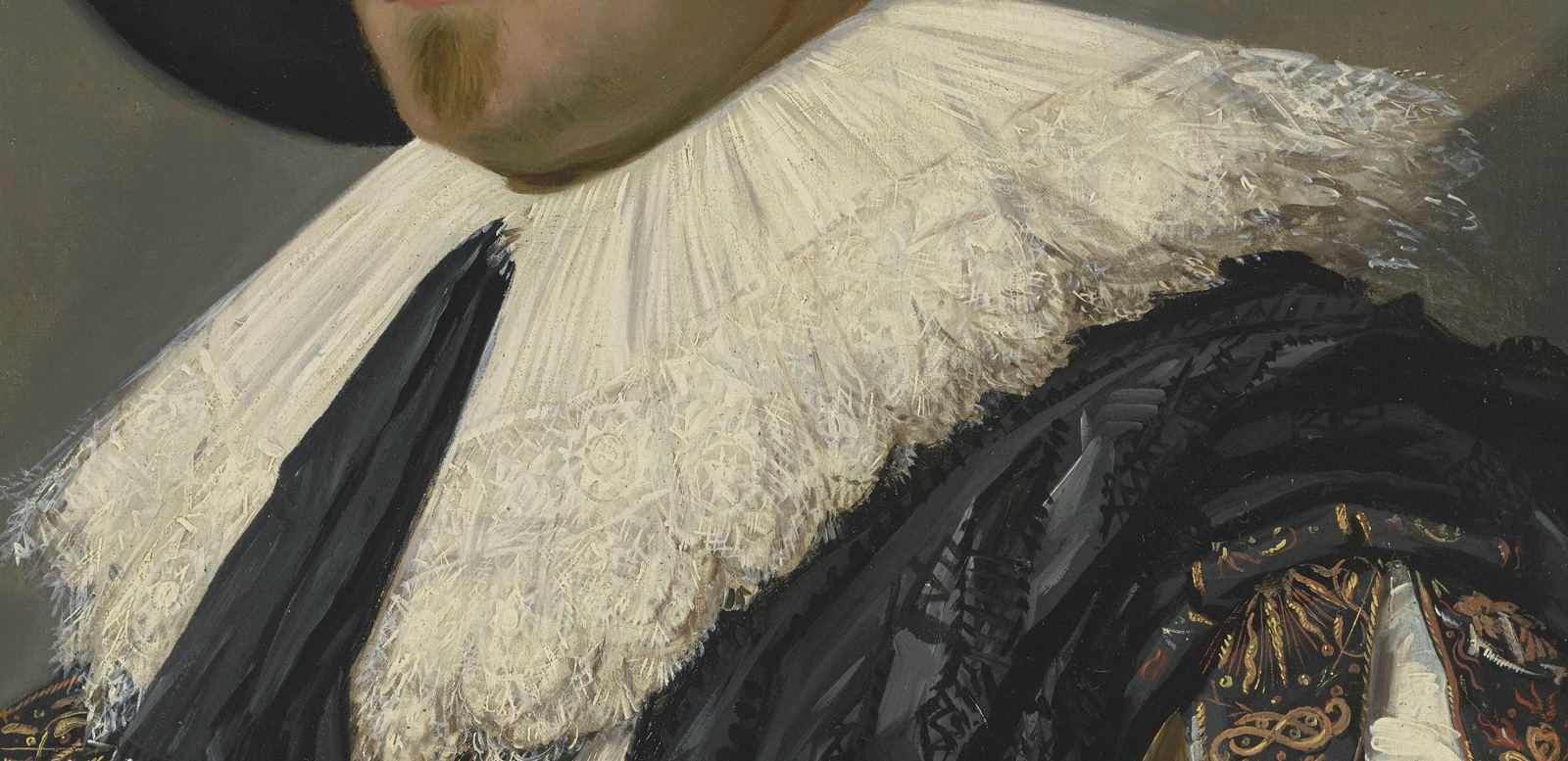
The white collar spreads in a broad, irregular fan around the neck. It is not a stiff, unbroken outline. Fine marks suggest openings, threads and layered edges against the darker cloth.
The collar carries light away from the face, then guides attention back towards it. Its width makes the head seem comparatively small while giving the whole upper body a more commanding silhouette.
Such passages are useful reminders that an informal-looking expression does not mean an informal commission. This was an ambitious portrait of a well-dressed young man. Its ease has been made with considerable care.
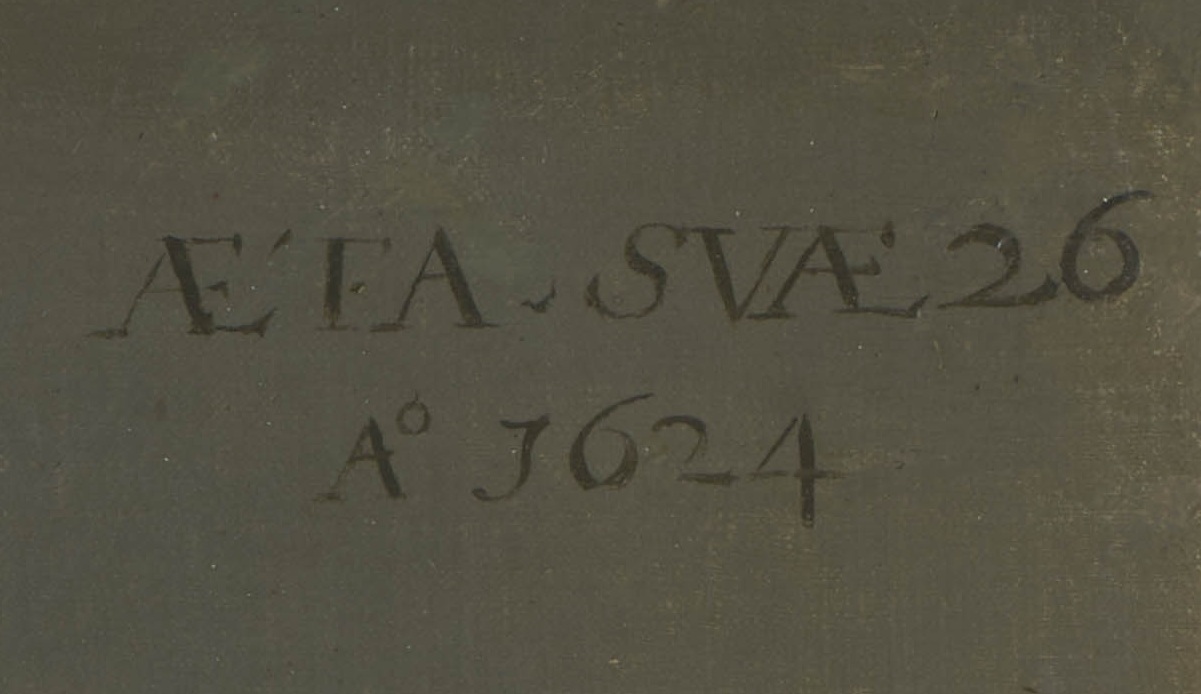
The inscription records his age, twenty-six, and the date, 1624. These are unusually concrete anchors in a portrait whose later nickname encourages invention.
A sitter’s name has been proposed in the scholarship, including the Haarlem merchant Tieleman Roosterman. Such suggestions should remain proposals rather than a secure identity. The painting’s appeal does not require the uncertainty to be concealed.
The Wallace catalogue considers the man likely to be unmarried, drawing on his dress and the conventions of paired portraits. That is an informed interpretation, not a marriage certificate hidden in the canvas.
The title belongs to the picture’s later reception. It describes how subsequent viewers wanted to remember him: lively, stylish and self-possessed. The person who sat for Hals and the figure created by that nickname are related, but not identical.
Hals’s achievement is not simply that he painted quickly or used loose marks. The portrait coordinates materials that demand very different treatment: skin, hair, lace, dark satin and patterned cloth.
The effect changes with distance. Move close in a detail and the work of the brush becomes more conspicuous. Return to the whole and those separate decisions become a person who seems to have noticed us.
That encounter explains why the uncertain smile survives the uncertainty of the name. The man’s biography is incomplete. His painted manner is remarkably specific.
Frans Hals painted it in 1624.
His lips are closed. The lively effect comes from the eyes, slight smile, facial hair and pose.
His identity remains uncertain. Tieleman Roosterman is a proposed identification, rather than a securely established one.
It belongs to the Wallace Collection, London, inventory P84.
The painted inscription gives his age as twenty-six.
The artist profile uses a historical copy after Hals, now in the Metropolitan Museum of Art. It is identified as a copy, rather than an original self-portrait.
Faithful public-domain reproduction of The Laughing Cavalier, via Wikimedia Commons. Detail images are crops of the same historical painting; no reconstruction or upscaling.
Enjoyed this story?
Save articles to your collection
Log in or create a free account, and this article will be waiting in your Private Collection.
Log in or sign up
Man Writing a Letter
Gabriel Metsu, c. 1664
The gallery list
Every painting is already 50% off. Join the list and we will send you an extra $15 code, plus first access to new collections.
No spam. Unsubscribe anytime. · Privacy Policy
Welcome
Your $15 code is on its way. Explore the gallery while you wait.