Loading cart…
No products in the cart.

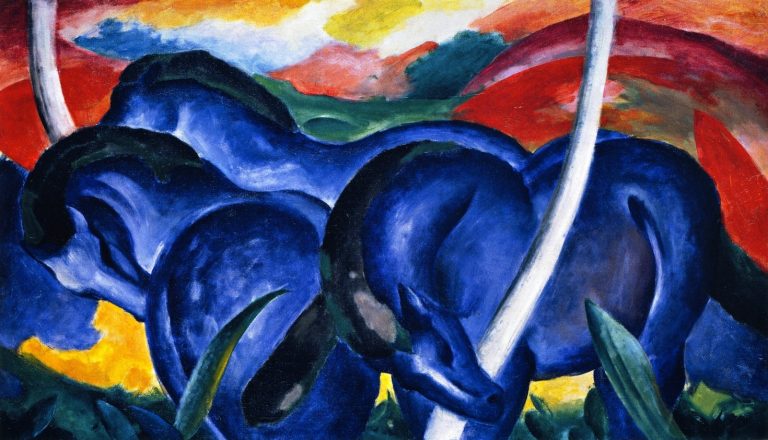
1911 · Oil on canvas · Walker Art Center, Minneapolis
Save articles to your collection
Log in or create a free account, and this article will be waiting in your Private Collection.
Log in or sign up Explore the artistFranz Marc →
The blue reaches us before we have counted the animals. It spreads across shoulders, curved necks and lowered heads, deepening into dark outlines and lifting into pale, almost white patches. Red hills press forward behind it. Green leaves rise from below. Nothing waits quietly in the background.
Franz Marc painted The Large Blue Horses, or Die großen blauen Pferde, in 1911. Three animals gather so closely that their bodies form a single broad structure across the canvas. They remain recognisable as horses, but their colour and interlocking shapes release them from the appearance of a particular field on a particular day.
The original belongs to the Walker Art Center in Minneapolis. It is an oil painting on canvas, approximately 105.7 × 181.1 centimetres. It should not be confused with Marc’s separate Blue Horses of the same year in the Seattle Art Museum. The painting shown here, including every detail below, is the Walker composition.
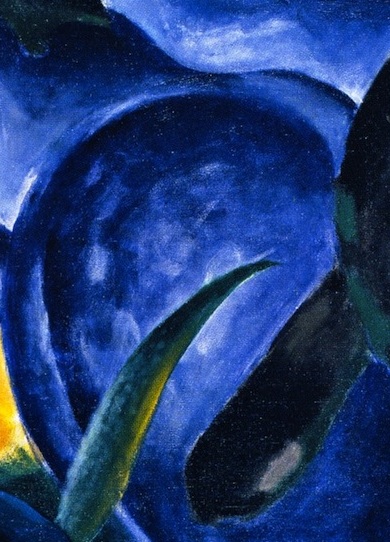
The lowered head is built from changes within the blue. A dark contour establishes its edge; a lighter passage carries the bridge of the face. The pointed ear and long muzzle give us enough information to recognise the animal without a meticulous account of hair, lashes or skin.
Its downward movement repeats elsewhere. A neighbouring neck bends, another head lowers, and the rounded shoulders carry the eye back across the group. There is no rider to direct the movement and no human face to become the centre of the story.
These animals are not performing for an audience. Their closeness can suggest calm, mutual shelter or inward concentration. Those are responses to the arrangement, rather than a single narrative that the picture explicitly illustrates. Marc leaves room for the group to be experienced as a presence before it is explained.
Trace the upper edge of the group. A rising back becomes a slope, then a dip, then another rounded mass. Behind the animals, the landscape answers with its own succession of red and green contours.
The result is a landscape that does more than provide a setting. It participates in the bodies’ rhythm. Forms that we initially assign to separate things begin to work together: a shoulder, a hill, a folded neck, a leaf.
Marc does not remove every sign of depth. One horse overlaps another, and the distant shapes rise beyond them. Yet the saturated colour keeps pulling those distances towards the painted surface. We move between reading a place and seeing an arrangement of coloured areas.
The two pale trunks make that shifting space easier to notice. Their straighter, brighter forms interrupt the broad curves and pass vertically through the composition. They do not divide it neatly into three independent portraits of horses.
The short answer is that Marc was using colour for expression rather than local description. Blue here is not merely a report of the horses’ coats under an unusual light. It is a deliberate choice that reorganises the entire encounter with the animals.
The contrast with the surrounding red gives the blue a weight it would not have against a neutral field. Green passages make another connection between the horses and the earth beneath them. The colours depend on their neighbours: none works as an isolated label.
It is tempting to decode the picture through a small dictionary in which each colour always means one thing. That approach can make the painting seem easier while reducing its complexity. Marc’s interest in colour’s spiritual and emotional possibilities does not mean every patch should be converted into a fixed verbal message.
Look instead at what this blue does. It unifies the group, separates the animals from familiar natural colour, and still allows considerable differences of light and density within each body. The apparently simple choice contains many different blues.
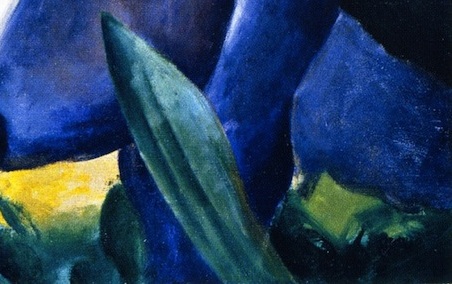
The foreground plants are larger and sharper than a conventional strip of incidental grass. Their pointed forms reach into the softer blue curves. Green sometimes echoes the darker passages within the animals rather than remaining entirely separate from them.
That overlap prevents a clear boundary between a central subject and decorative surroundings. The horses dominate the scale of the painting, but their environment continually touches and answers them.
It also changes the viewer’s position. We are close to the plants and to the animals’ bodies, with little open ground in which to stand back. The painting places us before a compact living structure, not a distant pastoral view observed from a comfortable lookout.
The picture belongs to the experimental period associated with the Blaue Reiter, or Blue Rider, circle. Marc’s animals, bold colour and simplified shapes formed part of a wider search for alternatives to merely copying visible appearances.
The name of the group can make a blue horse seem like an obvious illustration of a programme. But the work is more useful to look at as a painting than as a logo. Its particular arrangement matters: three animals press together, their heads bend down, and the red landscape moves around them.
Marc died in 1916 during the First World War. His short career makes the freshness of the 1911 painting especially poignant, but it should not be treated as a prediction of his death. The concentrated colour and bodily rhythms were artistic decisions made in a moment of active experimentation.
The painting’s twentieth-century history adds another layer. The Jewish Museum’s exhibition research distinguishes its route from the seizure of Marc’s works in German public collections: The Large Blue Horses was already privately owned when the Nazis targeted his art.
It appeared in an anti-Nazi exhibition in London in 1938 and then travelled to the United States for Twentieth Century Banned German Art. The Walker records its acquisition in 1942 through the T. B. Walker Foundation and Gilbert M. Walker Fund.
This distinction matters. The wider persecution of modern art was real, but it does not justify describing this particular canvas as a painting the Nazis stole. An artwork’s history deserves the same specificity as its visible details.
That history has not exhausted its effect. Returning to the canvas, the animals still seem to belong to their own world. There is no dramatic incident to solve. The sustained encounter is with their weight, their closeness and the extraordinary colour through which Marc makes them present.
Franz Marc painted the work in 1911.
The original is in the Walker Art Center collection in Minneapolis, accession number 1942.1.
Three animals form the closely overlapping group.
No. Marc painted several blue-horse compositions. The Walker’s large horizontal painting and the Seattle work are distinct pictures.
Visit the Franz Marc collection for other works, including his cats, foxes and horse subjects.
Faithful public-domain reproduction of The Large Blue Horses, via Wikimedia Commons. Detail images are crops of the same historical painting; no reconstruction or upscaling.
Enjoyed this story?
Save articles to your collection
Log in or create a free account, and this article will be waiting in your Private Collection.
Log in or sign up
Man Writing a Letter
Gabriel Metsu, c. 1664
The gallery list
Every painting is already 50% off. Join the list and we will send you an extra $15 code, plus first access to new collections.
No spam. Unsubscribe anytime. · Privacy Policy
Welcome
Your $15 code is on its way. Explore the gallery while you wait.