Loading cart…
No products in the cart.

1926 to 1954 · Oil on canvas, masonite and metal · Museo Frida Kahlo, Mexico City, and museums worldwide
Save articles to your collection
Log in or create a free account, and this article will be waiting in your Private Collection.
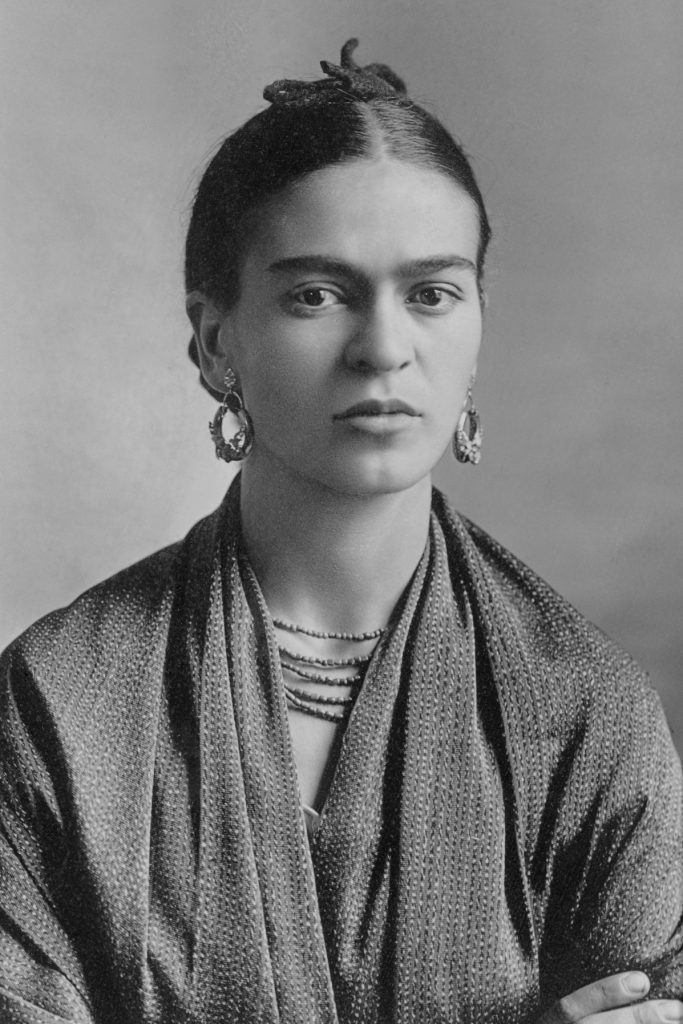
Log in or sign upFrida Kahlo painted around 140 pictures in a career of under thirty years, most of them small, many of them of herself. She painted her broken spine, her marriage, her lost pregnancies, her two cultures and her own death, and turned a private life into some of the most recognisable images of the twentieth century.
She was born Magdalena Carmen Frida Kahlo y Calderón on 6 July 1907 in Coyoacán, then a village on the edge of Mexico City, in the blue house her father had built. Her father, Guillermo Kahlo, was a German-born photographer; her mother, Matilde Calderón, was Mexican, of Spanish and Indigenous descent. Frida later said she was born in 1910, the year the Mexican Revolution began, because she wanted to be a daughter of the new Mexico.
At six she caught polio, which left her right leg thin and weaker than the left. At eighteen, on 17 September 1925, the bus she was riding home from school collided with a tram. A metal handrail went through her body. Her spine, collarbone, ribs and pelvis were broken, and her right leg and foot were crushed. She survived, but spent months in bed in plaster, and she would have more than thirty operations over the rest of her life.
It was in that bed that she started to paint. Her mother had a special easel made so she could work lying down, and a mirror was fixed above her so she could see her own face. She had planned to study medicine. She became a painter instead.
Partly because she was so often alone, and the subject always available to her was herself. Of roughly 140 paintings, around 55 are self-portraits. She explained it simply, in words that are now among the most quoted of any artist:
I paint myself because I am so often alone.
Frida Kahlo
But her self-portraits are never just likenesses. She uses her own face, always calm and direct, with the dark joined eyebrows she refused to pluck, as a fixed point around which everything else happens: monkeys, parrots, thorns, ribbons, roots, wounds, hearts, the sun and the moon. The face stays the same. What surrounds it tells you how she feels.
She also dressed for her paintings. From the late 1920s she wore the long skirts, embroidered blouses and braided hair of the Tehuana women of the Isthmus of Tehuantepec in southern Mexico. The clothes were a statement of Mexican identity, and they also hid her damaged leg.
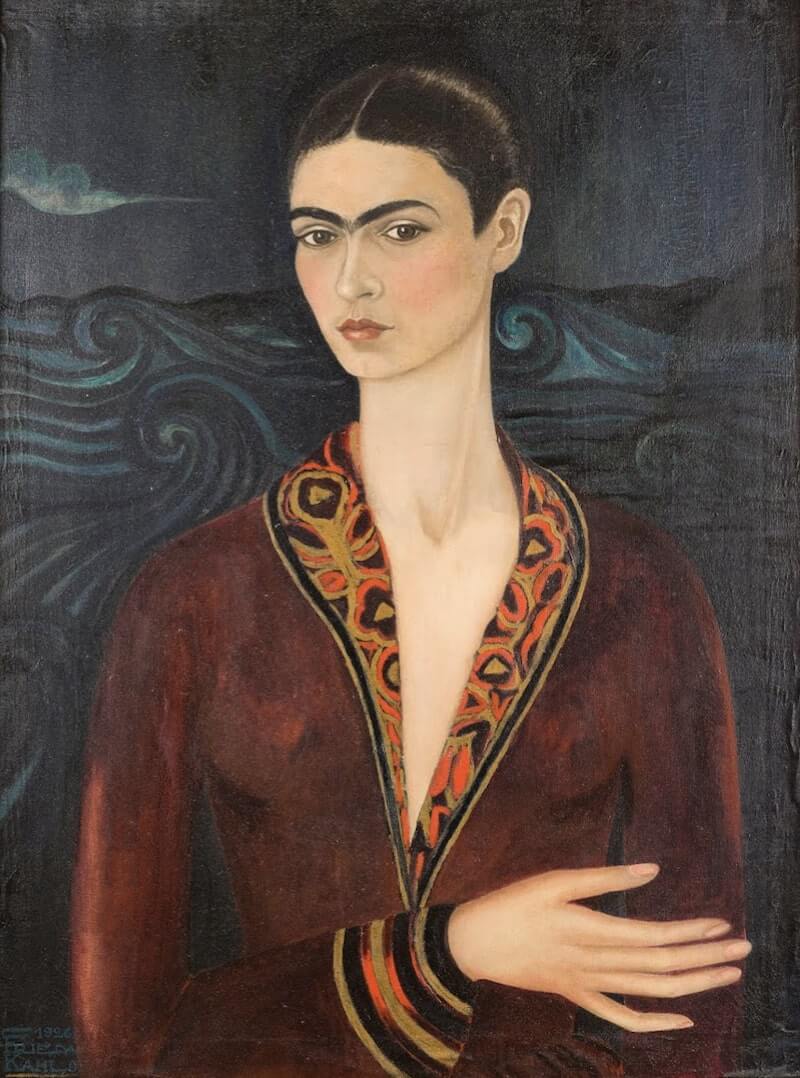
Self-Portrait in a Velvet Dress, 1926. Her first serious painting is a gift for her boyfriend, Alejandro Gómez Arias, who had been on the bus with her. She paints herself with a long neck, an elegant hand and a deep red velvet dress against a dark sea, in the style of the Italian Renaissance portraits she admired in books. It is still a conventional picture, but the steady gaze is already hers.
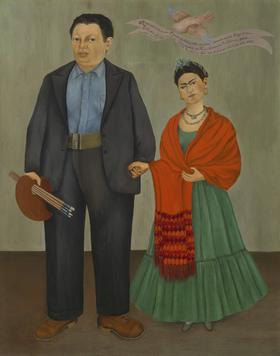
Frieda and Diego Rivera, 1931. In 1929 she married Diego Rivera, the most famous painter in Mexico, twenty years older than her and more than twice her size. People called them the elephant and the dove. In this double portrait, painted in San Francisco, he stands huge and solid holding his palette and brushes. She is tiny beside him, holding his hand, her feet barely touching the ground. A dove above them carries a ribbon with a dedication. It is a wedding portrait, and also a picture of who, at that time, was considered the real artist.
In 1932 Rivera was painting murals in Detroit and Frida went with him. It was there that her painting changed completely.
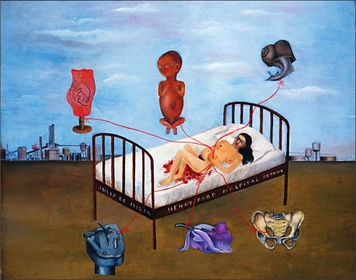
Henry Ford Hospital, 1932. In July 1932 she lost a pregnancy and almost died. Soon afterwards she painted herself naked on a hospital bed, lying in a pool of blood, in the middle of an empty landscape with the factories of Detroit on the horizon. Six red ribbons, like umbilical cords, run from her hand to floating objects: a foetus, a snail, a pelvis, an orchid, a model of the female body and a machine. It is small, painted on metal like a Mexican devotional picture, and unlike anything painted by anyone before her.
What you can see, and what is interpretation: the bed, the blood, the ribbons and the six objects are all in the painting, and the words Henry Ford Hospital are written on the bed frame. What each object stands for is not written anywhere. The snail is often read as the slowness of the miscarriage, the machine as the hospital itself, but those readings come from writers, not from Frida.
My Birth, 1932. Soon after, her mother died, and Frida painted her own birth: a woman on a bed, her face covered by a sheet, the adult head of Frida emerging between her legs, and a painting of the grieving Virgin on the wall above. It is one of the most shocking pictures in her work, and she seems to have intended it to be. It is in a private collection.
Self-Portrait on the Borderline between Mexico and the United States, 1932. Here she stands on a stone pedestal in a pink dress, holding a small Mexican flag, exactly on the border. On the left is Mexico: ruins of a pyramid, a skull, ancient statues, flowers with roots in the earth, the sun and the moon. On the right is the United States: skyscrapers, factory chimneys smoking out a Ford sign, and machines whose cables plug into the ground. She clearly knows which side she belongs to. It is in a private collection.
My Grandparents, My Parents, and I (Family Tree), 1936. Frida paints herself as a little girl standing in the courtyard of the blue house, holding a red ribbon that connects her to her family. Above her float her parents in their wedding portrait, and above them her four grandparents, her mother's Mexican parents over the mountains and her father's German parents over the sea. Even her mother's pregnancy is shown, with the young Frida as an unborn child. It belongs to the Museum of Modern Art in New York.
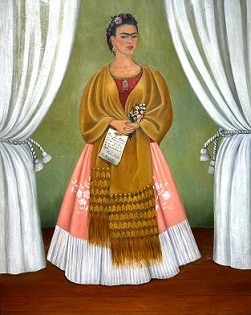
Self-Portrait Dedicated to Leon Trotsky, 1937. In 1937 the exiled Russian revolutionary Leon Trotsky came to live in the blue house, and Frida had a short affair with him. She gave him this portrait for his birthday: Frida standing between two curtains like an actress on a stage, in a pink and cream dress, holding a bouquet and a letter that dedicates the painting to him.
What the Water Gave Me, 1938. Instead of her face, this time we see her feet, at the end of a bath, and in the water floats everything in her life and her imagination: her parents, a Tehuana dress, a burning skyscraper, a dead bird, a skeleton, a woman held by a rope. It is the painting that most convinced the French poet André Breton that she was a Surrealist. She disagreed. It is in a private collection.
The Frame, 1938. A small self-portrait on aluminium, set behind glass painted with bright flowers and birds in the style of Mexican folk art. When Frida's work was shown in Paris in 1939, the French state bought it. It was the first work by a twentieth-century Mexican artist to enter the Louvre's collection, and it is now in the Centre Pompidou in Paris.
In 1938 she had her first solo exhibition, at the Julien Levy Gallery in New York, and in 1939 she went to Paris for a show organised by Breton. He described her art as a ribbon around a bomb.
The marriage with Diego was famously unfaithful on both sides. When Frida discovered that he was having an affair with her younger sister Cristina, it almost broke her. They divorced in 1939 and remarried a year later in San Francisco.
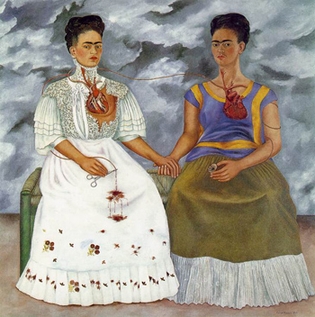
The Two Fridas, 1939. Her largest painting, about 1.7 metres square, painted during the divorce. Two Fridas sit side by side on a bench under a stormy sky, holding hands. On the right she wears Tehuana dress and holds a tiny portrait of Diego as a child. On the left she wears a white European wedding dress. Both of their hearts are exposed. A single vein runs from the portrait of Diego through both hearts to the white Frida, who tries to stop it with a pair of surgical forceps, and blood drips onto her white skirt.
What you can see, and what is interpretation: the two dresses, the exposed hearts, the vein and the forceps are all clearly painted. That the Tehuana Frida is the one Diego loved and the European Frida the one he left behind is the usual reading, and Frida herself linked the painting to the divorce, but she never wrote down an explanation of each detail.
Self-Portrait with Cropped Hair, 1940. Painted after the divorce. Frida sits in an oversized dark man's suit, the kind Diego wore, with scissors in her hand. Her long hair lies cut all around her chair on the floor. Across the top of the canvas she wrote the words of a Mexican song: look, if I loved you it was because of your hair; now that you have no hair, I don't love you any more. It belongs to the Museum of Modern Art in New York.
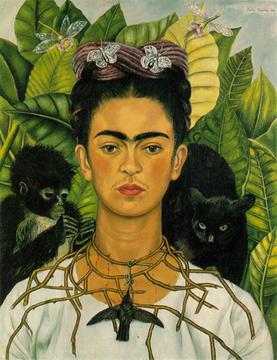
Self-Portrait with Thorn Necklace and Hummingbird, 1940. Her face in close-up, calm, against a wall of green leaves. Around her neck is a necklace of thorns that pricks her skin until it bleeds, and hanging from it is a dead black hummingbird, in Mexican folk tradition a charm for luck in love. A black monkey sits on one shoulder and a black cat on the other.
Through the 1940s her health got worse. She wore a series of plaster and steel corsets to hold up her spine, and the operations kept coming.
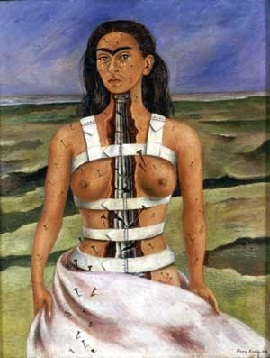
The Broken Column, 1944. She paints herself standing in a bare, cracked landscape, her body split open down the middle. Inside, instead of a spine, there is a broken stone column, crumbling in several places. A white corset of straps holds her together, and her skin is covered with nails. Tears run down her face, but she looks straight at us, her expression unbroken. It is perhaps the most direct painting of physical pain in modern art.
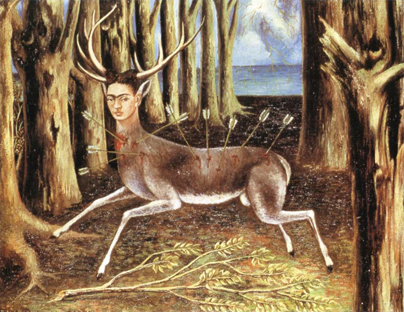
The Wounded Deer, 1946. A young stag running through a forest, pierced by nine arrows, with Frida's own head and antlers. In the background is a stormy sea. She painted it after an operation in New York that she had hoped would cure her pain, and did not.
The Love Embrace of the Universe, the Earth (Mexico), Myself, Diego, and Señor Xólotl, 1949. Layers of embrace, like Russian dolls. The universe, half day and half night, holds the Earth, shown as an ancient Mexican goddess, who holds Frida, who holds Diego in her arms like a baby. Diego has a third eye on his forehead. Her dog, a hairless Mexican Xoloitzcuintli, sleeps curled at the bottom. It is in the Jacques and Natasha Gelman Collection in Mexico City.
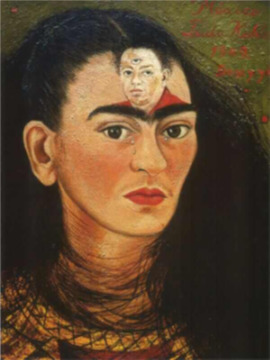
Diego and I, 1949. A close-up self-portrait with tears on her cheeks and her long hair wrapped around her neck. On her forehead is a small portrait of Diego, with a third eye of his own. She painted it while Diego was involved with the film star María Félix. In 2021 it sold at auction in New York for 34.9 million dollars, the highest price ever paid for a work by a Latin American artist.
In 1950 she spent most of the year in hospital in Mexico City, after a series of spinal operations. Her later paintings are mostly still lifes of fruit, painted from her bed or a wheelchair, often with small Mexican flags or political messages, as she became more committed to communism.
In April 1953 the photographer Lola Álvarez Bravo gave her the only solo exhibition she ever had in Mexico. Her doctors told her not to go. She arrived by ambulance and was carried in on a stretcher to her own four-poster bed, which had been moved into the gallery, and she received her guests lying down. In August of that year, gangrene forced the amputation of her right leg below the knee.
Viva la Vida, Watermelons, 1954. Her last known painting is a still life of watermelons, some whole, some cut open, bright red against a blue sky. On the pale flesh of the front slice she wrote her name, the place, Coyoacán, the year, and the words Viva la Vida: long live life. She died in the blue house a few days later, on 13 July 1954, aged forty-seven. The painting belongs to the Museo Frida Kahlo.
In her lifetime she was respected, but she was usually introduced as Diego Rivera's wife. Her reputation grew slowly after her death, and then very quickly from the late 1970s and 1980s, when feminist historians, Chicano artists in the United States and a best-selling biography by Hayden Herrera, published in 1983, presented her as one of the great artists of the century. The 2002 film Frida, with Salma Hayek, carried her image around the world.
Today her face is everywhere, on posters, bags and fridge magnets, and the phenomenon has its own name: Fridamania. Her paintings themselves are rare and rarely move. The reason they still hold attention is the same as it was in 1932. She painted what other artists left out: pain, blood, miscarriage, disability, jealousy, divided identity, and painted all of it with the calm of a saint in a church picture.
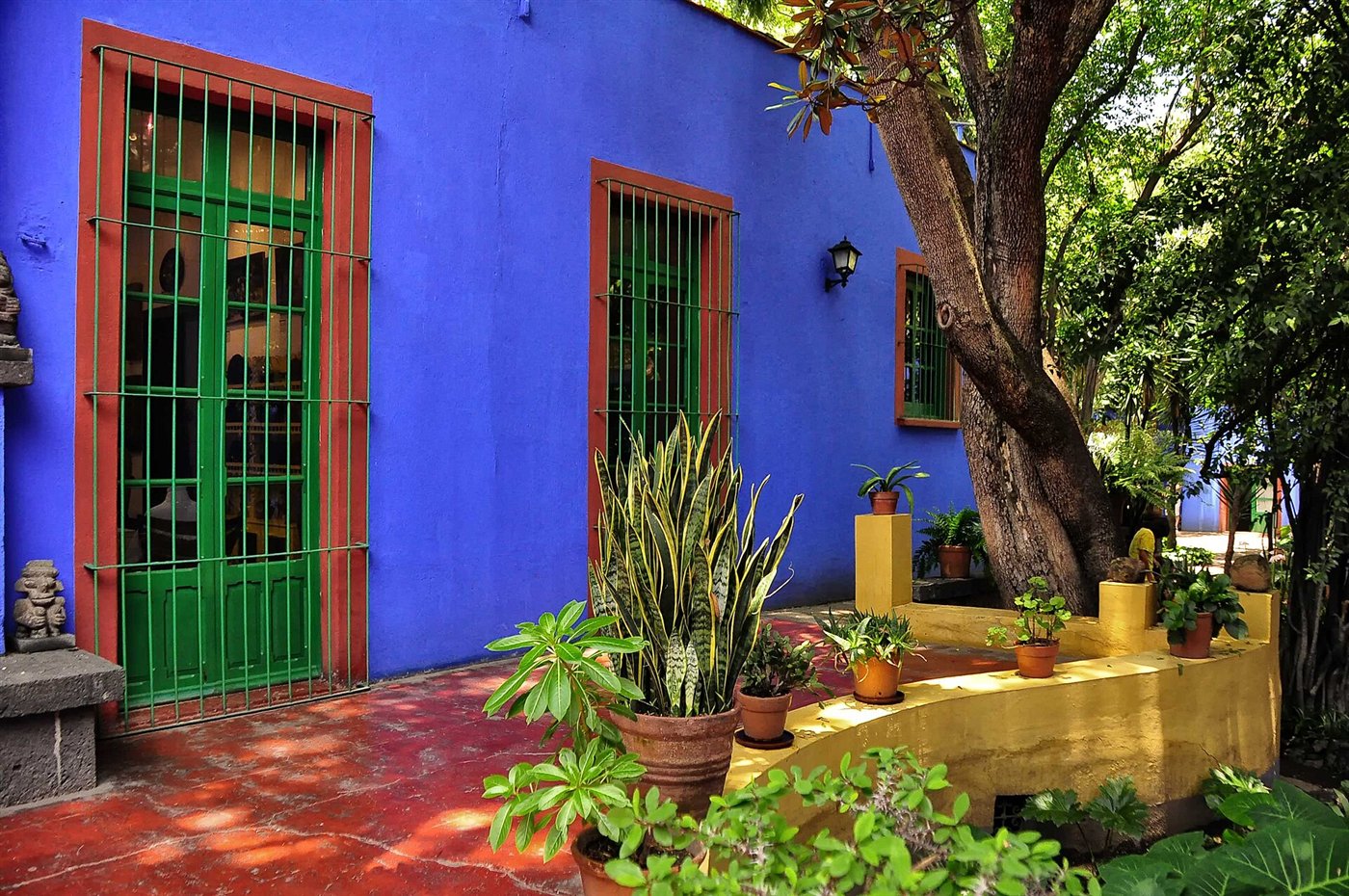
The best place to start is the blue house itself. La Casa Azul in Coyoacán, where she was born and died, has been the Museo Frida Kahlo since 1958, with her studio, her bed, her clothes, her corsets and paintings including Viva la Vida. Book ahead: it is one of the most visited museums in Mexico.
In Mexico City, the Museo Dolores Olmedo holds the largest single group of her paintings, including Henry Ford Hospital and The Broken Column, and the Museo de Arte Moderno has The Two Fridas. In the United States, look for her at the Museum of Modern Art in New York, the San Francisco Museum of Modern Art, the National Museum of Women in the Arts in Washington and the Harry Ransom Center in Austin. In Europe, The Frame is at the Centre Pompidou in Paris. Many other works are in private collections and appear only in exhibitions.
Enjoyed this story?
Save articles to your collection
Log in or create a free account, and this article will be waiting in your Private Collection.
Log in or sign upWhat can be seen in the paintings, what is documented, and what is interpretation are kept separate throughout this article. Frida Kahlo's paintings are protected by copyright (© Banco de México Diego Rivera Frida Kahlo Museums Trust) and are shown here in low resolution, for commentary only. ByMuseum does not sell reproductions of her work.