Loading cart…
No products in the cart.

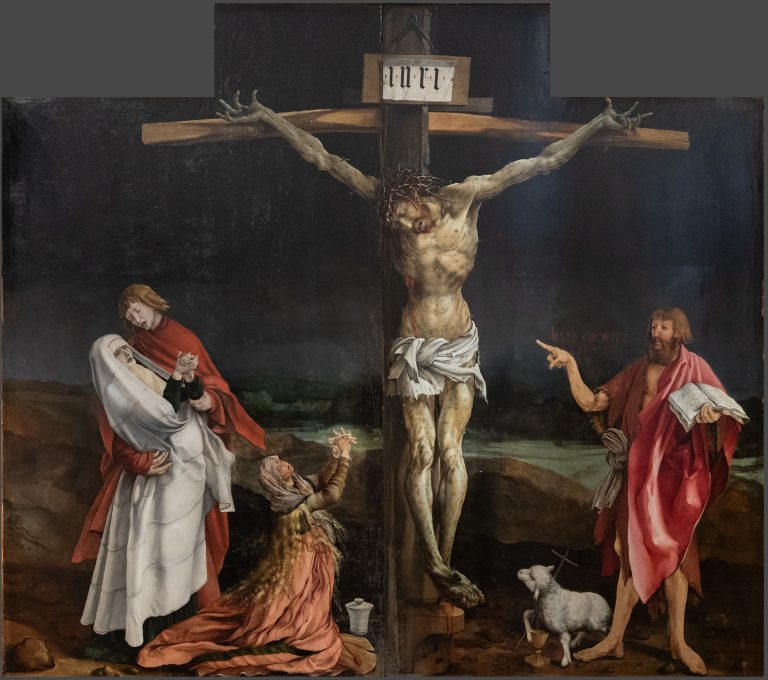
1512–1516 · Oil and tempera on limewood · Musée Unterlinden, Colmar
Save articles to your collection
Log in or create a free account, and this article will be waiting in your Private Collection.
Log in or sign up Explore the artist · later memorialMatthias Grünewald →
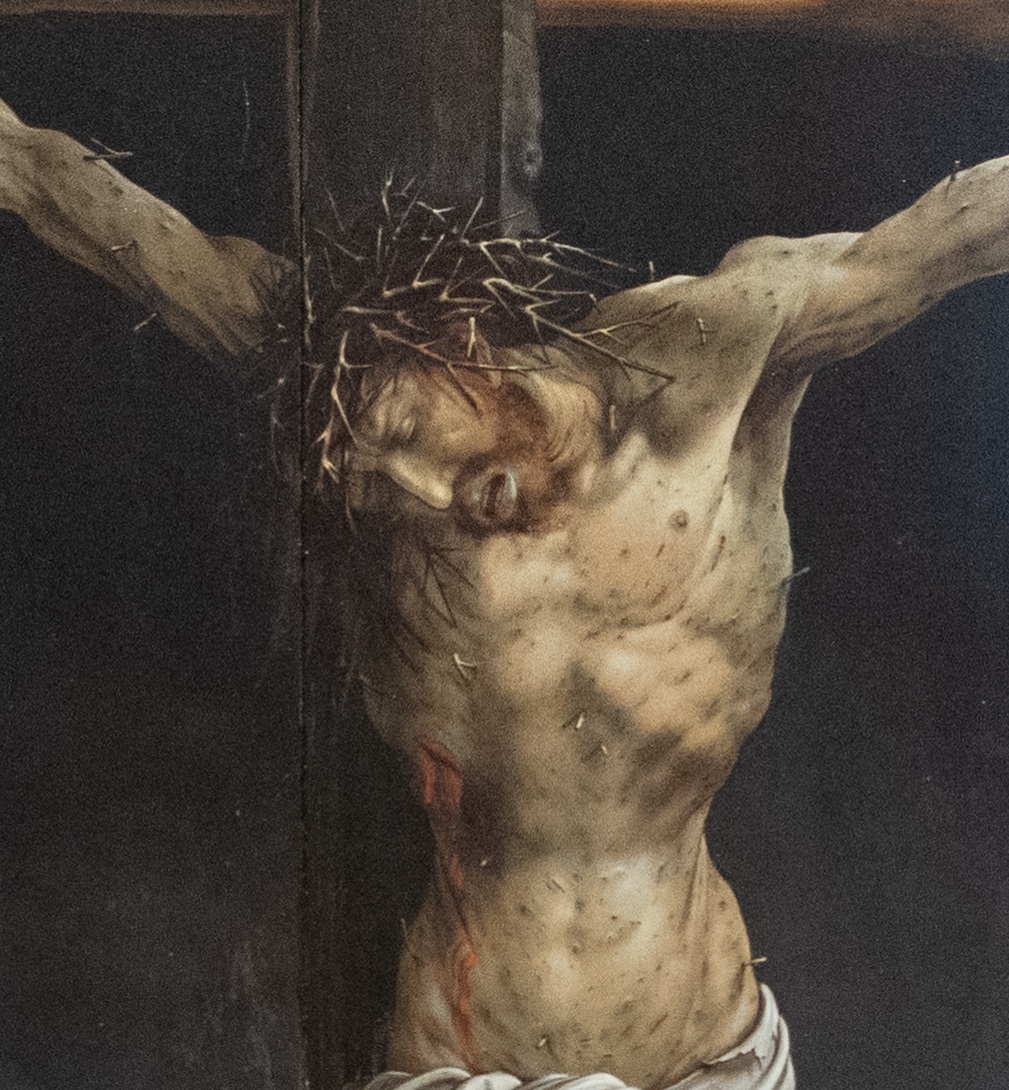
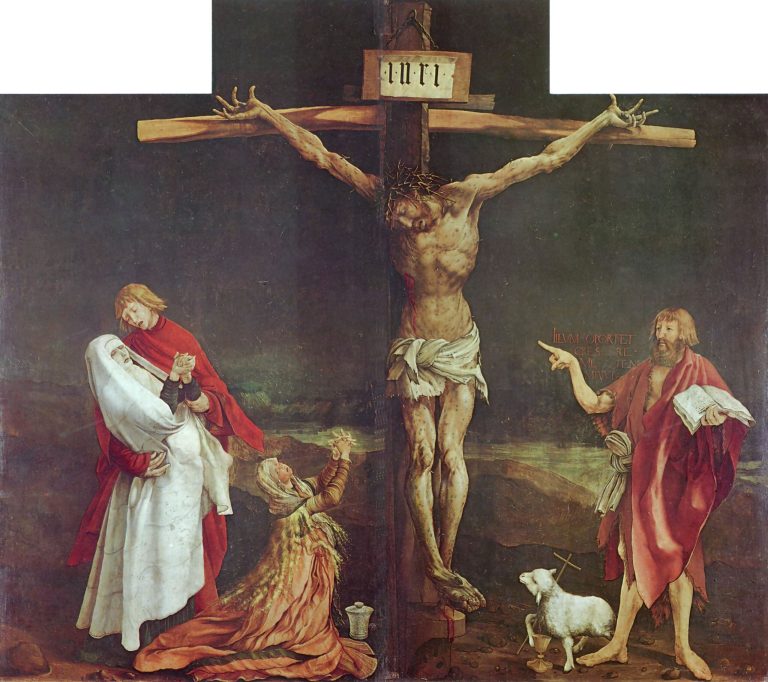
Christ's fingers spread against the darkness. His head falls forward, his skin is marked, and his feet twist at the base of the cross. The mourners do not provide a calm frame around him. One woman collapses, another reaches upward, and a man at the right points.
This is the Crucifixion at the centre of the Isenheim Altarpiece, painted by Matthias Grünewald between 1512 and 1516. It belongs to a much larger object whose wings could open to reveal radically different scenes. The altarpiece is now at the Musée Unterlinden in Colmar, France.
The original setting matters. It was made for the Antonite monastery at Isenheim, where a hospital cared for people suffering from serious illness. Grünewald placed this wounded body within a community already familiar with pain.
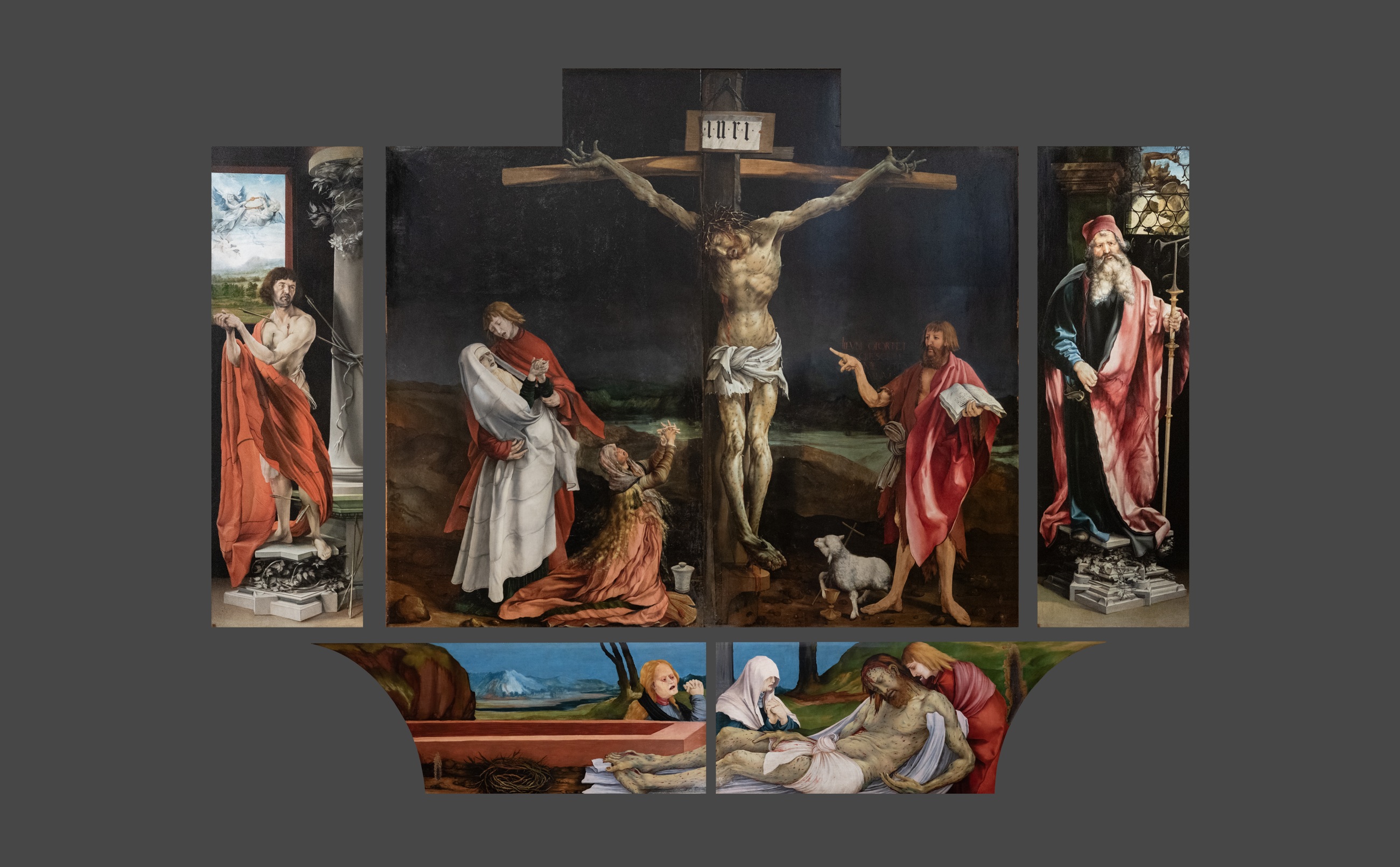
The Isenheim Altarpiece is a polyptych, an altarpiece with multiple panels and movable wings. Its three presentations combine painting with carved sculpture. Grünewald painted the panels; Niclaus of Haguenau was responsible for the sculptural work.
In the closed presentation, the central Crucifixion stands between Saint Sebastian and Saint Anthony. A Lamentation occupies the lower compartment, known as the predella. Each part contributes to the whole, but the central panel has a particularly concentrated emotional force.
The reproduction associated with this story is the central Crucifixion panel. It does not include the complete winged altarpiece, its carved shrine or every painted scene. That distinction matters when comparing images and dimensions.
Seen as a whole, the object also changes our sense of the cross. The tall side saints remain upright while the mourners buckle or kneel. The lower body of Christ lies horizontally. Several arrangements of the human body surround the central vertical.
The Antonites specialised in caring for sufferers of Saint Anthony's fire, a historical name associated with ergot poisoning. Their hospital setting provides an important context for the altarpiece's attention to bodily suffering.
The Musée Unterlinden explains the possibility of identification between the sick and the afflicted Christ. A viewer undergoing physical pain could encounter a sacred body that had not been protected from disfigurement.
That context should not turn the painting into a clinical diagnosis. Its marks belong to an image of the Passion, with its own religious purposes and expressive choices. We cannot identify an individual patient's condition from the painted surface or treat every wound as a medical illustration.
What we can see is the painter's refusal to smooth the body into a distant ideal. The bent neck, uneven skin and rigid fingers make the crucified figure physically difficult to overlook. Compassion begins with attention rather than with an attractive appearance.
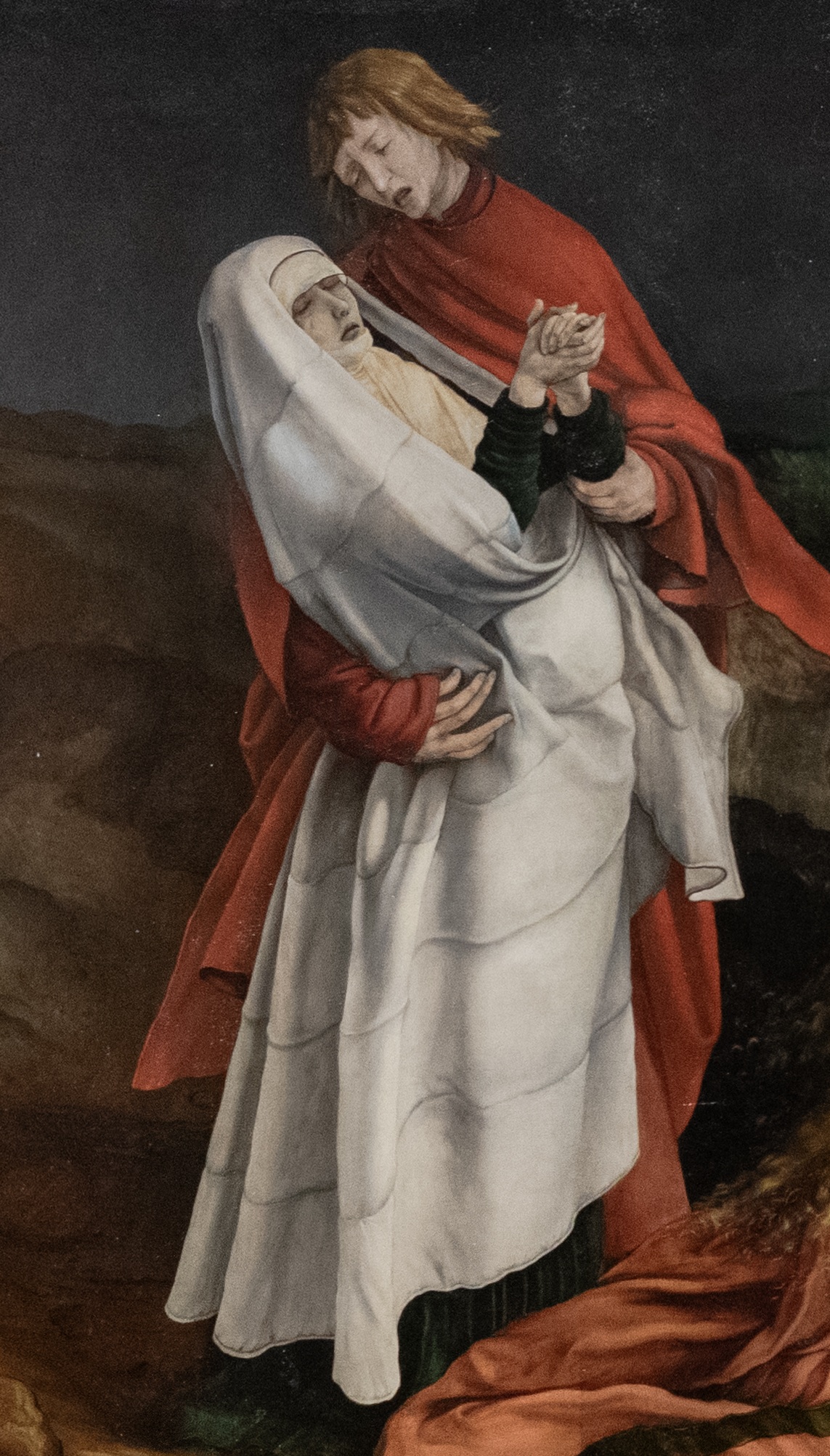
The Virgin wears white. Her clothing forms a large pale shape beside the dark cross, but brightness gives her no visible strength. She falls toward John, who supports her from behind.
Her hands remain together as her body loses its upright position. John's red garment surrounds part of the white cloth. Their overlapping shapes make support visible: the figure who can no longer hold herself is physically held by someone else.
The gesture differs from an isolated face displaying grief. Grünewald distributes the action across two bodies. Mary's collapse needs John's arms to become fully legible.
White also links her to Christ's loincloth. The two pale areas remain separated by darkness, making the distance between mother and son painfully apparent without requiring their faces to turn toward each other.
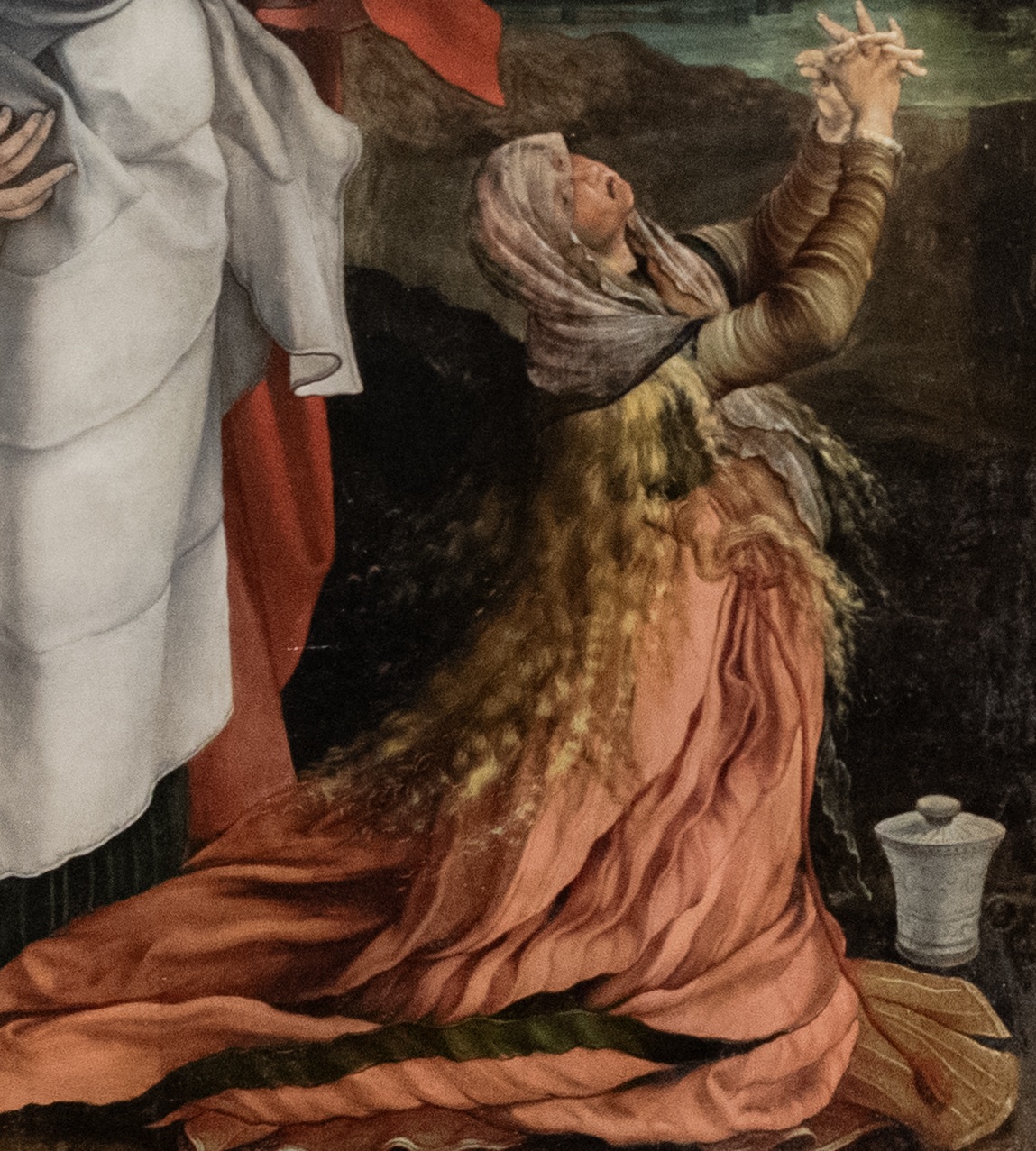
Mary Magdalene kneels at the foot of the cross. Her joined hands rise above her face, and her gaze follows them. An ointment vessel rests nearby, an attribute that helps identify her.
Her long hair and clothing spread down toward the earth while the forearms push upward. The opposing directions give the kneeling figure urgency. She is low in the painting, yet her attention travels straight toward Christ.
Compare her with the Virgin. One body falls and must be supported; the other actively reaches. The two responses are not interchangeable illustrations of sadness. Grünewald gives grief different postures and different relationships to the body on the cross.
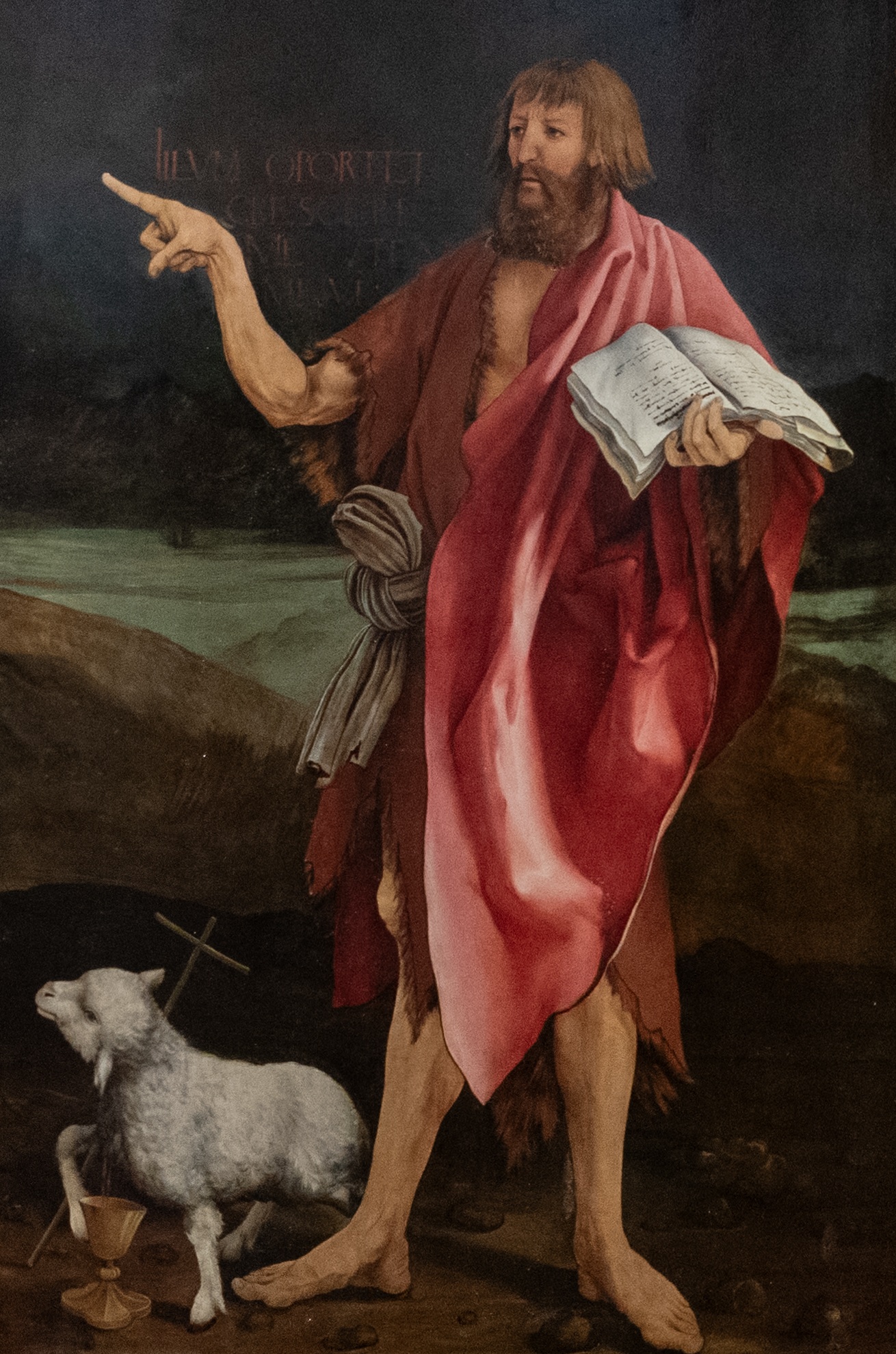
At the right, John the Baptist points toward Christ. A lamb carrying a cross stands below him. The Baptist had died before the Crucifixion, so his presence cannot be understood as a straightforward record of who attended the event.
He functions as a theological interpreter. His gesture directs attention to Christ, while the lamb invokes the Christian identification of Jesus as the Lamb of God. The picture brings different parts of Christian scripture into the same visible space.
The exceptionally clear pointing finger contrasts with the strained fingers on the cross. One hand directs; the others register pain. A small anatomical detail becomes a way of distinguishing explanation from experience.
His book makes another contrast with the mourners. They appear overwhelmed by the event. The Baptist presents it as something to be understood within a larger sacred history. The painting allows both responses to coexist.
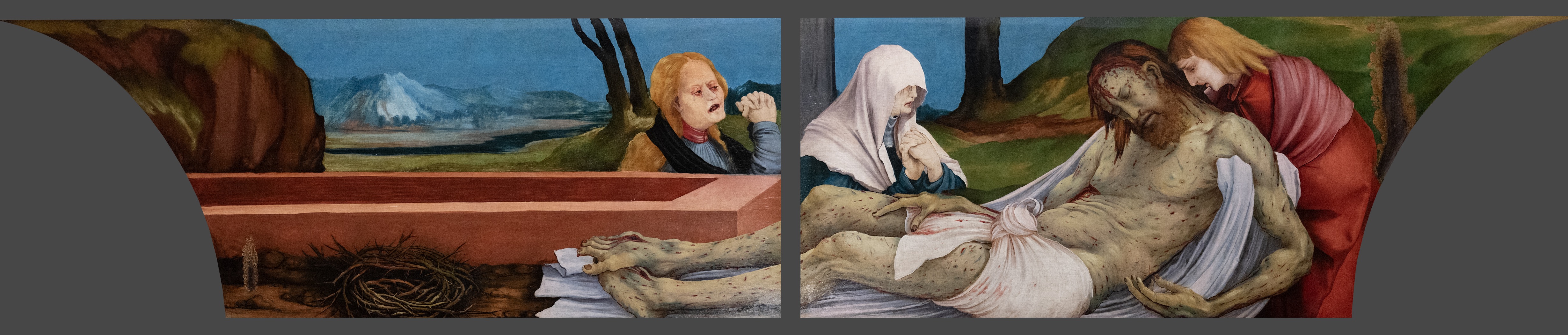
The predella returns to Christ after death. His body stretches across the lower scene while mourners gather around it. The cross's vertical suspension has become a horizontal weight.
This lower compartment matters to the rhythm of the whole altarpiece. The viewer looks up to the Crucifixion and down to a body brought within human reach. Grief shifts from watching at a distance to proximity.
The format itself helps tell the story. A long, low space accommodates the extended body differently from the central panel. Grünewald uses the structure of the object rather than treating each compartment as the same rectangular stage.
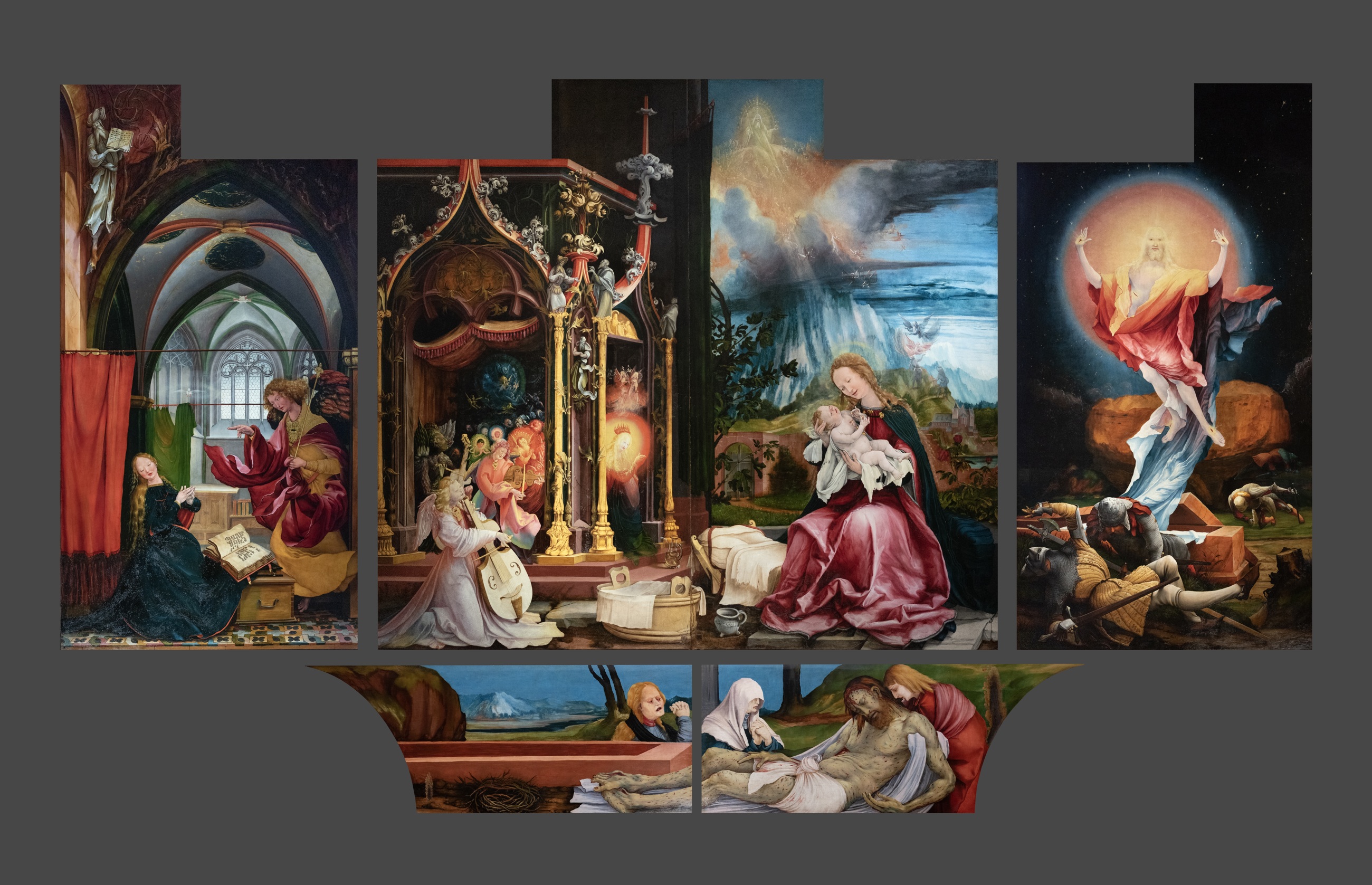
The first opening reveals the Annunciation, an angelic concert beside the Virgin and Child, and the Resurrection. Darkness no longer governs the entire centre. Colour, architecture and light create other ways of encountering the sacred.
These scenes are not separate pictures accidentally collected around the Crucifixion. They belong to a sequence of presentations. Closing or opening the wings changes what a congregation can see at one time.
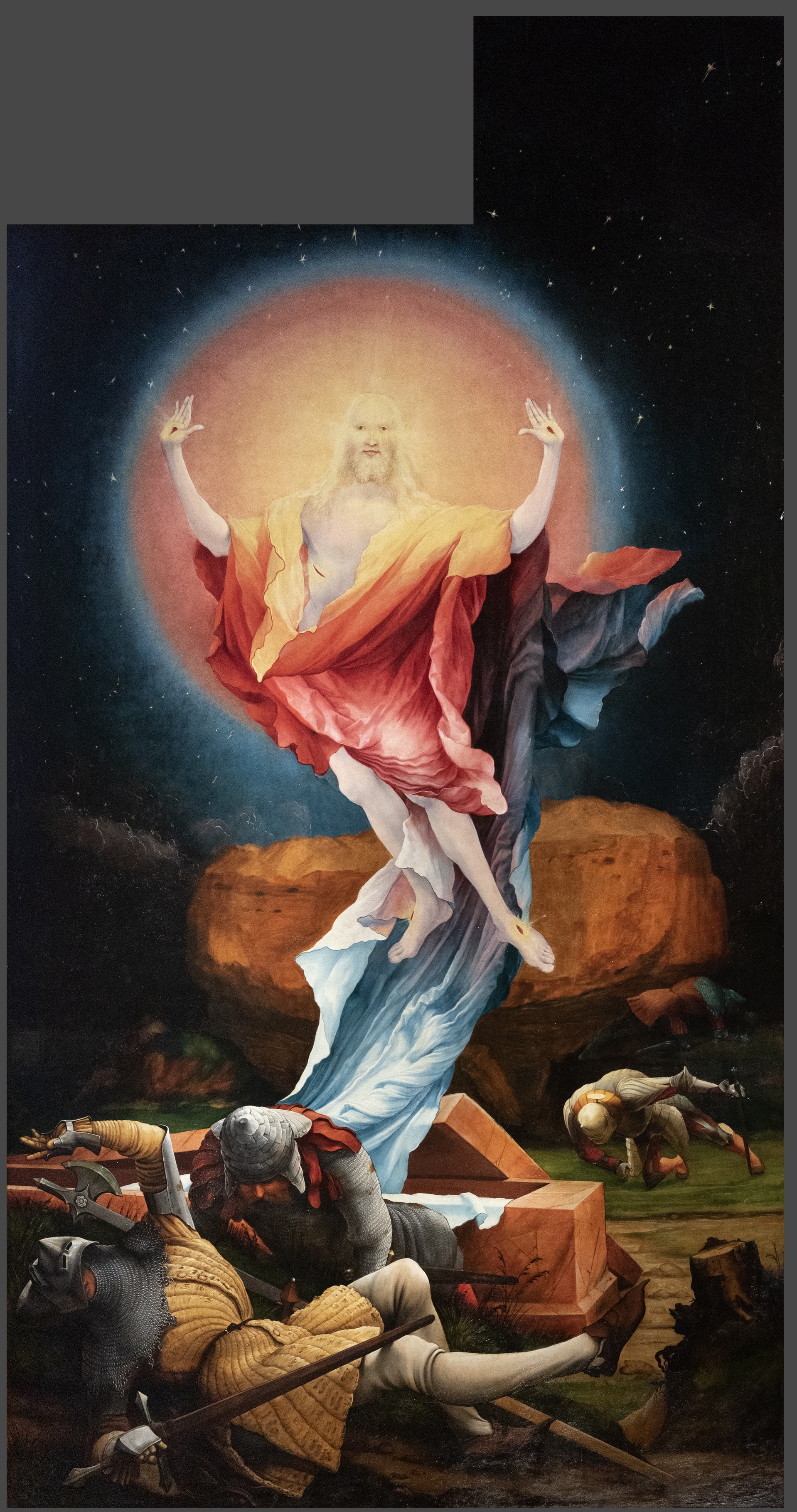
The Resurrection is especially striking after the closed view. Christ rises above the soldiers within a radiant field of colour. The body previously shown under extreme physical strain now appears to overcome ordinary weight.
The transformation does not erase the preceding suffering. The same altarpiece contains both states. For a viewer who remembered the closed panels, the luminous figure could carry the memory of the wounded one.
Opening the inner wings reveals the carved shrine, with Saint Anthony between Saints Augustine and Jerome. Painted scenes of Anthony's temptation and his meeting with Paul the Hermit appear at the sides. The object is therefore more than Grünewald's best-known Crucifixion.
The presence of Anthony connects this final presentation to the order that commissioned the work. Sculpture, painted narrative and the hospital's religious identity meet within a single structure.
Looking only at a reproduction of the central panel makes that structure easy to forget. Its terrifying body remains central to the altarpiece's reputation, but the complete work also makes room for infancy, music, endurance and resurrection.
Matthias Grünewald painted its panels in 1512–1516. Niclaus of Haguenau created the sculptural work.
It is in the Musée Unterlinden, Colmar, France. Its original destination was the Antonite monastery at Isenheim.
The image emphasises bodily suffering within a Passion scene made for an institution caring for the sick. The hospital context supports a reading involving identification and compassion; it does not establish a precise medical diagnosis of the painted body.
No. It is the central panel of the closed presentation. The complete altarpiece has movable wings, other painted scenes, a predella and a carved shrine.
The artist profile uses a later commemorative statue, not a verified lifetime likeness of Grünewald. Photograph by Tors, cropped from Wikimedia Commons, CC BY-SA 3.0; the cropped photograph retains that licence.
Matthias Grünewald, painted panels of the Isenheim Altarpiece, 1512–1516, Musée Unterlinden, Colmar. Photographs by Gsimonov (2023), CC0, Wikimedia Commons. Details cropped from those photographs.
Enjoyed this story?
Save articles to your collection
Log in or create a free account, and this article will be waiting in your Private Collection.
Log in or sign up
Man Writing a Letter
Gabriel Metsu, c. 1664
The gallery list
Every painting is already 50% off. Join the list and we will send you an extra $15 code, plus first access to new collections.
No spam. Unsubscribe anytime. · Privacy Policy
Welcome
Your $15 code is on its way. Explore the gallery while you wait.