Loading cart…
No products in the cart.

Thomas Theodor Heine occupies a singular and irreplaceable position in the history of German visual culture, standing at the precise intersection of fine art, political satire, and the decorative vocabulary of Art Nouveau. His significance to art history rests not…
Save articles to your collection
Log in or create a free account, and this article will be waiting in your Private Collection.
Log in or sign upThomas Theodor Heine occupies a singular and irreplaceable position in the history of German visual culture, standing at the precise intersection of fine art, political satire, and the decorative vocabulary of Art Nouveau. His significance to art history rests not merely on the visual elegance of his line work or his command of color, but on his remarkable ability to fuse aesthetic beauty with sharp social critique at a time when Germany was navigating profound political and cultural upheaval. He helped define the visual identity of an entire era, shaping how a generation of Germans saw power, class, and hypocrisy through the lens of a drawing. To study Heine is to understand how graphic art can function simultaneously as ornament and as weapon, and why that dual function matters to the broader story of modernism in Europe.
Born in Leipzig on February 28, 1867, Heine studied at the Dusseldorf Academy of Fine Arts before relocating to Munich, the city that would become the center of his creative life and public reputation. In 1896 he became one of the founding contributors to Simplicissimus, the Munich-based satirical magazine that quickly became one of the most influential and controversial periodicals in Europe. His covers and interior illustrations for the magazine, often featuring his iconic red bulldog as a symbol of biting defiance, brought him into direct conflict with German authorities and even resulted in a prison sentence in 1898 for an illustration deemed an insult to Kaiser Wilhelm II. Rather than silencing him, this episode amplified his reputation. He continued producing work of remarkable vitality and wit through the Weimar Republic era, but the rise of National Socialism forced him into exile in 1933. He lived in Czechoslovakia, Norway, and ultimately Sweden, where he died in Stockholm in 1948. His life and career trace a full arc of the turbulent European twentieth century, and his art remains a vital document of that journey.
The visual language of Thomas Theodor Heine draws its power from a productive tension between the decorative and the confrontational. In purely technical terms, Heine worked with a line of extraordinary confidence and economy, a line that owed much to the sinuous, organic contours of Art Nouveau while simultaneously sharpening those contours into instruments of satirical precision. His compositions frequently employ flat areas of bold color, influenced by the Japanese woodblock prints that captivated so many artists of his generation, combined with strong black outlines that give his figures an almost theatrical clarity. His mastery of contrast, both tonal and conceptual, allowed him to place elegant decorative borders around images of social brutality, creating a visual irony that reinforced the satirical content. He understood instinctively that beauty and discomfort could coexist on the same surface, and that this coexistence could unsettle a viewer far more effectively than outright ugliness.
Beyond the line itself, Heine was a sophisticated colorist who used a restrained but purposeful palette to guide emotional response. Deep reds, acid greens, and murky blacks recur throughout his body of work, creating a chromatic signature instantly recognizable to anyone familiar with the pages of Simplicissimus. His figure work is boldly caricatural without descending into mere cartoonishness, preserving enough anatomical truth to keep subjects identifiable and human even as it exaggerates for effect. His ornamental borders and compositional frames, drawn directly from the Art Nouveau repertoire of flowing botanical forms and interlaced curves, serve not merely as decoration but as ironic commentary, framing scenes of political corruption or bourgeois complacency within structures of almost mocking elegance. This combination of refined formal skill and subversive intent is what makes the style of Heine so distinctive and so enduringly compelling.
Each card links to its own article with full analysis and reproduction details.
 #1
#1
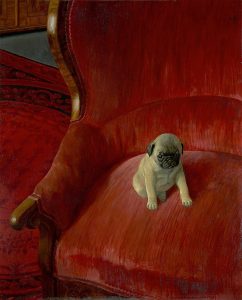 #4
#4
A print can reproduce colors. What it cannot reproduce is texture, depth, and the physical presence of oil paint on canvas. Thomas Theodor Heine technique depends on these.
At ByMuseum, every reproduction is painted by hand using oil on canvas. There is no inkjet, no digital print. The brushwork is real. The result looks like a painting because it is one.
Enjoyed this story?
Save articles to your collection
Log in or create a free account, and this article will be waiting in your Private Collection.
Log in or sign up