Loading cart…
No products in the cart.

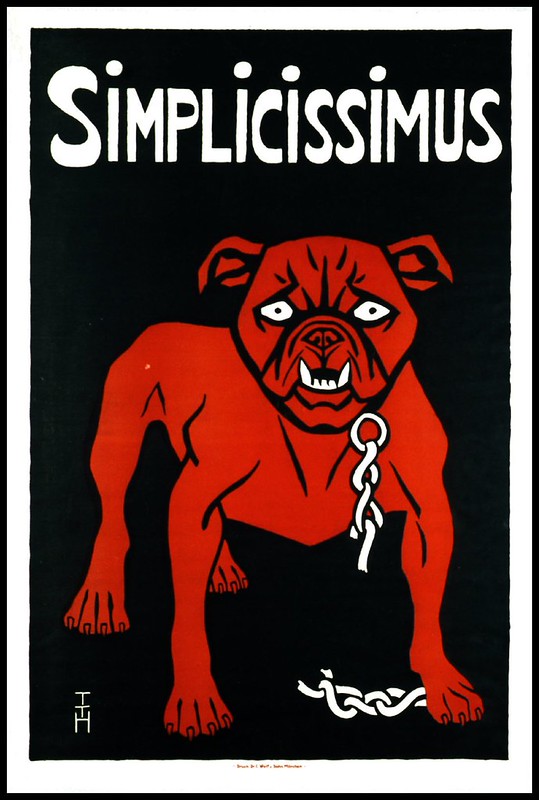
1897 · Oil on canvas · Monacensia Literary Archive and Library, Munich, Germany
Save articles to your collection
Log in or create a free account, and this article will be waiting in your Private Collection.
Log in or sign upThomas Theodor Heine introduced the red bulldog as the visual mascot of Simplicissimus magazine beginning in 1896 and 1897, shortly after the founding of the publication by Albert Langen in Munich. The magazine was conceived as a vehicle for political and social satire at a moment when Germany under Kaiser Wilhelm II was experiencing rapid industrialization, growing class tension, and an increasingly assertive imperial ideology. Heine, who was among the founding artistic contributors to the magazine, understood that the publication needed a visual identity as aggressive and memorable as its editorial content. The bulldog, straining against a chain, communicated defiance and barely contained energy in a single, immediately legible image. Heine rendered this figure in oils as a compositional study before translating it into print, and the resulting oil work preserves the full vitality of his creative process. The historical significance of this image extends well beyond the purely aesthetic. In 1898, Heine was sentenced to six weeks in prison for an illustration published in Simplicissimus that was deemed offensive to Kaiser Wilhelm II. This act of official censure transformed both Heine and the bulldog into symbols of press freedom and artistic courage in the German-speaking world. The image circulated widely, was recognized by readers across social classes, and established a template for the kind of politically engaged graphic art that would characterize German visual culture well into the Weimar era. The oil study for this work represents the moment when a visual idea crystallized into a cultural institution, making it one of the most historically loaded images in the entire body of work produced by Heine.
The composition of the red bulldog image is a study in the intelligent deployment of simplicity. Heine places the animal at the center of the pictorial field, allowing the powerful musculature of the figure to command the full attention of the viewer without competition from background detail. The body of the bulldog is rendered in a deep, saturated red that reads with immediate force against the lighter ground, a chromatic decision that owes something to the bold flat color fields of Japanese ukiyo-e woodblock printing and something to the theatrical traditions of German popular illustration. The chain that restrains the animal is drawn with crisp, confident linework that contrasts with the more fluid contours of the body, creating a visual tension between confinement and energy that mirrors the satirical and political tensions the magazine sought to expose. What makes this work visually extraordinary is the economy of means through which Heine achieves such communicative force. There is no superfluous detail, no atmospheric shading, no narrative context beyond the single figure and its chain. The Art Nouveau influence is legible in the assured, slightly stylized quality of the outline and in the decorative sensitivity with which the overall shape is arranged within the frame, but Heine has stripped away the more florid ornamental tendencies of the movement in favor of a graphic directness suited to the polemical purpose of the image. The result is a composition that functions both as a sophisticated work of applied art and as an instantly decoded popular symbol, a rare double achievement in any medium. Collectors who wish to own this as a hand-painted oil reproduction can explore the available options at ByMuseum, where skilled artists recreate the full chromatic impact of this landmark image.
The symbolism embedded in the red bulldog image operates on several levels simultaneously, which is precisely why the image has retained its interpretive power across more than a century. At the most literal level, the chained bulldog represents the satirical press itself, energetic, aggressive, and willing to bite, but restrained by legal and governmental authority. The choice of the bulldog rather than a more conventionally noble animal such as a lion or an eagle is itself a satirical gesture, the bulldog is not a creature of heraldic prestige but of stubborn, inelegant persistence, qualities that Heine clearly associated with the mission of independent journalism in an autocratic political environment. At a deeper level, the image speaks to the cultural condition of German artistic and intellectual life at the close of the nineteenth century, a moment when the freedoms promised by modernity were in constant negotiation with the authoritarian impulses of imperial governance. The red of the bulldog carries connotations of both danger and passion, of the blood of political struggle and the fire of creative energy. The fact that Heine himself was imprisoned for his work at Simplicissimus transformed the image retrospectively into something close to a self-portrait in symbolic form, a representation of the artist as a figure of contained but irrepressible defiance. For contemporary collectors and admirers of Art Nouveau graphic art, owning this as a hand-painted oil reproduction is an opportunity to bring one of the most resonant symbolic images of the German fin de siecle into direct, tangible relationship with the present. Visit the ByMuseum product page to commission your hand-painted oil reproduction today.
Enjoyed this story?
Save articles to your collection
Log in or create a free account, and this article will be waiting in your Private Collection.
Log in or sign up