Loading cart…
No products in the cart.

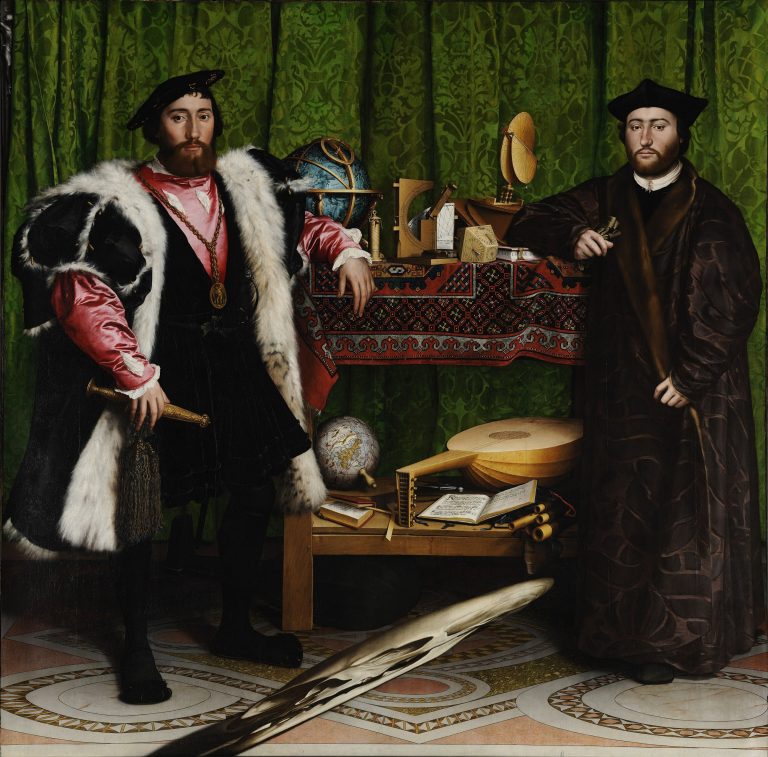
1533 · Oil on oak · National Gallery, London
Save articles to your collection
Log in or create a free account, and this article will be waiting in your Private Collection.
Log in or sign up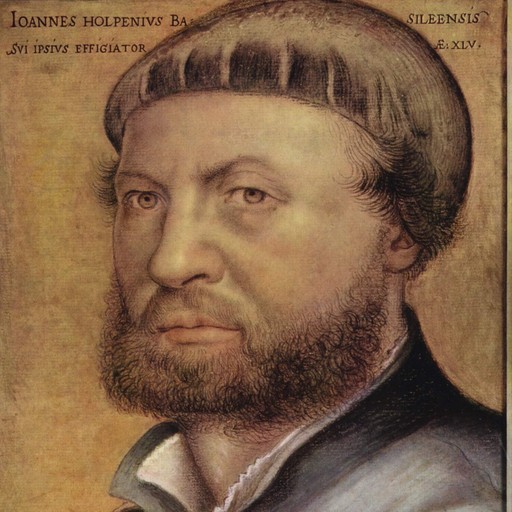 Explore the artistHans Holbein the Younger →
Two men stand beside a display of objects they appear to understand. Globes describe the world and the heavens. Instruments measure time. Books promise knowledge. Then an enormous pale shape slides across the foreground, refusing to fit the same orderly space.
Hans Holbein the Younger painted The Ambassadors in 1533. The nearly life-size double portrait, now in London's National Gallery, rewards two quite different kinds of attention: examining the things on the shelves and changing the position from which you look.
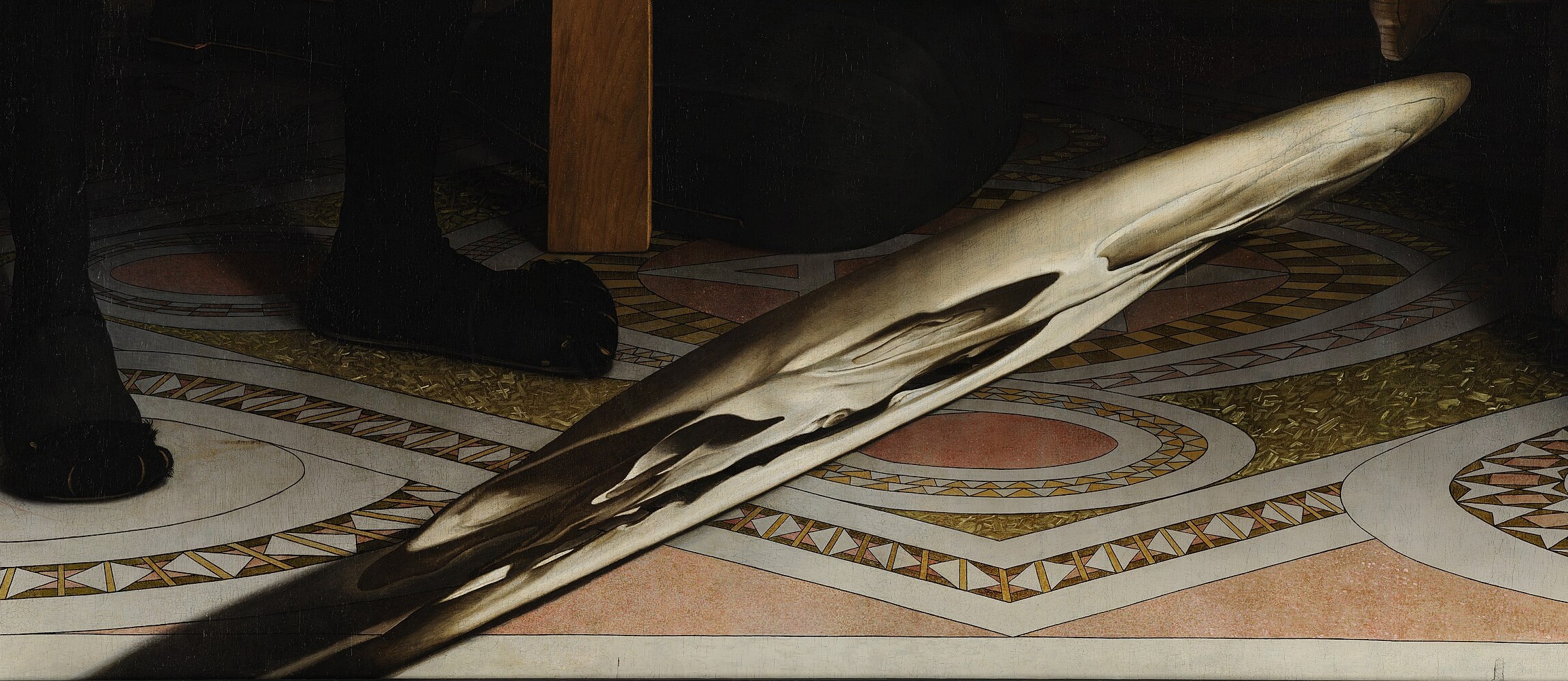
The pale shape is a skull. Seen directly, it is stretched almost beyond recognition. From an oblique angle at the right, it resolves. Holbein has placed a reminder of death in a painting whose other surfaces make worldly achievement look extraordinarily convincing.
The man at the left is Jean de Dinteville, the French ambassador to Henry VIII's court. His visitor at the right is Georges de Selve, Bishop of Lavaur, who also undertook diplomatic work. They are friends as well as men with public responsibilities.
Their presence in England in 1533 places the portrait within the upheaval surrounding Henry's marriage to Anne Boleyn and his break with Rome. That background matters, but it does not turn every small object into an unambiguous political message. The National Gallery's catalogue distinguishes documented identities from the many interpretations the picture has attracted.
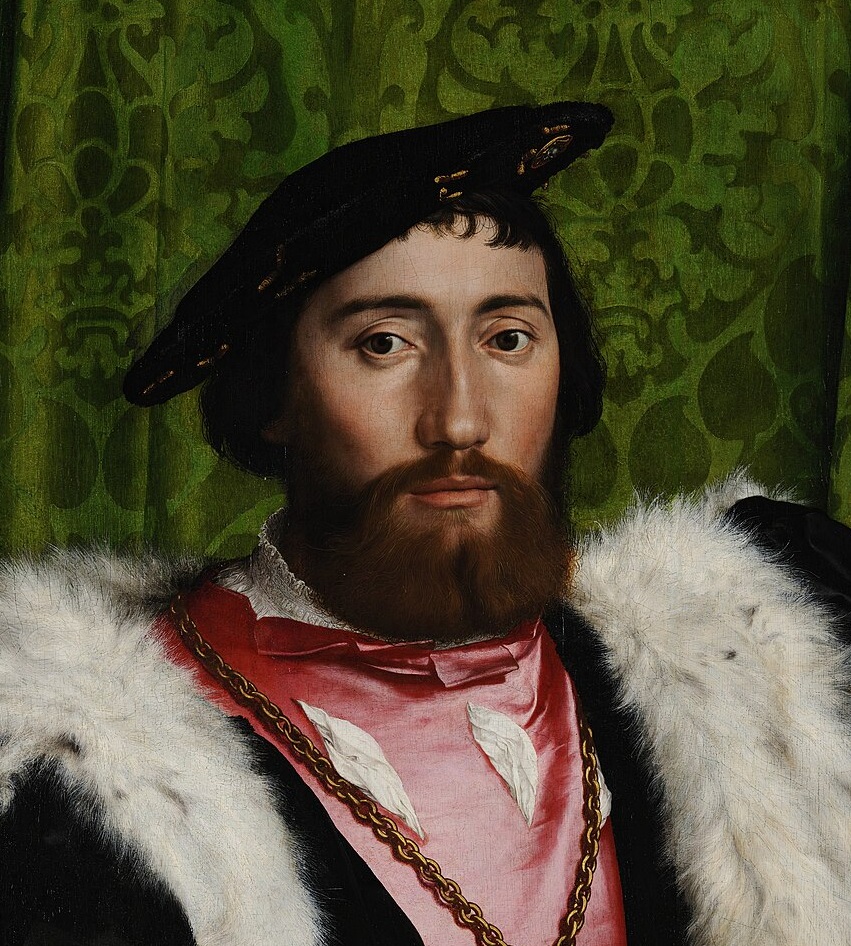
Dinteville makes a broad silhouette. The white fur crosses pink satin and a black outer garment. A chain and medal lead the eye down from his face. One hand rests near his dagger; the other falls against the shelf. His pose allows his clothes and possessions to be seen.
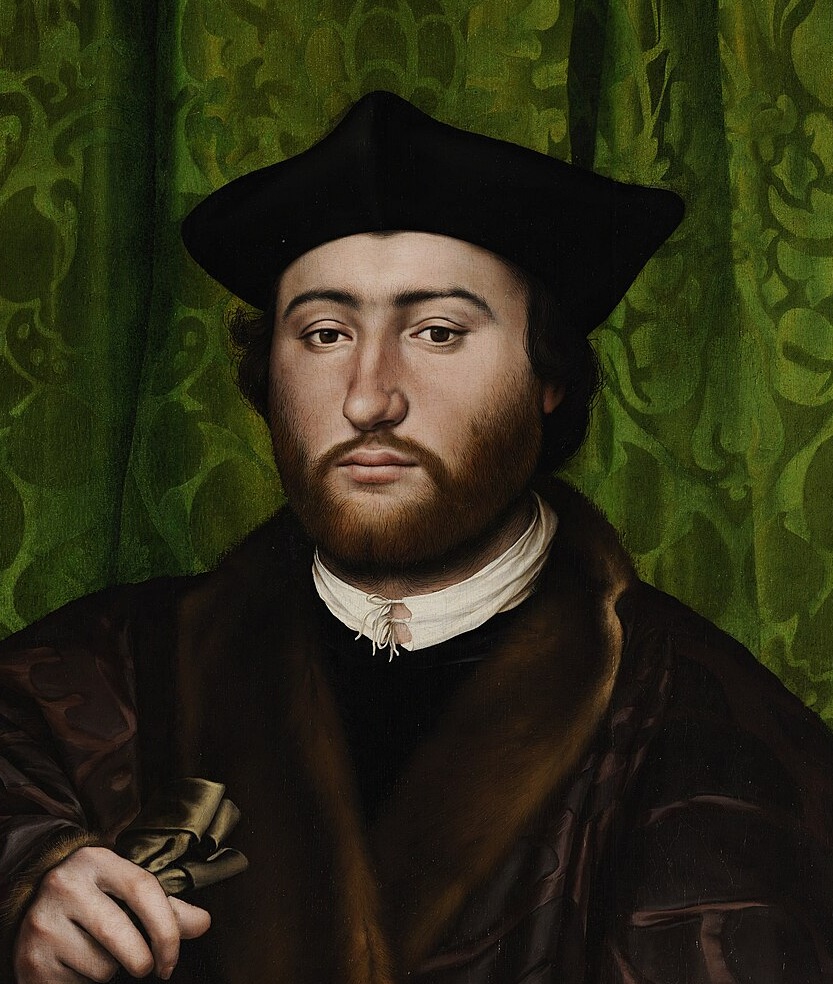
De Selve's darker clothing produces a different presence. The small white collar stands out between his beard and gown. He leans on a book while keeping his other hand low, holding gloves. The two men share the same space without adopting the same posture.
Neither gives a theatrical response to the skull beneath them. Their apparent composure is one reason the strange foreground remains so disturbing. The painting leaves viewers to make a connection its sitters do not visibly acknowledge.
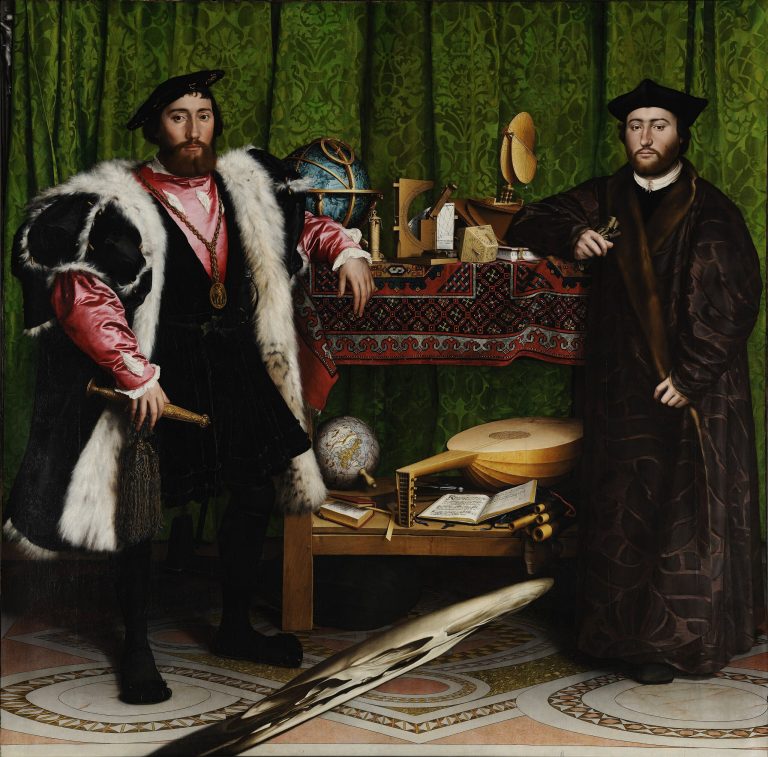
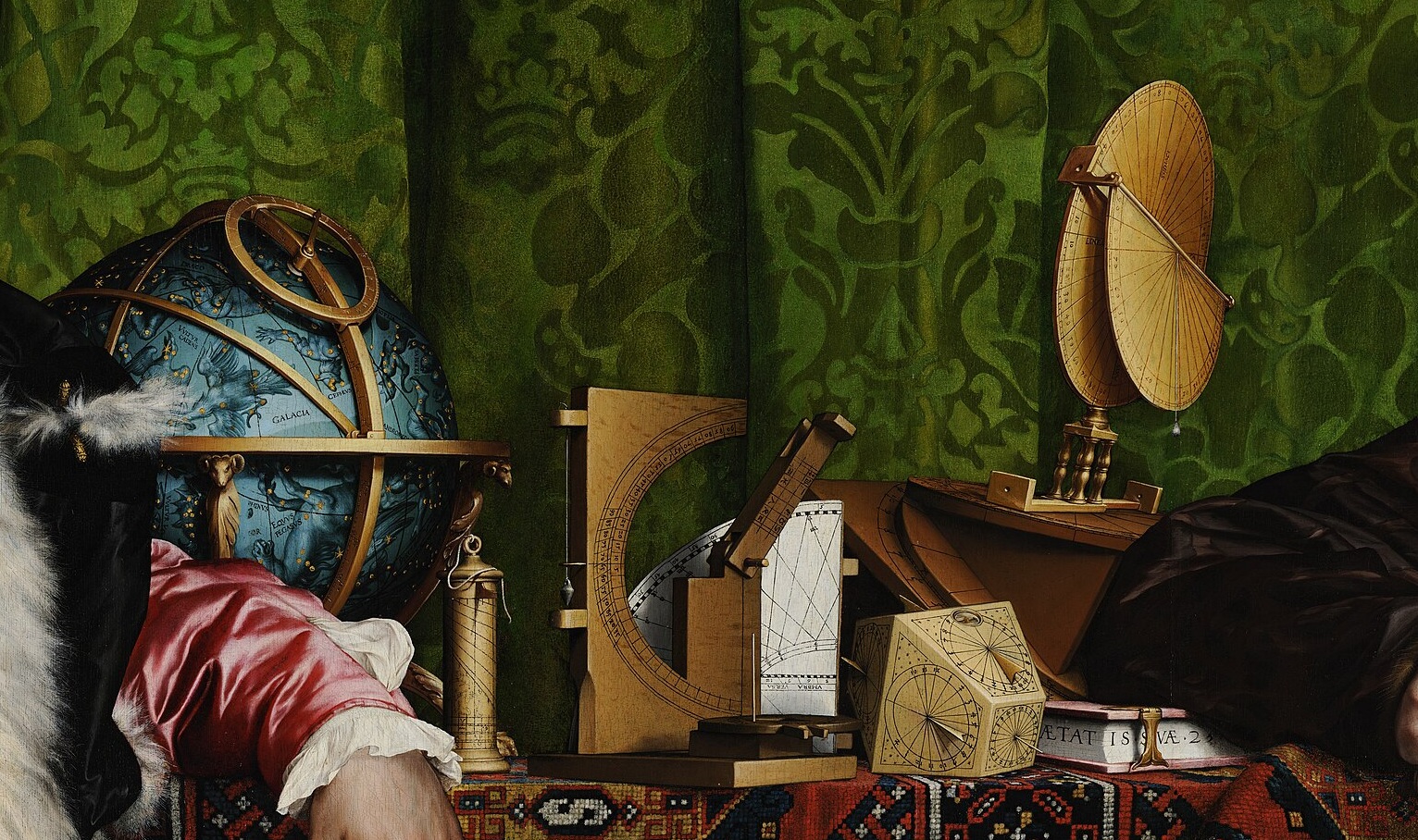
The upper shelf is crowded with carefully distinguished forms. A celestial globe sits beside instruments involving scales, angles and shadows. Brass-coloured edges, wooden surfaces and white markings invite close inspection.
The National Gallery identifies astronomical and time-measuring instruments among this display. These were tools of educated observation, not an assortment of vaguely scientific ornaments. Holbein makes the instruments look usable even where their arrangement would require a specialist to interpret it.
Look at the relationship between the objects and the hands. The men can rest against the shelf as if the apparatus belongs naturally within their world. The heavy patterned textile below the instruments helps join this intellectual display to wealth and material comfort.
It would be a mistake to assume that all the instruments work together to encode one securely established date or hour. Scholars have proposed several readings of their settings. The visible point is firmer: measurement occupies a conspicuous place between these two men.
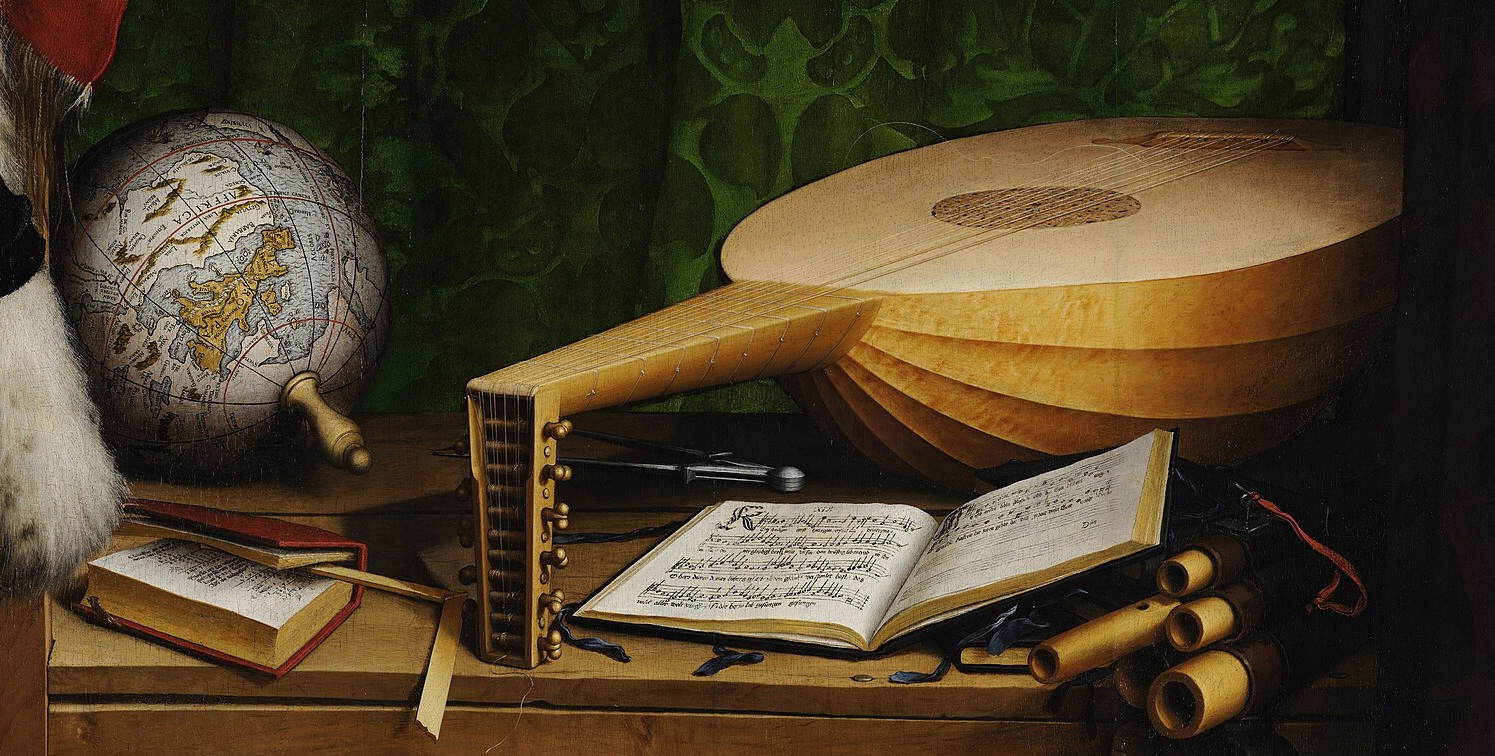
The lower shelf brings the eye back to the earth. Its globe differs from the celestial sphere above. Books lie open or turn their pages toward us. The lute extends across the available space, its neck pointing toward the left.
One lute string is broken. The National Gallery also draws attention to a missing flute and the juxtaposition of a book of arithmetic with a Lutheran hymnbook. Together, these objects have encouraged readings involving harmony, division and religious disagreement.
Those readings are persuasive possibilities rather than a key that settles every detail. A broken string can suggest discord, especially in this historical setting. It is still useful to begin with the particular object: an instrument whose promise of music has been interrupted.
The lute's curved back is warmly lit. The books and pipes make smaller horizontal lines below it. Even before their meanings are considered, these contrasts show how much Holbein can do with objects that never move.
The distorted skull is an example of anamorphosis: an image stretched so that it becomes recognisable from a particular viewpoint. A straight-on photograph preserves the distortion. Simply cropping it does not remove the effect.
At an oblique angle from the right, the broad pale streak compresses into a human skull. The change asks the viewer to leave the position from which the two men and their belongings look most convincing.
That is more than an optical trick placed in an unused corner. The skull crosses the foreground at the scale of a major figure. It disrupts the patterned floor, the space between the men's shoes and the expectation that a portrait will offer one stable view.
It is commonly understood as a memento mori, a reminder of death. That reading does not require us to imagine that the sitters despised their learning or possessions. The tension comes from holding worldly accomplishment and human mortality within the same image.
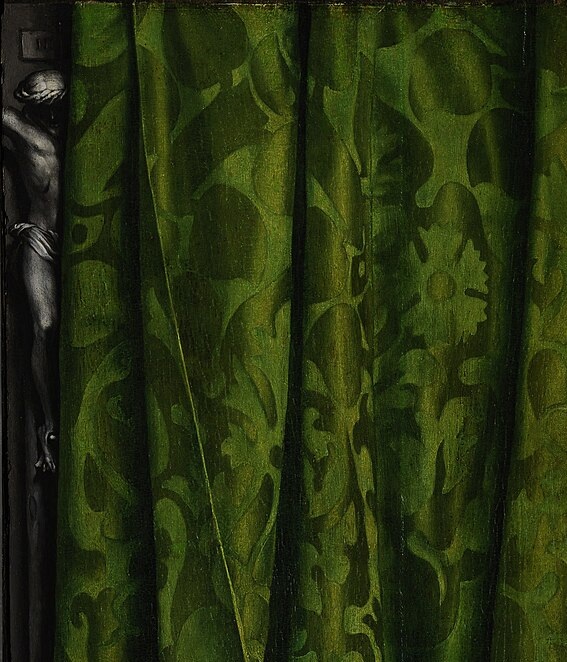
At the upper left, a crucifix appears behind the green curtain. It is small, dark and easy to overlook after the brilliance of the clothes and instruments.
The skull sits where it will eventually demand attention. The crucifix waits at the edge. Within a Christian reading of the picture, the two can connect death to the hope of salvation. Their very different visibility is worth noticing before assigning a complete theological programme to the painting.
The curtain helps construct the contrast. Across most of the background it is a rich, patterned surface. In this corner, its edge also becomes a means of concealment. Holbein lets a piece of drapery organise what the viewer can discover.
The Ambassadors is often presented as a collection of hidden symbols. That approach can make its objects seem like answers waiting to be decoded. It also risks making the two people disappear behind an ingenious puzzle.
Return to their faces after studying the shelves. They are particular men, depicted during a difficult year, wearing different clothes and maintaining different postures. Their world includes diplomacy, faith, learning, wealth and uncertainty.
Holbein gives those concerns weight through surfaces we can see: fur against satin, paper against polished wood, a taut string beside a broken one. The skull unsettles that convincing world without making its visible particulars irrelevant.
To look at the painting well is to move between these scales of attention. An object can be meticulously painted and open to interpretation. A portrait can proclaim achievement and still leave room for death.
The original is in the National Gallery, London, inventory NG1314.
Holbein painted it in 1533 in oil on oak. The National Gallery records dimensions of 207 by 209.5 centimetres.
View the painting at a steep angle from the right. Its stretched shape is an anamorphic image that resolves from an oblique viewpoint.
The painting is associated with Jean de Dinteville and his residence at Polisy in France. The National Gallery's catalogue traces its ownership and discusses what can be established about its original setting.
Hans Holbein the Younger, The Ambassadors (1533), National Gallery, London. Faithful public-domain reproduction via Google Art Project/Wikimedia Commons. Detail images are crops of this source.
Enjoyed this story?
Save articles to your collection
Log in or create a free account, and this article will be waiting in your Private Collection.
Log in or sign up
Man Writing a Letter
Gabriel Metsu, c. 1664
The gallery list
Every painting is already 50% off. Join the list and we will send you an extra $15 code, plus first access to new collections.
No spam. Unsubscribe anytime. · Privacy Policy
Welcome
Your $15 code is on its way. Explore the gallery while you wait.