Loading cart…
No products in the cart.

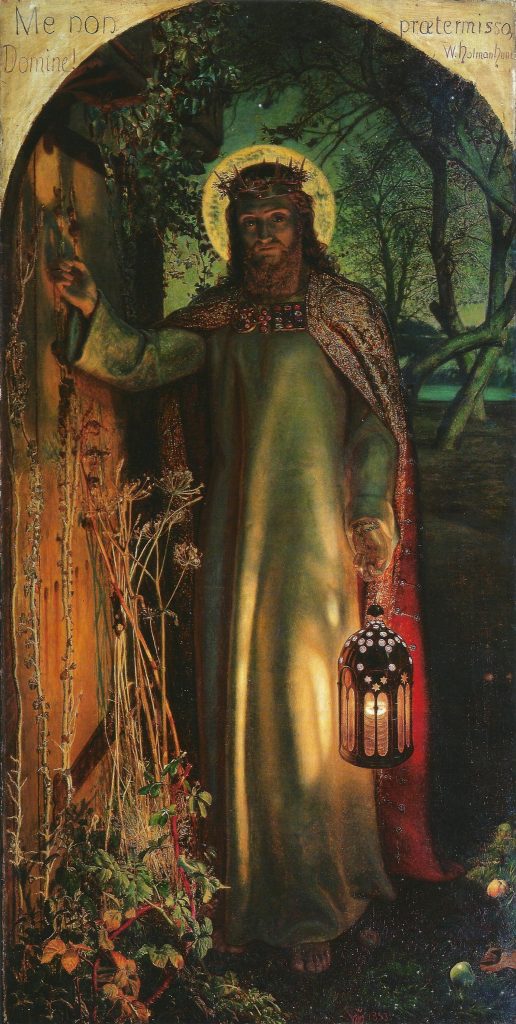
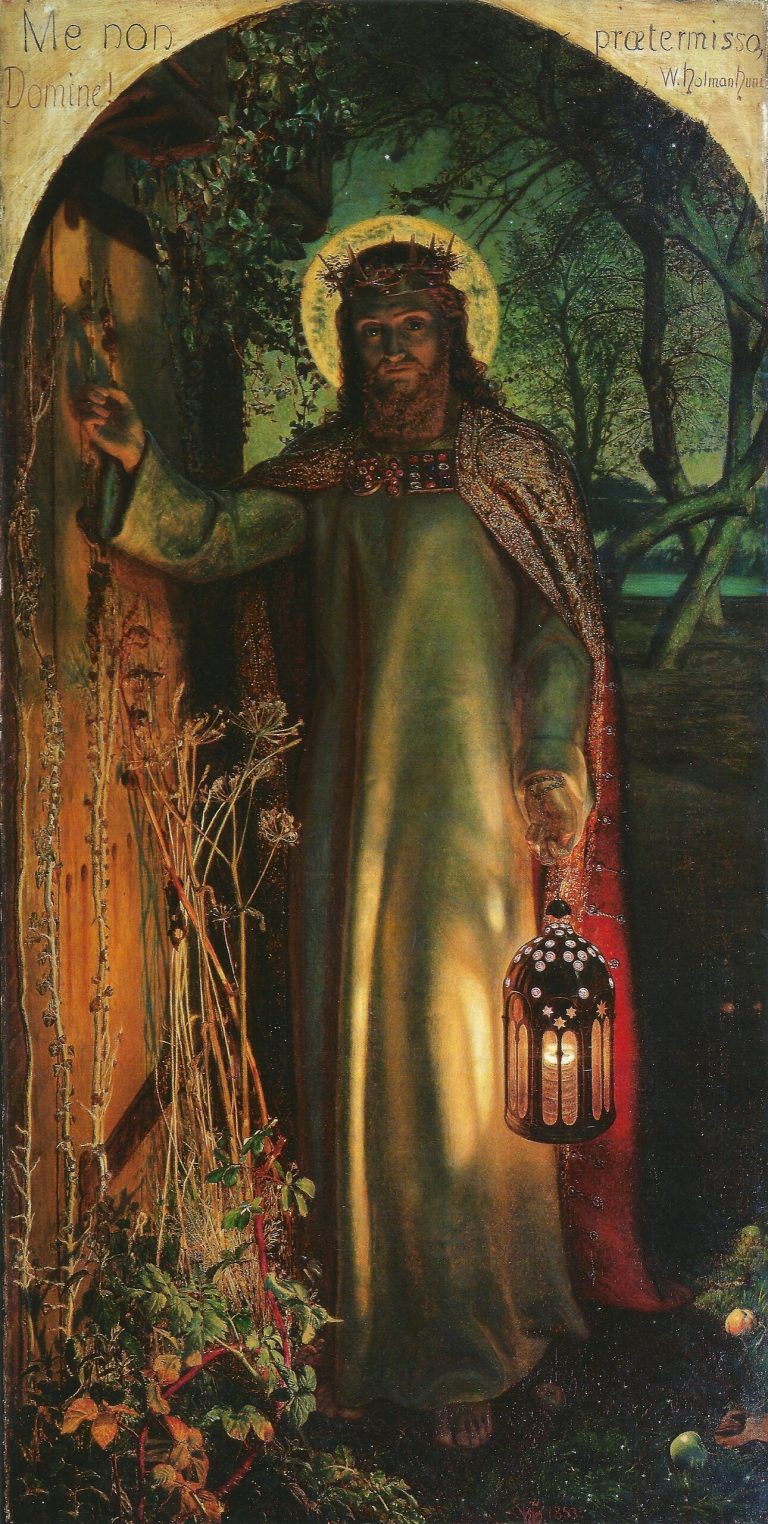
1851–1853 · Oil on canvas laid on panel · Keble College, Oxford
Save articles to your collection
Log in or create a free account, and this article will be waiting in your Private Collection.
Log in or sign up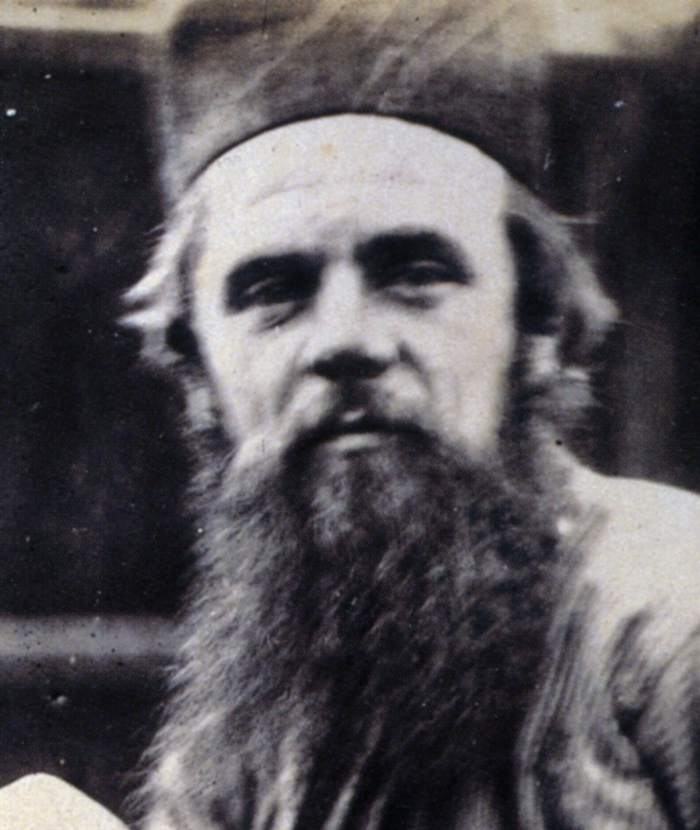 Explore the artistWilliam Holman Hunt →
Look just below Christ’s raised hand. Lantern light falls across the boards, and you can follow the door down to the weeds at its base. There is no handle on this side. Whoever is inside will have to open it.
That pause is the subject of William Holman Hunt’s The Light of the World. Christ has brought a lantern, knocked and waited. The painting stays with him at the threshold. Hunt’s first version, painted in the early 1850s, hangs in the side chapel at Keble College, Oxford.
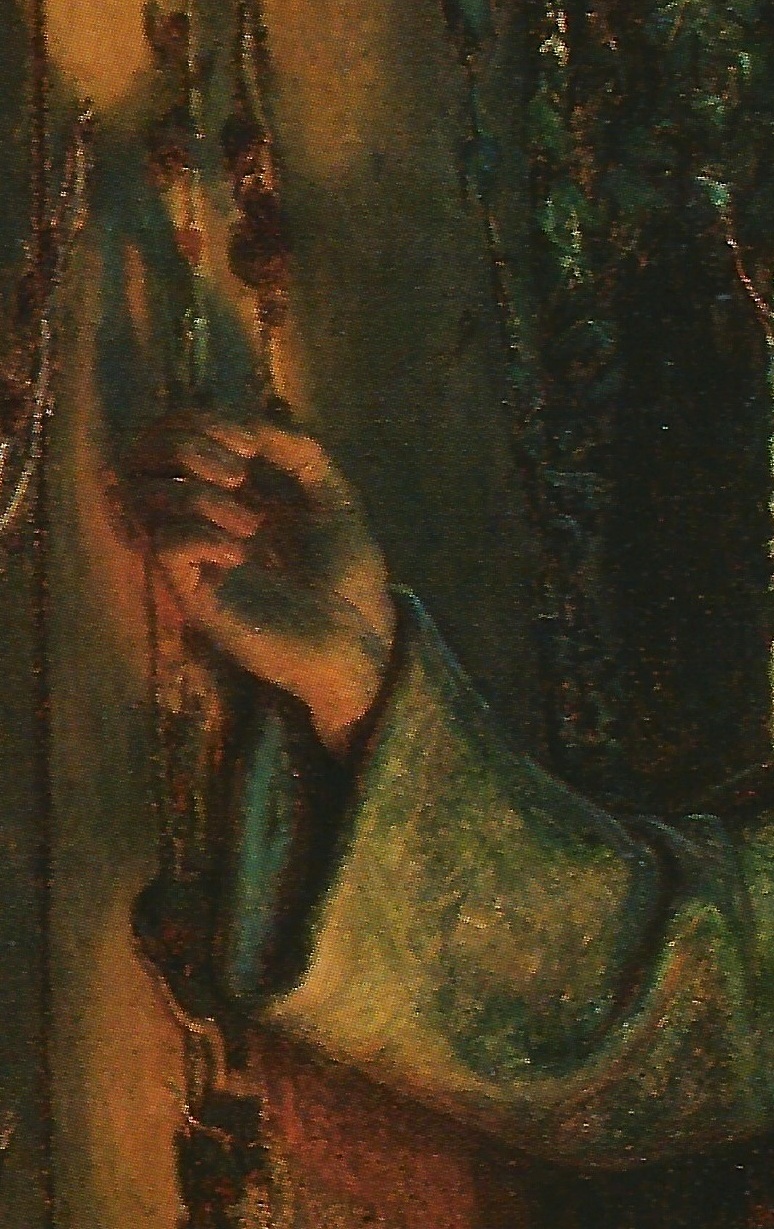
Keble College reads the door as the human soul. The missing handle turns an ordinary piece of carpentry into part of that metaphor. Christ can make his presence known. The choice to open the door belongs to the person within.
The wood is surrounded by growth. Rusted fittings, vegetation and the obstructed threshold suggest a door left unopened. Hunt lets neglect take material form instead of writing the condition beside the figure.
The raised hand is restrained. A violent blow would tell a different story. Here the request for entry must coexist with the possibility that nobody will respond.
The knock comes from Revelation 3:20, where Christ calls to whoever will open the door. The title echoes a different passage, John 8:12, in which Christ calls himself the light of the world. Hunt brings the two passages together in the raised hand and the lantern.
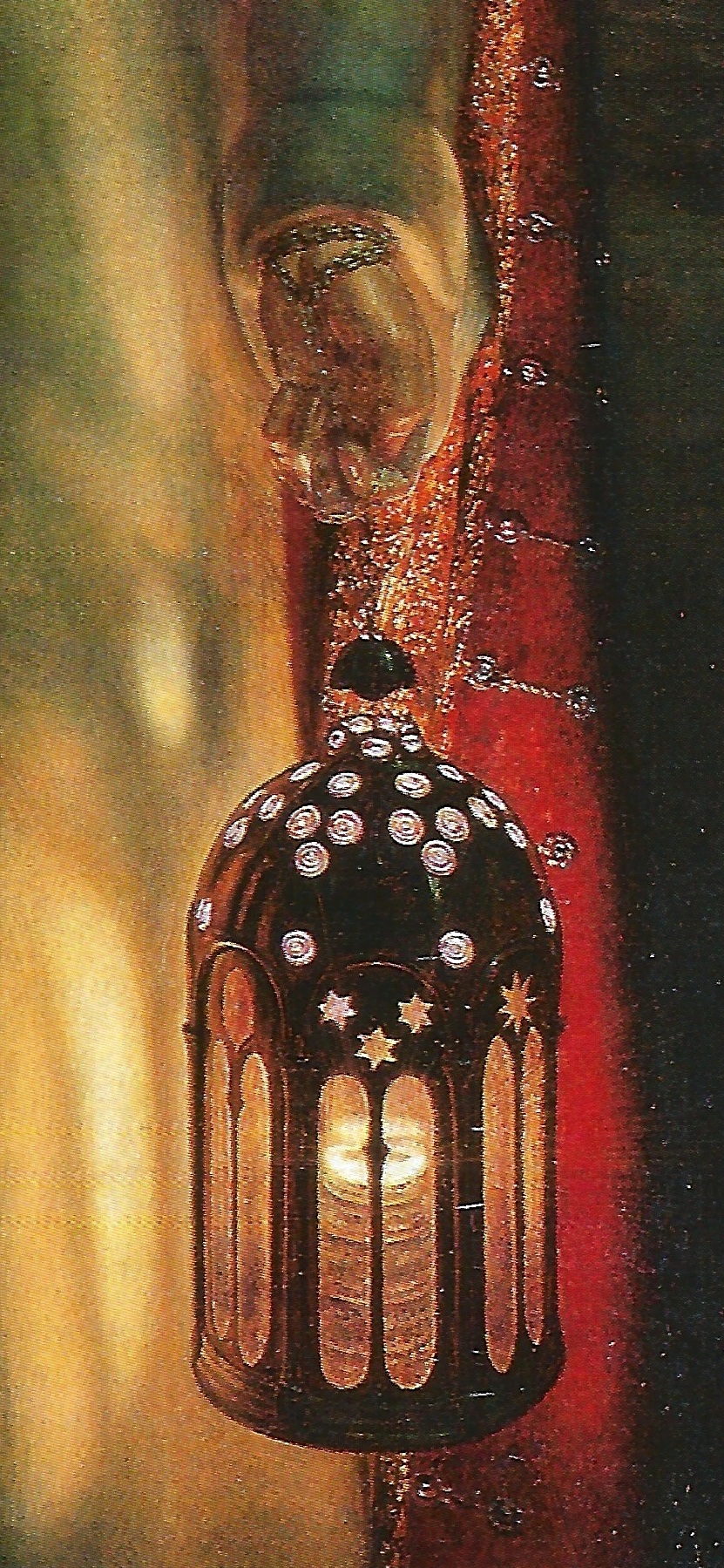
The lantern hangs below the face. Its glowing centre lights the robe near it and gives the figure a source of illumination that belongs within the physical scene.
The halo offers another kind of light. Keble's interpretation identifies the lantern with conscience and the halo with salvation. Those meanings are part of the painting's Christian symbolism, rather than properties a lamp would possess in any image.
The two lights also occupy different positions. One must be carried in a hand; the other surrounds the head. Between them, the figure remains clothed in a long passage of changing brightness.
Look at the small stars punched into the lantern’s metal casing and the tall openings below them. Hunt designed a brass lantern as a model for the painting. Manchester Art Gallery holds it alongside its own version of the picture. The light catches the robe through the openings Hunt worked out on an object he could hold.
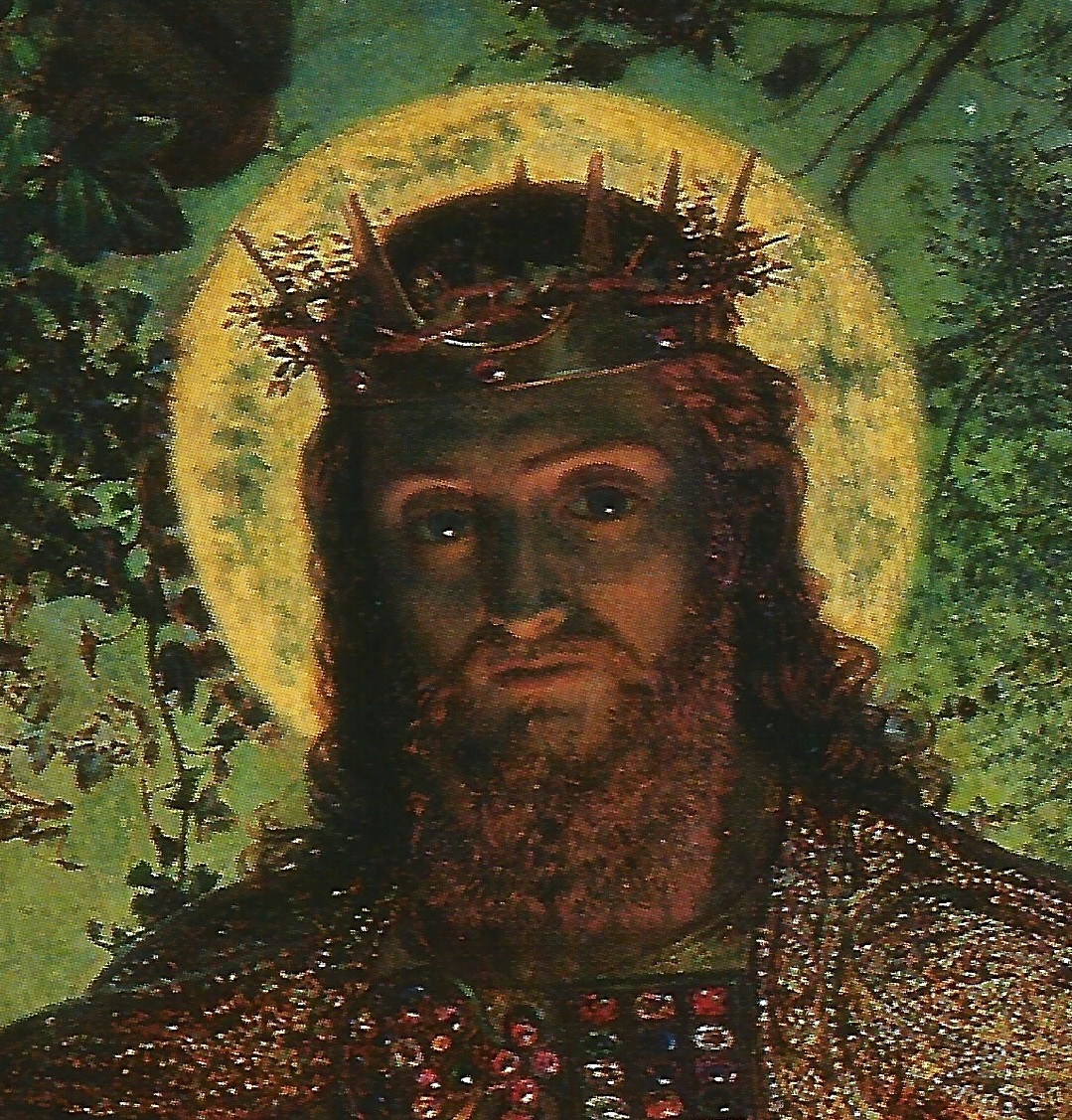
The halo makes a bright circle behind Christ's head. Crown-like forms cross the hair, including the sharp points of thorns. The face remains serious rather than visibly triumphant.
These associations bring different aspects of Christ's identity together. The thorns recall the Passion, while the rich clothing and crown suggest kingship. The waiting figure carries both suffering and authority.
His gaze turns outward toward the viewer. We do not see the person behind the door, but we are not left entirely outside the encounter. The frontal face creates an address that the closed wood itself cannot provide.
That arrangement keeps the painting from becoming only a catalogue of religious objects. The halo, thorns, robe and lantern surround a figure who appears to be waiting for a response.
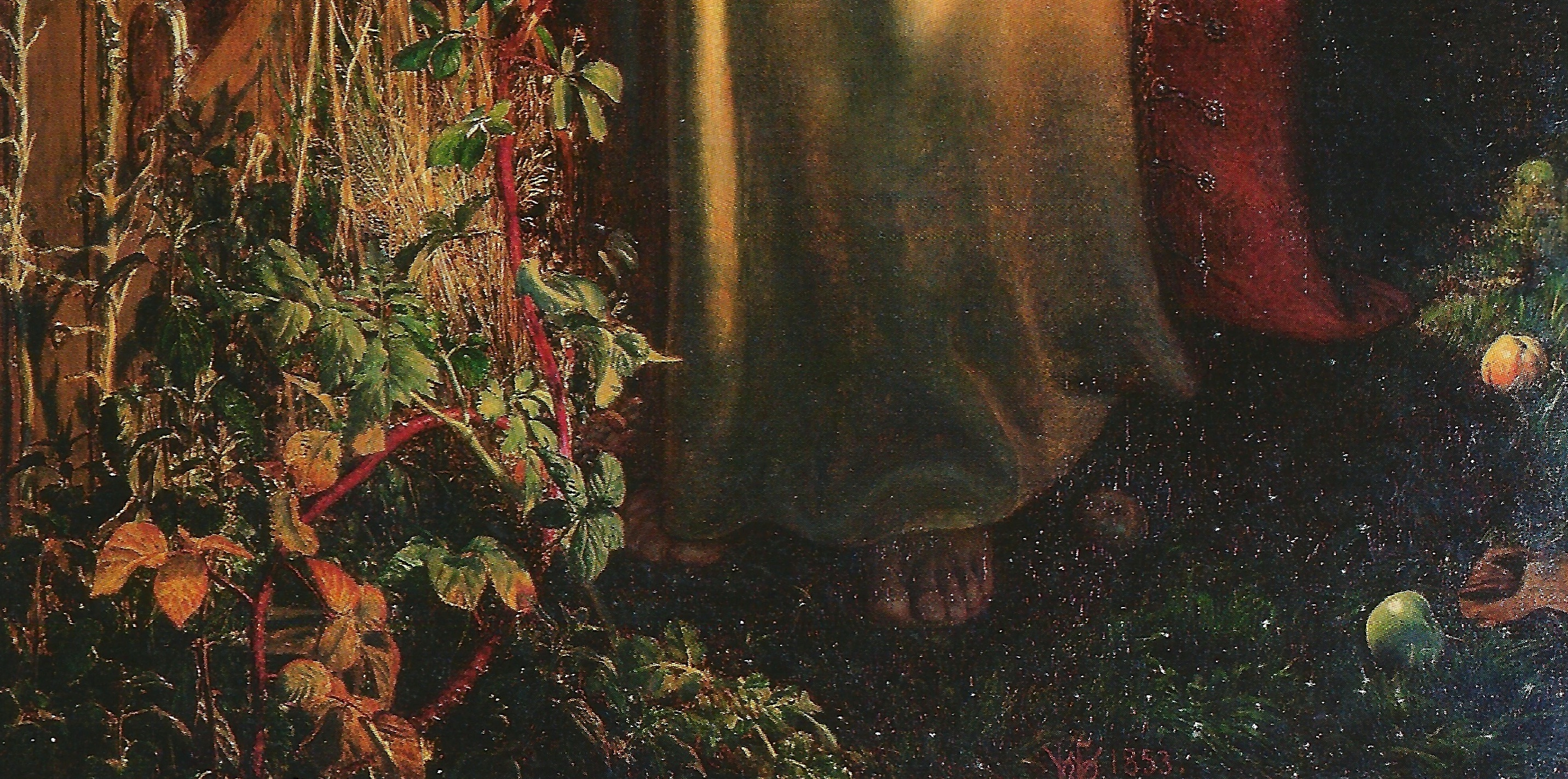
The threshold is full of growth, dry stems, leaves and fallen fruit. The area nearest the viewer is not a clean platform arranged for a ceremonial visitor.
The plants and fallen fruit make the threshold look long neglected. St Paul’s Cathedral also reads the fallen apples in its version as a possible allusion to the Fall. The fruit stays close to the ground, at the point where the visitor would have to step if the door opened.
The plants also make the stillness less simple. Growth has continued while the human action implied by the door has failed to happen. The environment records a duration that the single raised hand cannot.
Hunt's close attention to material things is essential to the metaphor. A generic door in an empty space would not convey the same long postponement.
The trees and shadowed background place the figure within a dim environment. Yet the sky is not a uniformly black field. Cool light remains beyond the nearer forms.
Keble College describes Hunt’s attention to the dawn light. Beyond the figure, the trunks and branches have enough light behind them to stay visible. The landscape feels poised between night and day, just as the figure stands at the moment between a knock and an answer.
The contrast between the warm lantern and cool surroundings makes that possibility visible at more than one scale. A small light is present now; a wider light is suggested beyond the immediate encounter.
It is easy to flatten all the symbolism into one instruction. Slower looking keeps the parts distinct: a closed door, a patient figure, something already illuminated and something still awaiting an opening.
Oxford. Hunt’s first version hangs in the side chapel at Keble College. The Museum of Oxford dates it to 1851 to 1853. It is about 125 centimetres high and 60 centimetres wide, an unusually narrow format that draws attention to the figure and the door.
Manchester. Manchester Art Gallery holds the smaller early version, dated 1851 to 1856 in the Oxford conference volume. It is just under 50 centimetres high. The gallery also holds Hunt’s brass lantern model.
London. Hunt painted the third version between 1900 and 1904 with help from Edward Robert Hughes. At just over three metres high, it is much larger than either early version. The painting toured Canada, South Africa, New Zealand and Australia before industrialist Charles Booth’s gift was received at St Paul’s Cathedral in 1908.
A painting can make an action last much longer than it would in life. Hunt preserves the hand before the door opens, or before any refusal becomes visible.
That unresolved moment gives the image its particular force. The light is available, the visitor has arrived, and the threshold remains obstructed. The decision belongs to an unseen person.
For a viewer approaching it through Christian belief, that person may become a reflection of the self. For another viewer, the arrangement remains an unusually concentrated study of invitation, delay and the limits of entering someone else's space.
William Holman Hunt made three versions of the painting. Edward Robert Hughes helped him with the large version at St Paul’s Cathedral.
The first version hangs in the side chapel at Keble College, Oxford. The other two versions belong to Manchester Art Gallery and St Paul’s Cathedral, London.
The door represents the human soul in the painting's Christian symbolism. It must be opened from within rather than forced from outside.
Keble's account identifies it with the light of conscience, distinct from the halo's association with salvation.
St Paul’s Cathedral dates its version to 1900–1904, roughly fifty years after the first.
William Holman Hunt, The Light of the World, 1851–1853, Keble College, Oxford. Artwork image via Wikimedia Commons. The composition matches Keble College’s reference photograph. Detail images are cropped from the same source.
Enjoyed this story?
Save articles to your collection
Log in or create a free account, and this article will be waiting in your Private Collection.
Log in or sign up
Man Writing a Letter
Gabriel Metsu, c. 1664
The gallery list
Every painting is already 50% off. Join the list and we will send you an extra $15 code, plus first access to new collections.
No spam. Unsubscribe anytime. · Privacy Policy
Welcome
Your $15 code is on its way. Explore the gallery while you wait.