Loading cart…
No products in the cart.

1883 · Oil on panel · Alte Nationalgalerie, Berlin
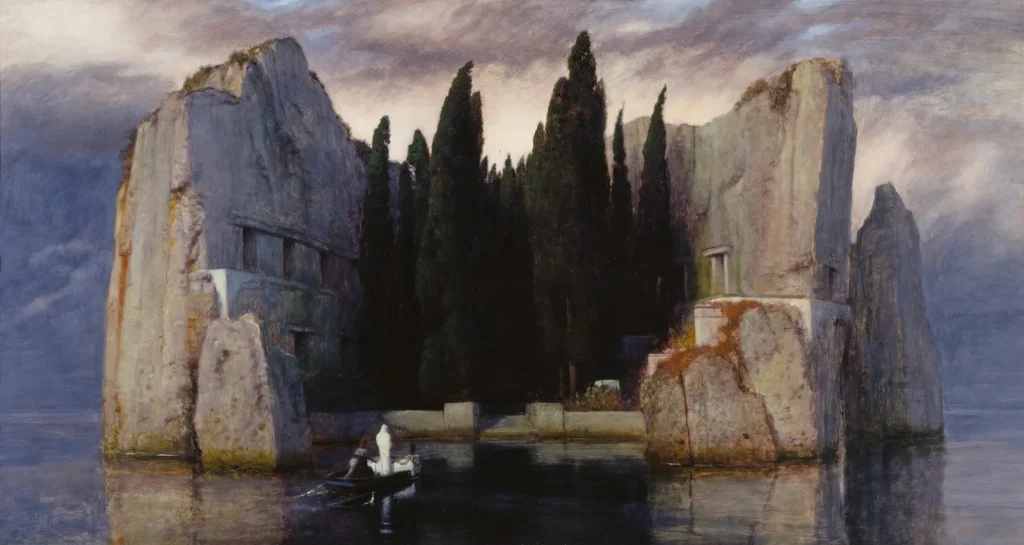
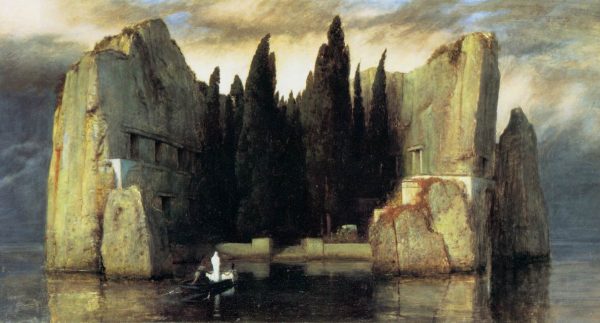
In 1880 a young widow called Marie Berna came to Arnold Böcklin's studio in Florence and asked for a painting. She did not want a subject. She wanted, she said, something to dream over. Böcklin had a canvas on the easel already, an island of rock and cypresses in a still sea, and he added what she had asked for: a small boat rowing toward it, with a coffin in the bow and a figure in white standing over it.
He wrote to her when it was done that she would be able to dream herself into the world of shadows until she believed she could feel the soft warm breeze that ruffled the water, and hear the oars, and would want to disturb the solemn silence with a word.
He never gave it a name. The dealer who sold the third version called it Die Toteninsel, the Isle of the Dead, and the name stuck to all five.
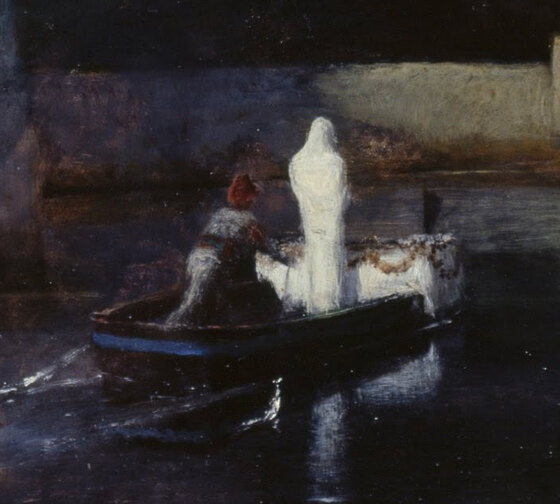
A rowing boat crosses flat dark water toward a landing stage. An oarsman with his back to us pulls. In the bow, standing, is a figure wrapped entirely in white, and in front of it, draped in white with flowers on top, a coffin. The boat is the only thing moving in the picture, and it is moving very slowly.
Who is the figure in white? A mourner, a priest, the soul of the dead, Charon's passenger: Böcklin does not say and never did. The white is the one bright thing in the painting, and it pulls the eye into the middle of the composition, where the boat is about to disappear into the shadow between the rocks.
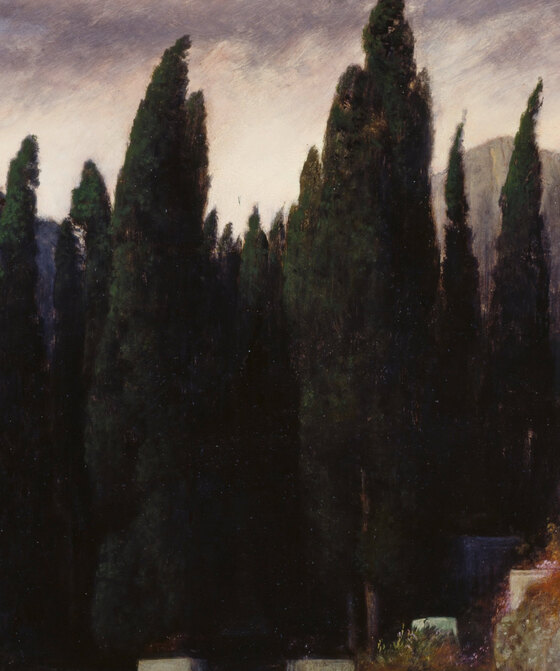
The island is a ring of pale rock around a grove of cypresses so dark they read as a hole in the picture. Cypresses grow in every graveyard from Italy to Greece; they are the tree of mourning in the whole Mediterranean, and Böcklin, a Swiss who lived most of his life in Italy, knew it. The grove is the destination. It is where the boat is going and where we cannot see.
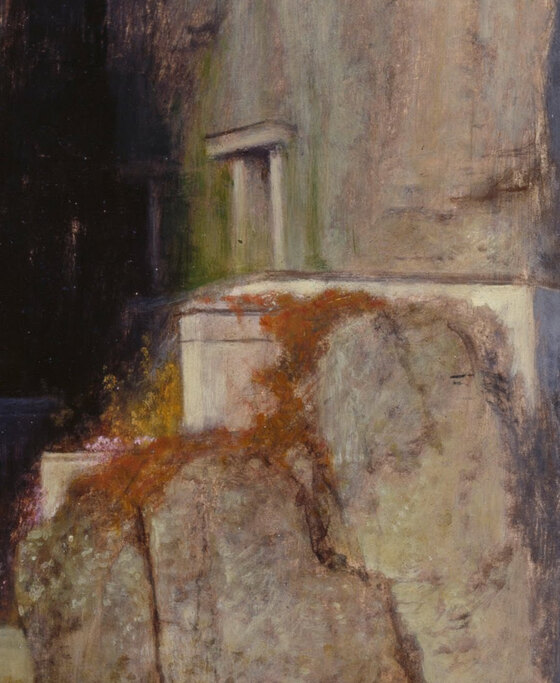
In the cliffs on either side are doorways and windows cut into the rock: tombs, of the kind Böcklin had seen in ancient Greek and Etruscan sites. On the right-hand cliff of this version, above one of them, he painted two initials, A B, on the lintel. He was reserving his place.
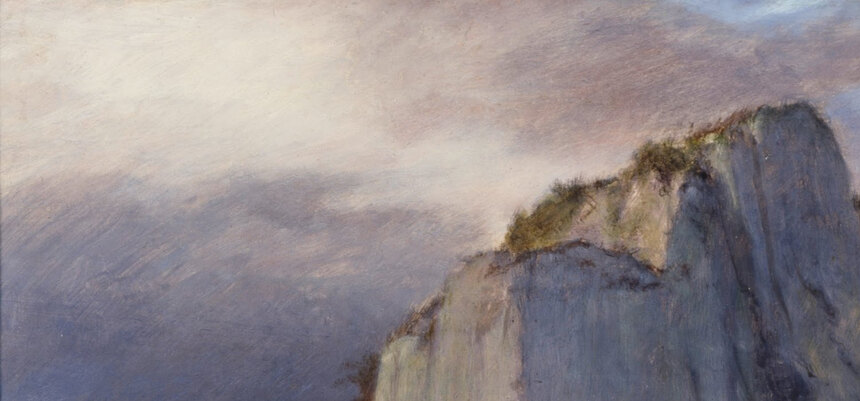
Böcklin painted the island five times between 1880 and 1886, each for a different buyer, and no two are the same. The first, for a collector in Basel, is bright and calm and has no boat at all; the boat was added later. The second is Marie Berna's, now in New York. The third, painted in 1883 for the Berlin dealer Fritz Gurlitt, is the one described here: the sky has darkened, the water is glassy, the rocks are higher and the initials have appeared. The fourth was destroyed by a bomb in Rotterdam in 1945 and survives as a black and white photograph. The fifth is in Leipzig.
The Berlin version is the famous one, and the darkest. Gurlitt sold it, it passed through dealers, and in 1933 Adolf Hitler bought it. It hung in his Munich flat, then in the Reich Chancellery, where it appears in the background of the photographs of Molotov's visit in 1940. After the war the Allies found it in a salt mine and it went, eventually, to the National Gallery in Berlin. That history is part of the painting now, and the museum does not hide it.
It means whatever you bring to it, and that was the design. A widow wanted a picture to dream over, and Böcklin made one with no story, no named figures and no explanation: an island, a boat, a coffin, silence. It is the least specific great painting of the nineteenth century, and the most suggestive.
That is why it went everywhere. By 1900 a print of it hung in more middle-class homes in Germany than any other picture; Nabokov wrote that it could be found in every Berlin flat. Freud had one in his consulting room. Lenin had one over his bed in Zurich. Clemenceau owned one. Rachmaninoff, who saw a black and white reproduction in Paris in 1907 and only later the colour original, wrote a symphonic poem with the painting's name and the rhythm of the oars in it, and said that if he had seen the colour first he would not have written it. Strindberg put it on stage at the end of The Ghost Sonata. Dalí and Giger and de Chirico all painted their own.
It is a painting about crossing over, and it does not say to what. That is the reason nobody has been able to leave it alone.
Arnold Böcklin was born in Basel in 1827, trained in Düsseldorf, and spent most of his life in Italy, painting centaurs, nereids, plague, war and Pan out of the Italian landscape with a gravity that his contemporaries found either magnificent or absurd. He was the most famous painter in the German-speaking world at his death in 1901 and almost forgotten twenty years later, when abstraction made his mythologies look like opera sets. The Surrealists brought him back. The Isle of the Dead never went away.
There are five. The one everyone knows, the third version of 1883 with the dark sky and the initials on the tomb, is in the Alte Nationalgalerie in Berlin. It is oil on panel, 80 by 150 centimetres. The first is in the Kunstmuseum Basel, the second in the Metropolitan Museum in New York, the fifth in the Museum der bildenden Künste in Leipzig.
It is a painting for quiet rooms: studies, bedrooms, the end of a corridor, the wall you look at when you are thinking. Our hand-painted reproduction of the Isle of the Dead is painted in oil on canvas from the Berlin version, cypresses and initials included, and it wants a dark frame and low light. Do not hang it opposite the bed unless you mean to.
More Böcklin in our Arnold Böcklin collection, and the wider Symbolism archive.
Visible details, documented facts and interpretation are kept separate throughout this article. Böcklin's letter to Marie Berna is paraphrased from the Metropolitan Museum's account.