Loading cart…
No products in the cart.

1841 · Oil on canvas · Musée du Louvre, Paris
Save articles to your collection
Log in or create a free account, and this article will be waiting in your Private Collection.
Log in or sign up Explore the artistJohn Martin →
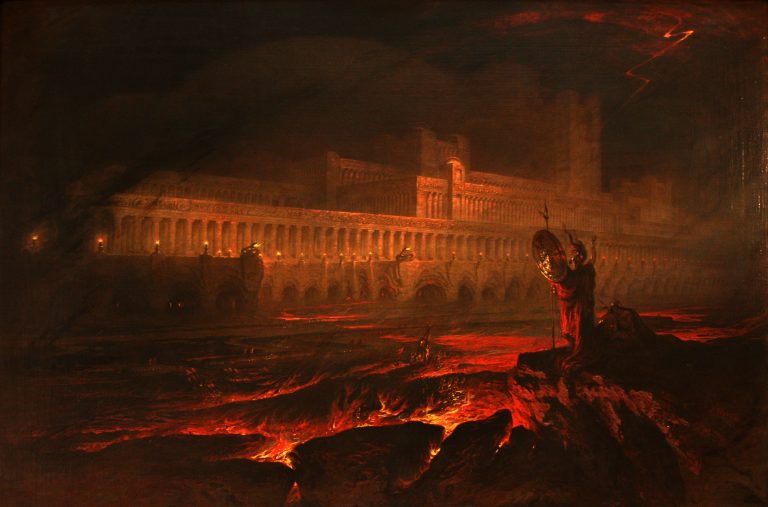
Look for the figure in red on the right. He stands on a ledge with a round shield raised above the flames. Across the gulf, a palace stretches so far that its columns vanish into smoke. The figure is Satan, and the palace is Pandemonium, the gathering place of the fallen angels in John Milton’s Paradise Lost. John Martin painted the scene in 1841.
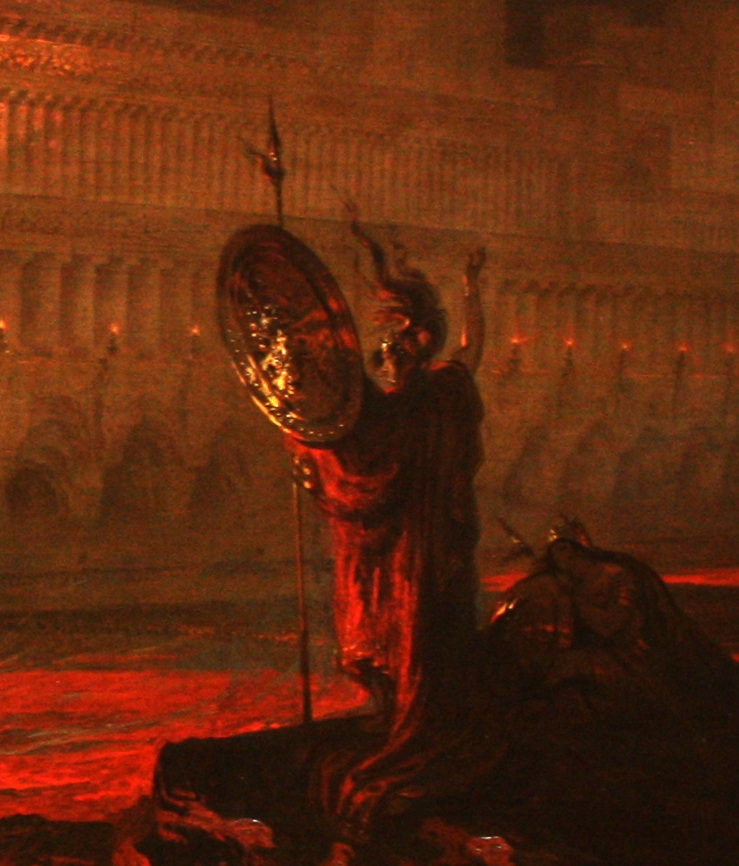
The Louvre reads the scene as the moment Satan brings the palace into being with a breath. Martin gives him a narrow strip of solid ground. Fire curls around the rock below his feet, and the light catches the shield and the folds of his red cloak. His upright figure is easy to pick out against the horizontal lines of the palace, even though it occupies only a small part of the canvas.
Look down and to the left of the ledge. Among the streaks of fire are tiny upright shapes, barely distinct from the rocks. The Louvre identifies the fallen angels in the burning landscape. Once you spot them, the gulf between the ledge and the palace looks much wider. Those faint figures give you a way to measure it.
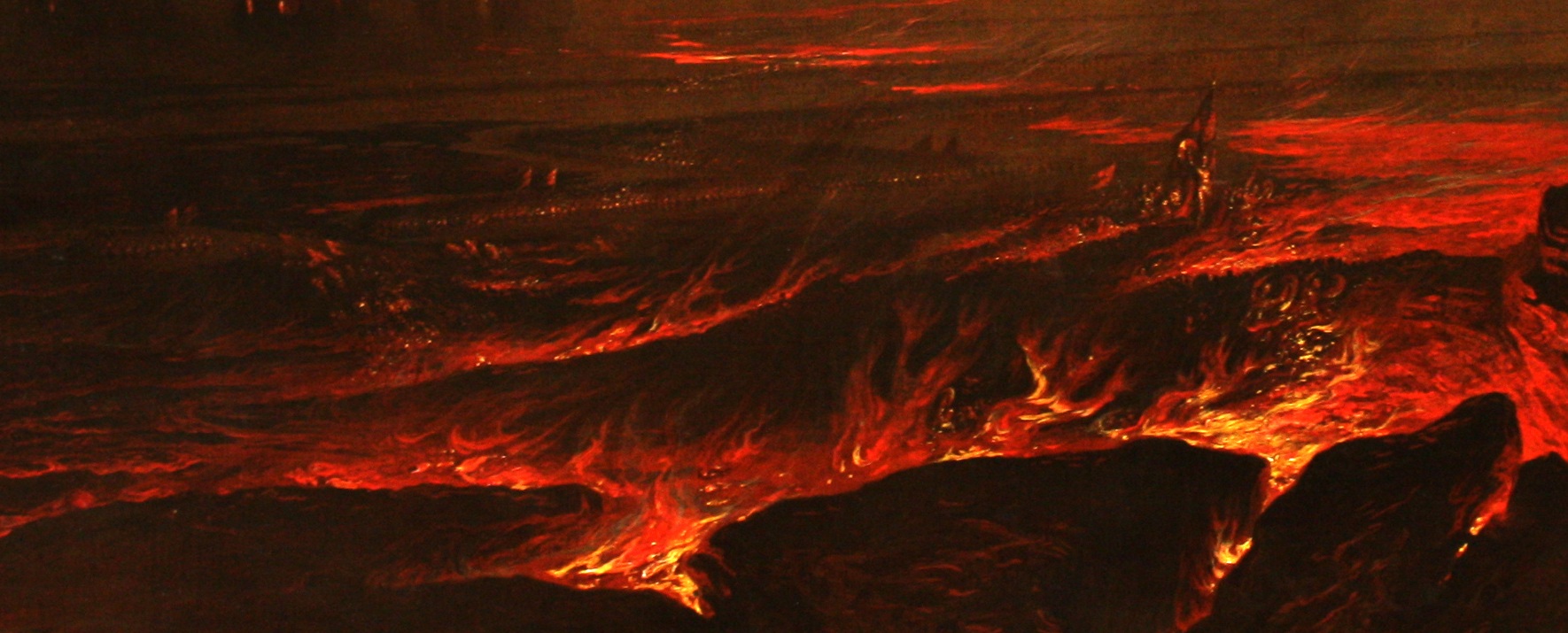
In Book I of Paradise Lost, the defeated angels mine the ground of Hell and smelt what they find there. Milton names Mulciber as the architect. When the building appears, he describes its rise in two lines that Martin’s 1841 exhibition listing echoed:
Anon out of the earth a fabric huge
Rose like an exhalation
Milton goes on to describe a temple-like building with Doric columns and gold ornament. You can trace that order in Martin’s long colonnade. Individual lights mark the terrace below it, each divided from the next by a short stretch of darkness. Farther back, taller blocks disappear into the haze. The building begins in lines you can count and ends somewhere you can barely see.
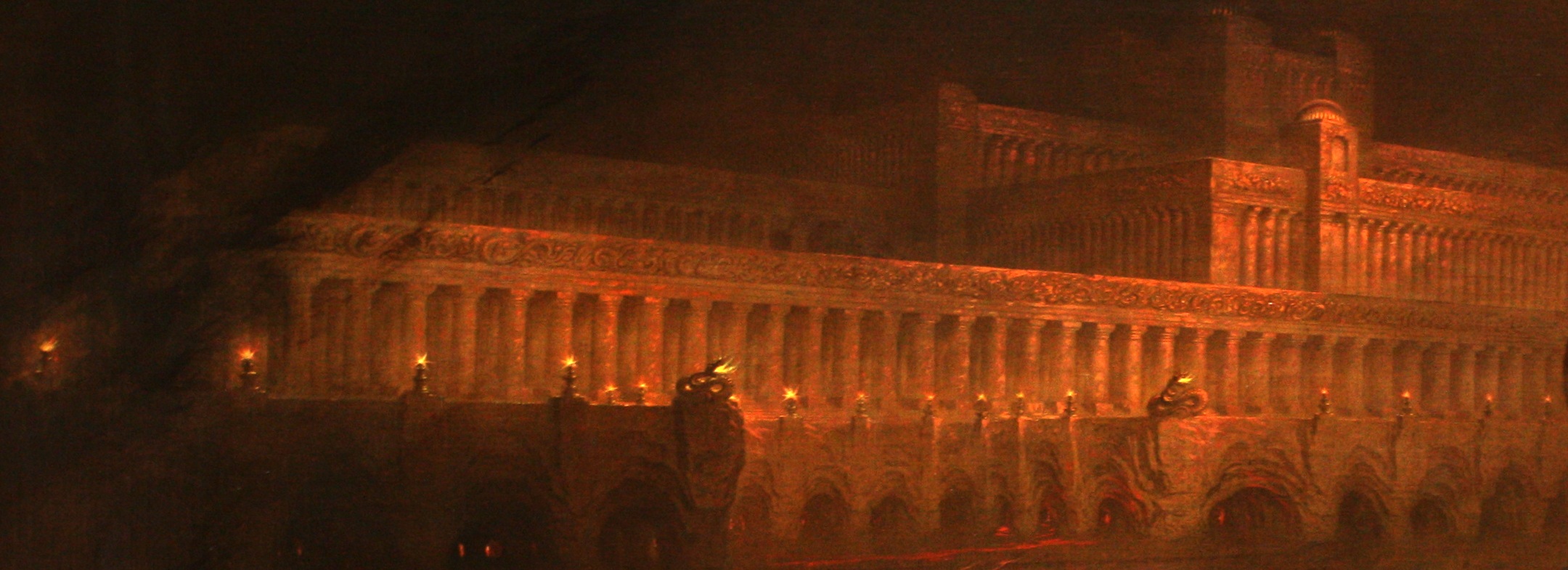
Milton coined Pandemonium as the name of the palace where Satan and his peers would assemble. The word now means uproar, but its first sense in the poem is a place. That distinction helps explain the eerie regularity of Martin’s Hell. An organised council needs an entrance, a hall and room for everyone to gather.
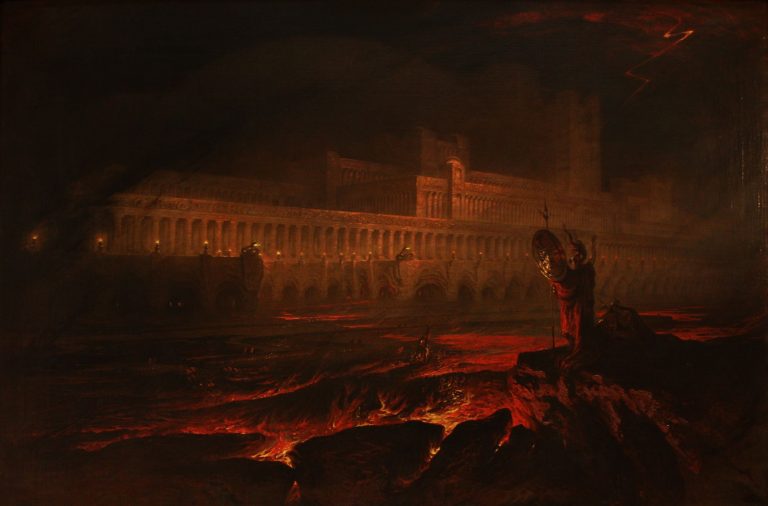
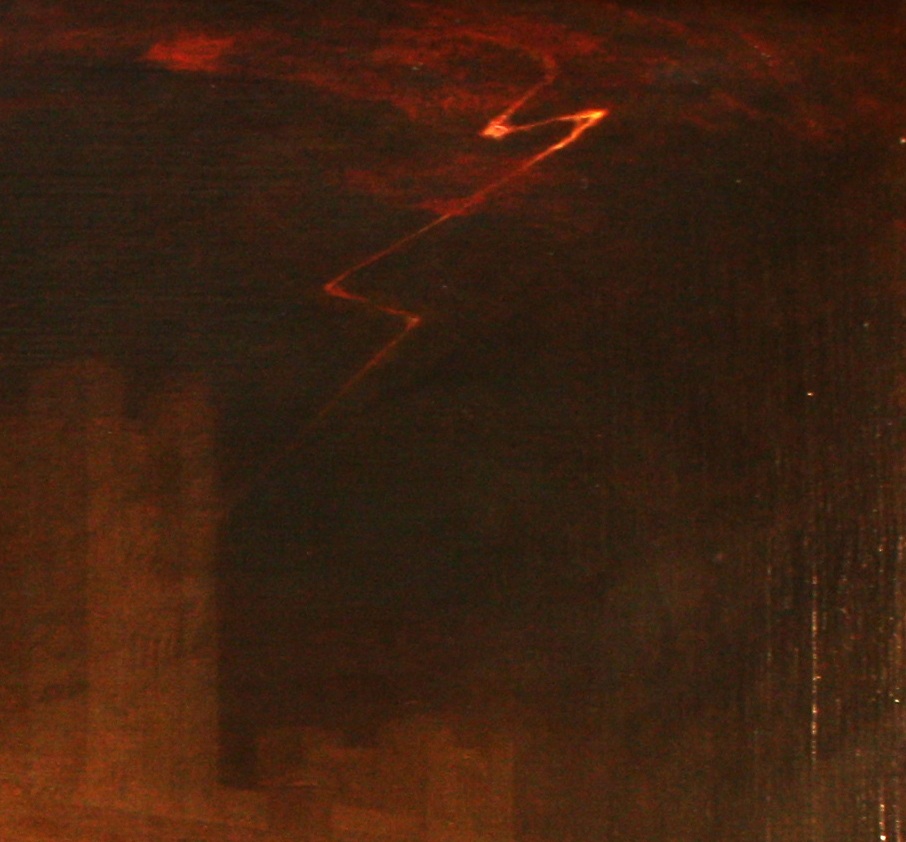
Look above the right end of the palace. A thin red bolt crosses the clouds, doubles back in a bright kink, then trails towards the tower. The upper part of the tower only just registers through the smoke. The closer you look, the less certain its outline becomes.
The flash lasts the length of a few brushstrokes. Down below, the lamps along the terrace hold their places in a neat row. The change in direction is what makes the bolt so sharp to the eye. It cuts across the long horizontal lines Martin has spent most of the painting building.
Martin had already made prints of the scene in 1824 and 1831. In the 1841 painting, colour gives the palace and the ground different kinds of light. Warm, pale lights run in a measured row along the terrace. Below them, red and orange break across the foreground in irregular seams.
Martin returned often to the idea of a building large enough to dwarf a crowd. Compare the terraces in Belshazzar’s Feast, where ranks of people help carry the eye into the distance. In Pandemonium the crowd almost disappears. The lights are what lead you towards the palace.
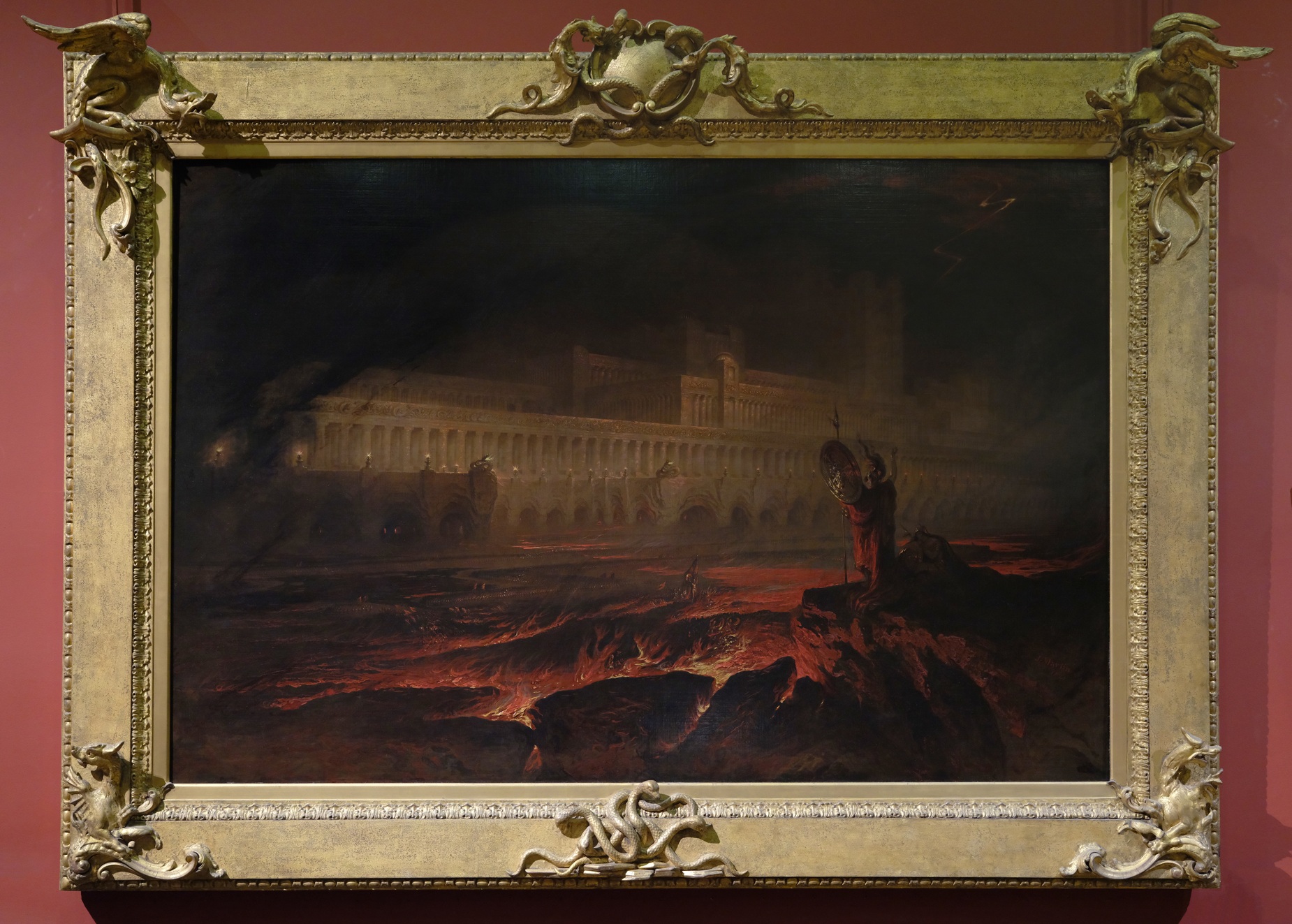
Martin designed the frame as well as the painting. The Louvre records serpents and dragons in its decoration. They curl around the outer corners, carrying the subject into the space between the painted scene and the gallery wall.
At the Royal Academy in 1841, Pandemonium was exhibited alongside its companion, The Celestial City. The first owner recorded by the Louvre, the locomotive engineer Benjamin Hick, owned both. The Louvre acquired Pandemonium in 2006. The oil painting measures 123 cm high by 185 cm wide and is catalogued as RF 2006 21.
Stand back from the image and the first thing to hold is that bright line of columns. Let your eyes adjust, and the people below it start to appear. Martin makes you take in the scale of Hell before you can see who has come to fill it.
Enjoyed this story?
Save articles to your collection
Log in or create a free account, and this article will be waiting in your Private Collection.
Log in or sign up
Man Writing a Letter
Gabriel Metsu, c. 1664
The gallery list
Every painting is already 50% off. Join the list and we will send you an extra $15 code, plus first access to new collections.
No spam. Unsubscribe anytime. · Privacy Policy
Welcome
Your $15 code is on its way. Explore the gallery while you wait.