Loading cart…
No products in the cart.

Max Kurzweil holds a firmly respected place in the legacy of the Vienna Secession, the celebrated movement that transformed decorative and fine arts in Central Europe at the turn of the twentieth century. His paintings continue to attract admiring audiences…
Max Kurzweil holds a firmly respected place in the legacy of the Vienna Secession, the celebrated movement that transformed decorative and fine arts in Central Europe at the turn of the twentieth century. His paintings continue to attract admiring audiences at major Austrian institutions, particularly the Wien Museum, which preserves several of his most significant works. Collectors of Viennese Jugendstil seek out his compositions for their distinctive warmth, intimacy, and technical refinement. In the contemporary art market and in academic studies of the Secession, Kurzweil is recognized as one of the movement's most skillful portraitists of private, domestic life. His ability to capture feminine grace and interior atmosphere with a palette of luminous, carefully orchestrated color has earned him a lasting reputation as an artist who translated the philosophical aspirations of the Secession into scenes of genuine human feeling. Art historians frequently cite his figure paintings as exemplary statements of the Secessionist ideal that beauty and everyday experience are inseparable. Hand-painted oil reproductions of his works allow collectors today to bring that sensibility into their own homes.
The legacy of Kurzweil was built through a disciplined artistic education and a deep immersion in the intellectual culture of Vienna. Born in 1867 in the Moravian town of Bisenz, he studied at the Vienna Academy of Fine Arts and later in Paris, where exposure to French Impressionism and Post-Impressionism broadened his visual thinking considerably. He returned to Vienna and became a founding member of the Vienna Secession in 1897, contributing to its landmark exhibition program and to the iconic journal Ver Sacrum. His friendship and professional association with Gustav Klimt and other Secession colleagues sharpened his commitment to integrating decorative pattern with figurative painting. Throughout the late 1890s and into the first decade of the twentieth century, Kurzweil produced portraits, genre scenes, and figure studies that balanced Secessionist decorative ambition with a direct and tender observation of individual character. His career was cut short by his death in 1916, yet the body of work he left behind demonstrates a sustained and coherent artistic vision that remains deeply compelling to scholars and art lovers alike.
The technique of Kurzweil reflects a thoughtful synthesis of influences drawn from Impressionist color practice, the decorative flatness championed by the Vienna Secession, and a careful academic training in figure drawing. His brushwork is confident but never mechanical, applying paint in layers that build up a surface alive with subtle variation. He favored natural light sources, allowing the glow from a window or a soft interior lamp to fall across the faces and clothing of his subjects in ways that reveal form without harsh shadow. His palettes tend toward warm golds, creamy whites, and muted rose tones, occasionally punctuated by stronger accents of blue or green. This chromatic approach creates an atmosphere of gentle intimacy that draws the viewer into the pictorial space as though invited into a private moment. The handling of fabric and textile in his figure paintings is particularly accomplished, as he renders the weight and sheen of different materials with convincing tactile precision while keeping the overall composition unified and harmonious.
The visual language of Kurzweil is defined above all by an attention to psychological presence. His figures are never merely decorative arrangements of color and line, even when the compositional structure owes a clear debt to the Secessionist interest in flattened pattern and rhythmic silhouette. Faces are rendered with a directness that suggests close and empathetic observation, and the relationship between a figure and her surrounding space is always carefully negotiated so that the interior environment amplifies rather than overwhelms the human subject. His compositional choices frequently emphasize a quiet diagonal or a gently asymmetrical arrangement that gives his paintings a sense of arrested movement, as if the subject has paused for just a moment within an otherwise continuous flow of daily life. This quality of suspended time is central to the lasting emotional appeal of his paintings and makes hand-painted oil reproductions of his work deeply rewarding to live with.
Each card links to its own article with full analysis and reproduction details.
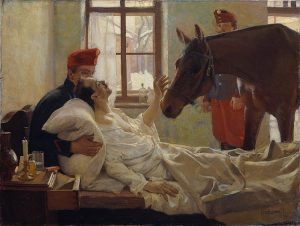 #1
#1
A print can reproduce colors. What it cannot reproduce is texture, depth, and the physical presence of oil paint on canvas. Max Kurzweil technique depends on these.
At ByMuseum, every reproduction is painted by hand using oil on canvas. There is no inkjet, no digital print. The brushwork is real. The result looks like a painting because it is one.
A note from the studio
Our studio is working through an exceptional number of commissions, so we have paused new orders for a short time. We will start taking orders again on 1 October.
Every painting is made entirely by hand, and we would rather pause than rush one. Thank you for your patience and your trust.
Leave your details and we will reserve your place: we will write to you as soon as orders reopen.
Thank you
Your request is saved. We will write to you on 1 October, and a confirmation is on its way to your inbox.