Loading cart…
No products in the cart.

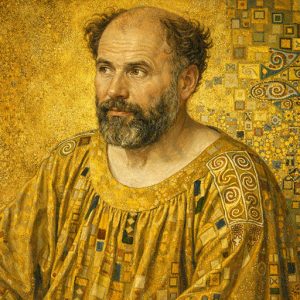
Gustav Klimt was born on July 14, 1862, in the working-class district of Baumgarten on the outskirts of Vienna, in what was then the Austrian Empire. He was the second of seven children born to Ernst Klimt, a gold engraver…
Gustav Klimt was born on July 14, 1862, in the working-class district of Baumgarten on the outskirts of Vienna, in what was then the Austrian Empire. He was the second of seven children born to Ernst Klimt, a gold engraver who had emigrated from Bohemia, and Anna Klimt, a woman with unfulfilled ambitions in music performance. The family lived in modest circumstances, and financial hardship was a persistent feature of Klimt's early years. Despite these difficulties, the artistic environment of his household, shaped by his father's skilled metalwork and decorative craft traditions, left a lasting impression on the young Gustav. In 1876, at the age of fourteen, Klimt received a scholarship to attend the Vienna School of Arts and Crafts, known in German as the Kunstgewerbeschule. There he studied alongside his brother Ernst and their close friend Franz Matsch. The three young artists trained under professors who emphasized historical painting and decorative technique, equipping Klimt with the academic foundations that would define and later confine his early professional output. Together, the trio formed a commercial decorating company known as the Kunstler-Compagnie, securing commissions for theater interiors and allegorical ceiling paintings across the Austro-Hungarian Empire. These early works demonstrated an accomplished command of the academic tradition and brought Klimt considerable public recognition during the 1880s.
The trajectory of Klimt's career shifted dramatically in the late 1890s following the death of his brother Ernst in 1892, an event that affected him profoundly and contributed to a long period of introspection and artistic reinvention. In 1897, Klimt became a founding member and the first president of the Vienna Secession, a group of progressive artists who broke away from the conservative Academy of Fine Arts to champion new directions in visual culture. The Secession promoted the idea that fine art and applied decoration were of equal value, a philosophy that resonated deeply with Klimt and helped him develop his mature style. The celebrated Beethoven Frieze of 1902 and the controversial Faculty Paintings commissioned by the University of Vienna marked this transitional period, generating fierce debate about the role of symbolism and sensuality in public art. By the early 1900s, Klimt had entered what is widely referred to as his Golden Period, during which he incorporated actual gold leaf into his canvases, referencing Byzantine mosaics and the gold work of his father's trade. His close relationships with patrons from the Viennese Jewish bourgeoisie, including the Bloch-Bauer and Lederer families, allowed him to pursue ambitious portrait commissions and large-scale decorative projects. Klimt never married, but he maintained a long and significant relationship with the fashion designer Emilie Floge, who remained a central figure in his personal and creative life. He died on February 6, 1918, following a stroke and subsequent pneumonia, leaving behind a body of work that continues to draw devoted audiences to museums and galleries around the world.
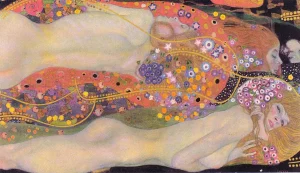
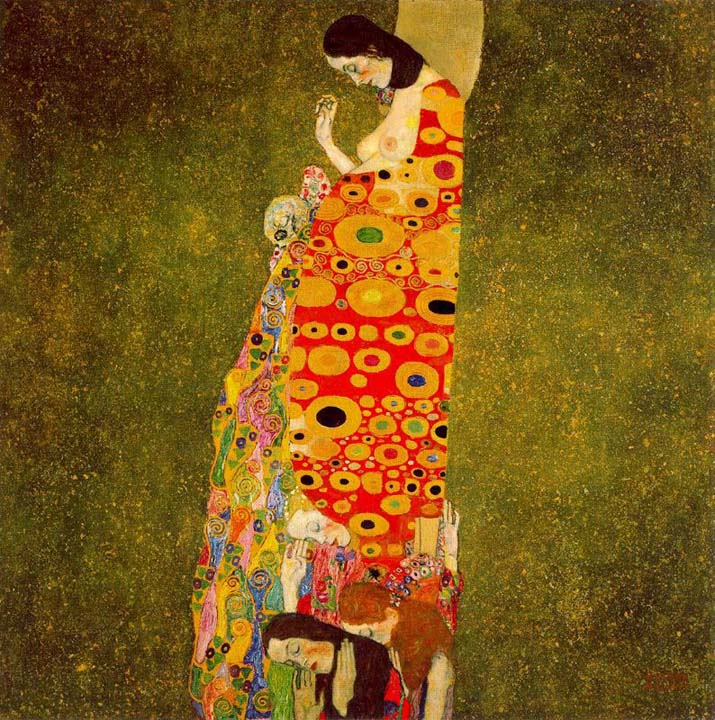
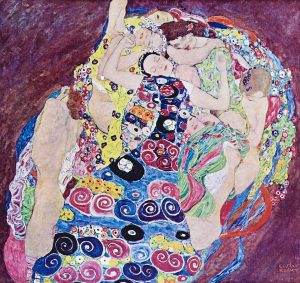
The visual language of Gustav Klimt is one of the most immediately recognizable in the history of Western art. His mature style represents a synthesis of influences drawn from Byzantine mosaic tradition, Japanese decorative arts, ancient Egyptian ornamentation, and the emerging currents of Art Nouveau that swept through Europe at the turn of the twentieth century. What distinguishes Klimt from many of his contemporaries is his deliberate tension between two pictorial modes. The figures in his paintings, particularly the faces and hands of his subjects, are rendered with a naturalistic softness that conveys genuine psychological presence and warmth. Surrounding these figures, however, are fields of highly stylized, two-dimensional ornamental patterning, often incorporating actual gold and silver leaf pressed directly onto the canvas surface. This contrast between the organic and the geometric, the tactile and the abstract, creates a visual dynamism that pulls the viewer simultaneously toward intimate human emotion and toward a more transcendent, almost otherworldly plane of experience. The decorative elements are never merely background. They function as symbolic extensions of the figures they surround, communicating psychological states, social hierarchies, and erotic energy through the language of pattern and material richness.
Each card links to its own article with full analysis and reproduction details.
 #0
#0
 #2
#2
 #3
#3
 #4
#4
 #4
#4
 #5
#5
 #6
#6
 #7
#7
 #8
#8
 #9
#9
 #10
#10
A print can reproduce colors. What it cannot reproduce is texture, depth, and the physical presence of oil paint on canvas. Gustav Klimt technique depends on these.
At ByMuseum, every reproduction is painted by hand using oil on canvas. There is no inkjet, no digital print. The brushwork is real. The result looks like a painting because it is one.