Loading cart…
No products in the cart.

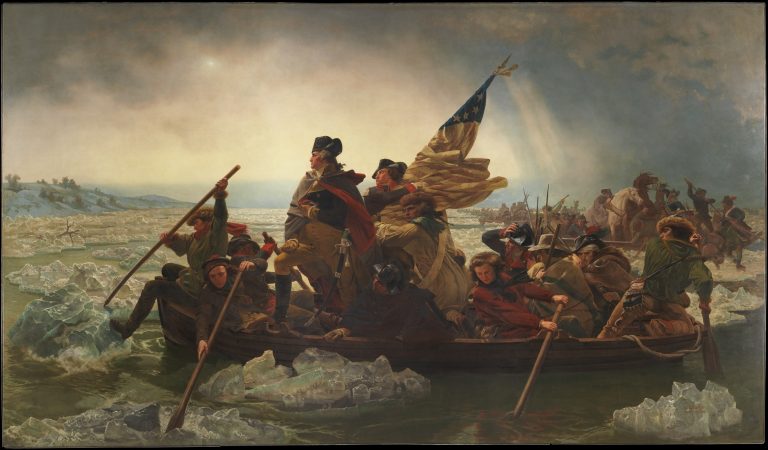
1851 · Oil on canvas · The Metropolitan Museum of Art, New York
Save articles to your collection
Log in or create a free account, and this article will be waiting in your Private Collection.
Log in or sign up Explore the artistEmanuel Leutze →
He has no oar in his hands. Around him, people bend, pull and brace themselves against the boat. George Washington stands almost upright, his face held against the light. The river seems to move beneath everyone except him.
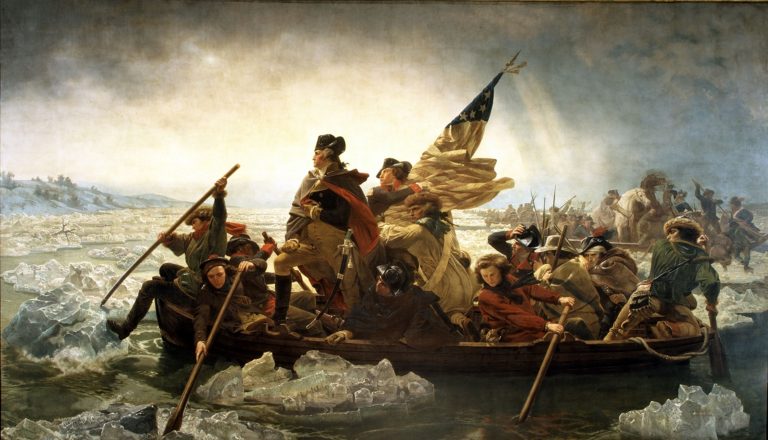
That contrast is the central invention of Emanuel Leutze’s Washington Crossing the Delaware. Painted in 1851, it imagines the Continental Army’s crossing on the night of December 25 to 26, 1776, before the attack on Trenton. Leutze turns a dangerous military operation into a picture of leadership. The scene looks immediate, but it was created roughly seventy-five years after the event.
The painting belongs to The Metropolitan Museum of Art in New York. At nearly six and a half metres wide, it makes the people in the foreground feel close to life size. Reproductions can make it look like an illustration; the original is an encounter with a crowd moving through your field of vision.
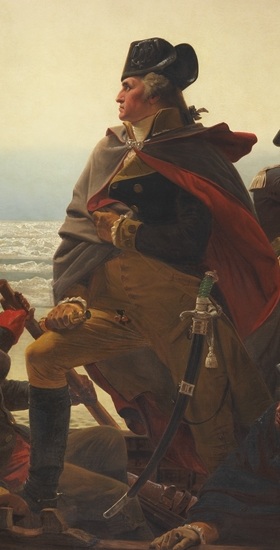
Washington’s army crossed from Pennsylvania into New Jersey during a winter campaign in which the revolutionary cause was in serious difficulty. The successful surprise attack at Trenton followed on December 26. The crossing itself was a risk taken before anyone could know the result.
Leutze gives us the uncertainty without showing the battle. There is no enemy in the foreground, no surrendered weapon and no victory parade. The immediate obstacles are water, weather, ice and the work of keeping the boat moving. The general looks toward a destination outside the frame.
Notice how little open space there is between the passengers. Knees, shoulders, weapons and oars overlap. Their bodies make the danger understandable before the historical background is explained. Even a leader who seems completely composed depends on the people crouching around his feet.
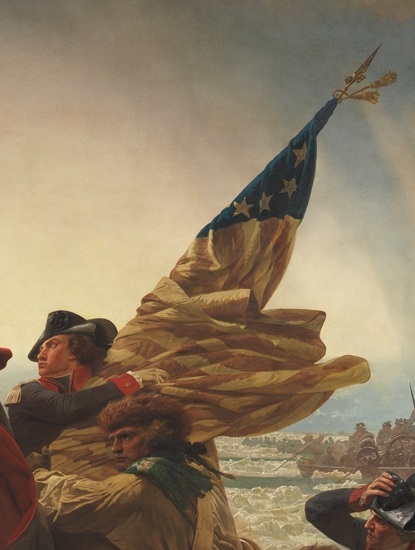
The flag extends the group upward. Its fabric catches more light than the brown coats below, and its long diagonal runs back into the wind. Together, Washington and the flag form a conspicuous peak above the boat.
The officer carrying it is traditionally identified as James Monroe, the future fifth president. This is a staged historical image, however, not a record of the passengers in one documented boat. The flag also compresses history: the familiar national flag belongs to the nation that emerged from the Revolution, rather than an exact reconstruction of equipment on that December night.
Leutze lets a later viewer recognise the United States before the people in the story have secured its future. That is one reason the image is so memorable. It gives the crossing a destination in history as well as a destination on the opposite bank.
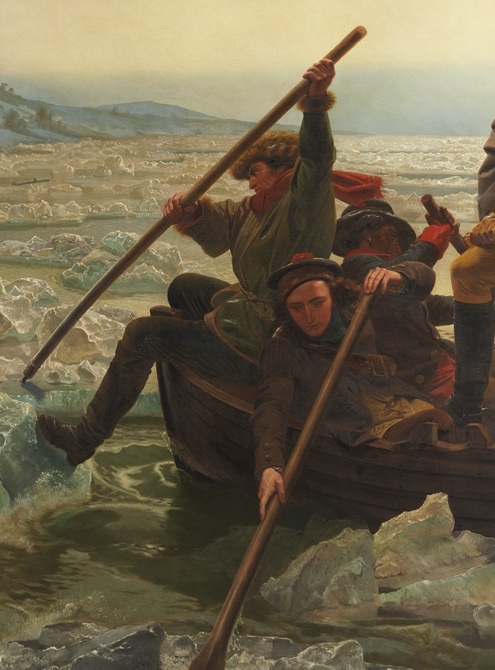
Follow the long oar at the left from the raised hand down to the water. The diagonal cuts across the boat’s horizontal edge. Another rower bends low, bringing the effort back toward the foreground. Their grips are firmer and their postures less composed than Washington’s.
The distinction matters. If the general were removed, this would remain a picture of collective labour. If the rowers were removed, his heroic stance would become physically impossible. Leutze places command and dependence inside the same small space.
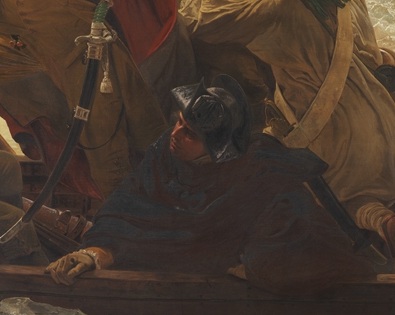
The Black figure below and to the right of Washington is particularly important to that collective image. His presence makes the painted group more varied than a row of identical uniformed soldiers. Specific names have been proposed for figures in the boat, but the image does not establish a secure historical identity for every face.
Reading the figure as an individual at work is more useful than attaching an unsupported name. His arm reaches along the boat, his body inclines forward, and his dark coat keeps him within the dense foreground group. He contributes to the passage rather than simply witnessing it.
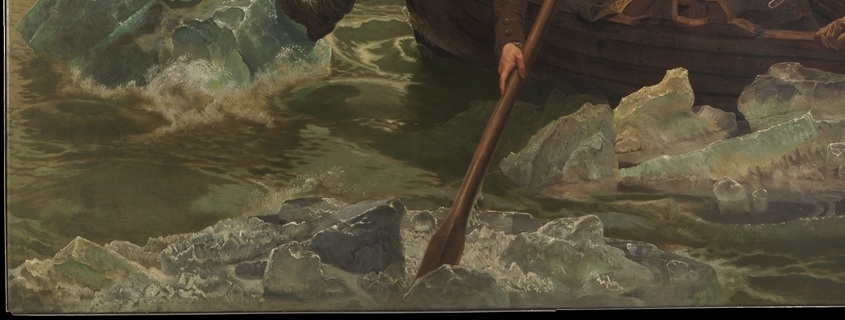
The ice is almost sculptural. Pale green slabs rise above the water, with edges sharp enough to catch the light. Beside them, the dark hull looks vulnerable. The surface keeps changing from transparent water to something that appears solid.
Leutze worked in Düsseldorf and drew on the Rhine for his river. The Met’s interpretation identifies several departures from the event: the large ice formations, the boats and their crowded loads, and the dramatic morning light. The actual crossing took place at night. Mount Vernon likewise treats the picture as an allegorical reconstruction rather than a literal account.
These differences are worth knowing, but spotting mistakes is only the beginning of looking. Brightness behind Washington separates his profile from the surrounding crowd. The ice provides a visible obstacle. The narrow boat makes cooperation easy to understand. Each choice helps a viewer grasp the story quickly, even where it complicates the history.
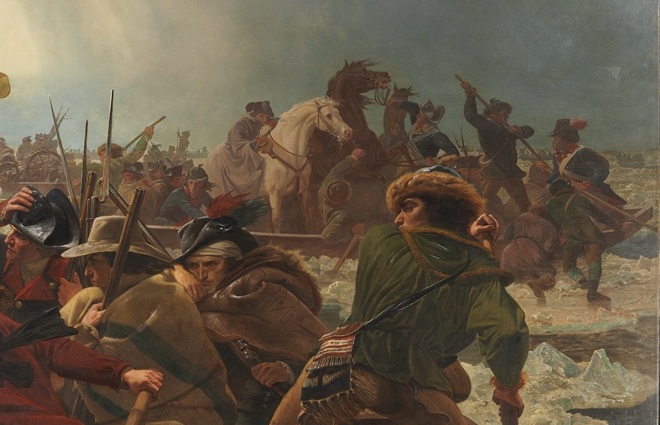
The river is not occupied by Washington alone. Behind the main group, boats and people continue into a cold, hazy distance. A horse’s pale head and the upright shapes of weapons interrupt the low skyline.
Those smaller figures prevent the foreground from becoming a self-contained portrait. The same effort appears to be happening again and again beyond it. Their reduced contrast also makes the near boat feel closer: we can distinguish its hands and faces, while the others dissolve into weather.
The horse is part of Leutze’s pictorial construction, not evidence that this is what a particular crossing boat carried. It is possible to recognise its visual purpose and retain that historical caution at the same time.
Leutze was born in Germany and grew up in the United States before returning to Europe to study. He painted the Met’s canvas in the wake of the European revolutions of 1848. Mount Vernon connects his American subject with his support for political liberty in Europe.
The choice of subject therefore had more than one audience. For Americans, Washington could embody a founding struggle. For European viewers, the same story could offer an example of resistance to established power. A painting set in 1776 also belonged to the political imagination of 1851.
Its persuasive power leaves a question open. Who is included in the national story, and who is left beyond the boat? The Met’s Beyond Myths interpretation discusses later artists who challenged or revised Leutze’s account. Their responses show how thoroughly this particular arrangement of bodies became a familiar image of the nation.
Returning to the foreground makes that debate concrete. Washington is easy to find. The rowers take longer. Looking at both changes the painting from a portrait of one man’s resolve into a question about whose effort history remembers.
Emanuel Leutze painted the large canvas held by The Met in 1851. It is an oil painting, not an eyewitness image made during the Revolution.
The 1851 canvas discussed here is in The Metropolitan Museum of Art, New York, accession number 97.34. Other versions, studies and later reproductions also exist.
It depicts a real crossing before the Battle of Trenton, but its lighting, boat and other details use artistic licence. Read it alongside historical accounts rather than treating it as a photograph.
The Met records the unframed canvas as 378.5 centimetres high by 647.7 centimetres wide.
Emanuel Leutze, Washington Crossing the Delaware, 1851. The Metropolitan Museum of Art, Gift of John Stewart Kennedy, 1897, 97.34. Public domain, museum Open Access image.
Enjoyed this story?
Save articles to your collection
Log in or create a free account, and this article will be waiting in your Private Collection.
Log in or sign up
Man Writing a Letter
Gabriel Metsu, c. 1664
The gallery list
Every painting is already 50% off. Join the list and we will send you an extra $15 code, plus first access to new collections.
No spam. Unsubscribe anytime. · Privacy Policy
Welcome
Your $15 code is on its way. Explore the gallery while you wait.