Loading cart…
No products in the cart.

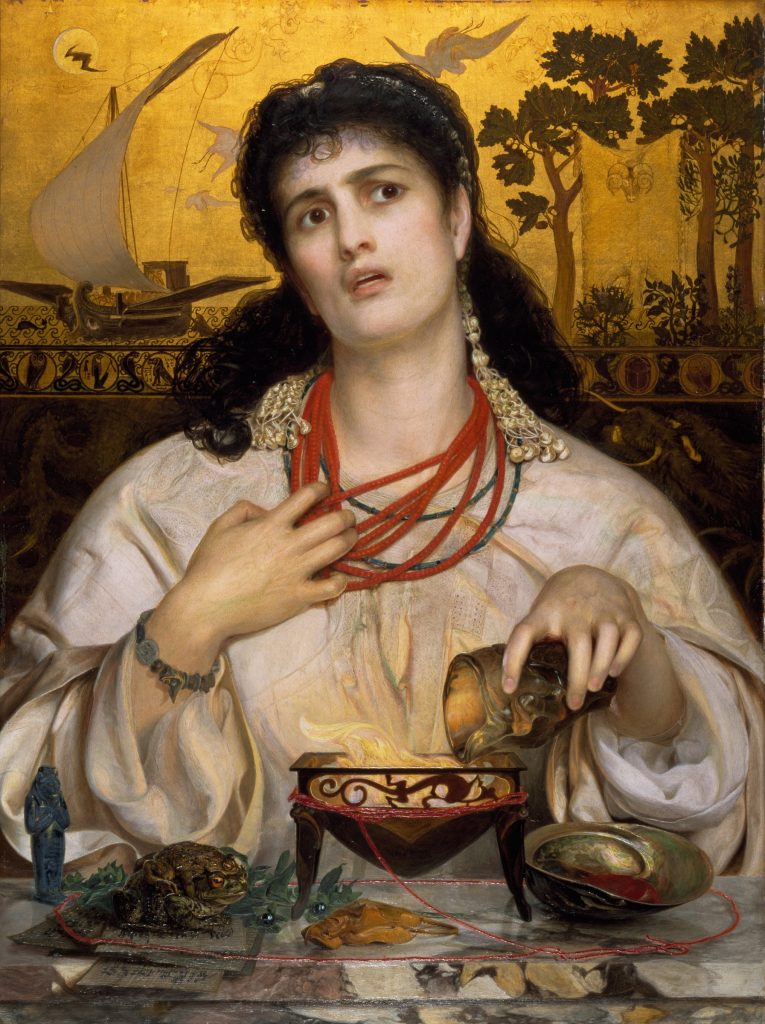
1866 to 1868 · Oil on panel with gilded background · Birmingham Museums Trust, Birmingham
Save articles to your collection
Log in or create a free account, and this article will be waiting in your Private Collection.
Log in or sign up Explore the artistFrederick Sandys paintings →
A woman tilts a small vessel above a flame. Her other hand touches the red strands at her throat. Yet her face turns away from the work, lips parted, eyes fixed somewhere beyond the table. Frederick Sandys makes the action look controlled and the person carrying it out look anything but settled.
His Medea, painted in 1866 to 1868, brings the ancient sorceress into a close, crowded space. It is an oil painting on panel with a gilded background, held by Birmingham Museums Trust. The small scale, roughly 61 by 46 centimetres, makes its elaborate surface feel almost private.
For readers searching for a Medea painting, the artist matters. This is Sandys’s dark-haired figure at a brazier, not Delacroix’s mother fleeing with her children or Evelyn De Morgan’s standing Medea. Each painter selects a different moment from a story too large to fit into one image.
In the Greek myth, Medea uses her knowledge to help Jason obtain the Golden Fleece. He later abandons her for another marriage. Sandys’s painting is generally understood as the preparation of a deadly spell against Jason’s new bride, Glauce, rather than a depiction of the children’s murder.
The Birmingham Museums catalogue connects the scene with the fatal bridal garment. Neither the bride nor Jason appears in the foreground. Sandys concentrates on the act before its consequences: the vessel is tilted, the fire is lit, and Medea remains alone with what she is making.
That choice puts time under pressure. We know that something has happened to bring her here and that something terrible may follow. The painting holds between those events, where a gesture can still seem both deliberate and uncertain.
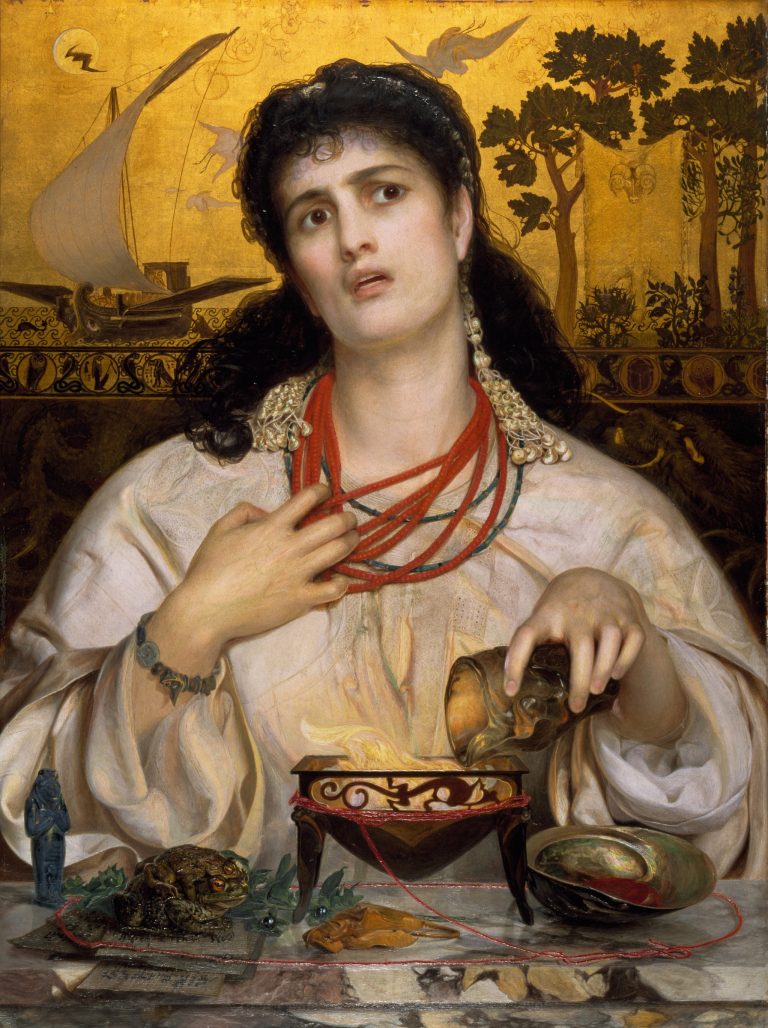

Medea’s eyebrows rise unevenly. The head leans, the mouth opens slightly and the eyes do not follow the hand above the fire. Dark curls gather around a face that is pale against the gold. Her expression interrupts the splendour of the surrounding materials.
Calling her merely jealous misses the disturbance Sandys has painted into that face. Calling her an innocent victim would ignore the work underway below it. Her attention seems divided between the present task and something she cannot keep from returning to.
The result is a portrait-like encounter within a mythological painting. We look for a readable expression and find competing signs. The hand acts; the face appears to hesitate. The painting does not tell us whether that hesitation will change anything.
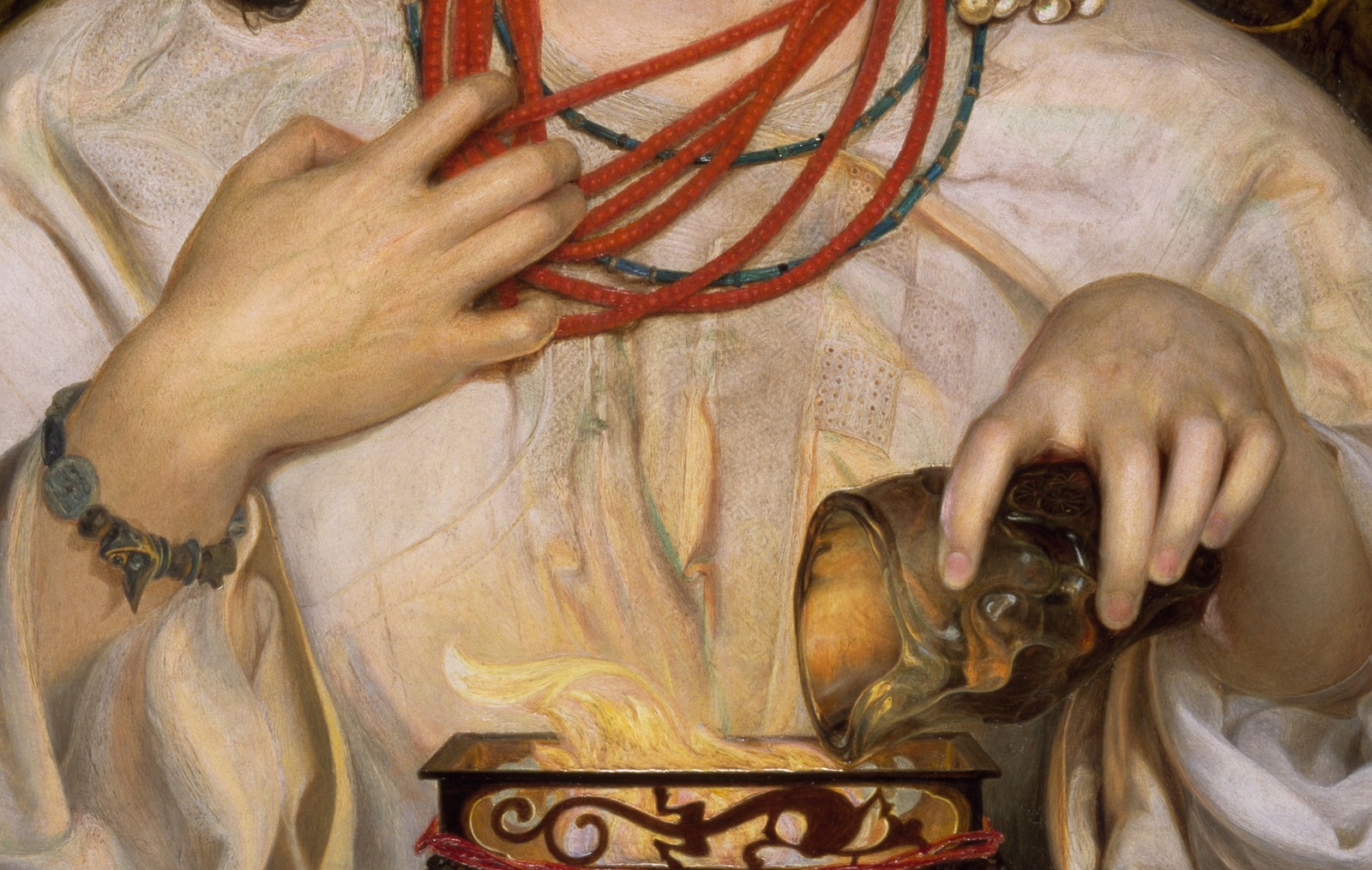
One hand turns inward to the body, gathering the necklace near the chest. The other reaches outward with the vessel. Their separation gives the composition a tension that a single raised dagger would not have. Sandys has made destruction look like an activity requiring patience and a steady wrist.
The broad white sleeves frame both gestures. Pale fabric directs the eye down from the head, then across the table toward the small flame. The warm vessel is dark enough to remain distinct against that fabric, so the viewer can follow the pouring action without a theatrical burst of light.
Notice that the fingers around the necklace do not rest loosely. They press into a knot of red strands. Even without assigning a symbol to the jewellery, the grip turns an ornament into evidence of strain.
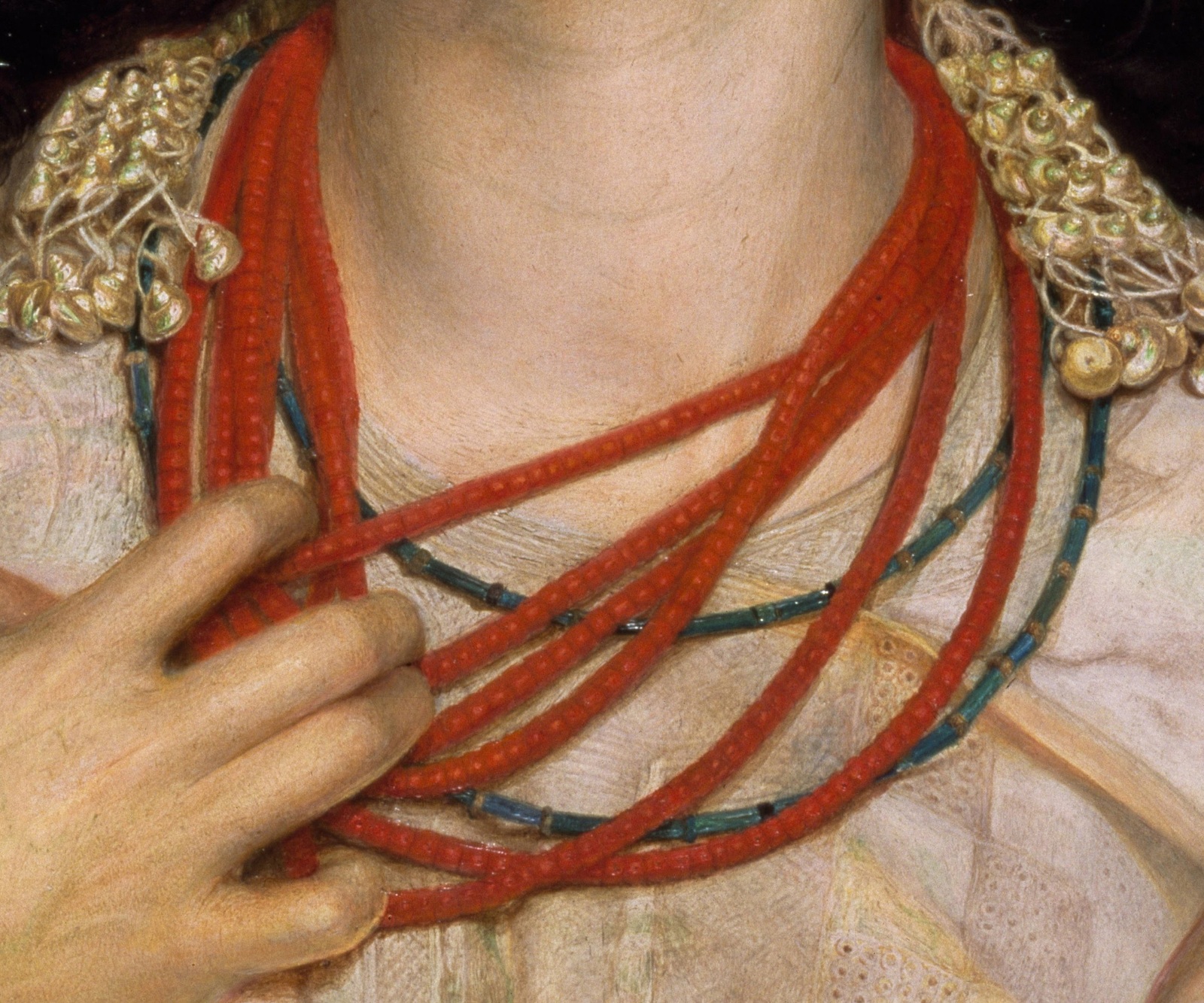
Red coral draws a strong line across the pale chest. Its irregular pieces differ from the smoother beads of the other necklace, and the strands collect in Medea’s hand. The same red returns in the thread crossing the table, linking the body to the apparatus of the spell.
Birmingham’s interpretation associates the coral with protection, particularly of her children. That makes the detail painful in the context of Medea’s story, but it is a symbolic reading rather than a label proving what she is thinking at this instant.
Visually, the coral also prevents the white garment from becoming an empty area. It carries the eye between face and hands. Protection, anxiety and ornament occupy the same few inches of the painting.
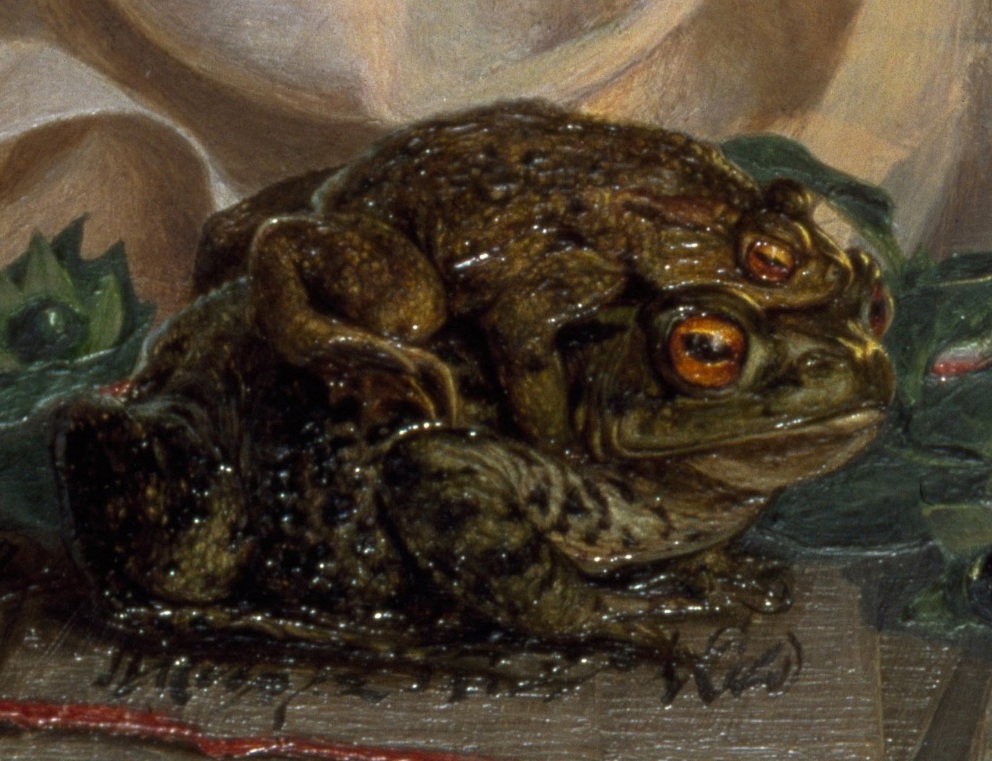
At the lower left, two toads sit among leaves beside the brazier. Their mottled skin and bright eyes make a coarse, damp-looking contrast with the polished vessel and decorated metalwork. They are easy to overlook when attention stays on Medea’s face.
The museum identifies them as mating and connects them with Jason’s infidelity. That association belongs to the interpretation of the scene; the visible animals do not provide a universal dictionary of what every painted toad must mean.
Their placement matters regardless. Sandys brings the tabletop close to the viewer, so the small creatures occupy our side of the encounter. The enchantment does not remain an abstract force in the gold background. It has a dense material presence among leaves, flame, string and living bodies.
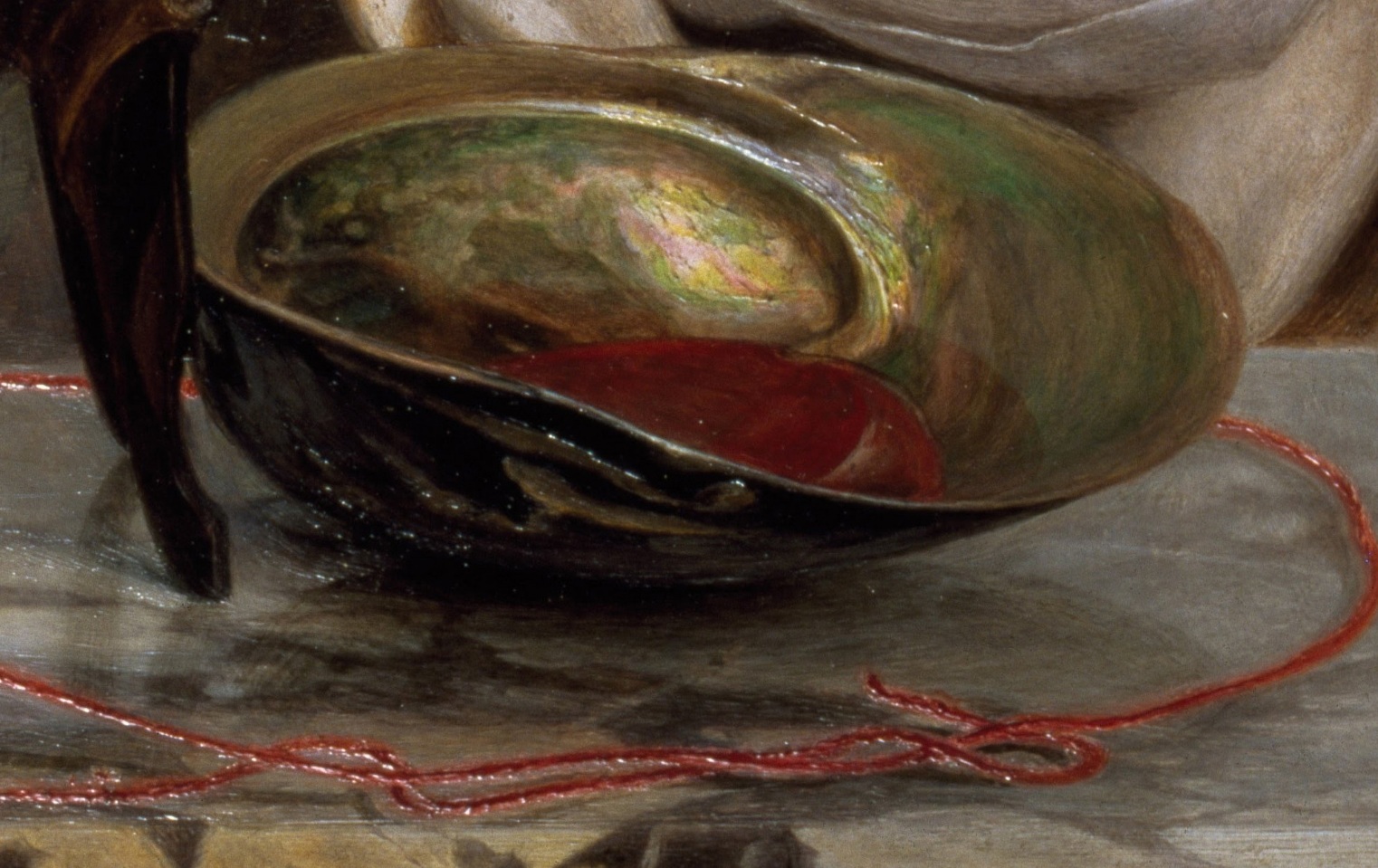
An iridescent shell rests on the opposite side of the brazier. Its curved rim, dark interior and reflected colours make it look both precious and usable. The red thread snakes past it across the front of the picture.
The scholarly literature offers several associations for these objects, including magical boundaries and the ingredients of a harmful mixture. It is useful to distinguish those interpretations from direct observation. We can see the thread and the shell clearly; their exact ritual role is not written into the painted surface.
Together with the brazier, they widen the action beyond the pouring hand. The spell occupies a working area, not just a single gesture. The table feels prepared, and its closely described objects suggest a process already underway before we arrived.
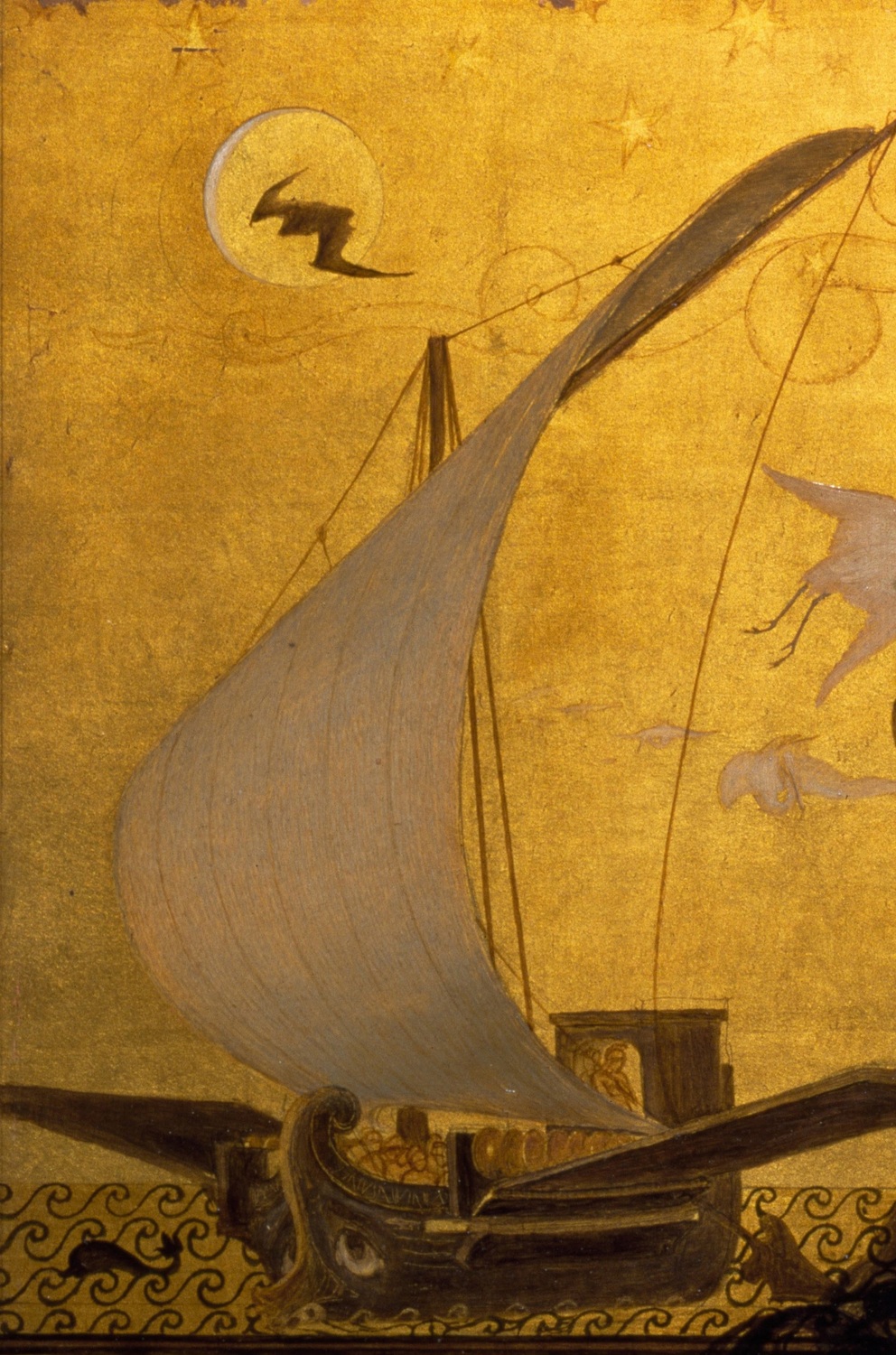
A ship with a high pale sail appears at the left of the gilded background. It recalls the voyage of the Argo and the life Medea shared with Jason. Rather than showing a distant natural harbour, Sandys sets the vessel among flat ornamental waves and patterned forms.
The background does not behave like the room behind a sitter. It behaves more like a decorated surface carrying fragments of a story. The gold brings those fragments forward, so memory appears to press against Medea’s shoulders instead of receding into space.
This is why the picture rewards a movement between near and far. The hands tell us about the current action. The face resists a simple explanation of it. The ship brings another time into the same panel. Sandys gives the painting several kinds of narrative without dividing it into separate episodes.
Sandys belonged to the wider Pre-Raphaelite world, and the intense drawing and attention to objects here are central to the picture’s effect. The historical Medea has not been reconstructed in a reliably ancient interior. Ornament from different traditions shares the gilded surface, creating an imagined environment for the myth.
The painting was accepted for the Royal Academy exhibition of 1868 but not hung, then shown in 1869. The exclusion prompted public argument. The Victorian Web’s scholarly catalogue discussion records that history and identifies the model as Keomi Gray. The reasons for the Academy’s decision should not be reduced to a certainty the surviving evidence does not provide.
The controversy is part of the work’s reception, but the painting does not need it to remain difficult. The closest view of Medea is also the moment when her intentions become hardest to separate from her distress.
She tilts a vessel above a brazier in a scene interpreted as the preparation of the fatal enchantment for Glauce. The painting does not identify a chemically specific substance.
Sandys’s panel belongs to Birmingham Museums Trust. It is catalogued as Medea, 1866 to 1868, accession 1925P105.
No. De Morgan’s 1889 work shows a different composition and is held by the Williamson Art Gallery and Museum. The shared subject offers a useful comparison, rather than making the paintings interchangeable.
Compare Sandys’s inwardly divided figure with his Morgan le Fay at work on an enchanted robe. Both painters’ versions of Medea appear in our 20 famous witch paintings guide.
Explore the hand-painted Medea reproduction or browse the Magic and Witchcraft collection.
Collection records supply catalogue facts; interpretive possibilities are identified in the text. Full images and detail crops reproduce the historical painting without reconstruction. Collection ownership does not guarantee current display.
Enjoyed this story?
Save articles to your collection
Log in or create a free account, and this article will be waiting in your Private Collection.
Log in or sign up
Man Writing a Letter
Gabriel Metsu, c. 1664
The gallery list
Every painting is already 50% off. Join the list and we will send you an extra $15 code, plus first access to new collections.
No spam. Unsubscribe anytime. · Privacy Policy
Welcome
Your $15 code is on its way. Explore the gallery while you wait.