Loading cart…
No products in the cart.

1874 · Oil on canvas · Kirkcaldy Galleries, Fife, Scotland
Save articles to your collection
Log in or create a free account, and this article will be waiting in your Private Collection.
Log in or sign up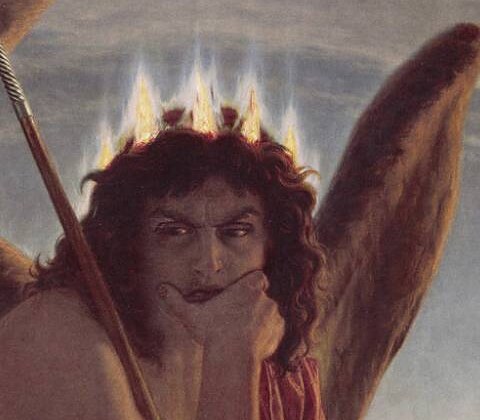
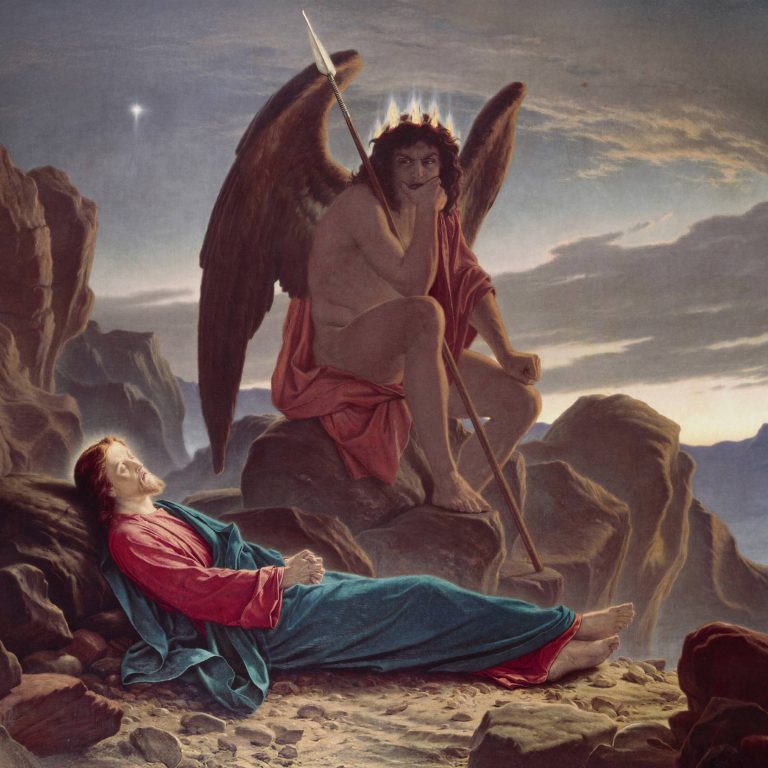
The title tells you what to expect: Satan Watching the Sleep of Christ. So you look for the watcher, and you find him high on a rock, winged, with a spear in one hand and a crown of small blue flames on his head. And then you notice something the title does not mention. Satan is not looking at the sleeping man below him. His eyes have slid sideways, out of the painting, toward you.
Sir Joseph Noel Paton painted it in 1874. It is one of the strangest pictures of the Temptation of Christ ever made, because nothing has happened yet. No bargain, no mountain, no kingdoms of the world. Just a tired man asleep on the ground, and the devil sitting over him in the half-light, thinking. To understand what he is thinking about, you have to know where we are.
We are in the wilderness of Judea, at the start of the story told in the gospels of Matthew, Mark and Luke. Jesus has just been baptised. Before he begins to preach, he goes out alone into the desert and fasts.
Then was Jesus led up of the Spirit into the wilderness to be tempted of the devil. And when he had fasted forty days and forty nights, he was afterward an hungred.
Matthew 4:1 to 2, King James Version
Forty days without food. This is the moment the gospels skip over: the last night before the tempter speaks. Most painters of the Temptation of Christ go straight to the drama, the devil holding out a stone or pointing to the kingdoms of the world from a mountain top. Paton chose the silence before it. It is dawn, the sky is still grey and cold, and the devil has come early. He is waiting for Christ to wake up.
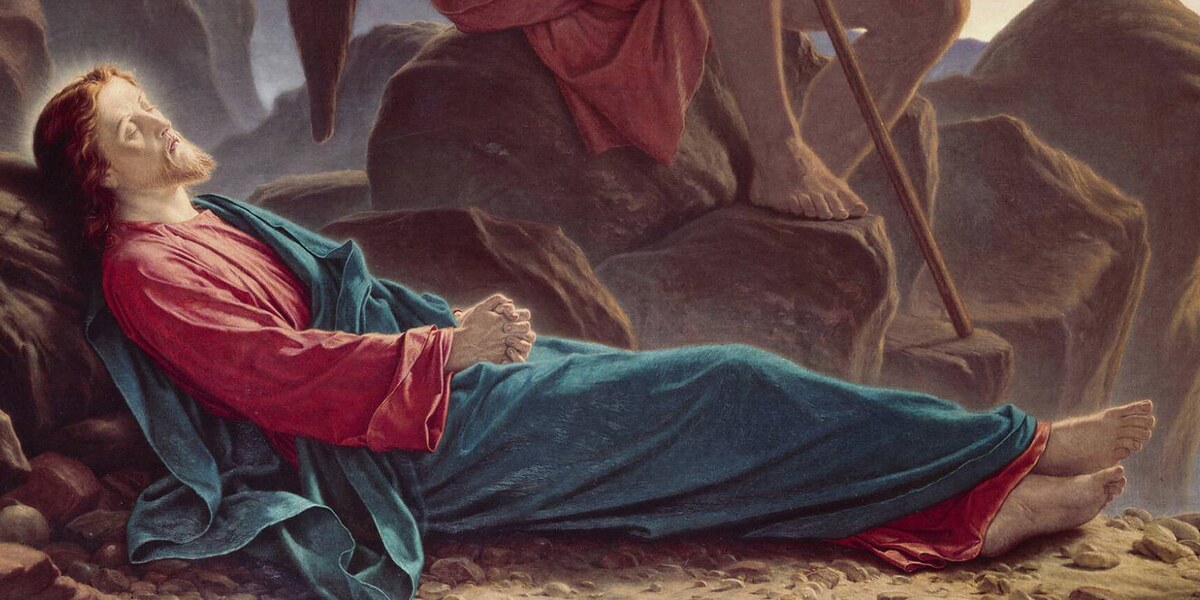
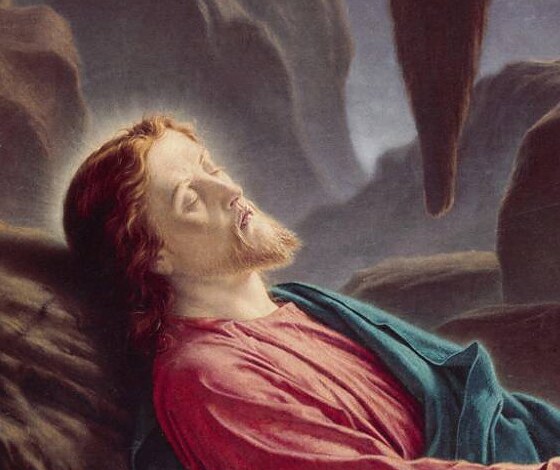
Look at how Christ sleeps. He has lain down where he stopped, with his head against a rock and his mantle pulled round him against the cold. His face is calm. A faint halo glows around his head, so faint you might miss it. His hands are folded on his chest, the way people fold their hands to pray, or the way the dead are laid out.
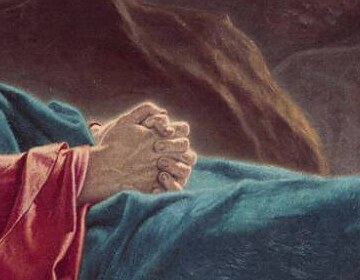
His feet are bare, and the ground around them is nothing but stones. That detail is not an accident of the landscape. When the devil finally speaks, his first temptation will be about exactly these stones:
If thou be the Son of God, command that these stones be made bread.
Matthew 4:3, King James Version
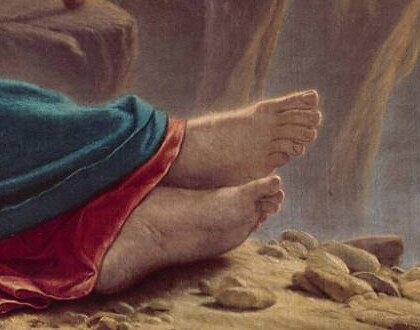
A starving man, asleep on a floor of stones, and a watcher who already knows what he is going to say. The whole Temptation is in the picture. It just has not started.
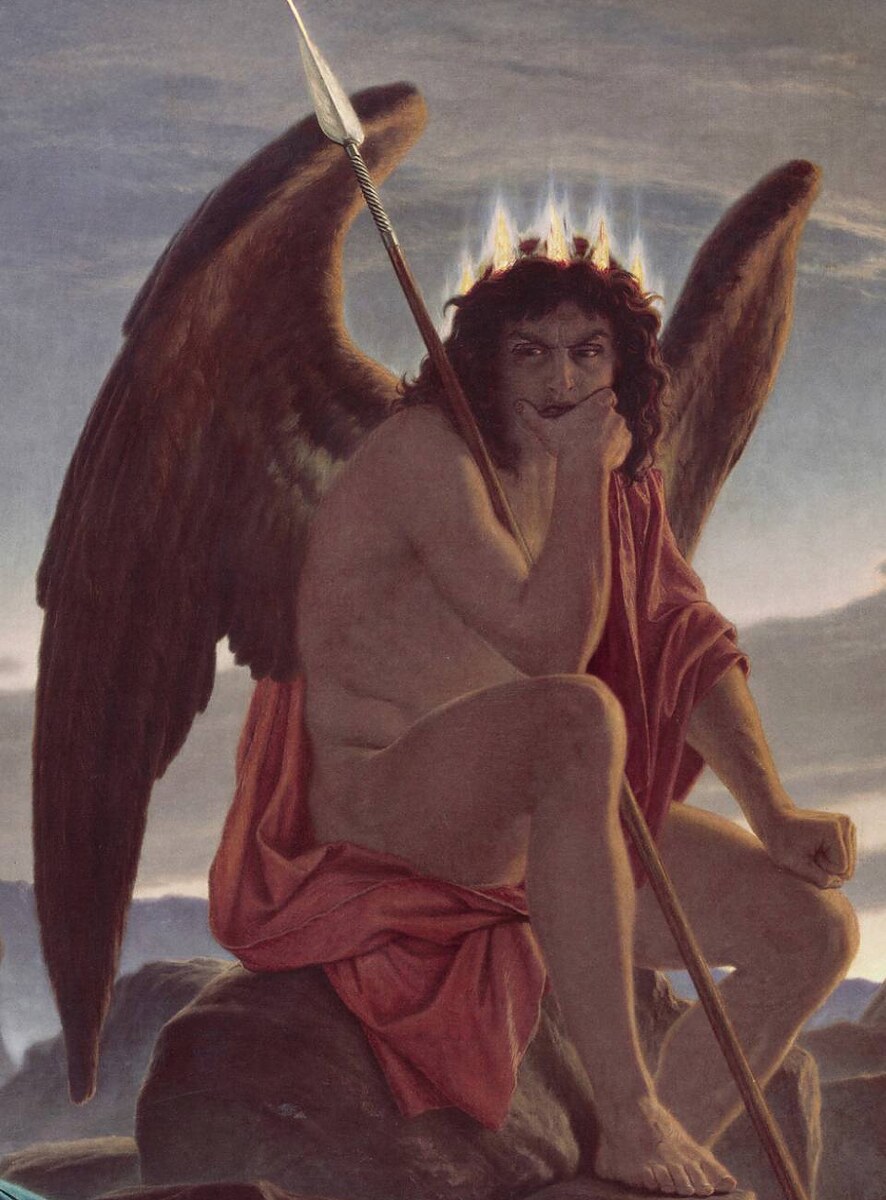
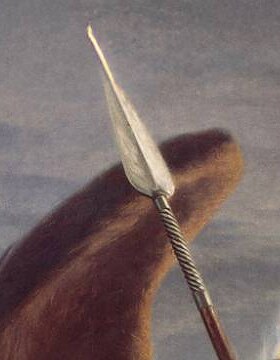
Paton built the painting on opposites. Christ lies low; Satan sits high. Christ has a soft halo of light; Satan has a crown of flames. Christ is asleep and unarmed; Satan is awake and holds a spear, its point cutting into the sky above his wing. Even the colours answer each other: Christ wears red and blue, and Satan has a red cloak thrown over his knees, the same colour as the robe of the man he is watching.
But look at Satan's body. He is not about to strike. He is sitting with his chin on his fist, like someone working out a problem. There is an old idea in Christian writing that the devil did not know for certain who Jesus was, and that the Temptation was a test to find out. The first words he says in the gospel are If thou be the Son of God. If. Paton paints that doubt. Satan is not gloating. He is puzzled, and he is patient.
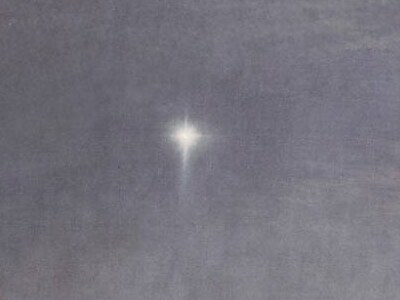
High in the sky, above the rocks on the left, there is one bright star. It is easy to miss, and it is the cleverest thing in the painting. A single star still shining at dawn is the morning star, and in the Bible the morning star has two owners.
How art thou fallen from heaven, O Lucifer, son of the morning!
Isaiah 14:12, King James Version
Lucifer, the name tradition gave to Satan before his fall, means the light-bringer, the morning star. But at the very end of the Bible, Christ claims the same title for himself:
I am the root and the offspring of David, and the bright and morning star.
Revelation 22:16, King James Version
Paton never explained the star, so we cannot be sure he meant this. But he knew his Bible well, and he put exactly one star in the sky above two figures who both lay claim to it: the fallen angel sitting in the dark, and the sleeping man who will not fall.
The meaning of Satan Watching the Sleep of Christ is in the waiting. Evil in this painting is not a monster or a storm. It is patient, clever and quiet, and it comes when you are tired, hungry and alone. That is why it has become a favourite image for Lent, the forty days before Easter that remember these forty days in the wilderness.
It is also a painting about Christ as a man. He needs to sleep. He is exhausted and hungry, and he is lying on the bare ground like anyone else. Paton shows him at his weakest, which is exactly what makes the ending of the story matter. The gospel of Luke closes the scene with a line that could be a caption for the watcher on the rock:
And when the devil had ended all the temptation, he departed from him for a season.
Luke 4:13, King James Version
For a season. Satan in Paton's painting knows he will lose today. He is already thinking about next time.
Joseph Noel Paton was born in 1821 in Dunfermline, in Fife, into a family of damask weavers, and ran the design department of a muslin factory before he became a painter. As a student at the Royal Academy in London in 1843 he met the young John Everett Millais, who later asked him to join the Pre-Raphaelite Brotherhood. Paton said no and went home to Scotland, though he went on painting in the same bright, detailed Pre-Raphaelite style.
He first became famous for fairies: The Quarrel of Oberon and Titania and The Reconciliation of Oberon and Titania, crowded with tiny fairies from Shakespeare, are still in the National Galleries of Scotland. Queen Victoria made him her Queen's Limner for Scotland in 1865, and he was knighted two years later. In his later years he turned almost entirely to religious paintings, and Satan Watching the Sleep of Christ is the most striking of them. In 1877 James Faed made a large mezzotint of it, titled Satan Watching the Sleep of Christ in the Wilderness of Temptation, which carried the image far beyond the gallery.
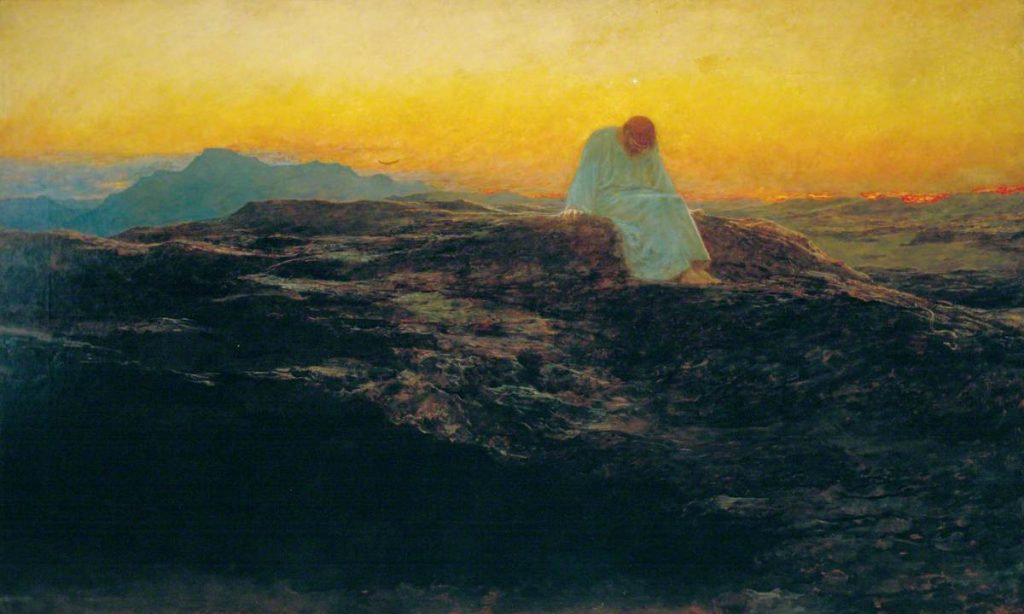
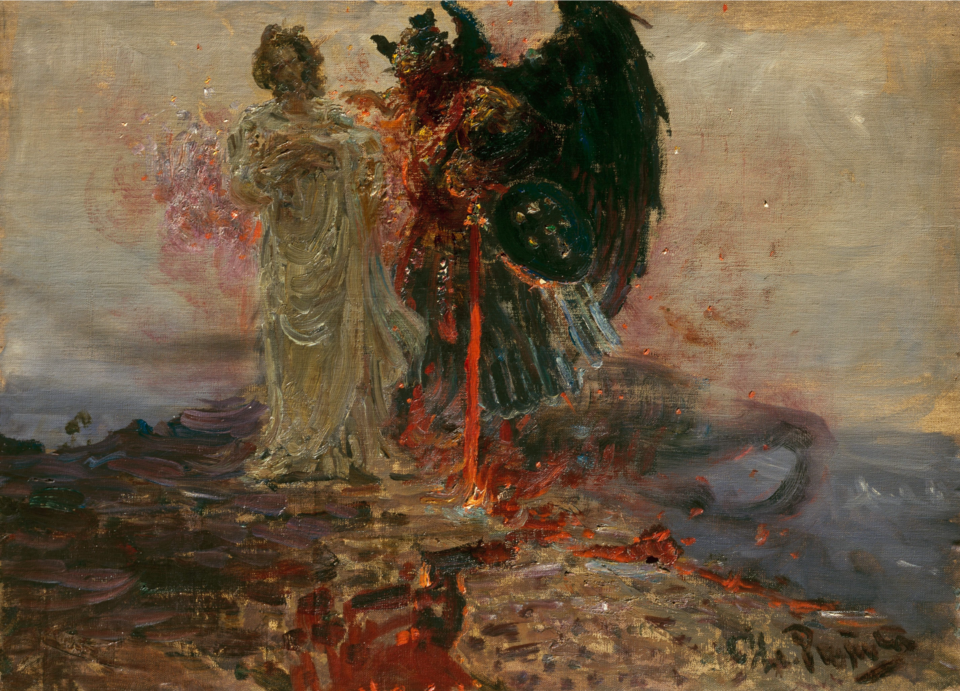
Other painters took the same story in very different directions. Briton Rivière showed Christ alone and starving on a rock, with no devil at all. Ilya Repin painted the moment Christ sends the tempter away. Tintoretto made the devil a beautiful angel holding up the stones.
The painting belongs to Kirkcaldy Galleries in Fife, Scotland, a short drive from Dunfermline, where Paton was born. It is oil on canvas, 126.5 by 165.5 centimetres, with an arched top that makes it feel like an altarpiece or a window onto the desert.
We paint Satan Watching the Sleep of Christ by hand in oil on canvas, arched top and all, with the cold dawn light, the crown of blue flames and the single star. See the hand-painted reproduction.
Enjoyed this story?
Save articles to your collection
Log in or create a free account, and this article will be waiting in your Private Collection.
Log in or sign up